
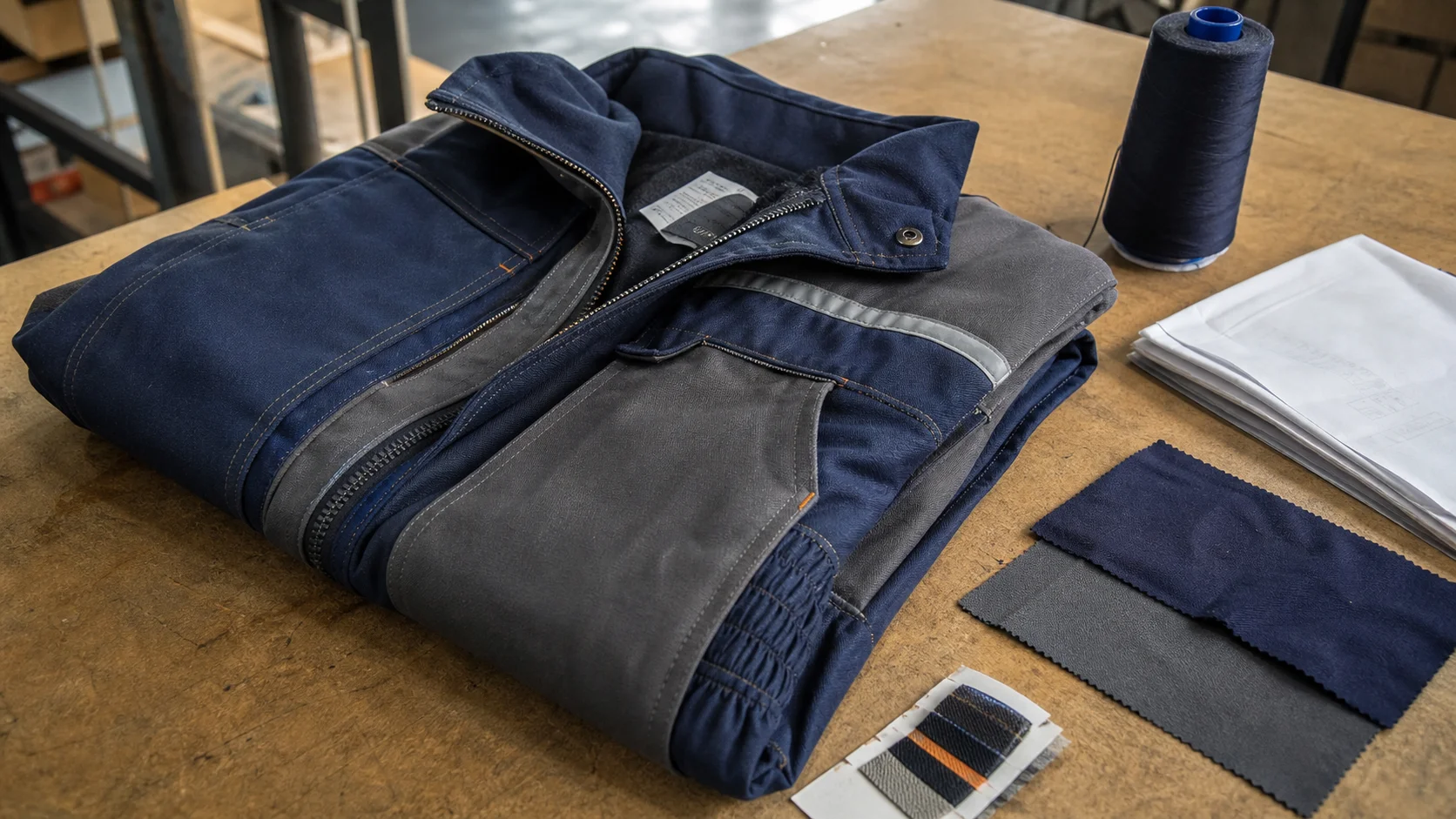
A practical AQL inspection outline for work jacket orders, built for warehouse safety teams checking high-visibility details, seam integrity, sizing, labeling, and packaging before bulk release.
Warehouse safety teams do not buy work jackets only for appearance or comfort. The order has to hold up to daily abrasion, repeated laundering, cold storage exposure, hi-vis requirements, and the practical reality of long shifts around pallets, forklifts, and loading bays. That is why an AQL inspection checklist matters. It gives the buyer a structured way to catch defects before shipment, but it only works if the checklist is tied to the real risks in the jacket specification.
This article is for buyers, sourcing teams, and warehouse safety managers who need a practical work jacket order AQL inspection checklist for warehouse safety teams. It covers what to inspect, how to think about sampling, which defects are worth rejecting, and where quality failures usually appear in production. The goal is not to overcomplicate the order. The goal is to avoid preventable problems that cost time, money, and safety compliance later.
If you need support with development, production, or inspection coordination, useful starting points are services, contact us, and about us.
Work Jacket AQL Checklist for Warehouse Safety Orders - Outerwear & Jackets manufacturing guide
AQL, or Acceptable Quality Limit, is a sampling method used to decide whether a shipment is acceptable, needs sorting, or should be rejected. For work jackets, the point is not to prove perfection. The point is to catch defects at a level that protects function, safety, and consistency without inspecting every single unit.
For warehouse safety orders, that distinction matters. A jacket with a loose thread on an internal seam may be tolerable if it does not affect use. A jacket with a missing reflective panel, broken zipper, wrong size label, or compromised flame-resistant construction is not. Safety teams should treat the AQL plan as a filter, not a guarantee. It identifies the visible and measurable defects that can be checked on a finished garment lot. It does not replace fabric testing, wash testing, or certification review when those are required.
A good AQL plan for work jackets should reflect actual risk. Cosmetic flaws can be tolerated at a higher rate than defects that affect visibility, closure, fit, durability, or compliance.
Inspection gets messy when the order spec is vague. A warehouse safety jacket is not a generic outerwear item. The buyer should define the jacket type before any AQL checklist is finalized.
For warehouse safety orders, spec clarity is not administrative detail. It is the inspection standard. If the jacket was approved as a hi-vis product with reflective bands placed at specific points, then an off-position reflective tape is a defect, not a minor variation. If the product is meant for cold rooms, insulation consistency and cuff sealing become much more important than a soft handfeel on the shell fabric.
Many buyers default to standard AQL numbers without thinking through the use case. That can be a mistake for safety-related outerwear. A common starting point is to treat critical defects with zero tolerance and apply tighter major-defect limits than you would for fashion apparel. Minor defects can usually be handled more flexibly, but the final tolerance should match the order risk.
Typical sourcing practice for work jackets often uses a three-tier approach:
There is no universal AQL number that fits every warehouse order. A hi-vis jacket, a winter insulated jacket, and a basic warehouse shell should not be judged with the same tolerance. A lower-risk internal wear jacket can accept more cosmetic variation than an outer layer used in visibility-controlled areas. The right move is to define the inspection severity by use case, then make the factory sign off on that standard before mass production.
Sampling is strongest when it is blind to convenience. If the cartons closest to the dock are selected every time, the inspection becomes predictable and easy to game. Randomization matters. So does coverage across size curves. Many jacket problems hide in the extended sizes where pattern grading, trim consumption, and construction tension change.
The checklist below is designed for finished-goods inspection of warehouse safety jackets. It assumes the order may include either standard work jackets or a safety-oriented version with visibility, insulation, or weather protection requirements.
Defect grading should be consistent and tied to the end use. A warehouse jacket that fails a comfort preference is not the same as a jacket that fails visibility or closure. Buyers should define examples in advance so the inspector is not forced to improvise under time pressure.
The safest purchasing rule is simple: if a defect can confuse a wearer, weaken the jacket under use, or undermine a safety claim, classify it aggressively. If a defect is only visible under close review and does not affect use, classify it as minor only after the team has aligned on that definition. Weak classification creates two problems: disputes with the supplier and inconsistent replenishment quality.
Work jackets look straightforward until production starts. The category carries more variation than buyers sometimes expect. The risks below show up repeatedly in warehouse safety programs.
Shell panels can shift in shade between rolls, especially with synthetic blends or coated fabrics. When the jacket uses multiple panels, the mismatch can become obvious after sewing. This matters more for hi-vis or branded outerwear than for plain utility jackets.
Reflective trim can be poorly aligned, weakly bonded, or inconsistently stitched. The tape may look acceptable on the line but peel or curl after use. Buyers should verify both placement and attachment security. Where compliance is involved, the paper trail matters as much as the appearance.
Trims are a common source of order noise. One zipper lot may run smoothly while another binds or separates under tension. Snap fasteners may be fine on sample pieces and weak in production. It is better to approve a trim standard early than to react after the shipment is packed.
Cold-weather jackets can pass visual inspection and still feel uneven in use if fill distribution is poor. Thin spots near the shoulders, sleeves, or hem can create wearer complaints even when the garment technically passes a visual check. For insulated workwear, the factory process matters as much as the final look.
Warehouse jackets often get washed hard. If the order relies on a claimed shrinkage target, the buyer should expect pre-shipment testing or documented fabric performance. A jacket that looks correct out of carton can still become nonconforming after one wash cycle if the fabric, thread, or construction was not balanced for laundering.
Embroidery, print, or heat transfer can shift in placement, density, or color. For safety teams, this is not always cosmetic. Badly placed decoration can interfere with reflective zones or size labels. Decoration should be treated as part of the functional spec, not as an afterthought.
A lot of inspection headaches disappear when the sample approval process is disciplined. The sample set should include more than one garment type if the order has size spread or special trims. At minimum, the buyer should review a development sample, a pre-production sample, and if needed, a golden sample sealed as the reference for bulk comparison.
Lead time is often shaped by approvals, not sewing capacity alone. Delays usually come from trim sourcing, sample iteration, lab testing, color matching, or last-minute spec changes. Buyers who want fewer inspection failures should protect the sample gate. A rushed approval cycle often creates a weak AQL outcome later because the factory never had a stable reference.
Warehouse safety jackets are evaluated differently from casual outerwear. The buyer should ask one question repeatedly: does this defect change how the garment protects the worker or supports compliance?
A cleaner visual finish can sometimes increase cost without meaningfully improving service life. In a warehouse environment, durability and functional consistency often deserve more budget than premium cosmetic detailing. Loose interior aesthetics are not ideal, but they may be a smarter trade than weakening the shell or trims.
Thicker insulation feels reassuring, yet it can reduce movement and increase wearer rejection if the jacket is too bulky for lifting, steering, or climbing. A jacket that is technically warmer but limits motion may fail in actual use. Fit should be inspected with movement in mind, not only flat measurements.
High-visibility materials can be stiffer and less breathable. That is acceptable only if the jacket still remains wearable for the shift length. If workers refuse to wear it, the safety value drops sharply. Buyers should balance the visibility requirement with the likely work intensity and climate.
Cheaper jackets often save money on paper but create hidden costs when labeling is weak, trims vary, or supplier records are incomplete. If the order may be audited, the inspection package should include traceability of fabric, trim, and testing records. That is especially important when the jacket carries a compliance claim.
For buyers managing repeated replenishment, the best result usually comes from tightening a few high-risk checkpoints rather than trying to inspect everything with equal intensity. Focus on what can break safety, fit, and issue control. Leave the rest in a normal apparel tolerance band.
Inspection is more effective when supplier control starts before cutting. A factory that understands the inspection standard is less likely to ship avoidable defects. That means the PO, tech pack, approved sample, and inspection method should be aligned from the start.
Lead time for work jackets depends on more than stitching capacity. Fabric dyeing, lining sourcing, reflective tape procurement, zipper availability, lab testing, and approval turnaround can all extend the schedule. If the order uses a special finish, such as water resistance, FR treatment, or a specific hi-vis color standard, the risk of delay rises.
Buyers should ask for a production timeline that separates material lead time from sewing lead time. That separation helps spot pressure points early. It also reduces the temptation to approve a marginal bulk lot just to meet a ship date. A late but conforming shipment is usually better than an on-time shipment with weak safety performance.
If supplier communication is inconsistent, a third-party QA partner can help keep the inspection standard disciplined. The key is not to outsource judgment blindly. It is to make sure the same criteria are applied to the same order every time. For teams that want production support, inspection coordination, or sourcing assistance, the services page is a logical starting point.
There is no single standard that fits every jacket order. Many buyers use a tighter standard for critical and major defects, then allow a more flexible limit for minor cosmetic issues. Safety-oriented jackets usually justify stricter controls than basic outerwear, especially when visibility or closure function is involved.
That depends on the jacket’s purpose and the contract spec. If the reflective tape is part of a safety requirement or compliance claim, placement or missing tape should often be treated as critical. If it is decorative on a non-safety jacket, the severity can be lower. The order documents should define that before inspection.
The usual problem areas are zipper failure, seam weakness, shade variation, reflective tape misplacement, size inconsistency, and decoration errors. Packaging mistakes and label errors also create real supply-chain issues even when the garment itself is acceptable.
The sample size depends on shipment quantity and the sampling table being used. Buyers should follow the chosen AQL standard and inspect across cartons, sizes, and color runs. A random sample from only one carton is too weak for meaningful control.
No. Visual inspection is useful, but it is not enough when the jacket carries performance or compliance claims. Buyers should also confirm measurements, label accuracy, trim quality, and any required test documentation. For some orders, lab testing or document verification is necessary alongside finished-goods inspection.
A shipment should be rejected when critical defects exceed the agreed tolerance, when major defects are widespread, or when the shipment does not match the approved sample and spec in a way that affects safety, usability, or compliance. Sorting may be acceptable for limited cosmetic issues, but only if the buyer has the time and supplier support to do it correctly.
For teams building a repeatable sourcing process, it helps to align inspection, development, and supplier communication under one standard. If that is the direction you need, the best next step is usually to review the production workflow on about us and then move to contact us for the current order scope.
Get a free quote from Fabrikn — your trusted B2B clothing manufacturer with 10+ years of experience. MOQ as low as 200 pieces.
Get a Free Quote →A work jacket AQL checklist should be practical, not ceremonial. Warehouse safety orders fail when the inspection standard is too vague, too soft on critical defects, or disconnected from how the jacket will actually be worn. The strongest approach is to define the use case clearly, lock the spec early, inspect across cartons and sizes, and treat functional safety issues as non-negotiable. That is the difference between a shipment that passes on paper and a jacket that performs in the warehouse.