
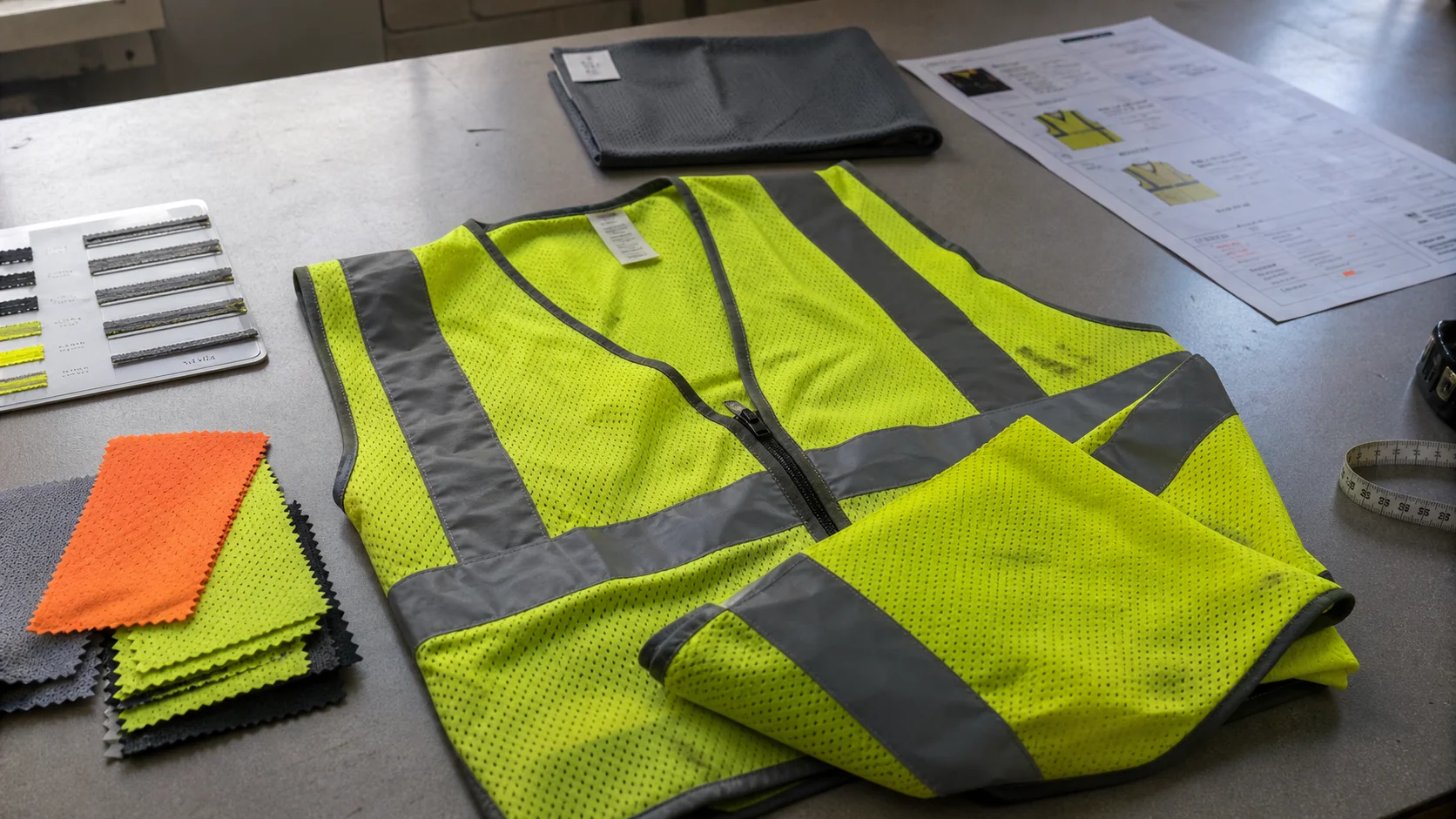
A product-specific compliance checklist for security contractors sourcing recycled polyester safety vests, covering visibility standards, reflective trim, labeling, test reports, factory controls, and supplier documentation.
Security contractors buy safety vests for a simple reason: visibility has to hold up in the field. When the vest is made from recycled polyester, the sourcing brief becomes more specific. Buyers need the right color performance, reflective layout, labeling, paperwork, and production controls, not just a low unit price. This checklist is written for teams evaluating a recycled poly safety vest supplier for security contractor use, where compliance, consistency, and delivery discipline matter more than marketing language.
The best purchasing decisions usually come from a narrow set of questions. Does the vest meet the visibility standard required by the contract? Is the recycled fabric traceable enough to support sustainability claims? Can the supplier hold color, trim, and reflective performance across repeat orders? Are samples approved before bulk cut, and are inspection risks understood before production starts? Those questions drive the real outcome.
If you are building a broader sourcing program, review the supplier capabilities on services, then confirm the company profile on about-us, and use contact-us when you are ready to request a quotation or compliance pack.
Recycled Poly Safety Vest Compliance Checklist for Buyers - Sustainable Fashion manufacturing guide
Security contractors work in environments where visibility can affect both safety and operational control. A vest may need to support patrol work, traffic management, access control, warehouse escorting, or event security. In those settings, the garment is not decoration. It is a functional piece of equipment that has to be legible at distance, comfortable over long shifts, and durable enough to survive repeated wear and wash cycles.
Recycled polyester is often chosen because it supports sustainability goals without abandoning the performance profile buyers expect from polyester. The material can work well for lightweight high-visibility vests, but recycled content does not remove compliance obligations. The garment still needs the right color, reflective tape placement, seam construction, and labeling. A vest that looks acceptable in a showroom can still fail a spec check if the trim, stitch density, or reflective area is off.
For security contractors, the commercial risk is straightforward. An inconsistent vest program can create site noncompliance, reissue costs, employee complaints, and avoidable replacement orders. That is why supplier compliance should be treated as part of procurement, not as a post-order quality issue.
The exact regulatory requirement depends on the country, end user, and contract language. Buyers should not assume that a recycled polyester vest automatically qualifies as compliant. The supplier needs to map the product to the applicable visibility standard, garment class, and labeling requirement before bulk production.
For buyers in the US market, the common reference point is ANSI/ISEA 107. In other markets, EN ISO 20471 or a local equivalent may apply. Security contractors should confirm whether the vest is being used as a high-visibility garment, an auxiliary visibility layer, or a branded uniform accessory. That distinction changes the required design and testing scope.
At minimum, the supplier should be able to show:
A useful rule: do not accept a document pack that describes only the fabric. Compliance applies to the finished vest. Stitching, pocket placement, closure type, trim density, and panel geometry can all affect the final result.
The table below is a practical checklist for sourcing a recycled poly safety vest supplier for security contractor programs. It is designed for buying teams that need both sustainability proof and field-ready quality.
Checklist Area What to Verify Why It Matters Buyer Risk if Missed Recycled content Fiber claim, traceability documents, recycled polyester percentage Supports sustainability claims and customer reporting Marketing claim risk, rejection by ESG-sensitive clients Visibility standard Applicable ANSI/ISEA, EN ISO, or contract specification Defines minimum design and performance requirements Noncompliance on site or during inspection Reflective tape Width, positioning, stitch security, retroreflective performance Affects visibility in low light Reduced safety performance and failed audit checks Fabric weight GSM, hand feel, breathability, opacity Impacts comfort and durability Hot, flimsy, or see-through garments Color consistency Approved shade band, lot control, colorfastness Maintains uniform appearance across orders Shade variation across team uniforms Trim quality Zippers, hook-and-loop, snaps, binding tape, elastic Controls field durability and user satisfaction Premature failure in daily use Labeling Care label, fiber content, size, origin, compliance marks Needed for traceability and user instructions Retail or contract rejection Sampling process Proto sample, size set, pre-production sample, sealed approval Prevents bulk surprises Wrong fit, wrong trim, wrong tape layout Inspection plan AQL level, critical defect definition, carton marking Creates measurable quality control Shipment disputes and chargebacks Lead time control Fabric availability, dyeing queue, trim sourcing, packing time Improves delivery reliability Late deliveries and rushed substitutionsUse this checklist before you compare prices. Low quotations often ignore one of the items above, then the cost appears later in sample revisions, freight holds, or replacement claims.
Recycled poly safety vests are usually built from warp knit mesh, solid polyester tricot, or a blended knit designed for better breathability. The best choice depends on the climate, shift length, and whether the vest sits over outerwear. Security teams working indoors may prioritize lighter mesh and lower heat retention. Outdoor patrol teams often need a more substantial body fabric that stays presentable after repeated use.
A practical spec sheet should define the following:
Buyers sometimes over-specify features that look useful on paper but complicate production. For example, extra utility pockets can interfere with reflective coverage and raise sewing variability. Heavy branding can also reduce usable compliance area. The cleaner the spec, the easier it is for the supplier to hold the design consistently.
Color choice deserves careful attention. Fluorescent lime and fluorescent orange are common, but the right color must match the visibility category and site environment. A contractor operating near road traffic may need a different color and reflective configuration than a contractor working in a warehouse or at an event venue. Ask the supplier to confirm the dye formula or color reference against a physical standard card, not a screen image.
Sample control is where many vest programs succeed or fail. A supplier may be able to quote quickly, but pricing means little if the final garment does not match the approved version. Security contractors should expect a formal approval sequence.
That process sounds formal, but it saves money. A supplier that resists sample sign-off before bulk cutting is creating avoidable risk. Buyers should push back if the supplier wants to “confirm in bulk” while key details remain unresolved.
Sample approval should include practical use checks, not only appearance. The vest should be tried over the garments security staff actually wear. A vest that fits over a polo shirt may bind over a jacket. A closure that looks fine on the table may be too slow or too weak in the field. Those issues need to be resolved before production, not after delivery.
MOQ for recycled poly safety vests varies by supplier, customization level, and fabric availability. Typical ranges can start around a few hundred pieces for simple stock-like programs and rise into the low thousands for custom color, custom reflective layout, or branded private-label orders. A low MOQ usually comes with tradeoffs: higher unit cost, fewer color options, or limited trim choices. Buyers should not expect a full custom compliance package at the same cost as a plain stock vest.
Lead time is equally conditional. The main drivers are fabric sourcing, recycled yarn availability, dyeing, reflective tape procurement, label printing, sample approvals, and inspection booking. If the supplier already has approved fabric and standard tape in stock, production can move faster. If the order requires custom shade matching, imported reflective tape, or new labels, the schedule extends quickly.
A reasonable planning approach is to ask the supplier for three dates:
Those dates reveal more than a single promised lead time. They show where the delay risk sits. If the supplier cannot separate fabric timing from sewing timing, the delivery promise is weak.
Security contractors should also build in a buffer for contract changes. Uniform programs often expand after the first purchase. A supplier with a tested supply chain for recycled polyester fabric, trim, and packaging is easier to scale than one that depends on spot buying every cycle.
Inspection is the point where design intent meets production reality. Recycled poly safety vests often fail on small details that are easy to overlook in approval rounds. Buyers should define critical defects before shipment.
Common risk areas include:
AQL inspection is useful, but only when the buyer defines what counts as critical, major, and minor defects. For a security contractor, a missed reflective band is not a minor issue. A mislabeled size may be a shipping nuisance, yet a compliance defect can stop deployment. Buyers should distinguish the two.
When the vest is tied to a site requirement, treat compliance as part of the product, not as a document attached to the product. That shift reduces arguments later in the process.
Packaging also matters. Some programs need individual polybags, size stickers, barcode labels, and carton outer marks that match a receiving system. If the supplier has weak carton discipline, the operational problem may appear after the goods pass garment inspection. That is still a supplier quality issue.
Supplier selection should be practical and evidence-based. A compliant-looking catalog page is not enough. Ask direct questions and request written answers.
These questions separate a manufacturing partner from a trading-only arrangement. For some buyers, a trading arrangement is still acceptable if quality control is strong and documentation is complete. For others, especially recurring security contractor programs, direct factory visibility is worth more than a slight price reduction.
If the supplier has a structured sourcing or development team, ask how they manage product sign-off and production control. The service model on services should show whether the company can handle custom uniform projects, not just commodity apparel.
Recycled polyester is only as credible as its paperwork. Buyers should ask for the exact basis of the recycled claim. Is it post-consumer recycled content, pre-consumer recycled content, or a blend? Is the claim supported at fiber level, fabric level, or garment level? That distinction matters when sustainability reporting is part of the contract.
Useful documentation can include:
Buyers should be cautious about unsupported eco language. Terms like “green,” “eco-friendly,” or “sustainable” are too vague for procurement use on their own. Ask for specific evidence. If the supplier cannot support the claim cleanly, the safe move is to limit the language used in the contract and on packaging.
For teams comparing vendors, the company background on about-us can help determine whether sustainability is part of an actual production system or just a sales angle. When in doubt, request documents early rather than after the purchase order is issued.
The right vest program is not always the most expensive one. The right program is the one that avoids hidden cost. That means spending on the parts that directly affect compliance and field performance, while resisting unnecessary extras that do not improve deployment.
Spend on:
Save on:
There is also a tradeoff between custom and standardization. A fully custom vest may align better with a security company’s brand, but it can raise MOQ, lengthen lead time, and increase inspection complexity. A semi-custom approach often works better: standard compliance base, controlled logo placement, and a limited set of approved sizes and colors.
For many buyers, that is the most efficient route. It reduces deviation, keeps reorders easier, and preserves enough flexibility to satisfy the client without turning the garment into a one-off project.
Get a free quote from Fabrikn — your trusted B2B clothing manufacturer with 10+ years of experience. MOQ as low as 200 pieces.
Get a Free Quote →Start with the compliance standard, recycled content documentation, reflective tape specification, and sample approval process. Those four items determine whether the supplier can actually support a security contractor program.
MOQ often starts in the low hundreds for simpler programs and can rise into the low thousands for custom colors, branding, or specialized reflective layouts. The exact number depends on fabric availability, print complexity, and whether the order uses stock or custom components.
Lead time depends on sample approval speed, fabric sourcing, trim availability, and inspection scheduling. A supplier with ready materials can move faster. Custom dyeing, new labels, or imported reflective tape will extend the schedule.
Ask for the recycled content declaration, compliance or test reference, material spec sheet, label artwork, size chart, and sample approval flow. If the order is large, request the inspection plan as well.
Most failures come from small but important issues: reflective tape misalignment, shade variation, weak stitching, incorrect labels, or carton marking mistakes. These problems are common when the supplier lacks strong production control.
Yes, if the finished garment is designed and tested against the correct visibility standard. Recycled content does not reduce compliance by itself. The key is whether the finished vest meets the required color, reflective coverage, and construction criteria.
Use the same checklist for every vendor. Compare documents, sample quality, inspection discipline, and repeat-order consistency before comparing unit price. That produces a more reliable sourcing decision.
For a shortlist or quotation request, use contact-us and provide the target standard, quantity, size split, logo requirements, and required delivery window. Clear inputs usually produce a cleaner quotation and fewer revision rounds.