
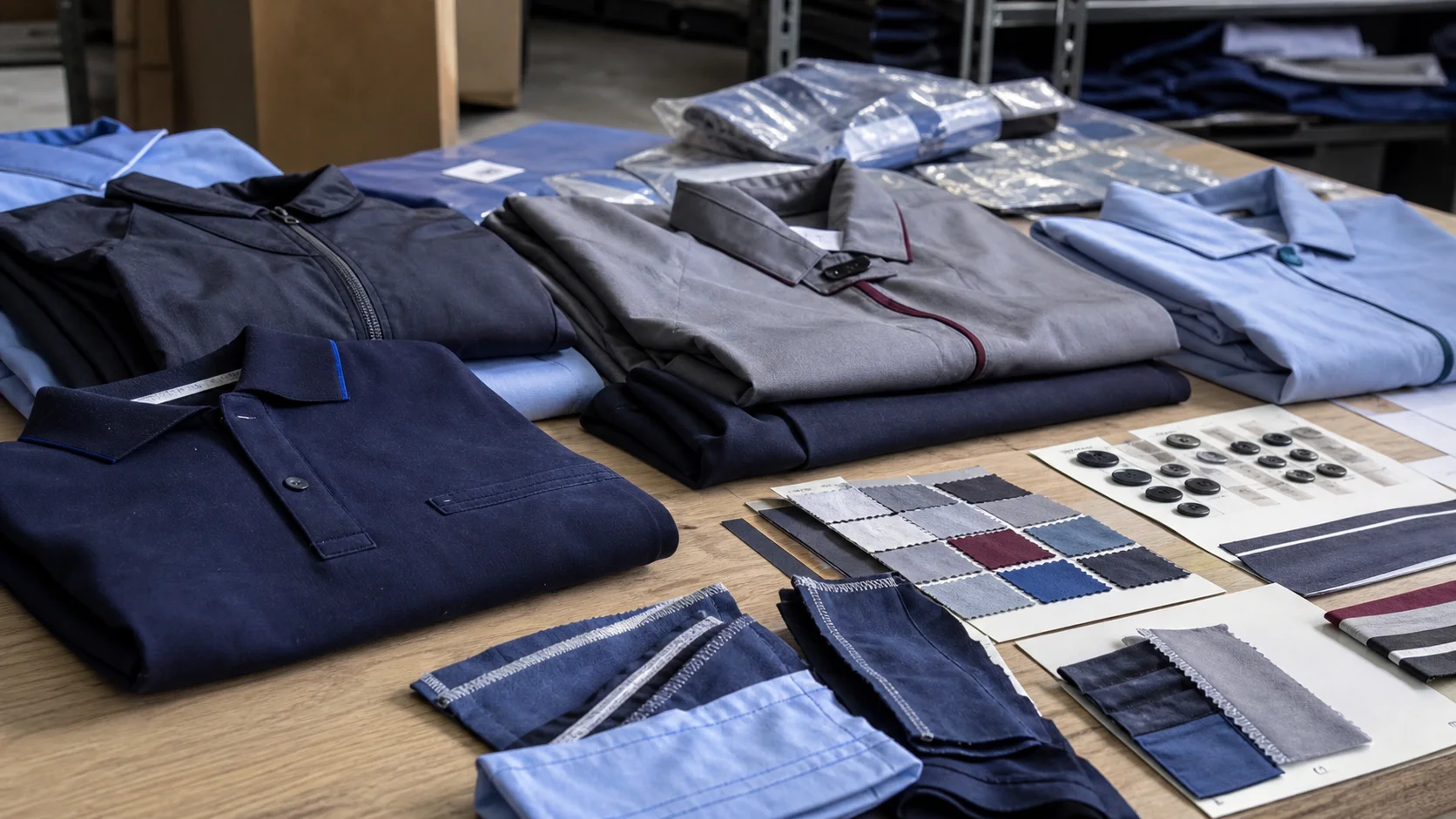
A distributor-focused outline for auditing service uniform factory colorfastness, covering lab tests, wash performance, shade control, documentation, and shipment release criteria.
Uniform Colorfastness Audit for Distributor Buyers - Quality & Inspection manufacturing guide
A uniform colorfastness audit checks whether a service uniform retains its color under normal wear, washing, perspiration, rubbing, light exposure, and chemical contact. For distributor buyers, the point is not just to confirm that a fabric looks good on the rack. The real concern is whether the garment stays consistent after repeated use across a fleet of employees, stores, hotels, clinics, restaurants, or field teams.
Colorfastness matters most when the same uniform must be reordered for a long program. A jacket or polo that matches today can drift by the next production lot if the factory changes dye lots, yarn sources, finishing chemistry, or wash processes. That drift creates visible mismatch across departments, branches, and reorder cycles. It also creates avoidable complaints, returns, and replacement costs.
A proper audit looks at the full path from fiber and yarn selection through dyeing, finishing, sewing, packaging, and shipment. For distributor buyers, the audit should also confirm that the factory can repeat the same result on future orders. Single-lot success is useful, but repeatability is what protects a uniform program.
A colorfastness claim is only useful when the test method, standard, and acceptance level are written into the purchase specification. Without that, “good color” is just a sales phrase.
Distributor buyers carry a different risk profile than one-off retail buyers. A single consumer purchase can tolerate some variation. A uniform program cannot. Reorders, size runs, and phased rollouts expose any weakness in shade control. One weak lot can create a mixed inventory that never matches again.
Service uniforms are exposed to harsher conditions than many buyers expect. Restaurant aprons see hot water, detergent, food stains, and frequent drying. Hospitality uniforms face repeated laundering and ironing. Healthcare and cleaning garments often contact bleach, disinfectants, and perspiration. Field service garments may see UV exposure, humidity, and abrasion. Each of these conditions can trigger fading, bleeding, or crocking.
For distributor programs, poor colorfastness can also damage account trust. Buyers do not usually separate “fabric defect” from “supplier problem.” If a uniform fades early, the distributor is often the first phone call, even if the root cause is in yarn selection or dye-house control. An audit reduces that exposure before production starts.
Internal review of the supplier’s broader manufacturing capability also matters. A factory that handles service uniforms well should be able to explain its test methods, standard references, and corrective actions. For a broader view of supplier capabilities, review the factory’s published service pages such as https://fabrikn.com/services/ and company background at https://fabrikn.com/about-us/.
A colorfastness audit should not stop at a single wash test. The right test plan depends on garment type, fiber content, end use, and expected care method. The most common checks are listed below.
This measures how much color changes after laundering and whether the color transfers to adjacent fabrics. It is the baseline test for most uniform programs. Cotton, cotton-rich blends, and dark shades usually need close attention because they are more likely to show shade shift or dye bleeding.
Dry and wet crocking tests measure whether color rubs off onto light surfaces or trim. This matters for belts, collars, cuffs, waistbands, aprons, and garments worn near white shirts or upholstery. Dark navy, black, red, and rich green shades are frequent trouble spots.
Perspiration fastness checks how the fabric responds to sweat. This is important for active service roles, hot climates, and garments worn for long shifts. Poor performance here can create patchy fading, color change, or transfer at underarms and back panels.
Light exposure can weaken some dyes even when wash performance looks acceptable. This matters for window displays, outdoor service, delivery teams, and storage under strong light. Pigment-rich colors and fluorescent shades often need more cautious evaluation.
Some service programs use chlorine bleach, oxygen bleach, disinfectants, spot cleaners, or industrial detergents. A factory should confirm whether the selected fabric and dye system can tolerate the specified cleaning chemistry. This is critical for healthcare, janitorial, and food service accounts.
Colorfastness and shrinkage are related in practical terms. A garment that shrinks unevenly can look faded because seams and panels distort. Buyers should request both color and dimensional testing in the same approval cycle.
A useful audit follows a structured path, not an informal “looks okay” review. Distributor buyers should ask for evidence at each step, then lock the approved result into the order record.
Start with the job function and care routine. A front-of-house hospitality shirt does not need the same chemical resistance as a housekeeping tunic. A work shirt for outdoor delivery does not need the same light performance as a warehouse vest. The intended use determines which tests matter.
The factory should confirm fiber content, yarn type, weave or knit construction, dye class, and finish. The color target should be tied to a physical standard such as a lab dip, strike-off, or approved swatch. If the buyer allows the factory to change any of these later, the audit loses value.
Specify the method used for each test, along with the acceptable result. Some buyers use ISO methods, others use AATCC or internal standards. The method itself matters because different labs can produce different outcomes. A supplier should not substitute its own preferred method without written approval.
For dyed fabrics, the color must be approved before mass production. Lab dips should be checked under natural light and, when relevant, under store lighting. For printed or contrast-trim uniforms, strike-offs should also be reviewed. Sample approval should cover both main fabric and any contrast components, because mismatch often appears there first.
Before bulk cutting, send a pre-production sample through the planned wash and finishing sequence. This is where hidden risks show up. A fabric can pass a simple lab test and still fail after garment dyeing, enzyme washing, heat setting, or steam pressing.
Colorfastness does not end at sample approval. Bulk production needs lot-to-lot shade control and in-line or end-of-line checks. The factory should record dye lot numbers, batch numbers, and any rework. If the order is split across multiple production runs, each run should be checked against the same approved standard.
Distributor programs usually need future replenishment. Keep the approved lab dip, test report, trim spec, sewing spec, and wash standard together. Without record control, the next order may be based on memory rather than evidence.
Colorfastness is not only a dye issue. The entire garment build can influence how the color behaves over time.
Specification Area What to Lock Why It Matters Fiber content Cotton, polyester, viscose, nylon, spandex blend ratio Different fibers take dye differently and age at different rates Dye class Reactive, disperse, vat, direct, pigment, or solution-dyed approach Determines wash stability, light resistance, and possible bleed Fabric weight GSM or oz/yd2 Heavier fabrics can hide wear better but may hold more dye variability if not controlled Finish Softener, wrinkle resistance, water repellency, stain guard Finishes can affect dye uptake and later fading behavior Thread Core-spun, poly core, cotton thread, color match Mismatch or weak thread dye can make seams look aged before the garment does Trim and labels Zippers, buttons, tapes, patches, reflective elements, labels Trim can bleed, discolor, or create visual mismatch after washingPolyester-rich garments usually offer better wash stability than many cotton-only garments, but they are not automatically safer. Disperse dyes can still shift under heat, and some dark polyester shades show crocking if finishing is poor. Cotton-rich garments often feel better and take deep shades well, yet they can be more vulnerable to fade and bleed if the dyeing process is not tightly controlled.
Trims deserve the same attention as the body fabric. Cheap buttons, printed labels, heat transfers, and reflective tape can fail before the garment fabric does. Once that happens, the uniform looks rejected even if the base cloth remains acceptable. Buyers should require trim colorfastness to be evaluated where the trim is visible or heavily handled.
Distributor buyers should expect colorfastness control to affect both minimum order quantity and lead time. The number is not fixed, but typical MOQ ranges can help with planning.
Sampling usually takes longer than buyers expect. A realistic sequence may include fabric sourcing, lab dips, sample sewing, wash testing, revision, and final sign-off. For many programs, 10 to 21 days for lab dips and sample feedback is normal if the fabric is already available. If the factory must source or develop a new fabric, the timeline can stretch further.
Bulk production lead time depends on fabric availability, dye-house capacity, factory loading, and inspection scheduling. A common range for standard uniform programs is 30 to 60 days after sample approval, though complex orders can take longer. Buyers should assume extra time for repeat dye runs, shade correction, and lab retesting.
Cost also varies by the level of testing. A full colorfastness package may add lab fees, pre-production sample costs, and extra handling. That is usually cheaper than chargebacks, rejections, or replacement shipments after a rollout.
Most colorfastness issues are predictable if the buyer knows where to look. The following failure points appear often in service uniform programs.
Two lots can both pass a basic test and still look different side by side. This is especially visible in navy, charcoal, black, burgundy, and forest tones. The solution is lot control, approved master shade samples, and clear rules for allowable variation.
If the factory uses a different wash temperature, detergent, or softener than the approved process, the fabric may fail after production. Buyers should ask the factory to document the exact finishing and laundering parameters used for approval samples.
Printed labels, contrasting collars, piping, and sewn-on emblems can bleed into the main fabric. This often happens after the first hot wash. A garment may pass visual inspection in the carton and still fail after one laundry cycle.
Deep colors can transfer during wear, especially when they are heavily finished or under-cured. This creates problems for white undershirts, upholstery, and adjacent garments in shipping cartons.
Lab results matter, but they do not replace garment-level testing. A fabric swatch can look excellent while the sewn garment fails because of thread, seam stress, pressing heat, or garment wash effects. Buyers should require both fabric and finished-garment checks where risk is high.
If the buyer does not define an acceptance standard, the factory and the buyer may judge the same result differently. That creates delay and conflict. The purchase order should state the test method, required rating, and any special conditions such as “no visible bleed on white contact cloth” or “no noticeable shade change after three wash cycles.”
A distributor buyer can reduce risk by asking for the following before approving production:
It also helps to ask the factory how it handles order changes. A late switch from 100 percent cotton to a poly-cotton blend, or from reactive to pigment dye, can alter colorfastness enough to invalidate the original approval. Changes should be treated as a new approval cycle, not a minor update.
Service uniform buyers should ask practical questions, not vague capability questions. The answers reveal whether the factory understands repeatable color control.
If a factory cannot answer these points clearly, the buyer should treat the risk as unresolved. A polished sales presentation does not replace process control.
For buyers comparing broader supplier support, the contact route at https://fabrikn.com/contact-us/ can be useful when requesting sample development, test documentation, or program-level guidance.
Distributor buyers often need more than a price quote. They need a partner that can hold a color standard across multiple orders, manage testing discipline, and flag risks before shipment. A reliable factory should be able to support product development, sample approval, production control, and final inspection without forcing the buyer to guess where the risk sits.
The strongest approach is to write the buying specification in plain terms. Define the garment use, expected wash method, accepted shade standard, required fastness levels, and replacement rules for failures. Then ask the factory to confirm feasibility before cutting fabric. That reduces back-and-forth and prevents approvals from becoming informal.
When the program involves multiple branches or reseller accounts, consistency matters more than short-term savings. A slightly higher unit price can be justified if the factory can hold color better, document test results properly, and avoid repeat-charge issues. In uniform supply, repeatability has real commercial value.
Get a free quote from Fabrikn — your trusted B2B clothing manufacturer with 10+ years of experience. MOQ as low as 200 pieces.
Get a Free Quote →It shows whether the fabric and finished garment can keep color under the expected wear and care conditions. It also checks whether the same result can be repeated on future production lots.
No. Wash fastness is important, but rubbing, perspiration, light exposure, and chemical resistance can be just as important depending on the end use.
At minimum, buyers should approve the lab dip or strike-off and at least one finished pre-production sample. Higher-risk programs may need additional wear and wash confirmation.
Many custom uniform programs start around 500 to 1,000 pieces per style or color, though simpler styles may begin lower and complex programs may require more.
If fabric is already available, sample approval and test review may take 10 to 21 days. Bulk lead time is often 30 to 60 days after approval, depending on complexity and factory workload.
There is no universal safest fabric. Polyester-rich fabrics often perform well in wash stability, while cotton-rich fabrics can offer better comfort and dye depth. The right choice depends on the required wash routine, appearance standard, and budget.
They approve color by eye without locking the test method, acceptance level, and reorder standard. That leaves too much room for variation between the first order and the next one.
Distributor buyers who want tighter control over uniform programs should treat colorfastness as a written requirement, not a visual preference. That is the difference between a one-time shipment and a repeatable supply program.