
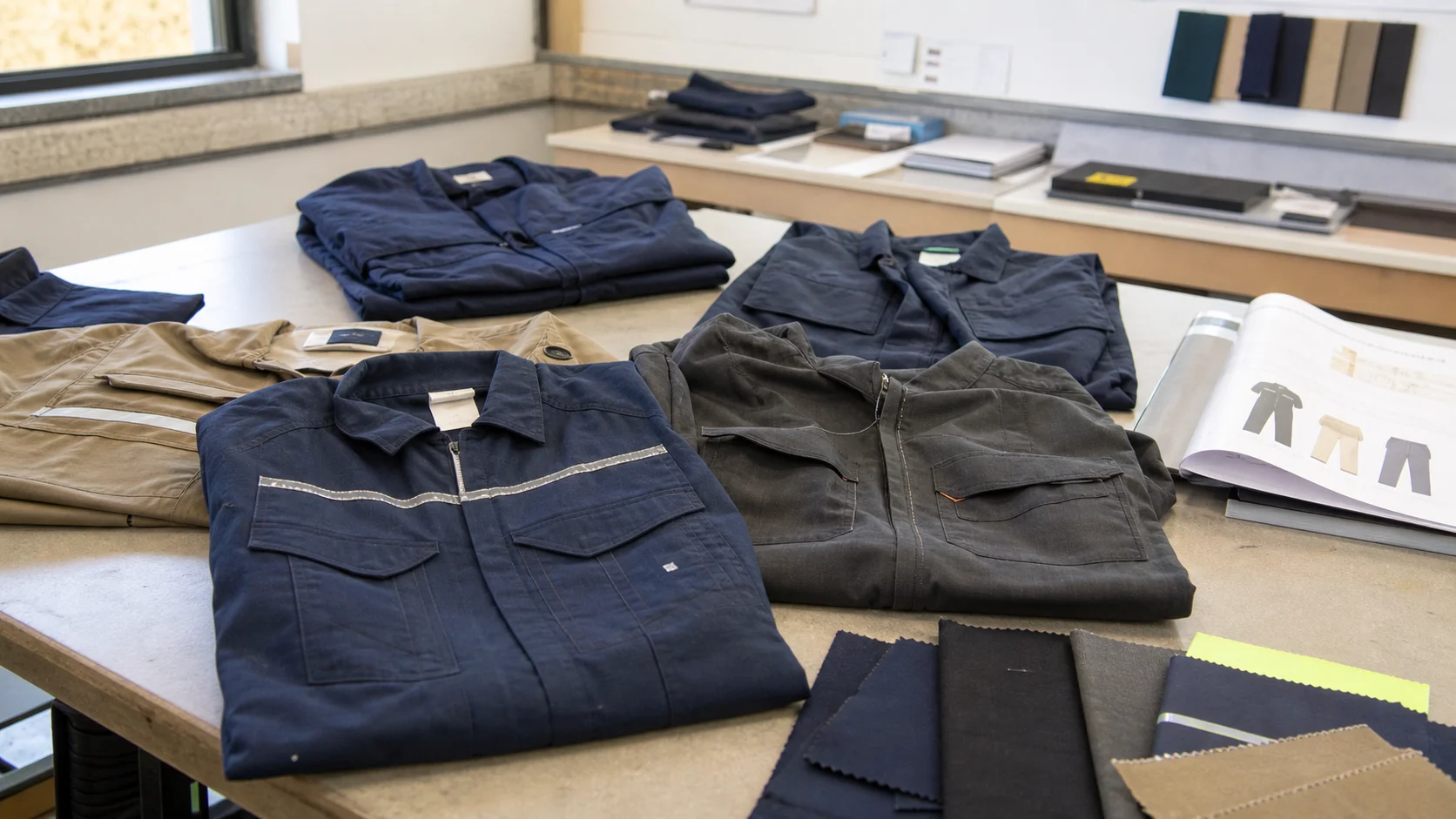
A quality inspection outline for corporate uniform buyers sorting coverall manufacturer defects, from seam failures and zipper issues to sizing, fabric flaws, labeling errors, and shipment-level acceptance decisions.
Coverall Defect Sorting for Uniform Buyers - Fabrikn production reference
For corporate uniform buyers, coverall defect sorting is not a warehouse housekeeping task. It is a cost-control process that protects wearer safety, brand presentation, deployment schedules, and supplier accountability. A small defect in a retail garment may be tolerable. A small defect in a workwear coverall can become a field complaint, a safety concern, or a full replacement claim when hundreds or thousands of employees receive the same issue.
This guide explains how buyers should sort defects when sourcing from a coverall manufacturer, especially for corporate uniform programs where consistency matters across departments, branches, and repeat orders. It covers defect classification, inspection checkpoints, fabric and trim risks, sample approval steps, typical MOQ expectations, lead-time dependencies, and the practical tradeoffs buyers need to make before approving bulk shipment.
Coveralls are usually bought for function first. They must protect regular clothing, support movement, withstand washing, carry company branding, and look consistent across the workforce. In some sectors, coveralls may also need flame resistance, antistatic performance, high-visibility panels, chemical splash resistance, or other compliance-related features. A buyer should not treat all coverall defects equally because the risk level changes by application.
A loose thread at an inside pocket is not the same as an open crotch seam, a broken zipper, a wrong reflective tape placement, or a mislabeled flame-resistant garment. Defect sorting helps buyers separate cosmetic issues from functional failures and safety-critical defects. That distinction is important when deciding whether to accept, rework, downgrade, or reject goods.
Corporate buyers often face pressure from operations teams to release uniforms quickly. That pressure is understandable when onboarding dates, site launches, or seasonal replacement cycles are approaching. Still, releasing defective coveralls too quickly usually moves the problem downstream. The warehouse team may spend extra time handling exchanges. Employees may lose confidence in the uniform program. Finance may see replacement costs that were not included in the original landed cost calculation.
Good defect sorting does not mean rejecting every imperfect garment. It means knowing which imperfections are acceptable, which require repair, and which should never reach the wearer.
The best sorting process starts before bulk production. A coverall manufacturer can only control defects properly when the buyer provides clear specifications and approval standards. Vague instructions such as “good quality stitching” or “standard industrial fabric” are not enough for a uniform program.
Buyers should provide a technical pack or specification sheet that covers the garment in practical terms. It does not need to be overcomplicated, but it must be specific enough to remove guesswork.
If the program is safety-related, buyers should request documentation that matches the end use. This can include fabric certificates, test reports, wash performance data, and applicable standard references. The buyer should verify which documents are required by local regulation or corporate safety policy before confirming the order.
Every bulk order should be judged against an approved sample. The sample becomes the physical standard for fabric hand feel, color, construction, trims, logo placement, and general workmanship. If multiple departments or regions will buy the same coverall, keep one sealed approval sample with the buyer and one with the manufacturer.
A common purchasing mistake is approving a photo instead of a physical sample. Photos help with communication, but they cannot reliably show fabric weight, zipper strength, seam bulk, pocket usability, or fit. For repeat programs, a controlled sample library is worth the effort.
Defect sorting works best when defects are grouped by severity. Most buyers use three main categories: critical, major, and minor. Some companies add a fourth category for “reworkable” defects, but reworkability should be treated as a decision status rather than a defect severity.
Defect Class Meaning Typical Buyer Decision Critical Defect may affect wearer safety, legal compliance, or essential function. Reject, quarantine, or require full corrective action before release. Major Defect affects appearance, durability, fit, branding, or usability. Rework, replace, sort out, or negotiate acceptance only if risk is low. Minor Small imperfection that does not affect function or brand presentation significantly. Accept within agreed tolerance or monitor if repeated.Critical defects should be rare. If they appear in inspection, the shipment usually needs quarantine until the source is understood. In coveralls, critical defects may include missing flame-resistant labels on FR garments, wrong safety tape on high-visibility garments, exposed sharp metal, broken closure on protective areas, serious contamination, incorrect certification claims, or fabric substitution that changes protective performance.
A critical defect is not a matter of negotiation unless the buyer has confirmed that the garment is not being used for the risk originally specified. If the coverall is part of PPE or safety-controlled workwear, buyers should be conservative.
Major defects are the most common reason for sorting. These include open seams, skipped stitches, zipper failure, wrong measurements outside tolerance, twisting legs, crooked pockets, heavy stains, shade variation, incorrect logo position, missing bartacks, incorrect labels, and defective reflective tape placement.
Major defects may be reworked if the repair does not weaken the garment or create an obvious appearance issue. A re-stitched seam may be acceptable. A removed and reattached heat transfer logo may leave a mark, making the garment unsuitable for front-line staff. The buyer should judge rework by the final wearer-facing result, not only by whether the factory can technically repair it.
Minor defects include loose thread ends, slight chalk marks that wash off, very small shade differences within approved tolerance, slight label angle variation, or minor stitch irregularity in a non-stress area. These may be acceptable if they remain within the agreed AQL limit and do not appear repeatedly in the same location.
Repeated minor defects can become a process warning. For example, loose threads on five garments may be minor. Loose threads across 60% of the shipment suggest poor finishing control and may lead to wearer complaints after distribution.
Fabric is the base risk in coverall production. Once fabric is cut, most fabric defects are difficult or impossible to remove without replacing panels. Buyers should push fabric inspection early, especially for large orders, special colors, FR fabrics, and high-visibility materials.
For uniform buyers, shade control is a major issue. A single employee may receive two or three coveralls from the same allocation, and visible shade differences look unprofessional. The problem becomes worse when replacement orders are made months later without retained shade standards.
Buyers should not rely only on visual inspection for fabric performance. The right testing scope depends on the end use, but common checks include dimensional stability, color fastness to washing, color fastness to rubbing, seam slippage, tear strength, tensile strength, pilling, and appearance after laundering. For FR or high-visibility coveralls, testing requirements may be more specific and should be confirmed against the applicable standard.
Fabric testing adds cost and time, but it is cheaper than replacing a failed uniform roll-out. For large corporate programs, pre-production fabric approval is a sensible control point. For small non-safety orders, a more limited fabric confirmation may be acceptable if the supplier has reliable material consistency and the buyer has approved a physical sample.
Coveralls carry more seam stress than many standard garments. Wearers bend, kneel, climb, squat, reach, and carry tools. The main construction risk is not whether the garment looks neat on a table. The real question is whether the garment survives movement and washing.
Defect sorting should pay special attention to bartacks. Missing or weak bartacks at pocket corners, zipper base, stress points, and side openings are usually major defects because they affect durability. A coverall may pass a quick visual review but fail after a few weeks if reinforcement is missing.
Thread quality matters. Buyers should specify thread composition and color where necessary. Polyester thread is common for general coveralls because of strength and wash durability. FR garments may require suitable FR sewing thread depending on the performance claim. If the wrong thread is used on a protective garment, the defect may be critical rather than major.
Fit defects create operational problems even when workmanship looks acceptable. A coverall that is too tight across the back restricts movement. A sleeve that is too long may interfere with work. A rise that is too short leads to seam stress and wearer complaints. Corporate uniform buyers should treat size consistency as a quality issue, not only a design issue.
Coverall measurement tolerances vary by fabric, style, and buyer requirement. Typical finished garment tolerances may fall around 0.5 cm to 1.5 cm for smaller points such as collar, cuff, and pocket placement, and around 1 cm to 2.5 cm for larger points such as chest, waist, inseam, total length, and sleeve length. Larger sizes may need slightly broader tolerance, but the buyer should define this in advance.
Measurement Point Common Risk Sorting Judgment Chest Too tight for movement or too loose for professional appearance. Major if outside tolerance and affects wearability. Inseam Dragging hem or restricted leg movement. Major if wearer safety or fit is affected. Torso length Pulling at crotch or shoulders when bending. Major for workwear comfort and seam durability. Sleeve length Interference with gloves, tools, or hand movement. Major or minor depending on deviation. Pocket placement Uneven appearance or reduced utility. Major if visibly wrong or functionally poor.Buyers should inspect measurements across several sizes, not only the medium sample. Grading problems often appear at the size range extremes. Big and tall sizes need particular attention because coverall movement depends on torso length, shoulder width, rise, and back ease working together.
A fit sample checks the base pattern. A size set checks whether grading is controlled across the size range. For a corporate program, approving only one size is risky if the order includes XS through 5XL. At minimum, buyers should review a base size, one small size, and one large size before bulk production. For complex styles or high-volume orders, a fuller size set is better.
Trims are small components, but they cause a high share of field complaints. Zippers, snaps, buttons, Velcro, elastic, reflective tape, labels, and logo applications must be checked carefully. A coverall with a failed zipper becomes unusable even if the fabric and stitching are acceptable.
Buyers should specify zipper type, zipper length, puller style, color, and whether a two-way zipper is required. Industrial users often prefer durable molded plastic or metal zippers, depending on work environment. Metal components may not be suitable for all electrical, food, or controlled environments, so the buyer should align trim choice with site requirements.
Reflective tape defects can be serious where visibility is part of the safety requirement. Buyers should verify tape width, placement, spacing, continuity, stitch line, heat application, and certification claim. Poorly applied tape may peel after washing or crack during wear.
For high-visibility coveralls, color-blocking and reflective layout should not be adjusted casually by the factory to simplify production. A small placement change can affect compliance or visibility performance. Any adjustment should go through buyer approval before bulk cutting or sewing.
Corporate uniform buyers care about brand consistency. Logo defects are highly visible and often politically sensitive inside the organization. Common issues include wrong logo size, wrong thread color, poor embroidery density, heat transfer peeling, incorrect placement, slanted application, low print opacity, or inconsistent badge alignment.
The buyer should approve a strike-off or branding sample before bulk decoration. For embroidered logos, check thread colors, backing, density, and puckering. For heat transfers, check adhesion, edge clarity, stretch behavior, and wash durability. For screen printing, check color accuracy, hand feel, cracking risk, and placement repeatability.
Label defects can create distribution errors. Wrong size labels, missing care labels, incorrect barcodes, mixed sizes in cartons, and inaccurate carton marks cause problems long after inspection. If coveralls are shipped directly to branches or employee kits, packing accuracy becomes a major operational control point.
A structured sample process reduces bulk defect risk. The exact sequence depends on order size and urgency, but corporate uniform buyers should avoid jumping directly from quote to bulk production without checking physical samples.
The pre-production sample is the most important checkpoint before bulk release. It should not be approved if fabric, zipper, reflective tape, logo method, or label details are still placeholders. A buyer can approve a development sample with comments, but bulk production should not start until the final sample is locked.
For buyers building a new uniform program, it can help to review sourcing support through a manufacturing partner’s service structure. Information on product development, production coordination, and quality control can usually be discussed through pages such as Fabrikn services before committing to a production path.
MOQ and lead time strongly affect defect sorting options. A buyer with a larger order usually has more leverage to request custom fabric, special trims, and dedicated quality controls. A buyer with a smaller order may need to work with available fabrics, standard colors, and existing trim options.
MOQ varies by manufacturer, fabric availability, customization level, and logo method. The following ranges are common planning references, not guaranteed rules.
Order Type Typical MOQ Range Buyer Tradeoff Stock fabric, standard color, simple logo 100 to 300 pieces per style Faster and easier, but limited fabric and color control. Custom color or specific fabric weight 300 to 800 pieces per style or color Better brand match, but higher fabric commitment. Special trims, reflective layout, multiple pockets 500 to 1,000 pieces per style More functional control, but more inspection points. FR, antistatic, or certified safety coveralls 500 to 1,500 pieces or more Compliance control improves, but testing and documentation take longer.Small orders can still be successful, but buyers should keep customization realistic. If the order is only 150 pieces, requesting a custom-dyed fabric, special zipper, multiple logo placements, nonstandard packaging, and a full size range may create cost and delay problems. A better approach may be to use a proven standard fabric and concentrate quality control on fit, branding, and packing accuracy.
Lead time is not only sewing time. It depends on fabric booking, lab dip approval, trim sourcing, sample revisions, testing, production line capacity, inspection timing, packing requirements, and shipping method. Typical coverall lead times may range from 30 to 60 days for simpler repeat orders using available materials, and 60 to 120 days for custom or compliance-sensitive programs.
Defect sorting is easier when the buyer builds inspection time into the schedule. If goods must ship the same day they finish packing, the buyer has little room to sort, rework, or replace defective units.
A practical inspection plan should match order risk. Not every coverall order needs the same inspection intensity, but every order needs a defined acceptance method. Buyers should confirm inspection standards with the manufacturer before production begins.
Inline inspection is especially useful for coveralls because many defects are repetitive. If pocket placement is wrong on the first 100 units, the same mistake may appear across the full batch unless caught early. Final inspection is necessary, but it should not be the first serious quality checkpoint.
Many buyers use AQL sampling for final inspection. Common apparel inspection levels may use General Inspection Level II, with AQL levels such as 0 for critical defects, 2.5 for major defects, and 4.0 for minor defects. Some buyers apply stricter levels for safety wear, new suppliers, or high-visibility corporate programs.
AQL is a sampling method, not a guarantee that every garment is perfect. It helps buyers make a shipment decision based on statistical sampling. If the buyer needs every unit checked, especially for safety-critical or executive-facing distribution, then 100% inspection or targeted sorting may be required.
Once defects are found, goods should be physically sorted into clear categories. The sorting area should have enough light, measurement tools, approved samples, defect stickers or tags, and a recording sheet.
Sorting Category Meaning Next Action Pass Garment meets approved standard. Pack or release for shipment. Repair Defect can be corrected without visible or functional compromise. Send for rework, then re-inspect. Second quality Garment has non-critical issue but may be usable for limited purpose. Accept only with buyer approval and clear commercial adjustment. Reject Garment is not suitable for intended use. Replace, remake, or remove from shipment. Hold Decision requires buyer review or test confirmation. Quarantine until confirmed.Second-quality acceptance should be handled carefully. It may be reasonable for internal maintenance spares where defects are purely cosmetic. It is usually a poor choice for customer-facing staff, safety-related roles, or tightly controlled brand programs.
Defect sorting should not end with counting bad garments. Buyers should ask why the defect happened and how the manufacturer will prevent recurrence. A corrective action report does not need to be long, but it should identify the root cause, affected quantity, repair method, responsible person, and prevention step.
Buyers should avoid accepting vague answers such as “workers will be more careful.” A useful corrective action might include adding a pocket placement template, checking zipper function at end line, segregating fabric rolls by shade, adding bartack verification, or requiring supervisor approval before moving to the next production stage.
The commercial decision depends on defect severity, delivery urgency, replacement feasibility, and the buyer’s internal tolerance. Common outcomes include full rejection, partial shipment, repair before shipment, discount acceptance, replacement in the next production run, or supplier-funded re-inspection.
A discount is not always a good deal. If defective coveralls create complaints, returns, safety exposure, or brand damage, the saved amount may be smaller than the downstream cost. Buyers should accept discounts only when the defect is genuinely low risk and the receiving teams understand the limitation.
The following checklist gives buyers a practical structure for inspecting and sorting coveralls before shipment or distribution.
Uniform buyers who need help framing inspection expectations before placing an order can start by reviewing manufacturing and quality coordination options through Fabrikn’s services page. For program-specific questions, direct discussion through Fabrikn’s contact page is usually more useful than trying to solve technical issues after bulk production has started.
The best purchasing decision is not always the strictest one. A buyer should be strict on safety, function, size consistency, and brand-critical defects. The same buyer can be flexible on tiny thread ends, washable chalk marks, or packaging preferences if delivery timing is tight and the defect does not affect use.
Cost pressure also needs honest handling. A very low unit price often means less margin for better fabric inspection, skilled sewing operations, durable trims, and proper finishing. If the uniform program requires strong performance, the buyer should not remove every quality-control cost during negotiation and then expect premium results at final inspection.
For new coverall suppliers, start with a controlled pilot order when possible. A pilot order gives the buyer evidence on fit, wash performance, defect rate, packing accuracy, communication, and corrective action behavior. Once the supplier proves consistency, larger rollouts become less risky.
For repeat suppliers, keep score. Track defect types by order and compare them over time. A supplier with a slightly higher price but lower defect rate may be cheaper after sorting, replacement, and complaint handling are included. Quality cost is part of landed cost.
Buyers who want background on a sourcing partner’s positioning and operating model can review Fabrikn’s about page as part of early supplier evaluation. Company pages do not replace technical due diligence, but they help buyers understand whether a supplier is set up for structured B2B uniform work rather than one-off garment trading.
Coverall defect sorting gives corporate uniform buyers a practical way to protect safety, consistency, and budget. The process starts with clear specifications, approved samples, and realistic MOQ and lead-time planning. It continues through material checks, inline inspection, final inspection, and disciplined sorting of defective garments.
The main purchasing lesson is simple: define quality before production, not after defects appear. Buyers should classify defects by risk, inspect the highest-stress areas, verify fabric and trims, control branding, and demand corrective action when defects repeat. A coverall is not just another garment. It is a daily-use work item, and the quality standard should match that responsibility.
Get a free quote from Fabrikn — your trusted B2B clothing manufacturer with 10+ years of experience. MOQ as low as 200 pieces.
Get a Free Quote →Defect sorting is the process of separating finished coveralls into pass, repair, reject, hold, or second-quality categories after inspection. It helps buyers decide which garments can ship, which need rework, and which should not be released.
Common defects include open seams, skipped stitches, zipper failure, shade variation, stains, wrong measurements, crooked pockets, missing bartacks, incorrect labels, poor logo placement, and defective reflective tape application.
Critical defects include issues that may affect safety, compliance, or essential function. Examples include wrong FR materials, missing safety labels, incorrect high-visibility tape, exposed sharp components, serious contamination, or fabric substitution on protective workwear.
Many apparel buyers use AQL 0 for critical defects, 2.5 for major defects, and 4.0 for minor defects, often under General Inspection Level II. Safety-related garments, new suppliers, and high-risk programs may require stricter controls or 100% inspection.
Some defects can be repaired, such as loose threads, missed bartacks, open seams, or replaceable buttons. Defects involving fabric damage, shade variation, poor logo removal, wrong safety materials, or major measurement errors may not be repairable without compromising quality.
Typical MOQs may range from 100 to 300 pieces for stock fabrics and simple customization, 300 to 800 pieces for custom colors or fabric weights, and 500 to 1,500 pieces or more for certified safety coveralls or complex specifications. Actual MOQ depends on the manufacturer and material supply chain.
Simple repeat orders using available materials may take around 30 to 60 days. Custom fabrics, special trims, compliance testing, complex branding, or branch-level packing can extend lead times to 60 to 120 days or more.
Buyers should approve the fabric, color, trims, logo method, fit sample, size set where needed, care labels, compliance labels, packaging, and pre-production sample. Bulk production should not begin while key materials or branding details are still unresolved.
Coveralls face higher stress because wearers bend, kneel, climb, reach, and work with tools or machinery. Seam strength, closure durability, fit, fabric performance, and safety details matter more than they do in many basic office or promotional uniforms.
A discount may be acceptable for minor cosmetic issues that do not affect safety, function, or brand presentation. It is usually a poor decision for safety-related defects, poor fit, weak seams, zipper failures, or visible branding problems that will create complaints later.