
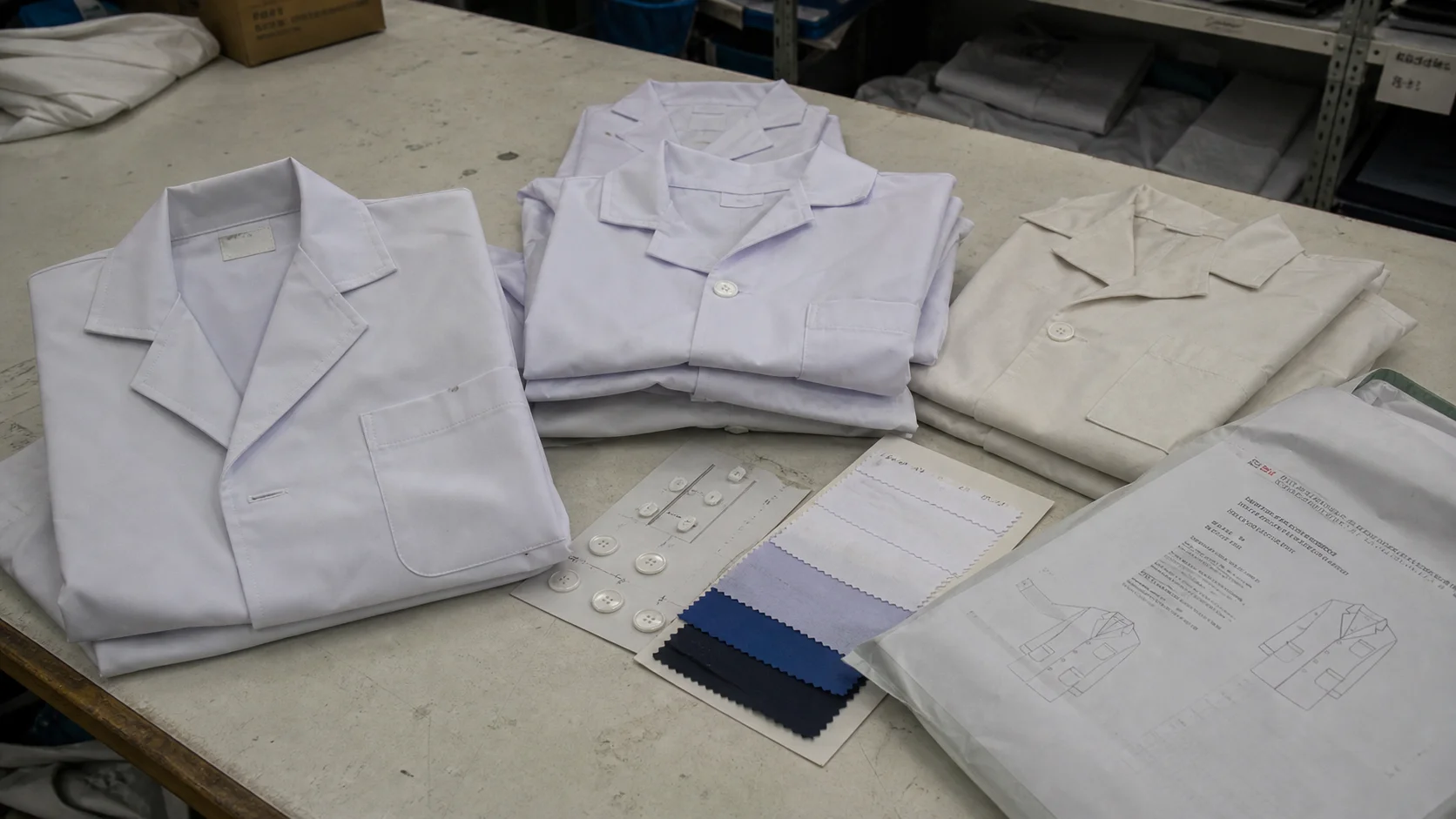
A product-specific factory release checklist for school operations teams buying lab coats, covering garment specs, decoration, labeling, packing,...
Lab Coat Release Checklist for School Buyers - Quality & Inspection manufacturing guide
A lab coat factory release checklist gives school operations teams a controlled way to approve finished goods before they leave the manufacturer. For school uniforms, science departments, vocational programs, medical training labs, and STEM academies, the issue is not only garment quality. It is timing, sizing, safety perception, student allocation, parent communication, and budget control.
Lab coats look simple on paper: white coat, front buttons, pockets, school logo, student sizes. In production, small misses create large operational problems. A weak button attachment becomes a complaint across multiple campuses. A pocket placed too low may not match the approved sample. A fabric that is too sheer can look cheap under classroom lighting. A sleeve that shrinks after washing can make the entire size run unusable by the second term.
School buyers often work under a fixed academic calendar. The coats must arrive before orientation, lab access, science practicals, open days, or inspection visits. Once the goods are shipped, sorting problems at campus level becomes expensive and disruptive. A release checklist shifts quality control upstream, where rework is still possible.
The best time to reject a poor lab coat is before bulk packing, not after cartons arrive at the school warehouse.
For B2B apparel purchasing, a release checklist should not be treated as paperwork for the factory to fill out casually. It should be a buying control document. It defines what must be checked, who signs off, which defects are unacceptable, and what evidence must be provided before final payment or shipment release.
This article is written for school operations managers, procurement teams, uniform coordinators, and education groups sourcing lab coats from a manufacturer or apparel supplier. It focuses on the practical factory release steps needed to reduce quality disputes and delivery risk.
Ownership should be agreed before the purchase order is issued. If no one owns release approval, the factory may assume shipment can proceed once production is packed. That can be risky for school buyers, especially when coats are customized with logos, department names, color-coded trims, or student-specific labels.
A practical release process usually involves three parties:
Smaller school orders may not justify a full third-party inspection, but they still need a documented final check. Larger multi-campus orders, recurring annual programs, or high-volume student uniform contracts should consider a more formal quality and inspection process. A supplier with structured apparel production services should be able to support this through documented samples, production checkpoints, and release evidence. Buyers can review manufacturing support options through Fabrikn's services page when planning a school apparel program.
Do not leave release approval to email comments such as “looks good” or “ship when ready.” Use measurable points: fabric GSM, shade, size tolerance, stitch quality, logo placement, carton quantities, barcode format, and defect limits.
The lab coat specification is the foundation of the release checklist. If the product spec is vague, inspection becomes subjective. A factory cannot consistently produce “good quality lab coats” without clear construction details.
A school lab coat specification should include:
For most school lab coat programs, polyester-cotton woven fabric is common because it balances cost, durability, wrinkle resistance, and washing performance. Cotton-rich coats may feel more breathable but can cost more and wrinkle more visibly. Higher polyester content may reduce cost and drying time, but it can feel less premium and may not be appropriate for every lab environment. School buyers should confirm whether the coats are intended for general classroom science, art and craft use, demonstration labs, medical training, or environments with stricter safety policies.
The specification must also state what the lab coat is not intended to do. Many school lab coats are not certified protective garments. If the coat must meet a specific safety standard, chemical splash requirement, flame resistance requirement, or institutional compliance rule, this needs to be specified before quotation. Do not assume a standard classroom coat is suitable for higher-risk laboratory use.
Fabric and trims are frequent sources of schoolwear quality complaints. They are also areas where factories may make substitutions if the purchase order does not block it. The release checklist should require confirmation that bulk fabric and trims match the approved sample and written specification.
Key fabric checks should include composition, GSM, hand feel, shade, shrinkage, colorfastness, pilling risk, and visible defects. For lab coats, school buyers should pay close attention to opacity. A low-GSM white fabric may look acceptable when folded on a factory table but appear too transparent when worn over a dark school uniform.
Typical fabric options include:
Fabric Type Typical Use Buying Judgment Polyester-cotton twill General school lab coats Good balance of durability, price, and easy care. Confirm opacity and hand feel. Cotton-rich woven fabric Higher-comfort programs and staff coats Better breathability, but can wrinkle and shrink more. Needs wash testing. Lightweight poplin Low-cost or short-term use Cheaper, but may look thin. Risk of transparency and lower durability. Heavier twill Durable student or vocational use More substantial feel. May be warmer and cost more.Fabric weight decisions should be practical. A very light coat may reduce unit cost and shipping weight, but it may not survive regular student use. A heavier coat may feel more professional and last longer, but it can be uncomfortable in warm classrooms. For school operations teams, the best fabric is usually the one that holds shape, washes consistently, covers underlying clothing, and stays within budget.
Trims include buttons, snaps, thread, labels, patches, zippers if used, fusible interlining, and packaging materials. Button quality matters more than many buyers expect. Students pull coats on quickly, stuff pockets, and wash garments repeatedly. Weak button stitching or poor snap attachment can create early failures.
The release checklist should require:
For embroidered logos, check thread color, density, backing removal, puckering, and placement. For heat transfers, check adhesion, cracking, edge lift, and wash resistance. Embroidery usually has a more durable schoolwear look, but it can pucker on lighter fabrics and adds cost. Heat transfer is cleaner for detailed artwork and may suit smaller runs, but buyers should ask for wash-test confidence before approving bulk.
School lab coats often cover a wide age range, which makes sizing difficult. A coat that fits one grade well may be unsuitable for another. The size set should be approved before bulk production, not after cutting starts.
A size set includes one sample from each size in the order range. For example, a school may need Youth S to Youth XL, Adult XS to Adult XXL, or numeric sizes for a more formal program. Each sample should be checked against the measurement specification.
Important measurements include:
Measurement tolerances should be realistic. For woven lab coats, common tolerances may range from plus or minus 0.5 cm for small details to plus or minus 1.5 cm for larger body measurements, depending on the measurement point and size. Do not make tolerances so tight that normal sewing variation causes unnecessary disputes. Do not make them so loose that the coats become inconsistent across sizes.
Fit approval should consider how students actually wear the coats. Many will wear them over uniforms, sweaters, blazers, or PE shirts. A slim fashion fit may look neat on a model but fail in daily school use. A relaxed fit is usually safer for mixed student populations, especially when the order is distributed through a school store or uniform office without individual tailoring.
Grading also matters. Sleeve length often becomes a complaint point. If small sizes are too long, younger students look untidy and may roll cuffs. If larger sizes are too short, older students feel restricted. The release checklist should compare bulk size measurements against the approved size set and grade rule.
Sample approval should be staged. Skipping samples may save a week early in the process, but it can cost much more if the final shipment is wrong. For school buyers, the sample process should be proportional to order value and risk.
A typical lab coat sample approval path includes:
For repeat orders using the same specification, schools may not need every stage each year. A pre-production sample and size confirmation may be enough if the fabric, factory, trims, logo, and measurements are unchanged. If any key component changes, sample approval should be repeated.
Every approved sample should be dated, photographed, labeled, and linked to the purchase order. Factories and buyers should both retain reference samples. Photos alone are not enough for fabric hand feel, opacity, or construction review, but they are useful for placement and color reference.
Approval comments should be specific. “Approved with changes” is dangerous unless the changes are listed clearly. A better note would be: “Approved for bulk after increasing sleeve length by 1 cm on Adult L to XXL, moving chest logo 1 cm higher, and changing care label to final artwork dated 12 May.” The release checklist should require inspection against the final approved version, not against an early sample.
Production readiness is where many avoidable mistakes are caught. Before cutting fabric, the factory should confirm that all materials, patterns, markers, labels, and trims are ready and approved. Cutting the wrong fabric shade or outdated pattern can affect the entire order.
A production readiness check should include:
School operations teams should also confirm order allocation at this stage. If the order is split across campuses, departments, or student groups, the factory must know before packing begins. Re-sorting hundreds or thousands of lab coats after delivery wastes staff time and increases the chance of distribution errors.
Factories may request approval to proceed quickly when fabric arrives late. Buyers should be careful here. A one-day pre-cut check is often worth it. Once bulk fabric is cut, options become limited. If the fabric shade, GSM, or shrinkage is wrong, rework may not be possible.
Inline inspection happens while garments are being made. It is especially useful for lab coat orders because construction defects can repeat across the batch. If the first sewing line attaches pockets at the wrong height, hundreds of coats may be affected before final inspection catches the issue.
Inline checks should focus on early detection:
For school lab coats, the main benefit of inline inspection is preventing mass repetition of simple mistakes. It also gives the factory time to retrain operators, adjust guides, correct patterns, or isolate defective panels before assembly continues.
Inline inspection is not always required for small orders. For example, an order of 100 plain lab coats without logo customization may rely on internal QC and final inspection. An order of 3,000 coats across multiple sizes and campuses should have more control. If the order includes school embroidery, special labels, or deadline-critical delivery, inline inspection becomes more valuable.
Buyers should ask the factory for inspection photos from early production. Useful photos include front view, back view, pocket close-up, label close-up, logo placement, seam close-up, button attachment, and packed unit. Photos do not replace measurement checks, but they help catch visible mismatch before the order is completed.
Final inspection is the core of the lab coat factory release checklist. It confirms whether finished goods are acceptable for shipment. This should happen after production is complete and before cartons are released. Ideally, goods should be fully packed or mostly packed so the inspector can review both garment quality and packing accuracy.
A final inspection should check workmanship, measurements, appearance, labeling, packing, quantity, and any buyer-specific requirements. Many apparel inspections use an AQL sampling method. For school orders, typical AQL levels may vary by buyer tolerance, order value, and risk. Common practice is to set stricter limits for critical defects and more moderate limits for minor workmanship issues. The buyer should define acceptable quality limits before production begins.
Defects are usually grouped as:
School buyers should not allow critical defects. Major defects should be tightly controlled because they create distribution problems. Minor defects need judgment. Rejecting a full shipment for a few small thread ends may be unreasonable if the factory can clean the goods quickly. Accepting coats with uneven sleeves, wrong logos, or poor opacity is not a good tradeoff.
Measurement inspection should compare sampled garments to the approved spec. Common lab coat measurement failures include short sleeves, uneven front length, tight armholes, oversized chest, and inconsistent pocket position. Inspectors should measure across several sizes, not only a middle size.
Workmanship inspection should look at seam consistency, skipped stitches, broken stitches, puckering, loose threads, open seams, crooked pockets, uneven collars, and buttonhole finishing. Lab coats are often white or light-colored, so stains and thread contamination show easily.
Appearance checks should include shade, fabric defects, stains, oil marks, dirt, creases, embroidery puckering, print quality, and symmetry. A lab coat is a visible school garment. Even if it is used in practical classes, it should look clean and consistent when issued.
Packing is where many school operations teams feel the pain of poor factory release control. A garment may be acceptable, but if sizes are mixed, cartons are mislabeled, or campus allocations are wrong, the receiving team loses hours sorting stock.
The packing section of the release checklist should cover:
Polybagging can protect white coats from dirt during transport, but it adds plastic waste and unpacking time. Some schools prefer individual bags for retail-style distribution through a uniform shop. Others prefer bulk packing by size to reduce waste and speed receiving. The right choice depends on how the school issues garments.
If the coats are distributed to individual students, buyer-provided name labels or student ID packing may be required. That increases complexity and should be agreed early. Student-specific packing can be useful, but it raises the risk of sorting errors. It also requires clean data from the school before production packing begins.
Carton marking should be simple and readable. At minimum, cartons should show purchase order number, style name, color, size, quantity, carton number, destination, and any campus allocation. If multiple campuses are involved, mixed cartons should be avoided unless the receiving team specifically requests them.
Factory release should not happen until required documents are complete. Documentation protects both buyer and supplier. It also helps school teams receive, allocate, and account for the shipment properly.
Common documents include:
Testing requirements should be set before production. If a school requires formal fabric testing for colorfastness, shrinkage, pH, restricted substances, flame resistance, or other standards, the supplier needs time and budget. Test reports cannot be responsibly created after goods are packed unless retained fabric or garments are submitted to a lab, and that can delay delivery.
Some school buyers do not need full laboratory testing for basic classroom lab coats. That is a cost decision. The tradeoff is risk. For larger programs, younger student use, or public-sector purchasing, stronger documentation is often worth the added lead time.
Lab coat sourcing timelines depend on fabric availability, customization, sample approval speed, factory capacity, testing needs, and shipping method. A realistic release checklist should account for these dependencies instead of assuming every order can be rushed at the end.
MOQ varies by supplier, fabric, customization, and production setup. For school lab coats, practical ranges may look like this:
Order Type Typical MOQ Range Buying Notes Plain lab coats from stock fabric 100 to 300 pieces Lower risk if fabric and patterns are already available. Custom logo lab coats 300 to 500 pieces MOQ may depend on embroidery setup, labels, and size split. Custom fabric, special color, or unique trims 500 to 1,000+ pieces Fabric mill MOQ can drive the true minimum. Multi-campus annual program 1,000+ pieces Better unit pricing, but more packing and allocation control needed.Very low MOQs are possible in some cases, especially when the supplier uses stock fabric and standard patterns. The unit cost will usually be higher, and customization options may be limited. Large orders can reduce unit cost, but they increase the cost of mistakes. A 2% size-label error in a small order may be manageable. The same error across a district-wide program can be a major operational problem.
Lead times vary widely, but school buyers can use these broad planning ranges:
Rushed orders are possible, but they reduce room for sampling, inspection, and rework. If the academic deadline cannot move, the buyer should protect time for final inspection. Cutting inspection time is one of the easiest ways to receive avoidable defects.
Operations teams should also plan internal lead time after delivery. Goods may need to be counted, checked, sorted, distributed to classrooms, added to a uniform store, or issued to students. Factory delivery date is not the same as student-ready date.
The following checklist can be adapted for school lab coat programs. It should be attached to the purchase order or used as a pre-shipment approval form. The goal is to prevent unclear release decisions.
Checkpoint What to Verify Release Decision Purchase order Style, quantity, sizes, color, delivery terms, and destination match current order. Hold shipment if order details are not aligned. Approved sample Factory has final approved sample and approved comments on file. Do not inspect against obsolete samples. Fabric Composition, GSM, shade, opacity, hand feel, and shrinkage match specification. Reject substitutions not approved in writing. Trims Buttons, snaps, thread, labels, patches, and packaging match approved standard. Require rework for unsafe or incorrect trims. Logo Artwork, color, size, position, and application method match approval. Major issue if logo is wrong or missing. Measurements Sampled garments are within agreed tolerance across all sizes. Assess severity and affected sizes before release. Workmanship Seams, collars, pockets, buttonholes, hems, and thread trimming are acceptable. Require repair or sorting for repeated defects. Cleanliness No stains, oil marks, dirt, fabric contamination, or strong odor. White coats need stricter visual review. Labels Size, care, fiber content, school label, and barcode are correct. Wrong labels can block distribution. Packing Carton count, size ratio, campus allocation, and carton marks match packing list. Hold shipment if cartons cannot be received accurately. Documentation Inspection report, packing list, invoice, test reports, and photos are complete. Release only after required documents are available.A release checklist should finish with one of three decisions:
Conditional release should be used carefully. It is acceptable for small, clearly defined issues such as extra thread trimming, carton remarking, or missing photos that can be supplied quickly. It should not be used for unresolved size failures, wrong fabric, missing labels, or safety concerns.
School lab coat orders have predictable risk areas. A strong release checklist puts these risks into the inspection plan rather than discovering them after delivery.
White lab coats can appear too sheer if the fabric is too light. Buyers should check opacity under normal lighting and over darker clothing. A slightly higher fabric weight may be worth the cost if it improves appearance and durability.
Embroidery and print placement can shift by size if the factory does not use placement templates. The logo should sit consistently on the chest and not disappear into the armhole or pocket seam on smaller sizes.
Mixed cartons may seem efficient for the factory but create receiving problems for schools. If mixed packing is necessary, carton-level packing lists must be accurate.
Buttons are a high-use stress point. Inspectors should check attachment strength and buttonhole opening quality. Poor buttonholes make coats hard to fasten and can fray quickly.
White coats show dirt from cutting tables, sewing machines, pressing equipment, and packing areas. Factories should protect finished garments during production and packing. Final inspection should include a clear cleanliness check.
Sleeve length complaints are common because lab coats are worn during practical work. Sleeves that are too long can interfere with activities; sleeves that are too short look poorly fitted. Measurement sampling should cover all key sizes.
Care labels should match the actual fabric and intended washing method. If the school launders garments centrally, washing requirements should be checked with the laundry process. A care label that is too delicate may not suit school use.
The most expensive inspection failure is one found after the shipment reaches the school. At that point, replacement, return, or sorting costs may exceed the value of earlier inspection. Buyers should protect inspection time in the production calendar.
Not every school lab coat needs premium construction. The right buying decision depends on use case, budget, and replacement cycle. A junior science coat used a few times per term does not need the same construction as a vocational training coat used daily. That said, the cheapest option is rarely the lowest-risk option for school operations.
Spend more on fabric opacity, seam strength, reliable sizing, and accurate packing. These areas directly affect student acceptance and distribution efficiency. Savings can sometimes be found in simplified packaging, standard trims, standard size ranges, and avoiding unnecessary customization.
Logo decisions also deserve clear judgment. Embroidery gives a durable, institutional look, but it increases cost and lead time. A woven patch can look structured but needs careful edge finishing. Heat transfer can be efficient for smaller orders and detailed designs, but it should be tested for wash durability. If the coat is likely to be washed frequently, do not approve a decoration method based only on its first-sample appearance.
For school groups building an ongoing uniform or lab apparel program, it is useful to align with a supplier that can manage specification discipline, sample approval, and release documentation. Buyers who need a conversation about program structure can use Fabrikn's contact page to start a sourcing discussion. Background information about the company is also available on Fabrikn's about us page.
The release checklist should be supported by commercial terms. If the purchase order does not mention inspection, the buyer may have less leverage when defects are found. Clear release terms reduce argument and help the supplier plan properly.
Useful terms to define include:
Factories generally prefer clear requirements when they are provided early. Late-stage quality demands can create tension, especially if the factory priced the order without allowing for testing, extra QC, special packing, or third-party inspection. School buyers should include release expectations at quotation stage, not after production is complete.
A lab coat factory release checklist is a practical control tool for school operations teams. It protects delivery timelines, student distribution, budget, and garment quality. It also gives the factory a clear standard to work toward.
The strongest checklist starts before production, with a locked specification, approved sample path, confirmed fabric and trims, realistic lead time, and clear inspection criteria. Final inspection is important, but it should not be the first serious quality check. Inline review, production readiness checks, and packing verification all reduce the chance of costly problems.
For school buyers, the purchasing judgment is straightforward: do not overcomplicate a basic lab coat, but do not leave critical quality points undefined. Fabric opacity, sizing, logo accuracy, seam strength, labels, and packing deserve disciplined control. A clean release process helps the school receive the right coats, in the right sizes, at the right time, with fewer surprises.
Get a free quote from Fabrikn — your trusted B2B clothing manufacturer with 10+ years of experience. MOQ as low as 200 pieces.
Get a Free Quote →A lab coat factory release checklist is a quality control document used before shipment. It confirms that the finished lab coats match the approved specification, sample, measurements, labels, packing instructions, and purchase order requirements.
A release checklist should be used for any custom school lab coat order, especially when the coats include logos, special labels, multiple sizes, campus allocations, or fixed academic delivery dates. It is most valuable before final payment or shipment release.
The most important points are fabric quality, opacity, measurements, pocket placement, logo accuracy, button strength, seam quality, cleanliness, care labels, size labels, and carton packing accuracy.
Typical MOQs may range from 100 to 300 pieces for simple stock-fabric lab coats, 300 to 500 pieces for logo-customized coats, and 500 to 1,000 or more pieces for special fabric, custom colors, or unique trims. Actual MOQ depends on the supplier and material availability.
Many school lab coat orders require 3 to 6 weeks for bulk production after sample approval. Sampling, fabric sourcing, testing, inspection, rework, and shipping can extend the total timeline. Buyers should plan backward from the date students need the coats, not only from the desired shipment date.
Inspecting every unit may be appropriate for small high-risk orders or student-specific packing, but many bulk apparel orders use sampling inspection. The buyer should define acceptable quality limits and require full sorting or rework if repeated defects are found.
Embroidery is often more durable and institutional in appearance, but it costs more and can pucker on lightweight fabric. Heat transfer can work for detailed artwork and smaller orders, but adhesion and wash durability should be checked before bulk approval.
The factory should hold shipment, identify the defect scope, repair or replace affected goods where possible, and provide evidence of correction. A re-inspection may be needed before release. Serious issues such as wrong fabric, wrong logo, unsafe trims, or major size failures should not be released without buyer approval.
Yes, if the defects are minor, limited, and do not affect use or appearance in a meaningful way. Examples may include a small number of loose threads that can be trimmed. Major defects such as wrong labels, poor measurements, stains, or missing logos should be handled before shipment.
School buyers should collect the final inspection report, packing list, invoice if needed, approved sample reference, measurement report, test reports if required, and shipment details. For multi-campus programs, carton-level packing information is especially important.