
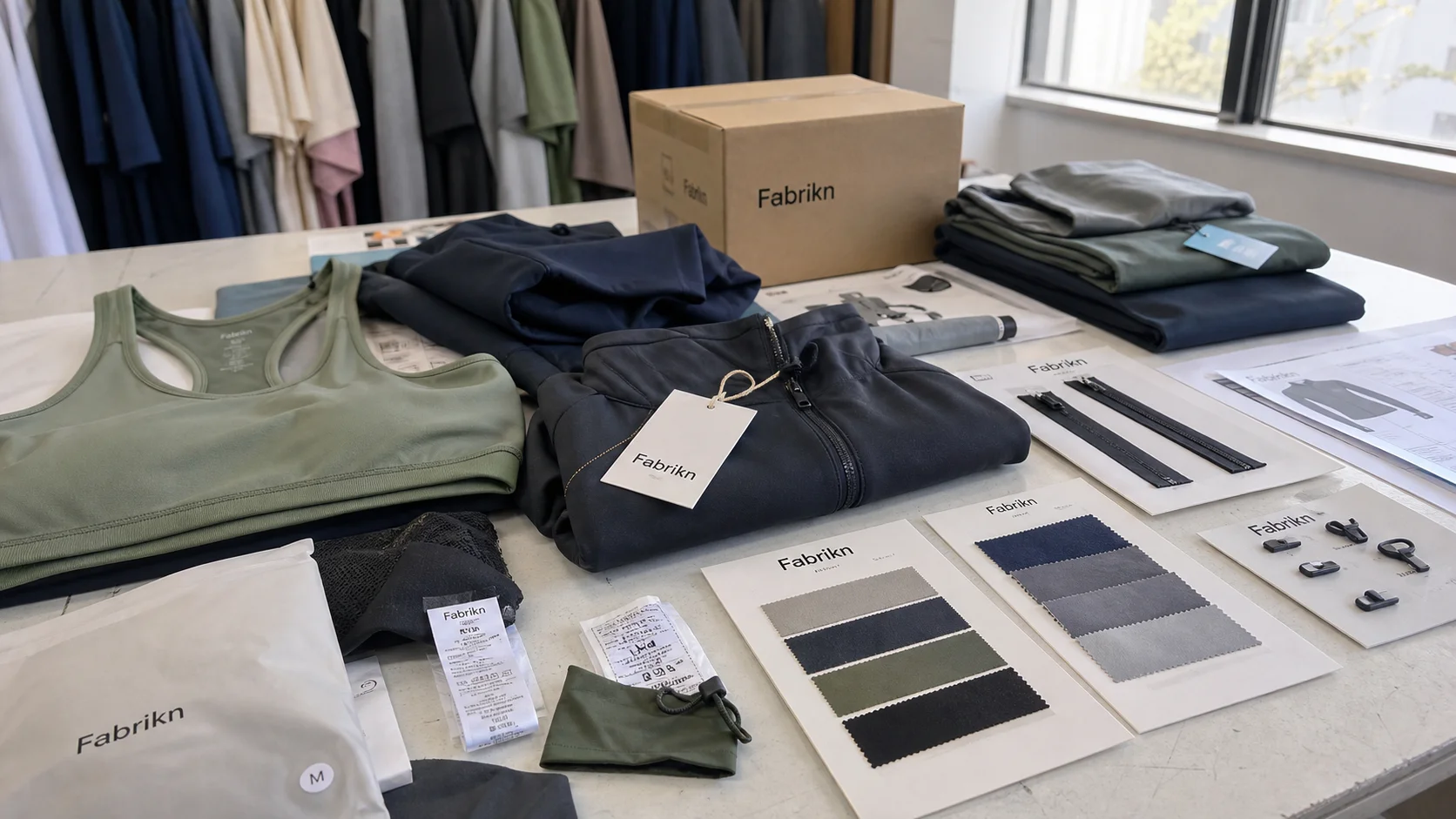
A detailed outline for retailers planning custom activewear sets, focused on fabric testing, pre-production validation, and launch-ready private label...
Custom Activewear Sets With Fabric Testing for Launches - Fabrikn production reference
For a retailer preparing to launch a private label line, custom activewear sets are one of the more practical categories to evaluate early. Matching bras, leggings, bike shorts, crops, jackets, and tops give a collection an immediate merchandising structure. They also raise the execution standard. Customers expect activewear to look coordinated on the rail, feel supportive in motion, recover after stretch, and hold color through repeated washing. If any of those basics fail, returns rise fast.
That is why custom activewear sets with fabric testing for retailer launches deserve more disciplined planning than generic cut-and-sew basics. A two-piece set may look simple online, but sourcing teams know the real work sits inside fabric performance, fit consistency, seam engineering, and repeatable bulk quality.
Retailers launching a new label are usually trying to achieve several goals at once:
Activewear sets can help on all five points, but only when the product is engineered for launch conditions rather than developed as a fashion sample alone. In practical sourcing terms, that means the fabric testing plan should be locked before bulk commitments, not discussed after pre-production is already under pressure.
Retail buyers and brand founders also need to make one basic judgment early: is the first launch intended to prove demand, or is it intended to establish long-term product authority? If the goal is a cautious market test, the line can stay tighter with fewer colors and controlled trims. If the goal is to position the brand as a serious performance offer, fabric certification, stretch recovery standards, and wear-test feedback need heavier attention from the start.
Either way, the launch should not rely on appearance alone. A clean sample with flattering fit is not enough in activewear. Fabric performance is the product.
Fabric testing is often treated as a technical box to tick near production. That is the wrong order for activewear. Testing should guide development decisions early, because it affects material selection, garment patterning, and even the claimed use of the final product.
In activewear, a fabric may need to satisfy several overlapping requirements:
Those are not theoretical concerns. They directly shape customer satisfaction and return rates. A retailer can survive a slightly delayed launch more easily than a launch built on leggings that go sheer in a squat test or bras that lose recovery after a few washes.
Most sourcing teams will review a mix of mill data, in-house checks, and third-party laboratory testing. The right balance depends on the product positioning. Entry-level fashion-active sets may require a narrower test scope than high-compression gymwear marketed for training. Still, even lower-priced launches need basic confidence in fabric weight, stretch, recovery, and colorfastness.
Common tests or checks considered for activewear fabrics include:
The purchasing judgment here is straightforward: the cost of testing is usually far lower than the cost of a failed first delivery. That matters even more for retailer launches because early reviews shape the entire label, not just one SKU.
Teams sourcing through an experienced manufacturing partner often use development support to align fabric and construction decisions with launch goals. Retailers comparing private label programs should pay close attention to whether the supplier can support fabric evaluation, sample refinement, and production planning as one process rather than isolated steps. A service structure like the one outlined at /services/ is usually more useful than a supplier that only quotes against a tech pack and waits for instructions.
A launch runs more smoothly when the product brief is specific. Retailers often lose time by approving the visual design while leaving technical standards too loose. Activewear sets need tighter specs because small material changes can alter fit, handfeel, opacity, and cost.
Before production, the sourcing package should ideally define the following:
Typical activewear set fabrics include nylon-spandex and polyester-spandex blends. Nylon-based qualities often give a smoother handfeel and premium perception, while polyester-based options may offer better cost control and easier access to performance finishes. Neither is automatically better. The decision depends on target retail, use case, and brand positioning.
Common ranges include:
Lighter fabric can improve cost and comfort but raises the risk of sheerness and seam grin. Heavier fabric can support premium positioning but may limit size tolerance and increase freight cost. There is no universal sweet spot.
Retailers should define whether the set is meant for yoga, studio wear, training, running, or everyday athleisure. That decision affects pattern ease and fabric selection. A soft brushed yoga handfeel does not always deliver the same hold as a denser compression knit. Trying to force one fabric to satisfy every use case often creates an average product with weak claims.
Do not treat trims as secondary in activewear. Elastic quality, cup options, thread type, zipper grade, reflective transfers, silicone prints, drawcord tips, and care labels all affect wear performance and consistency.
A low-cost trim choice can erase the benefit of a good base fabric. That is a common launch mistake.
Retailers should confirm Pantone references or approved lab dips, then assess how those shades behave across fabric bases. Dark shades can mask minor appearance issues but may show crocking risk. Light shades can be attractive for launch imagery but often require stricter opacity review. Matching a bra and legging in the same shade also sounds easier than it is, especially when lining, elastic, and face fabrics absorb dye differently.
Many early-stage brands underestimate grading complexity in stretch garments. A fit approved in one sample size does not guarantee balanced grading across the full size range. Compression garments need careful measurement tolerances because small variation in waistband, rise, or leg opening can change fit perception quickly.
When in doubt, reduce the number of silhouettes rather than rush too many patterns at launch. A smaller line with tighter spec control usually performs better.
MOQ planning is one of the first commercial filters in private label activewear. Retailers should expect variation based on fabric availability, color count, printing, trim customization, and packaging requirements.
These are broad commercial ranges, not fixed rules. A retailer should always ask whether MOQ applies per SKU, per color, per set, or per total order. Confusion at that stage leads to budget mistakes.
A disciplined sample path helps prevent bulk surprises. The sequence often includes:
Retailers should avoid approving pre-production samples made from substitute materials unless the differences are clearly documented. Activewear is too sensitive to fabric behavior for vague substitutions.
Lead time for custom activewear sets depends less on sewing alone and more on material readiness and approval speed. Fabric sourcing, dyeing, testing, branding trims, sample comments, and packaging can all extend the calendar.
As a rough planning guide:
A launch schedule gets more reliable when the critical path is mapped from fabric approval backward from the planned delivery date. Teams that only count sewing days usually under-plan.
Inspection in activewear should focus on function as well as appearance. A garment can pass a casual visual review and still create field complaints. Retailers preparing a first launch should define inspection priorities clearly, especially for matching sets where customers notice inconsistency quickly.
The practical buying decision is to focus inspection on the defects most likely to trigger returns, not just the easiest points to count. For leggings, opacity and seam durability deserve more attention than decorative finishing. For bras, support, symmetry, and elastic recovery matter more than a minor internal cosmetic issue.
Retailers entering private label often benefit from confirming expectations with the supplier early, including acceptable tolerances, key measurements, and how in-line or final inspections will be handled. Questions about production support, development workflow, and communication can usually be clarified early through a direct inquiry at /contact-us/.
The tension in custom activewear launches is simple: better fabrics and construction improve the product, but every upgrade affects cost. Retailers need a margin plan that protects the launch without stripping out the features customers actually notice.
A useful way to manage this is to separate high-visibility value drivers from lower-priority embellishments.
This is where many launches go off course. Teams sometimes overspend on packaging, hangtags, or cosmetic trim details while underinvesting in fabric testing and fit refinement. Customers rarely forgive weak product performance because the box looked polished.
Branding strategy should also stay realistic. If the retailer is new to the category, a compact opening assortment with one hero fabric and several coordinated silhouettes is often a better commercial move than launching across multiple fabric stories at once. That gives the team a clearer read on reorders, fit feedback, and which use cases resonate.
Buyers should also assess whether the brand promise matches the tested product. If the garment is positioned as high-performance training wear, the fabric and construction need to support that claim. If the product is better suited to light studio, lounge, or lifestyle use, the marketing should reflect that honestly. Overclaiming performance creates avoidable return pressure.
Retailer launches succeed when sourcing, merchandising, and quality planning are aligned early. For custom activewear sets, that means the launch plan should connect product intent, testing scope, sample approvals, MOQ decisions, and delivery timing in one working calendar.
A strong launch plan usually includes these actions:
There is also a strategic reason to take this approach. The first launch is not only about selling inventory. It is about establishing whether the product system can scale. A retailer that learns which fabric platform works, which silhouettes convert, and which quality points require tighter control is in a much stronger position for the second drop.
That is why careful supplier selection matters. The right partner should be able to discuss product development in commercial terms, not just quote a sewing rate. Retailers exploring private label activewear often review a supplier’s development capabilities, communication process, and category focus before moving ahead. A background overview such as /about-us/ can help frame that evaluation, but the real test is whether the development process addresses launch risk in a practical way.
In the end, custom activewear sets with fabric testing for retailer launches are not just a design project. They are a quality-control project, a margin project, and a brand-trust project combined. Retailers that treat fabric testing as part of the launch foundation are usually better equipped to protect sell-through, reduce returns, and build a label customers will come back to.
The commercial takeaway is clear. Start with a tight assortment, specify the product carefully, test fabric early, and approve only what can be repeated in bulk. That is the safer route for a first launch, and in activewear, safer usually means stronger.
Get a free quote from Fabrikn — your trusted B2B clothing manufacturer with 10+ years of experience. MOQ as low as 200 pieces.
Get a Free Quote →Typical MOQs often start around 100 to 300 pieces per style or color for simpler programs using available fabrics. Fully custom fabric, dye, trims, or packaging can push MOQs to 300 to 800 pieces per color or more. Buyers should confirm whether the MOQ applies per SKU, per color, or per total order.
Fabric testing helps reduce early product failures tied to sheerness, poor stretch recovery, pilling, color loss, and shrinkage. For a retailer launch, those issues can damage reviews and brand trust quickly. Testing is usually less expensive than managing returns and replacement stock.
Nylon-spandex and polyester-spandex blends are the most common choices. Nylon blends are often used for a smoother, more premium handfeel, while polyester blends can support cost control and performance finishing. The right choice depends on target retail price, compression level, and intended use.
Development timelines vary, but sample rounds often take 4 to 10 weeks depending on complexity and revision cycles. Bulk material preparation can take several more weeks, followed by 4 to 8 weeks for production after approvals. Custom colors, specialty trims, and slow approvals can extend that schedule.
Common risks include fabric sheerness under stretch, poor recovery, color mismatch between pieces, popped stitches, wavy seams, inconsistent waistband tension, and branding failure after wash. A focused inspection plan should prioritize the defects most likely to trigger returns.
In most cases, a tighter opening assortment is the safer decision. Launching with one or two proven fabric platforms and a focused group of matching silhouettes makes quality control easier and gives clearer sales feedback. Too many styles at once can dilute development attention and create avoidable fit and production problems.