
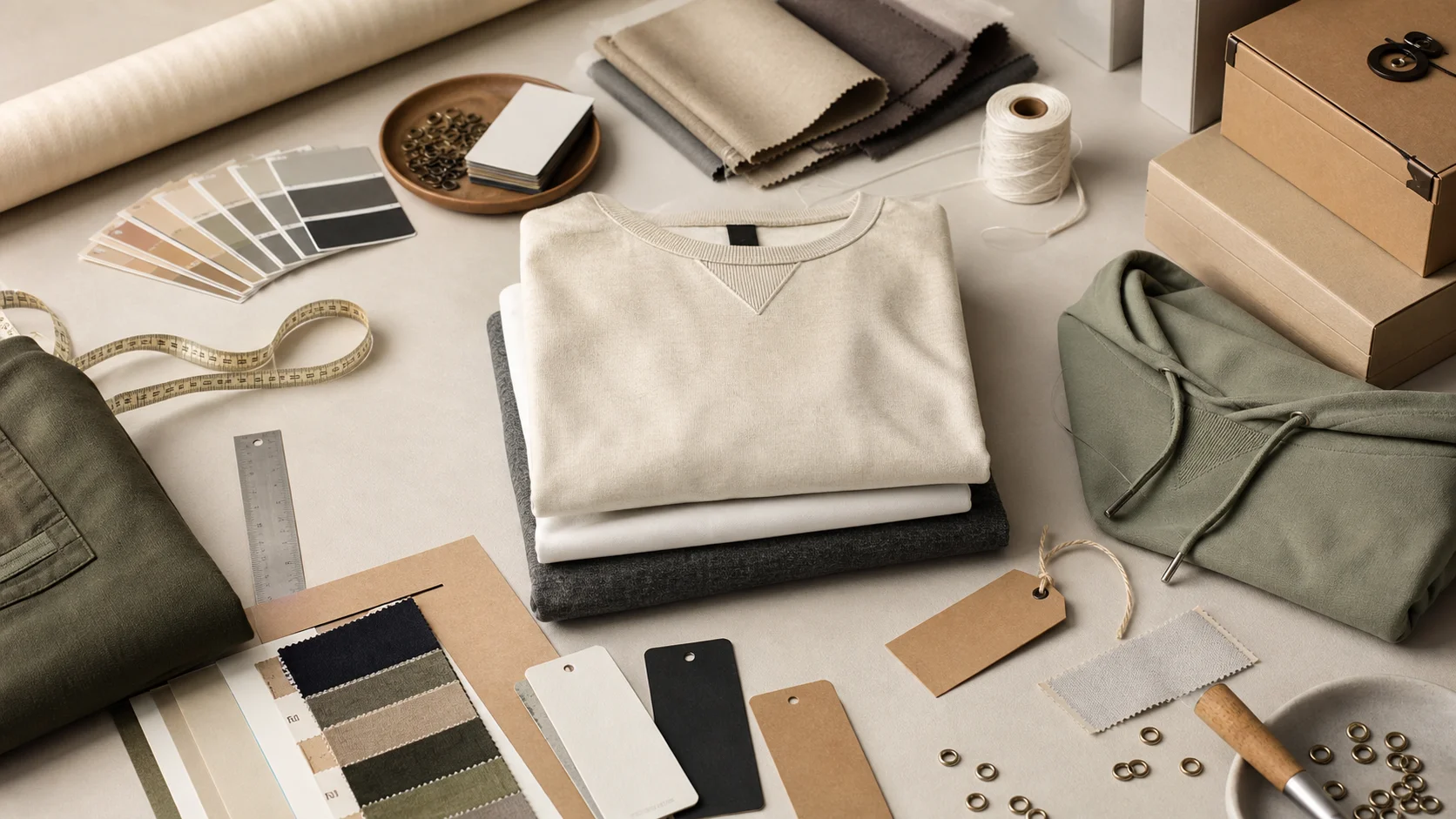
Branded Online Clothing Store Boxes with checks for samples, fit, MOQ, QC evidence, pricing terms, and delivery risk.
Fast answer: Branded Online Clothing Store Boxes: Board, Print, Inserts, and MOQ should be judged by production evidence, not by a generic sourcing promise. The buyer needs sample proof, cost breakdowns, QC checkpoints, and delivery buffers in writing.
Ask for recent sample photos, measurement tolerances, fabric or print test assumptions, decoration test notes, packing examples, and a named inspection checkpoint. These details show whether the team can repeat an approved sample at bulk volume.
Separate garment cost, decoration, labels, packaging, sampling, testing, freight, and rush charges. When every cost line is visible, it becomes easier to reduce colorways, adjust size depth, or reserve more time for sampling.
I’ve watched cartons get crushed on pack-out lines for a $28 dress and a $280 blazer, and the garment was never the problem. It was the box. In three factories across Vietnam and Turkey, I saw corners split, void fill stuffed into oversized mailers, and branding that never made it past the warehouse door. That is why custom branded boxes for online clothing store operations matter more than they first appear.
Unboxing is not decoration. It is a handoff. In apparel e-commerce, the package is often the only physical contact before the return window opens. When a customer compares three stores at once, the box becomes shorthand for value, care, and consistency. Data from WTO and retailer studies point to the same reality: small improvements in presentation and fit can lift repeat purchase intent and reduce damage claims, especially when parcel dimensions are trimmed by even 1-2 cm on each side.
The cheapest mailer often costs more than it looks on the quote. A plain poly mailer at $0.08 to $0.14 can trigger wrinkles, complaints, and higher return rates, while a tightly sized carton at $0.32 to $0.58 may cut dimensional weight by 10% to 18% and reduce crush damage. On 5,000 orders a month, one extra pound of billed weight can erase the savings from a cheaper box within days.
Premium DTC brands understand this instinctively. Their packs are engineered for touch, stacking, and life in a fulfillment center. Budget sellers often chase the lowest unit price, then pay twice through remakes, replacement shipments, and lost perceived value. I’ve seen a $1.10 branded carton create a stronger price signal than a $0.40 plain mailer with a sticker slapped on top. The customer reads the package before the product. That is why custom branded boxes for online clothing store brands are a profit tool, not a vanity line item.
Perceived value moves faster than material cost. A shopper who sees a clean printed box, a consistent closure, and a neat tissue wrap assumes better fit, better fabric, and better service before opening the garment. I’ve seen this pattern in mid-market labels selling $35 tops, luxury basics at $120, and value brands under $18. The same box can mean three different things, but it usually means one thing first: this brand is organized.
That first impression has measurable effects. Packaging recognition helps customers remember the store name after one purchase, and social sharing rises when the parcel feels intentional rather than random. In several brand audits, I saw premium-priced orders have a higher keep rate when the unboxing felt consistent, not because the box was flashy, but because it signaled control. A box that fits the product also reduces garment shifting, which lowers crease complaints on silk blouses, knit dresses, and tailored shirts.
For low-price basics, packaging payback is narrow. A $12 tee does not justify a $2 luxury setup unless the brand is chasing gifting or subscription retention. Mid-market fashion is where branded packaging often pays back fastest, especially between $30 and $90 price points, because shoppers compare against mass retailers and expect a little theater. Premium labels can absorb more packaging spend, but they also suffer more when the box feels cheap. A $160 sweater in a weak mailer sends the wrong message immediately.
Here’s the part people miss: a minimal, well-engineered box can outperform a heavily printed one. On one factory floor in India, I compared a full-bleed printed mailer with a one-color folded carton that used better board strength and tighter tolerances. The simpler box generated fewer damages, stacked better in cartons of 20, and cost 12% less after freight. Ink coverage did not save the brand. Structure did.
I’ve also seen branded packaging reinforce retention on reorder cycles. A customer who remembers the pack is more likely to repurchase in 30 to 60 days, especially when the box feels easy to open, easy to store, and easy to reuse. That matters for private label clothing brands building recognition without a giant ad budget. The package becomes a memory device. It also becomes a quality filter. If the box feels flimsy, shoppers assume the clothes will be flimsy too, and that assumption is expensive.
Mailer boxes, folding cartons, and rigid sets solve different problems. For tees, hoodies, and knitwear, corrugated mailer boxes are usually the practical choice because they protect against compression and keep shipping costs under control. I usually see E-flute or B-flute corrugate used for apparel, with board strength chosen around the product weight and the courier network. A 320 GSM French terry hoodie needs more crush resistance than a 140 GSM jersey tee, but neither needs the protection of shoe packaging.
Rigid boxes make sense for premium sets, gift bundles, and launch collections where the product price can support a higher package cost. They feel expensive because they are heavier, thicker, and slower to collapse under pressure. Folding cartons work well for accessories, scarves, hosiery, and small apparel items, especially when the brand wants a smaller footprint and a more retail-like presentation. I’ve seen folding cartons used effectively for bra packaging, where a compact carton kept cups from deforming and controlled shelf presentation; that logic is similar to custom bra manufacturing, where structure and fit matter as much as branding.
Paper stock choice matters more than most buyers expect. Recycled content can run from 30% to 100%, depending on local supply and print goals. A 350 GSM paperboard sleeve can be enough for light garments, while a 1.5 mm to 3 mm rigid board is better for premium sets. Coatings also change the feel. Matte lamination costs less than soft-touch in many markets, while foil stamping and spot UV add sheen but can complicate recycling. According to Textile Exchange, material decisions that reduce virgin input and waste carry real sustainability weight, and packaging is no exception. For brands seeking verified chemical safety, OEKO-TEX is another useful benchmark.
Product type should drive finish, not ego. Shirts need clean branding and dimensional efficiency. Shoes and embellished pieces need higher protection and better edge integrity. Scarves and delicate knits benefit from smooth interior wraps and anti-snag folds. If a supplier pushes a glossy finish for every SKU, I get suspicious. A $45 blouse does not need the same box spec as a $180 coat.
Shipping efficiency often beats luxury finish. A lighter box can save 40 to 90 grams per shipment, which sounds tiny until you multiply it by 10,000 orders. Less weight can mean lower freight, better pallet utilization, and fewer emissions. That is why I advise brands to think in systems. For custom baby clothing manufacturing, soft presentation and safe edges matter; for adult apparel, board rigidity, closure strength, and carton size usually matter more than a thick coating that adds cost but not protection.
Price changes fast with quantity. At 500 units, a plain stock mailer may cost $0.28 to $0.45, a one-color branded box $0.55 to $0.90, and a fully printed custom box $0.95 to $1.60, before freight. At 5,000 units, those numbers often fall to roughly $0.14 to $0.24, $0.30 to $0.52, and $0.58 to $1.05. By 20,000 units, unit costs can drop again, but only if the print spec, board grade, and carton size stay stable.
Total landed cost tells the real story. A box is never just the box. Add setup fees of $80 to $300, plate charges of $50 to $180, internal packing labor, and freight from factory to fulfillment center. Warehousing matters too. If one box style takes up 25% more pallet space, storage rent rises even if the unit price looks lower. Minimum order quantities often start at 300, 500, or 1,000 pieces, and that can lock cash into inventory for 2 to 4 months.
Damage costs can erase a false saving. I’ve seen a brand switch from a sturdy mailer to a thinner version and save $0.09 per unit, then lose $1.80 on each crushed return once the courier network got rough. Even a 1.5% reduction in damage claims across 10,000 monthly parcels can matter more than a small print upgrade. The same is true for dimensional weight. Shrinking carton depth by 1 inch can reduce billed weight enough to offset a better print finish within one quarter.
For smaller brands, the sweet spot is often a one-color printed box or a two-part mailer with a branded sleeve. For larger brands, the savings come from higher volume, tighter specs, and fewer SKU-specific variations. I worked with a label that cut packaging costs by 14% after standardizing three box sizes into two, and that change improved picking speed by 11% because warehouse staff stopped guessing.
If the brand also sells categories with different support needs, packaging should be segmented. A knit tee, a structured blazer, and an underwire style do not deserve the same insert logic. That is true in apparel, and it becomes even clearer in categories like private label clothing where the packaging has to protect brand equity as well as fabric. A prettier box that creates more freight and more returns is not premium. It is expensive theater.
Suppliers need precise inputs, not adjectives. Send exact internal dimensions, logo files in vector format, Pantone references, barcode placement, insert requirements, and the target carton count per shipper. I also send a reference sample when possible. That simple step can cut back-and-forth by 2 to 3 rounds and prevent costly assumptions about closure style or board thickness.
Factory audits reveal the same mistakes repeatedly. Weak side seams fail under compression. Oversized tolerances create sloppy fit. Poor ink registration makes logos blur at edges. Inconsistent folds change how the box stacks in cartons of 12 or 24. On one line in Vietnam, a 2 mm fold deviation did not sound serious until the cartons started leaning on pallet corners and crushing the lowest layer. That was a cheap lesson. It still cost $4,200 in replacements.
A proper sample approval process should include drop testing, rub resistance, and color checks. I ask for at least one transit sample, one pre-production sample, and one approved reference copy. Color should be checked under daylight-equivalent lighting, not just factory fluorescents. If the brand uses spot UV or foil, verify registration at the corners and compare the finish after folding. A good supplier will allow tolerances of about ±1 to ±2 mm, but only if that tolerance is stated before production starts.
Regional manufacturing differences are real. China often handles large runs and tight print consistency well, while India can be competitive on price and flexible on smaller decorative options. Turkey is strong for faster regional shipping into Europe, Vietnam often offers reliable apparel-linked packaging coordination, and domestic suppliers can shorten lead times to 7 to 14 days on short runs. For more complex sewn products and box inserts, I often pair packaging specs with cut and sew manufacturing so the garment and box arrive in sync.
Timeline is usually the hidden cost. A domestic short run can move from brief to delivery in 2 to 4 weeks, nearshore options often need 3 to 6 weeks, and offshore mass production usually takes 5 to 10 weeks once sampling is approved. Add 5 to 12 days for freight and receiving if the shipment moves by air or truck, and 3 to 5 extra days if customs or port congestion intervenes.
For start-ups, domestic suppliers are often the safest choice because MOQ is lower, color approval is easier, and mistakes are cheaper to fix. Mid-sized brands usually do well with Turkey or Vietnam when they need a balance of price and control. High-volume apparel businesses can source offshore for lower unit cost, then reorder on a fixed schedule. A launch with 1,000 to 2,000 orders in the first month can justify a simpler spec; a brand projecting 25,000 monthly orders needs a box plan that will survive fulfillment pressure.
Rush orders usually add 15% to 40% to the bill. I’ve seen brands pay it because they missed a trade show or social launch date. Reorders are faster and cheaper if the spec stays unchanged, which is why I push teams to freeze dimensions early. Change the size, and you often reset tooling, print plates, and freight calculations. Keep the design steady, and the second order can move 20% to 30% faster than the first.
From factory visits, the best regional match usually depends on both budget and complexity. China is often the broadest choice for scale. India can be better for flexible decor and cost-sensitive runs. Turkey is useful for European delivery speed. Domestic suppliers win when the launch window is tight and the order is under 2,000 units. The right region is not the cheapest quote. It is the quote that lands on time with fewer surprises.
Start with three numbers: SKU count, monthly volume, and target margin. Then choose the box style that protects the product without overbuilding it. A 12-piece tee line may need one mailer size. A mixed apparel range with knits, accessories, and premium sets may need two or three. Request three quotes, and compare landed cost, not just ex-works pricing.
Ask for samples, print proofs, and references from apparel brands with similar order sizes. I always want to see how a supplier handles 500 pieces and 5,000 pieces, because consistency at one volume does not guarantee consistency at another. Check whether they can provide carton tests, color matching records, and a clear reprint policy. If they cannot answer those in writing, I move on.
Then build the launch checklist. Confirm inventory counts, storage space, assembly workflow, and unboxing testing with real customers. Run a dry pack with 20 to 50 orders. Measure pack time, tape use, and box damage. If the setup creates bottlenecks, redesign before scaling. I’ve seen brands save more by reducing assembly time from 45 seconds to 28 seconds than by chasing a lower box quote.
My framework is simple. If the box protects margin, supports brand position, and fits shipping reality, order it. If it only looks expensive, cut it. I’ve watched too many brands confuse presentation with performance. The best packaging earns its keep on every shipment, not just on social media.
At 500 units, expect roughly $0.55 to $1.60 per box depending on style and print complexity. At 5,000 units, many apparel brands land closer to $0.30 to $1.05. Freight, setup, and storage can add 10% to 25% to the true cost.
MOQ often starts at 300, 500, or 1,000 pieces. Domestic suppliers may accept smaller runs, while offshore factories usually prefer higher minimums to cover setup. Ask whether MOQ changes by size, print color, or board grade.
Short domestic runs can take 2 to 4 weeks. Nearshore production often takes 3 to 6 weeks, and offshore runs usually need 5 to 10 weeks plus freight. Rush orders can raise the total by 15% to 40%.
Yes. Choose recycled fiber content, right-sized cartons, and water-based inks when available. A lighter box that reduces shipping weight by 40 to 90 grams can lower both freight and emissions. Avoid unnecessary laminations if recyclability matters.
They lift perceived value, make the order feel more premium, and can reduce damage claims. Shoppers often compare several stores at once, so a clean box helps the brand look more trustworthy. That effect is strongest for products priced between $30 and $120.