
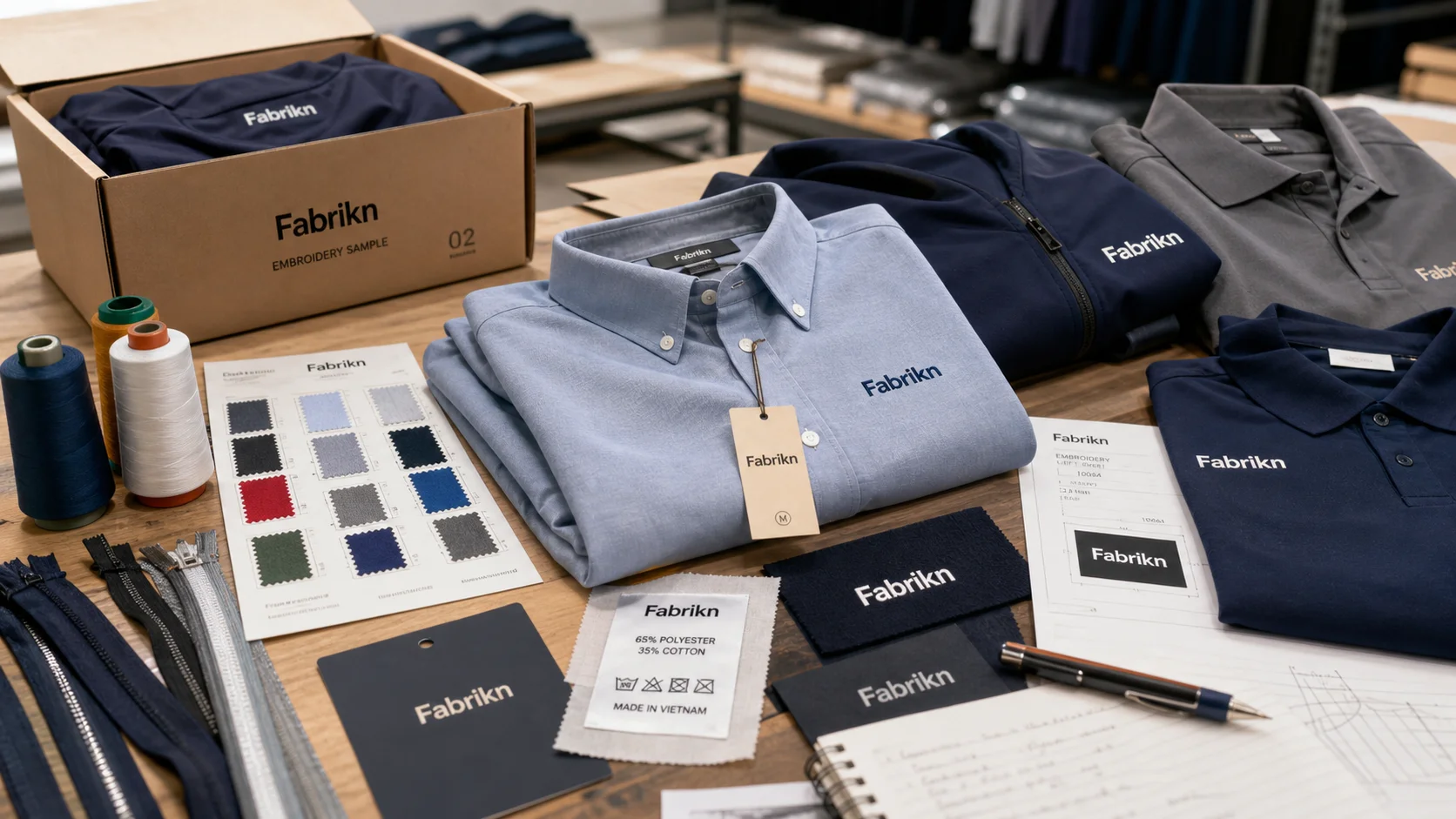
A product-specific outline for restaurant uniform startups evaluating custom chef coats, focusing on MOQ structures, fabric and trim decisions, branding methods, sampling, sizing, and production details that affect launch readiness.
Custom Chef Coats MOQ Options for Startup Buyers - Fabrikn production reference
For restaurant uniform startups, buying custom chef coats is rarely just a design decision. The real pressure usually comes from MOQ, pricing, and how much inventory a young business can carry without locking up too much cash. Buyers entering private label apparel often want a polished chef coat line with branded labels, size runs, and fabric upgrades, but they also need order quantities that fit a startup budget.
That is where MOQ planning becomes practical, not theoretical. If a supplier offers low minimums but limits customization, the product may not feel differentiated. If the supplier allows full private label development but only at a high volume, the order may be too risky for a new brand. Startup buyers need to balance brand presentation, production efficiency, and reorder flexibility.
In chef wear, MOQ decisions affect almost everything: fabric sourcing, trim availability, embroidery setup, pattern grading, cutting efficiency, and packing ratios. A buyer who understands these moving parts can negotiate better and avoid paying premium prices for the wrong version of customization.
This guide breaks down how custom chef coats with MOQ for restaurant uniform startups are usually structured, what quantity ranges are realistic, and where the main tradeoffs sit. For brands planning a private label line, it also helps to review a manufacturer’s broader capabilities on pages like /services/ and confirm development support early through /contact-us/.
MOQ stands for minimum order quantity, but in apparel sourcing it is not always a single number. That is the first point startup buyers should get clear. A supplier may quote MOQ by style, by fabric color, by total order, or by size-color breakdown. Those are not interchangeable.
For example, a chef coat program might be offered at 100 pieces per style, but that number may only work if all garments use the same stock fabric and one embroidery placement. Once the buyer asks for two colors, contrast piping, woven neck labels, custom packaging, and an expanded size range, the effective MOQ can rise.
There is also a difference between cut-make-trim production and full-package private label production. In a cut-make-trim model, the buyer may provide fabric or at least work from pre-confirmed materials. In a full-package model, the manufacturer sources shell fabric, buttons, labels, care tags, hangtags, and polybags. Full-package orders usually have more component-level minimums, which is why the stated MOQ on the quote sheet does not tell the whole story.
Startup buyers should ask one direct question early: is the MOQ based on a standard blank chef coat with branding added, or on a fully custom chef coat developed from scratch? That answer changes the cost structure and the lead-time risk.
MOQ ranges vary by supplier setup, fabric program, and degree of customization, but a few broad patterns are common in private label chef wear.
This range is usually possible when the factory works from an existing chef coat block, stock fabric, and standard trims. Buyers may still be able to add logo embroidery, woven labels, printed care labels, or basic packaging changes. This is often the most realistic entry point for restaurant uniform startups testing demand.
The tradeoff is limited design freedom. Pocket shape, placket construction, cuff details, and panel changes may be restricted. Size splits can also become tight. If the total order is only 60 pieces, the supplier may not support a broad run from XS to 4XL without surcharge or fit compromise.
This is often the most workable bracket for startups that want a true private label product without taking on large inventory exposure. At this level, suppliers are more likely to support custom patterns, branded labels, piping, contrast fabric panels, apron loop details, or upgraded buttons such as resin or knot styles.
Mid-range MOQ also gives better size balancing. A buyer can allocate units across core hospitality sizes more sensibly and still keep cutting efficiency acceptable. Unit cost usually improves noticeably once the order passes the lowest MOQ threshold.
Orders at this level generally unlock the best flexibility for fabric development, special dyeing, advanced trim customization, and stronger price efficiency. For startup buyers, though, this is only sensible when there is a clear sales channel already in place, such as hospitality group contracts, distributor programs, or a confirmed ecommerce pipeline for restaurant uniforms.
High MOQ can lower the per-unit cost, but it raises inventory risk. Chef coats are size-sensitive products. Unsold units often sit in the least popular size ratios, not evenly across the range. For a startup, cash tied up in wrong-size stock is usually a bigger problem than paying a slightly higher price per garment.
Buyers often hear a single MOQ number and assume it is fixed. In practice, MOQ moves depending on the product specification.
Stock fabric usually supports lower MOQs. Custom-dyed or specially woven fabric raises minimums because mills often have their own production thresholds. A standard chef coat fabric might be a 65/35 polyester-cotton twill around 180 to 240 GSM, or a 100% cotton twill in a similar weight band. If the buyer accepts existing mill shades such as white, black, or charcoal, MOQ stays easier to manage.
Once a startup requests a custom Pantone shade, brushed finish, peached hand feel, or stretch blend, the fabric minimum may exceed the garment minimum. In that case, the real MOQ is controlled by the mill, not the sewing line.
Standard plastic buttons, generic size labels, and basic polybags keep minimums low. Custom engraved buttons, woven main labels, printed satin care labels, branded hangtags, and barcode stickers are all manageable, but each item may carry a separate quantity threshold. One trim program rarely breaks a deal, but several small customizations together can push the order into a less efficient range.
Embroidery itself does not always force a high MOQ, but setup costs matter. If the logo is placed on the chest and sleeve, uses multiple thread colors, or needs a larger stitch count, startup buyers should expect a fixed setup charge or a higher per-piece application rate on small runs. Screen printing is less common for chef coats than embroidery, but heat transfer names or title badges may also affect costing and processing.
Using an existing block is cheaper and easier. A fully customized fit with revised body length, sleeve pitch, collar shape, vent placement, and women’s or unisex grading logic adds development work. If the startup wants separate men’s and women’s fit blocks, the supplier may treat them as different styles for MOQ purposes.
Bulk packed orders are simpler. Individually folded, branded, barcoded, size-stickered retail packs take more labor and more sourced materials. That does not always increase the formal MOQ, but it can reduce supplier willingness to accept very small runs at base pricing.
Chef coat startups should not treat sampling as a minor pre-production step. It is where most avoidable errors are caught, especially in a category that combines fit, function, and repeated laundering.
The process usually starts with a tech pack or a detailed reference sample. The buyer should specify fabric composition, fabric weight, color, button type, pocket count, seam finish, label placements, embroidery artwork, and measurement chart. If the spec sheet is vague, the sample round will slow down and the MOQ discussion may become less favorable because suppliers price uncertainty into the project.
A proto sample checks the general construction and design interpretation. Fabric may be substituted at this stage if the final material is not yet confirmed. Startup buyers should review collar roll, sleeve mobility, placket width, coat length, vent placement, and pocket function. For chef coats, mobility around shoulder and upper back matters more than many first-time buyers expect.
Once the overall design is accepted, a fit sample is used to confirm measurements and wearing ease. This is especially important if the garments must fit working kitchen staff across multiple body types. A coat that looks sharp on a hanger can fail in use if armhole depth, bicep ease, or chest allowance is too tight for active wear.
For larger or more formal orders, a supplier may provide a size set or at least a graded measurement review. This step matters because chef coats often have broader size runs than fashion tops. Small errors in grading can become expensive across XS to 4XL or beyond.
The pre-production sample should match approved fabric, trims, artwork, labels, and packaging as closely as possible. This is the version the buyer should sign off before bulk cutting begins. If branding details or care label content are still unresolved at this stage, the project is not truly ready for production.
Startup buyers who want a smoother sampling process should present brand background, target customer, and intended price positioning early. A capable manufacturer can then advise whether the product should be built on a practical stock program or a deeper custom route. That kind of preparation is easier when the buyer understands the supplier profile through pages such as /about-us/.
Low MOQ sounds attractive, but it nearly always comes with a pricing penalty. That is not a supplier problem as much as a production economics issue. Small orders spread sampling, marker making, cutting setup, trim handling, and quality control over fewer pieces.
Startup buyers should compare quotes using total landed logic, not just garment cost. A 75-piece order with stock fabric may cost more per unit than a 200-piece order, but it can still be the better buy if it reduces dead stock risk and shortens time to market.
There are a few practical tradeoffs worth weighing:
The strongest purchasing judgment for early-stage buyers is simple: do not chase the cheapest unit cost if it forces you into an untested volume. In restaurant uniforms, repeatability and reorder flexibility often matter more than shaving a small amount off the first production price.
Chef coats are workwear. Buyers need materials that can handle industrial or frequent domestic laundering, resist excessive shrinkage, and hold appearance after repeated use. That requirement should guide MOQ strategy.
One common sourcing mistake is over-customizing nonessential trims on the first order. A startup may gain more value by investing in fabric performance and fit than by ordering elaborate packaging for a product sold primarily into B2B hospitality channels.
Lead times for custom chef coats depend on more than factory sewing capacity. Sampling status, fabric availability, trim approval, embroidery programming, and seasonal production congestion all shape delivery timing.
A typical development sequence might look like this:
Stage Typical Timing Main Dependency Initial quotation and spec review 3 to 7 days Clear tech pack and artwork files Proto or first sample 7 to 21 days Fabric availability and pattern readiness Fit revision 7 to 14 days Buyer comments and pattern updates Pre-production sample 7 to 14 days Approved trims and final specs Bulk production 30 to 60 days Order quantity, line loading, and materials in-houseThese are only broad commercial ranges. A stock-fabric reorder may move faster. A custom-dyed fabric order with branded trims and multiple sample revisions will take longer. Buyers should also ask whether lead time starts from deposit date or from full approval of fabric, trims, and pre-production sample. That detail affects delivery planning more than many startups realize.
Chef coats are used in demanding environments, so inspection standards should focus on wear performance as well as appearance. Startup buyers should watch for a few recurring risks.
If the fabric is cotton-rich, shrinkage testing matters. A chef coat that loses body length or sleeve length after laundering can create immediate complaints. Buyers should request wash test expectations in writing, especially if the target customer uses commercial laundry services.
White chef coats may seem simple, but whiteness level and panel shading can still vary. Black and dark shades need checking for tone consistency between fabric lots and contrast components. If a program includes matching pants or aprons later, color continuity becomes even more important.
Logo placement errors are common in small custom uniform orders. Chest embroidery that sits too high, too low, or off-center is not always caught until packing. The buyer should approve placement measurements from clear reference points, not just from a visual mockup.
Kitchen uniforms are washed hard and worn often. Loose buttons, weak bartacks, or seam grin at side vents become costly if the startup is selling to professional users. Stress points such as underarm seams, pocket corners, and placket attachments deserve close review.
Broader size runs create more inspection exposure. If the supplier does not control grading and tolerance properly, the startup may receive garments labeled as one size but measuring close to another. That hurts reorders and damages buyer trust quickly.
For this reason, a pre-shipment inspection or at least a clearly documented inline and final quality process is worth discussing even on moderate-volume orders. Uniform products tend to be judged on consistency more harshly than casual fashion basics.
Suppliers respond better when startup buyers present a realistic order plan instead of a vague request for “the lowest MOQ.” A strong inquiry should include target quantity, fabric preference, logo application method, size range, desired delivery window, and whether the style will be based on an existing block or a custom pattern.
It also helps to separate must-haves from nice-to-haves. For example, branded woven neck labels and chest embroidery may be essential, while custom buttons and printed insert cards may be optional for phase one. That prioritization gives the supplier room to build a practical MOQ proposal instead of rejecting the project as too fragmented.
Buyers should also ask these direct questions:
These questions quickly reveal whether the supplier understands startup-friendly production or only high-volume programs.
For most restaurant uniform startups, the best approach is not the absolute lowest MOQ and not the deepest customization package. The most commercially sound strategy is usually one or two core chef coat styles, a practical stock-supported fabric, limited but visible branding, and an order quantity that allows a balanced size curve.
In many cases, that means aiming for roughly 100 to 200 pieces per style if the supplier supports it. This level often gives enough room for private label identity without forcing a startup into excessive inventory. It also improves the odds of cleaner production planning, better unit economics, and more consistent repeat ordering.
A lean first order should focus on what the end user notices most: fit, comfort, wash durability, and professional presentation. Those are the features that create repeat sales. Decorative complexity can come later once volume is proven.
From a purchasing standpoint, the smartest startup buyers treat MOQ as a planning tool, not just a price hurdle. They build the first order around reorder potential, not around a factory’s most optimistic quote. That mindset usually leads to better sell-through and more stable supplier relationships over time.
Get a free quote from Fabrikn — your trusted B2B clothing manufacturer with 10+ years of experience. MOQ as low as 200 pieces.
Get a Free Quote →A typical starting point is often around 50 to 100 pieces per style for semi-custom programs using stock fabrics and standard trims. Fully custom private label programs more often begin around 100 to 300 pieces per style, depending on fabric and branding details.
Yes, but the degree of customization matters. Low MOQ is most achievable when the buyer uses an existing chef coat pattern, stock fabric, and simple branding such as woven labels and chest embroidery. Full customization usually requires a higher order volume.
It depends on the supplier. Some quote MOQ per style regardless of color if the same stock fabric family is used. Others require minimums per color because cutting, dye-lot management, and size allocation become less efficient across smaller splits.
A 65/35 polyester-cotton twill in the 180 to 240 GSM range is often the most practical option for startup buyers because it balances durability, care performance, and sourcing flexibility. Buyers wanting a softer hand may choose cotton-rich options, but they should review shrinkage and wrinkle performance carefully.
Sampling can take several weeks depending on revisions, and bulk production commonly takes around 30 to 60 days after approvals and materials are in place. The timeline can extend if custom-dyed fabric, branded trims, or multiple fit revisions are involved.
The most common mistake is ordering too many styles or too much customization in the first run. That spreads quantities too thin, raises cost, complicates size management, and increases the risk of unsold inventory. A tighter initial range is usually the safer commercial decision.