
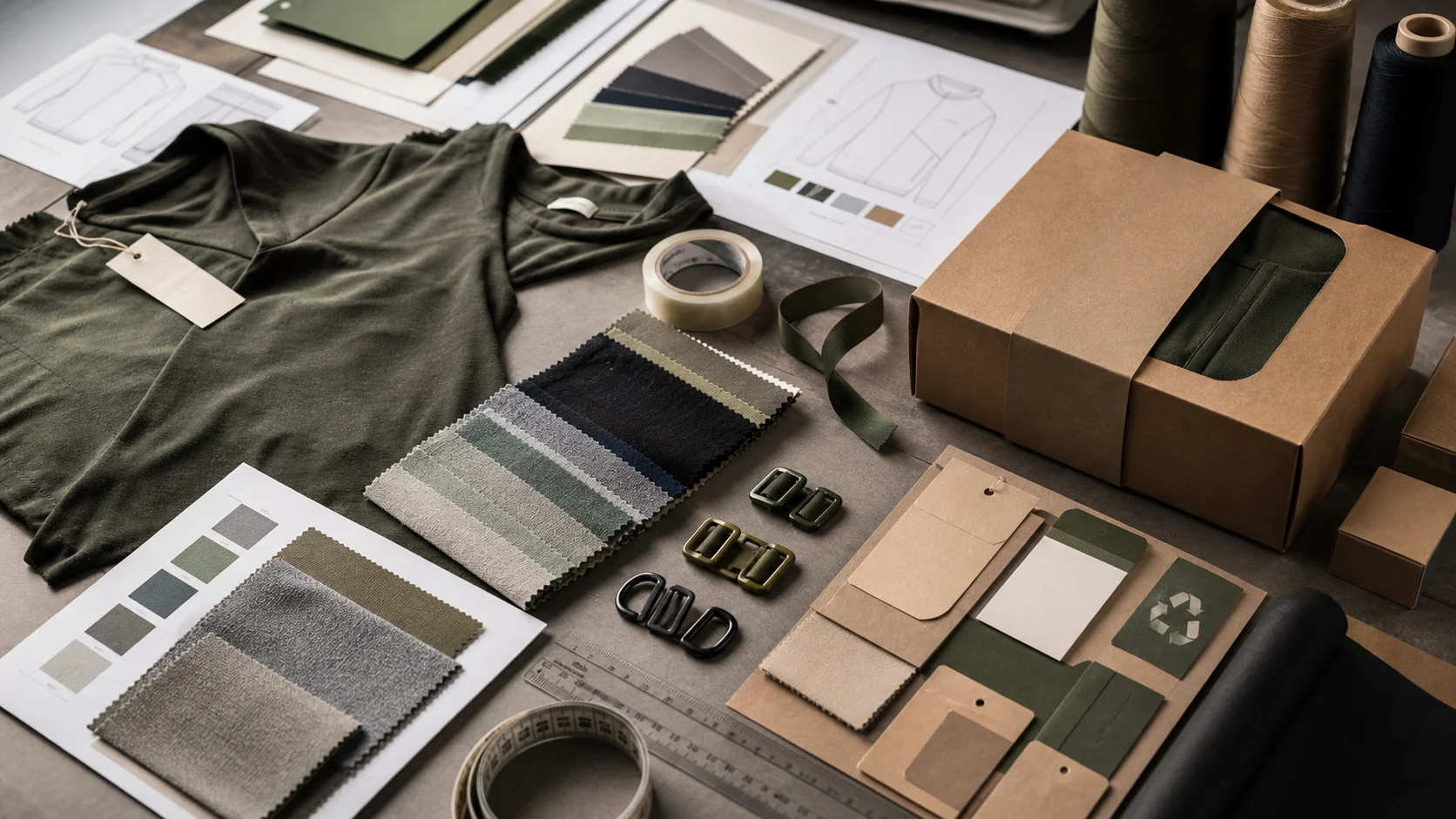
Custom Gift Boxes for Clothing Brands with checks for samples, fit, MOQ, QC evidence, pricing terms, and delivery risk.
Fast answer: Custom Gift Boxes for Clothing Brands: Costs, Design, ROI should be judged by production evidence, not by a generic sourcing promise. The buyer needs sample proof, cost breakdowns, QC checkpoints, and delivery buffers in writing.
Ask for recent sample photos, measurement tolerances, fabric or print test assumptions, decoration test notes, packing examples, and a named inspection checkpoint. These details show whether the team can repeat an approved sample at bulk volume.
Separate garment cost, decoration, labels, packaging, sampling, testing, freight, and rush charges. When every cost line is visible, it becomes easier to reduce colorways, adjust size depth, or reserve more time for sampling.
A box can sell the feeling before the garment ever gets a chance. With custom gift boxes for clothing brands, that first impression lands in seconds, and it can make a $28 tee feel more considered than a $60 tee in a plain mailer. Buyers judge texture, weight, and presentation almost instantly. Feels like a small stage performance before the product even arrives.
After 200-plus factory visits in eight countries—from Guangzhou’s Baiyun district sheet-fed lines to Dhaka’s hand-glued folding carton cells and Ho Chi Minh City’s lamination towers—the same complaint kept surfacing from operators: brands spend weeks perfecting fabric GSM, stitch density, and wash performance, then lose the sale moment with weak packaging. Feedback from retailers and packaging standards from ISO point to the same truth. Apparel buyers do not wait for a full wear test. They decide from the box, the print, and the reveal. And yet the packaging step still gets rushed.
DTC and gifting-heavy categories sharpen that logic even more. A 320 GSM French terry hoodie may be fine in a plain mailer for a volume-driven drop, but the same hoodie can gain perceived value in a rigid drawer box with a custom kraft pulp insert, a 0.8 mm foil-stamped logo, and one-color interior print. I have seen mid-market brands do better with a simpler box, sharper typography, and tighter board alignment than with oversized luxury packaging that swallows margin and feels theatrical rather than premium.
Here’s what most people miss: in several factories, the cleaner box won the test. Not the flashier one. A mid-tier label in Vietnam got stronger customer response with a $1.40 folding carton, crisp black ink, and a 2 mm tighter fit than with a $4.80 oversized magnetic box that looked rich on a render but sloppy in hand. Luxury cues have value, sure. Excess can make a brand look less disciplined, not more premium.
So I treat custom gift boxes for clothing brands as a revenue tool, not a vanity add-on. If the box improves open rates, social sharing, and gift readiness while staying within a sane margin band, it earns its place. The rest? Just expensive cardboard.
Folding cartons suit light apparel, accessories, and retail shelf display. Flat pack, cheap freight. They ship flat, which keeps freight low, and at MOQs around 500 to 1,000 pieces they can be economical for smaller launches. Rigid boxes fit gifting, influencer drops, and premium direct-to-consumer orders where unboxing matters more than carton compression. Mailer boxes are the workhorse for ecommerce because they protect product in transit and reduce the need for outer packaging. Drawer boxes sit in the expensive middle, ideal for limited editions, sets, and PR kits that need a dramatic pull-out reveal.
In factory samples, board strength has mattered just as much as print. No magic, just board strength. A flimsy 300 gsm SBS-C1S carton with a pretty finish often crushes at the corners after three to four warehouse handlings. By contrast, a 1.5 to 2.0 mm rigid board wrapped in printed paperboard holds shape better, especially with a paper or molded pulp insert. For brands building lingerie too, the same logic applies across categories, whether the order is for a tee, a bralette, or even custom bra manufacturing programs that need delicate support and clear size separation.
SBS paperboard gives a clean surface for sharp print and a bright retail look. Keeps the look tidy. Kraft signals restraint and material honesty, but it demands careful ink choice because dark fills can read muddy on rough fibers. Rigid board costs more, yet it carries weight well and usually survives premium handling better than cheaper alternatives. FSC-certified paper and recycled board are common asks now, and they can be specified without making the box look utilitarian. Water-based acrylic adhesive or EVA glue keeps seams tight at $2.50-4.00 per unit at 500 MOQ where manual gluing may still happen on a 52" die-cutting line.
Finish choice changes both cost and recyclability. No overkill. Matte lamination cuts glare and feels more current than high gloss. Soft-touch lamination adds a velvet feel, though it can show scuffs if packing lines are rough. Foil stamping, embossing, and spot UV each create a premium cue, but each one also adds setup cost and a chance for registration drift. On one run in Portugal, a one-color minimal print beat a heavily foiled version because the foil marks varied by 1 to 2 mm, which made the entire batch look inconsistent.
Magnetic closures impress buyers in a showroom, yet they can complicate recycling if used with mixed materials and heavy adhesive. Paper-based tuck closures, paper ribbons, and molded pulp inserts often perform better in recycling systems and on the production floor. Still, the simplest box that prints cleanly at 1,000 units usually scales better than the one that looks spectacular at 50 samples.
Size, print complexity, board structure, and hand assembly move quotes the fastest. Quick, no frills. A standard folding carton with one-color print, one dieline, and no special finish can start around $0.45 to $1.20 per piece at higher MOQs, while a rigid box with wrapped board, magnet closure, and insert can move from $2.80 to $7.50 or more depending on quantity and shipping route. Tooling also matters. A bespoke structure can add $250 to $900 in setup charges before a single unit ships.
Budget boxes may begin with low-volume paperboard builds at MOQ 500 to 1,000 pieces, with 7 to 14 days for sampling and 15 to 25 days for production once artwork is approved. Patience helps. Mid-tier packaging often sits in the $1.20 to $3.50 range and gives room for matte lamination, limited foil, and better board caliper. Luxury packaging moves sharply upward once you add wrapped rigid board, specialty inserts, and manual assembly, which can push lead times to 30 to 45 days or longer.
Here’s the part nobody says out loud: a $1.20 box can do more than a $4.00 box if the sizing is right and the print is disciplined. I have seen brands waste money on oversized inserts, layered ribbons, and multiple coatings that do not improve protection or conversion. Those extras add labor, raise defect risk, and create more touchpoints for shipping damage. Not a glamorous insight.
That matters for margin. And yes, not every drop has wiggle room. For apparel, I like packaging cost to sit around 2% to 5% of retail price for mass DTC and 5% to 8% for gift-led or premium drops. A $40 knit top can absorb roughly $1.00 to $2.00 in packaging without strain; a $180 coat can support more, especially if the box reduces returns and improves gift conversion. The goal is not the most expensive box. It is matching box spend with product price, order value, and fulfillment reality.
Brands building broader ranges, from underwear to outerwear, should also remember that packaging standards cannot be copied blindly across categories. A slim carton that works for tees may fail for structured knits, and the same supplier may handle custom baby clothing manufacturing with a softer fold profile, different compliance expectations, and more insert protection. I have seen brands save 12% on packaging cost simply by matching structure to garment thickness instead of forcing one box across every SKU. Lesson: don't force one box to rule them all.
Box dimensions should follow the garment, not the mood board. A folded tee in 18
A strong brief makes the supplier's job narrower and the quote more reliable. For custom gift boxes for clothing brands, include the target customer, sales channel, expected order quantity, size range, decoration needs, packaging requirements, and delivery market. Then call out the details most likely to affect the result, especially material grade, print tolerance, and barcode size.
The brief should also explain what cannot change. Some brands care most about hand feel, some about price, some about launch timing, and some about retail compliance. When those priorities are not written down, suppliers tend to optimize for whatever is easiest to quote. Clear priorities help the factory make better tradeoffs before the first sample is cut or printed.
Ask the supplier to respond with assumptions, not just a price. A useful reply states MOQ, sample route, production capacity, inspection plan, packing method, and freight handoff. If the answer is vague, the project may still work, but it needs a tighter pre-production stage before money and calendar pressure build up.
The best time to catch problems is before the pre-production sample is approved. Check measurements, color, placement, material behavior, shrinkage, construction, labels, and packaging in the same review instead of approving each item in isolation. Many bulk issues are not caused by one dramatic mistake; they come from several small unchecked assumptions.
For custom gift boxes for clothing brands, pay special attention to folding method, pack-out sequence, and retail compliance. These details often look minor in an email but become expensive once cutting, printing, sewing, packing, or shipping begins. A simple checklist with owner, due date, and approval status keeps the brand team and factory aligned.
Bulk production should not start until the supplier can explain how the approved sample becomes a repeatable production standard. That means reference sample storage, line instructions, inline checks, final inspection, and defect handling. A factory that can describe this process clearly is usually safer than one that only promises speed.
Price differences are useful only when the quotes cover the same work. Compare sample cost, material source, trims, decoration, packaging, testing, inspection, and freight assumptions. A low unit price can become expensive if it excludes items the brand needs before launch.
Timeline promises deserve the same scrutiny. Ask what happens if the first sample needs revision, whether materials are in stock, when the production slot is reserved, and how export packing is handled. The most reliable supplier is often the one that gives a realistic calendar instead of the fastest optimistic answer.
Before making the final decision, write down the specification, approval owner, delivery expectation, and the one or two risks that would cause the most trouble if missed. For custom gift boxes for clothing brands, this usually means checking material grade, print tolerance, barcode size, and the support process after the order is placed.
This last review does not need to be complicated. It simply makes the decision easier to repeat, easier to explain, and easier to verify when the finished product or jewelry arrives.
One useful way to pressure-test the decision is to ask what would happen if the order had to be repeated in six months. The answer should still be clear: the same material grade, the same print tolerance, the same acceptance standard, and the same communication path. If a second order would depend on memory or guesswork, the first order is not documented well enough yet.
Another useful check is to separate preference from requirement. Preference is the look, wording, or finish the brand likes. Requirement is the measurement, tolerance, certificate, material, or delivery condition that cannot fail. Good buying decisions keep both visible, so the final choice is not pushed around by the last email, the cheapest quote, or the prettiest sample photo.
Finally, ask who owns each approval. A project with one accountable owner for sample review, one owner for final content or artwork, and one owner for delivery sign-off usually moves faster than a project where every decision is shared loosely across a team. Clear ownership reduces delays and makes the finished result easier to judge.