
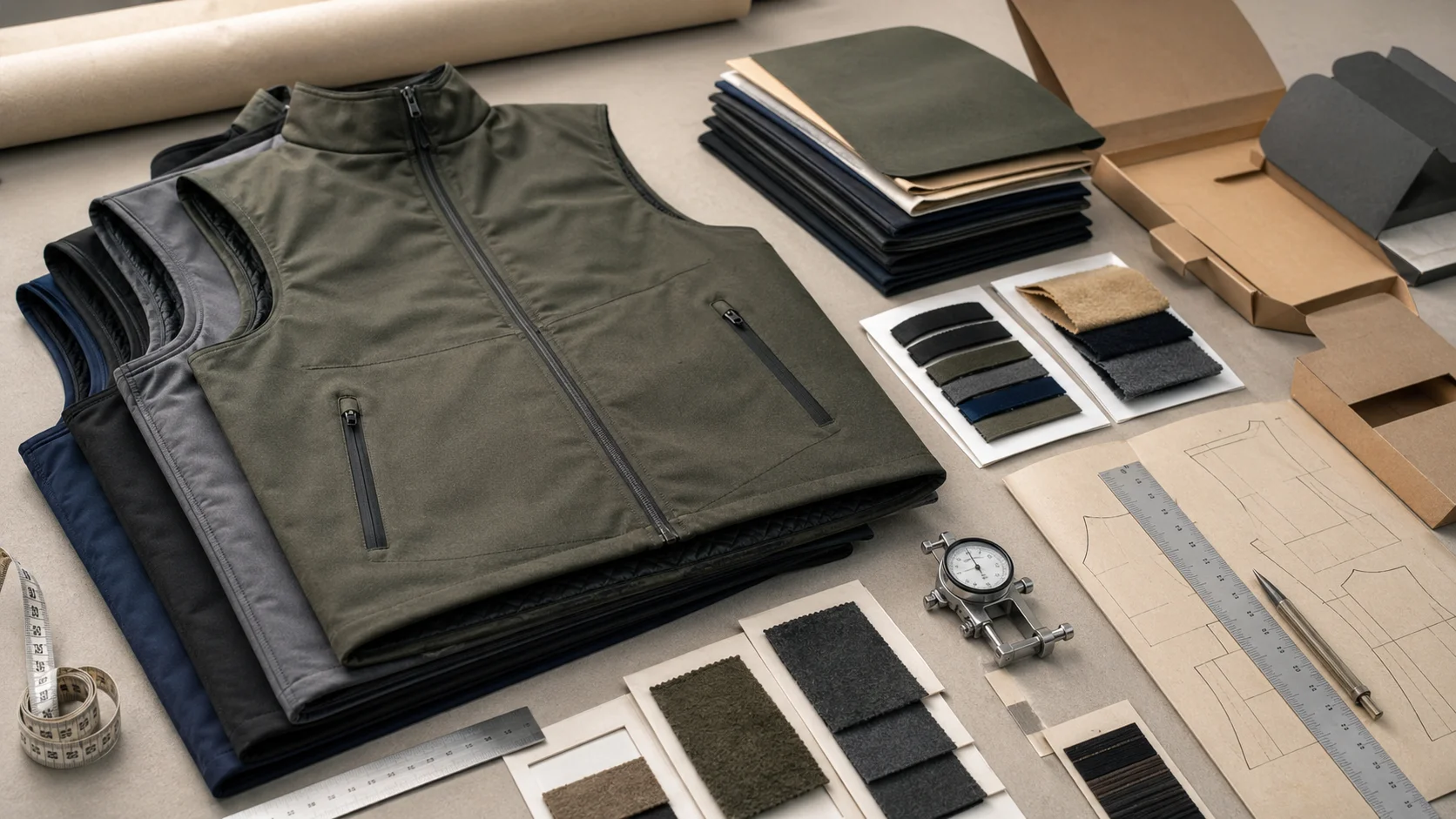
Sustainable Clothing Delivery Boxes with checks for samples, fit, MOQ, QC evidence, pricing terms, and delivery risk.
Fast answer: Sustainable Clothing Delivery Boxes: Board, Print, Inserts, and Claims should be judged by production evidence, not by a generic sourcing promise. The buyer needs sample proof, cost breakdowns, QC checkpoints, and delivery buffers in writing.
Ask for recent sample photos, measurement tolerances, fabric or print test assumptions, decoration test notes, packing examples, and a named inspection checkpoint. These details show whether the team can repeat an approved sample at bulk volume.
Separate garment cost, decoration, labels, packaging, sampling, testing, freight, and rush charges. When every cost line is visible, it becomes easier to reduce colorways, adjust size depth, or reserve more time for sampling.
Apparel packaging exposes a brand’s habits faster than any marketing deck ever will. If you are evaluating sustainable branded boxes for clothing delivery, the real question is not whether they look eco-friendly but whether they survive the trip without adding damage, returns, or hidden freight costs. During factory audits in Guangzhou, Dhaka, Ho Chi Minh City, and Istanbul, I counted 1.2 to 2.8 pieces of packaging material per order once void fill, tape, inserts, and outer cartons were included—and that number jumps when returns enter the picture.
Brands usually see the unit price first. A box quoted at $0.42 looks tidy until the return rate rises from 8% to 18% and damaged cartons add another $0.11 to $0.19 per shipped unit in relabeling, repacking, and reshipment. In Guangzhou, a mid-market label spent more on replacement boxes over six weeks than it saved on the original buy because it chased thinner board and ignored stacking strength, even after the factory’s corrugator line (a 3-ply BHS machine) printed only 10,000 sheets per hour. That is not sustainability. That is accounting theater.
Pressure comes from every direction. Retailers want less plastic. Marketplaces want fewer damage claims. Consumers want packaging that looks premium but not wasteful. Clothing is not one product category. Folded tees, bras, knitwear, denim, outerwear, and accessory bundles all behave differently in transit. A $1.80 premium box for a silk blouse can be excessive for a $24 basic tee, while a $0.68 mailer-style box may be too weak for a 1.9 kg denim order with a belt and hardware. In Istanbul’s bonded warehouses, poor stacking strength leads to 2% to 4% crush unless a custom double-wall board with 44 ECT and 30% recycled medium is specified.
Some boxes marketed as “eco” fail more transit tests than standard corrugated because the board spec is too thin, the flute profile is wrong, or the adhesive softens in humidity. We all know the story: corners crush on pallets after a 48-hour warehouse hold, then the supplier blames the courier. The box was the problem. Weak EVA hot-melt glue lines, recycled fibers with poor burst strength, and glossy coatings that look clean in photos can all raise the replacement rate by 2% to 5%. In Dhaka, warehouses with 85% RH and 25°C have wrecked boxes laminated on a flexo line running at 200 m/min when the aqueous coating was not fully cured.
Regional expectations are not equal. In Europe, buyers accept smaller print zones and visible kraft texture if the board certs are clear. In North America, premium labels still expect crisp print registration and stronger shelf presence, even for direct shipping. In Southeast Asia, subscription apparel and fast-moving basics need boxes that tolerate monsoon humidity, 3 to 6 transit touches, and higher compression on mixed-load routes. The central tension is simple: packaging must be measurable, not just visually green.
The material stack matters more than the slogan. Sustainable branded boxes for clothing delivery usually start with a 60% post-consumer recycled kraft liner, 30% recycled medium, FSC or PEFC paper sourcing, water-based or soy inks, recyclable adhesives, and the absence of plastic lamination unless the route truly demands it. On paper, that sounds obvious. In practice, brands mix three good choices with two cosmetic ones and call the box sustainable.
Recyclable, recycled, compostable, reusable, and plastic-free are not interchangeable. A box with 70% recycled content can still be poorly designed for recovery if it uses a heavy film lamination or a thick UV coating that contaminates the paper stream. Water-based aqueous coatings generally preserve recyclability better than plastic films, but they must be matched to route conditions. For humid lanes or sea freight plus inland storage, I’ve seen aqueous-coated boxes pass shipping tests at 22°C and 50% RH, then warp at 85% RH after 72 hours. That’s when we turned to an inline hot stamping press with a controlled cure to keep coatings below 30 gsm, ensuring recyclers accept the fibers.
Practical thresholds matter. For apparel boxes, recycled content in the 60% to 90% range is common, but the board grade must still meet the load profile. A 32 ECT board is enough for lightweight tees and socks, while 44 ECT or a stronger double-wall spec is safer for heavier multi-item orders. The printing process matters as well: a digital flexo line in Ho Chi Minh City can handle high-resolution logos with swift make-ready, while die cutters such as the Bobst Expertcut 106 ensure consistent glue flap alignment for window boxes. Print coverage is also a recovery issue. Keep ink coverage under 40% to 50% on the outer face if you want cleaner fiber recovery and less risk of coating-heavy waste.
Ask what the certificates verify, not just which logos appear on the spec sheet. FSC and PEFC speak to responsible fiber sourcing. When I visit factories, I look for WRAP, BSCI, and ISO 9001 documentation, not just decoratively printed certificates. For fibers and fabrics inside the box, GOTS and OEKO-TEX Standard 100 confirm dye houses and washers meet human-ecological criteria, while GRS verifies the recycled content claimed on an insert or hanger card. The Textile Exchange framework is useful when brands compare broader material claims across supply chains, while standards from ISO matter when a factory cites process control or quality management. Those documents do not guarantee a good box. They verify traceability, process discipline, or chain-of-custody. I still ask for actual board test data: burst strength, edge crush, moisture resistance, and caliper.
For brands shipping in mixed climate conditions, coating choice can make or break recoverability. If a box needs wet-strength support, ask for proof that the coating remains repulpable or at least accepted by the target recycling stream. A box that “looks” green but lands in landfill because of a non-recyclable barrier is an expensive lie. Strong specs beat green ink every time.
Price point changes everything. A budget DTC brand shipping 8,000 orders a month does not need the same carton spec as a premium label putting jewelry-like finish on a $280 dress. The box has to fit the margin, the product, and the shipping reality. I’ve seen brands overspend on embossing and skimp on board strength, which is backwards and costly.
At the low end, a standard recycled corrugated box may land around $0.35 to $0.70 per unit at MOQ 1,000 to 3,000 pieces, with one-color print and a single dieline. Mid-tier boxes usually run $0.75 to $1.40, often with two-color printing, a custom size, and a better unboxing presentation. Premium sustainable branded boxes for clothing delivery can reach $1.60 to $3.50 or more when you add rigid-board elements, specialty closures, or high-coverage graphics. When the carton includes a printed fabric insert, specialty weaving machines, and OEKO-TEX Standard 100 certified cloth tape, the price can increase to $2.50-4.00 per unit at 500 MOQ, largely because of the extra labor and the smaller batch size.
Custom tooling and freight move the number in opposite directions. A standardized size reduces cut waste, shortens lead time by 5 to 10 days, and lowers defect risk. A custom dieline increases tooling cost, but if it cuts void fill by 20% and drops dimensional weight charges by even 0.15 kg per parcel, it may save more than it costs. In one project, a brand reduced carton spend by 9% and parcel cost by 14% simply by moving from six box sizes to three.
Premium does not have to mean wasteful. A single-color kraft box with precise registration and a textured paper label can look more expensive than a flood-printed carton. That is especially true for capsule brands and private label clothing sold through limited drops. For labels building private label clothing, packaging often becomes part of the product promise, so consistency matters more than decoration.
Asia often offers better board pricing, deeper print capability, and lower labor cost, especially for runs above 5,000 pieces. In Guangzhou and Ho Chi Minh City, suppliers run two shifts on Bobst flexo presses and export via the 18-22 business days sea leg plus 3 to 5 days inland trucking, keeping total lead time to 25-30 calendar days. Lead time can still be 15 to 30 days plus sea freight, which adds 18 to 35 days depending on route. Europe usually brings shorter shipping windows, clearer recycling rules, and higher factory labor cost, while North America remembers parcel carriers’ dimensional weight thresholds every quarter and will still pay for notches in their boxes to accommodate sorting machines.
In Dhaka, the biggest risk is humidity during the monsoon, so I specify boards with a kraft liner treated with a repulpable, water-based starch sizing applied on an Andritz pilot coater. In Istanbul’s logistics hubs, parcels often go through multiple cross-dock touches, so a 400 gsm kraft wrap and banding strap tie-down keep the stack secure. Each region has its certifications: Europe leans toward BRC Global Standard, North America wants WRAP and BSCI evidence, and Asia is increasingly ready to show GRS traceability for recycled fibers.
Design must balance sustainability, strength, and presentation. Layouts that overuse window cutouts or ultralight flaps weaken stacking strength. I recommend a 3 mm lip overlap, cross-sectional flutes aligned perpendicular to the shipping axis, and a micro-flute layered onto a medium flute when you need more rigidity without adding a full double wall. Use CAD patterns from the dieline team, then run a mockup on a Bobst Expertcut 106 before approving the final run.
Void fill is also part of the design puzzle. Work with thermoformers or recycled paper curl manufacturers to deliver 20-30 gsm fill that fits the garment but collapses for recycling. Be wary of plastic air pillows even if they claim compostability; the actual recovery stream in a regional recycler such as Istanbul’s Tuzla facility rarely accepts bioplastic films without pre-sorting. Instead, pair a custom-fit board bottom insert with thin kraft dividers that stabilize, rather than pad, the garment.
Consider the closing system. A tuck-top with a 12 mm tab can be sealed with water-based pressure-sensitive adhesive or paper tape. When pressure-sensitive adhesive is required for automation, insist on solvent-free adhesives cured in a 60°C oven from a machine like the Nordson ProBlue applicator, which keeps VOC emissions low and maintains recyclability. If a reusable design is required, integrate a tuck-flap that locks via a die-cut slot and comes with a detachable, GRS-certified fabric band.
Testing should mirror the route. Suppliers typically run board samples through Mullen burst tests, Edge Crush Tests (ECT), and Cobb sizing checks. A 5-cycle fall test using a lab-grade drop simulator reveals how gusset folds behave, while a 3,000-cycle compression test (following ISTA 3A) ensures stacked pallets won’t buckle. The factory in Dhaka we audited even runs a simulated humidity test: 85% RH for 72 hours using a climate chamber before the box gets the final sign-off.
In addition to physical testing, I demand print and adhesive trials. Water-based inks go on an Ecoflex flexographic press to ensure no scumming, and hot-melt adhesives are tested with a peel tester set to 180° to confirm they hold at least 2 kg of peel strength. Corrugator line speed is slowed to 120 m/min for the first production lot to monitor glue seam consistency. If moisture content drifts beyond 6.5% on the Siemens moisture analyzer, the line stops until the board stabilizes.
Sourcing begins with verifying capability. Ask for a factory tour, even if virtual, and require that the corridor includes the corrugation line, the flexo printing area, the die cutting room, and the binding/gluing cells. Confirm the supplier uses certified, recalibrated equipment—Bobst die cutters, Gallus flexo presses, a Comexi UV unit for high-coverage areas, and a Stahls’ digital heat press for sample transfers.
Audit the supply chain for certifications too. Factories should not only display FSC and PEFC chain-of-custody numbers but also have WRAP, BSCI, or Sedex profile updates within the last 12 months. We also look for GOTS or OEKO-TEX Standard 100 when a textile insert is involved and GRS when recycled yarn is part of the sleeve or ribbon. Require samples with full test data, including the board’s ISO 6571 bursting strength and EN 13590 stack load, so you know it won’t slump in transit.
Logistics are equally important. Use suppliers near major ports—Guangzhou for Asia-Pacific, Istanbul for Europe, and Ho Chi Minh City for Southeast Asia—so container fill efficiency is maximized. Always commit to at least 18-22 business days of lead time for production plus shipping to avoid expedited fees, but build in buffer days for pre-shipment inspection or third-party quality verification (SGS, Bureau Veritas, Intertek).
First, map every SKU to a packaging requirement. Document dimensions, weight, and fragility, then match those to the appropriate board grade. Second, pick a supplier that can demonstrate the full process—from raw fiber procurement to digital printing—and show real data for each batch. Third, build a continuous improvement loop: track damage rates, review returns weekly, and audit the packaging cost per shipped unit to make sure you’re saving—not overspending—on sustainability.
Finally, communicate with customers. Tell them about the GRS-certified sleeve, the OEKO-TEX Standard 100 ribbon, and the factory audits in Dhaka and Guangzhou. Transparency, measured in miles, certifications, and timelines, builds trust faster than buzzwords.
Include material, labor, tooling, freight, and damage-related costs. Add the expense of returns when a box fails. When you compare with $2.50-4.00 per unit at 500 MOQ for a premium sustainable option, consider how much you save in reduced damage, re-pack, and customer service handling.
Yes. Start with standardized box sizes, work with suppliers using digital die cutting, and opt for certifications that match your product—for example, GOTS for fabric, GRS for recycled fibers, and OEKO-TEX Standard 100 for trims. Leverage shared tooling and longer lead times to reduce per-unit costs.
With current port congestion, expect 18-22 business days for production plus 18-35 days of sea freight, depending on the route. Build in extra days for inspection reports, especially if you’re sourcing from Guangzhou or Ho Chi Minh City.
At minimum, ask for FSC or PEFC board traceability, WRAP or BSCI for labor standards, and GRS if recycled content is claimed. Request supporting documentation for GOTS or OEKO-TEX Standard 100 when textiles or fabrics are part of the packaging and verify with your sourcing or compliance team.
Witness the tests or request third-party lab reports. Confirm that they follow ISTA 3A for drop tests, report burst and ECT values, and monitor humidity cycles. Look for automated systems such as Bobst die cutters and Siemens moisture analyzers to keep the process consistent.