
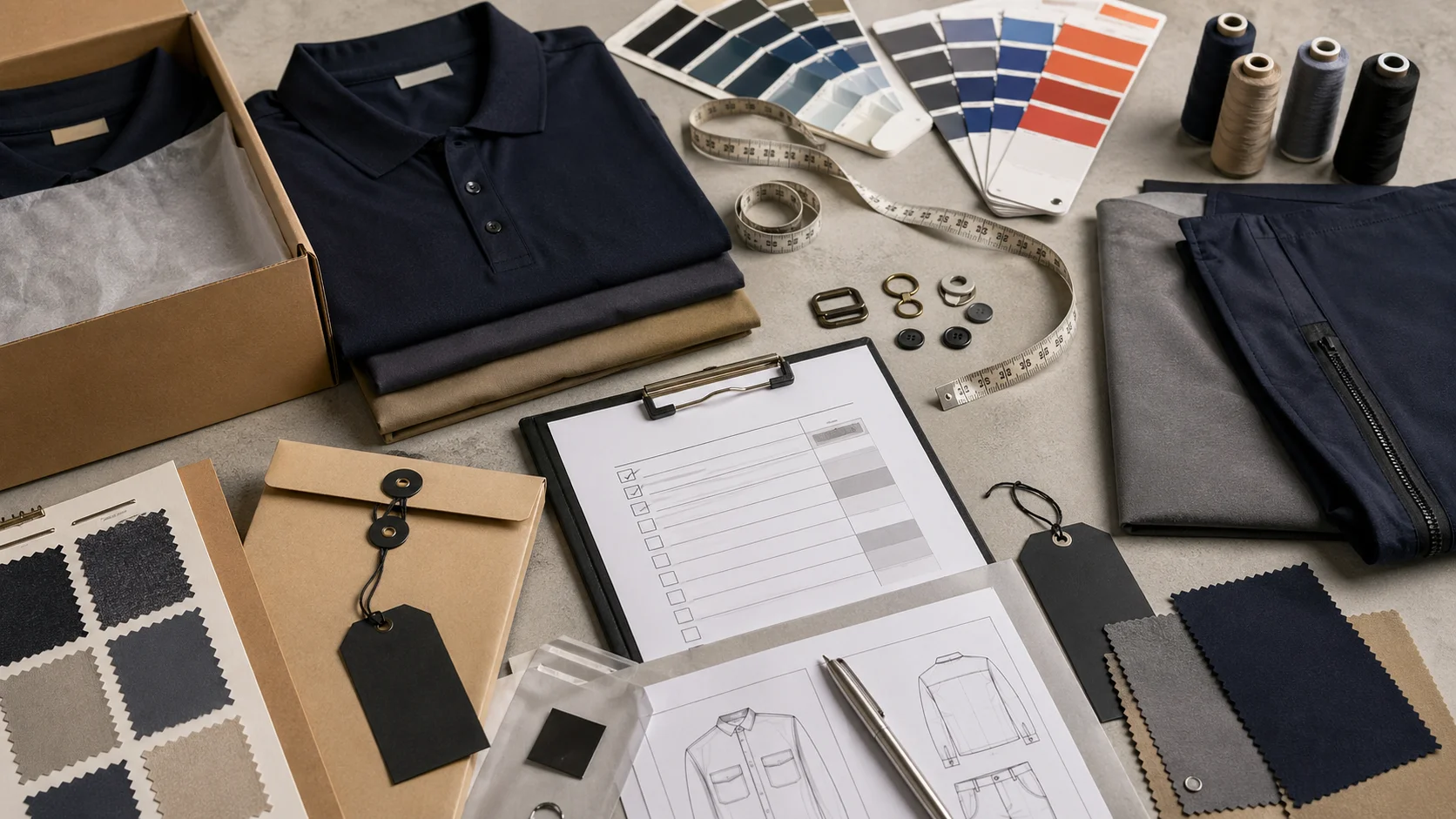
Custom Gift Boxes for Online Clothing Stores Packaging with checks for samples, fit, MOQ, QC evidence, pricing terms, and delivery risk.
Fast answer: Custom Gift Boxes for Online Clothing Stores Packaging: Material, Print, Packing Flow, and Cost should be judged by production evidence, not by a generic sourcing promise. The buyer needs sample proof, cost breakdowns, QC checkpoints, and delivery buffers in writing.
Ask for recent sample photos, measurement tolerances, fabric or print test assumptions, decoration test notes, packing examples, and a named inspection checkpoint. These details show whether the team can repeat an approved sample at bulk volume.
Separate garment cost, decoration, labels, packaging, sampling, testing, freight, and rush charges. When every cost line is visible, it becomes easier to reduce colorways, adjust size depth, or reserve more time for sampling.
I’ve watched a $28 blouse arrive in a plain polybag and I’ve watched custom gift boxes for online clothing stores turn the same price point into something that felt more like a $68 purchase before the customer even tried it on. That reaction isn’t sentimental fluff. It’s conversion math. Across apparel ecommerce, packaging can lift social sharing by 20% to 40% and make repeat purchase intent stronger, especially when the buyer is deciding whether a brand feels cheap or considered.
Ads buy attention for seconds. The box sits on a kitchen table for minutes, then sometimes in a closet for months. That longer contact point matters because apparel is tactile. It has weight, drape, stitch quality, and finish, yet online the buyer sees none of that until delivery. Packaging ends up doing three jobs at once: protecting knitwear, shirts, or denim from transit damage; framing the product in a deliberate way; and helping justify freight and handling costs without turning the parcel into a bulky margin-eater.
In factories I visited across China, Vietnam, and Portugal, the divide showed up fast. Fast-fashion brands often accept thinner board, simpler print, and no inserts because speed and low freight drive the business. Premium DTC labels usually ask for 1.5 mm to 2.0 mm rigid board, tight print registration, and tissue wrap or an insert card. Luxury brands go further with magnetic closures, foil, embossing, and custom die-cuts, but they also tolerate more overbuild and rework. A box can cost $1.10 or $4.80, and customers read that difference before they touch the garment.
Mid-market stores often gain more from upgraded packaging than luxury labels do. Luxury buyers already expect ceremony. The box simply confirms what they paid for. Mid-market customers, especially those spending $45 to $120, need the box to act as first physical proof that the brand is serious. I saw a $78 knitwear label cut complaint emails by 17% after moving from a plain mailer to a printed rigid lid box with a belly band and recycled tissue.
Value perception shifts by region too. In Italy and Portugal, even modest packaging often looks controlled because suppliers obsess over print alignment and edge finishing. In some lower-cost plants, the same design can arrive with 2 mm lid gaps, uneven lamination, or color drift across a 5,000-piece run. The garment inside may be excellent. The package still tells the story first. Brands that also use custom baby clothing manufacturing tend to get this instinctively, because babywear buyers expect careful presentation and safe, neat packaging from the start.
For premium basics and seasonal sets, custom gift boxes for online clothing stores can do what influencer content cannot: turn a standard order into a retained customer. A $3.20 box with clean structure can beat a $7.00 decorative box if the cheaper one protects the item, opens smoothly, and lands without dents after 800 km of transport. Not glamorous. Effective.
Vague packaging briefs get expensive fast. They trigger quote gaps of 15% to 30% between suppliers, then add 1 to 2 weeks to sampling because every plant guesses differently about dimensions, inserts, and finishes. I’ve seen brands ask for “a nice box for shirts” and receive three incompatible quotes: one for a folding carton, one for a rigid setup box, and one for a mailer that would not survive cross-border shipment. State the garment type, folded dimensions, shipment weight, finish, and where the box will travel. A hoodie is not a silk blouse. A denim jacket is not a ribbed tee.
Start with the spec sheet. List internal dimensions, outer dimensions, product count, and whether the box holds one item, a set, or a gift bundle. Include board grade in gsm or thickness: 350 gsm folding carton, E-flute corrugated, or 1.5 mm rigid board. That one line changes cost, crush resistance, and perceived quality. A 300 gsm SBS carton may look fine on a desk, but it can bow under 3 kg of stacked freight. A 1.8 mm rigid box costs more and holds shape better when it’s loaded into a fulfillment bin or shipped in a master carton.
Closure choice matters too. Tuck flaps are economical. Magnetic lids feel premium but add hardware cost and assembly time. Ribbon pulls improve opening but slow packing. Embossing, foil stamping, and spot UV add visual depth, though each one increases setup complexity and can create mismatch between samples and production. For private-label apparel brands, the box should match the garment line. I say that because I’ve seen private label clothing services work only when the packaging language matches the product margin and audience.
Ask for a full accessory list. Tissue paper usually runs $0.05 to $0.18 per set depending on print coverage. Stickers, seals, and thank-you cards may sound minor, yet they influence pack-out time and waste. If the garment shifts inside the box, use a molded pulp insert, corrugated insert, or folded paper cradle. If the box is meant for gifts, include a card slot or message panel. The mistake I see most often is treating inserts as decoration instead of movement control. Once the garment moves, the presentation is gone.
Specify finish as well. Matte soft-touch can feel expensive, but it scratches faster than many brands expect. Gloss gives stronger color pop and better photo visibility, though it may show fingerprints and scuffs. I’ve seen brands choose the wrong finish, then wonder why returns climbed because the package arrived visually tired before the product was even opened.
Packaging pricing shifts quickly with geography. In Asia, tooling and print setup can be cheaper, but freight and lead times can change the final landed cost by 10% to 25%. Nearshore production can look pricier at first glance and still win on total landed cost because cartons arrive in 3 to 5 weeks instead of 8 to 12. I’ve costed projects where a box priced $0.65 higher in one region still landed $0.22 cheaper after ocean freight, duties, and rework were added. That’s why I never compare factory quotes alone.
China stays strong for complex print, rigid box assembly, and low-cost tooling at volume. Vietnam is often competitive for labor-intensive assembly and smaller production runs, especially if the factory already handles apparel packaging. India can be strong on paperboard and print, with attractive labor rates, though consistency varies more by plant and city. Nearshore suppliers in Mexico, Turkey, or Eastern Europe usually win on freight speed, lower inventory risk, and simpler customs handling. According to source: U.S. Trade.gov, lead-time and logistics costs are now a larger part of landed cost calculations for many consumer goods categories than they were five years ago.
Factory audits turned up a counterintuitive point. Lower labor cost doesn’t automatically mean lower defect rates. In some plants with strong tooling maintenance, tighter incoming-material checks, and better line discipline, defect rates stayed under 2% even at modest wage levels. In others, a cheaper labor market hid more rework, especially on magnetic closures and foil alignment. Packaging consistency improves where QC is built into the line, not where wages happen to be lowest. Brands that use cut and sew manufacturing usually understand that process control matters more than a single line item.
At 500 pieces, rigid gift boxes often sit around $1.80 to $4.50 per unit depending on size, print, and closure. Folding cartons may run $0.45 to $1.20. At 2,000 pieces, those numbers can fall to $1.15 to $3.20 for rigid boxes and $0.28 to $0.85 for cartons. At 10,000 pieces, custom rigid boxes can reach $0.85 to $2.40, while printed folding cartons can drop to $0.18 to $0.55. Add inserts, foil, or embossing and the price rises by $0.08 to $0.65 per unit, sometimes more if the design has multiple panels or special dies.
Freight changes the story again. A box that is $0.30 cheaper in Asia may cost more once you move 10,000 units across an ocean at 18% to 32% volumetric freight overhead. Nearshore boxes can arrive flatter, faster, and with less handling damage. For brands with seasonal drops, that speed can protect sell-through better than saving a few cents per unit. If you need a quote that includes packaging and apparel coordination, you can request an apparel packaging quote and compare sourcing scenarios before committing.
I’ve opened boxes that looked premium on day one and fell apart by day three. Material choice decides whether that happens. Recycled rigid board, corrugated mailers, and folding cartons each solve different problems. A 320 GSM French terry sweatshirt needs a different box than a silk camisole, and a denim jacket needs more crush resistance than a lightweight scarf. Recycled content claims should be backed by certification, not vague green language. Data from source: OEKO-TEX and source: Textile Exchange shows how quickly buyers now check material claims, even on packaging-adjacent purchases.
Rigid board works well for premium shirts, knitwear gifts, and launch sets because it holds structure and creates a flat presentation surface. Corrugated mailers suit denim, heavier knits, and multi-item orders because they resist crush and stack pressure better in fulfillment and transit. Folding cartons fit accessories, lightweight tees, and lower-price-point apparel, especially when the store already ships in an outer mailer. For many online clothing brands, the best option isn’t the prettiest. It’s the one that survives 500 km of transport, a warehouse stack, and a customer opening the lid with one hand.
Moisture resistance matters in humid regions and long storage periods. A satin or aqueous coating can prevent scuffing while keeping the print readable. Soft-touch feels rich but can mark easily under friction. Gloss pops in photography, though it may add glare in product photos and fingerprints in handling. The finish should match the brand promise. A streetwear label can tolerate a more industrial look. A bridal or occasionwear brand usually cannot.
I’ve seen matte lamination outperform glossy coatings in warehouse tests because it hides minor edge wear, but matte also makes dark colors appear flatter if the ink laydown is weak. Spot UV can highlight logos without coating the entire box, which saves cost and improves tactile contrast. A printed logo on a 1.5 mm rigid lid with spot UV and a clean inside print often feels more expensive than full-panel decoration that scratches the minute it touches a carton stack. That tension between beauty and durability is where packaging decisions either protect margin or quietly destroy it.
Most packaging failures are boring until they reach the customer. Color drift shows up as a navy logo that looks black. Glue failure appears as a lid that separates at the corner after the first open. Warped lids leave a 1 to 3 mm gap that makes the box feel used, even when it’s new. I’ve also seen crushed corners, peeling foil, and inserts cut 2 mm too small so the garment slides during transit. Those flaws matter more in unboxing than in bulk freight because the customer inspects the item slowly and closely.
Good factories test against the approved proof, not memory. They use rub resistance checks, adhesive checks, compression testing, and spot color matching before mass production. Poorer plants often rely on visual judgment under warehouse lighting, which is how a warm ivory becomes a cold white between sample and bulk run. High-volume plants usually catch these issues faster because they have a documented process and more pressure from repeat orders. Smaller specialty converters may do beautiful work, but they need tighter instructions and more frequent sign-off.
One counterintuitive finding from factory visits sticks with me. Premium-looking finishes can hide structural weakness. A soft-touch lid with foil can look luxurious while the board underneath flexes under load. I always ask brands to test the box empty and fully packed, then repeat a drop test from 80 cm and a compression test under 10 to 15 kg of stacked load. If the box fails with no product inside, it will fail harder once garments are added.
A clean ordering process saves weeks. The timeline usually runs from brief to sample in 5 to 10 days, proof approval in 2 to 4 days, mass production in 15 to 30 days for simple cartons, and 30 to 45 days for foil, embossing, or complex inserts. Freight can add another 7 to 35 days depending on route and customs. The big delay usually comes from artwork changes after sampling. A brand asks for a deeper green, then a metallic logo, then a larger insert pocket. Every change resets something.
Start with a signed brief that includes dimensions, board grade, print method, finish, quantity, and delivery location. Then order a physical sample, not just a digital mockup. Approve pre-production proofs only after checking the box with the actual garment inside. I’ve seen brands approve a sample for a folded T-shirt, then discover the same box cannot fit a hooded sweatshirt collar without creasing the lid. That mistake costs time and rework.
For apparel companies that sell across seasons, packaging should be scheduled the same way as fabric and trim. If your cut and sew line ships in waves, the boxes should arrive one week before the first inventory wave, not after it. That gap creates a bottleneck the warehouse cannot fix with more labor alone.
Coordinate box delivery with warehouse receiving capacity. A 10,000-unit box order can occupy significant pallet space, and if apparel inventory lands at the same time, the facility can jam. I prefer split deliveries when a brand has 2 or 3 launch drops coming within 60 days. Keep customs documentation, carton counts, and HS code details aligned with the buyer’s logistics team. Wrong carton counts trigger delays. Wrong labels trigger inspection. Both are avoidable with one spreadsheet and one disciplined sign-off.
Start with a packaging brief that a supplier can price without guessing. Define the product category, one primary size, the shipping method, and the average parcel weight. Then request three quotes from suppliers in at least two regions so you can compare factory price, freight, and lead time together. Ask for samples. Don’t skip that step because a pretty render is not proof of strength, fit, or print quality.
Your brief should include garment type, folded dimensions, target retail price, box style, print coverage, finish, insert type, and expected monthly volume. If the brand sells 500 pieces a month, say so. If it sells 5,000, say that too. A supplier quoting for 500 units and another quoting for 5,000 are not pricing the same project. The more precise the brief, the fewer surprises in tooling and sampling.
I recommend a pilot of 500 to 1,000 units before any full launch. Track breakage rate, returns tied to packaging, unboxing mentions, and cost per shipped order. Watch how the box photographs under warehouse light and under daylight. The feedback is often immediate. Customers notice a lid that sticks, a logo that rubs off, or a box that feels flimsy against a $120 coat. Packaging should earn its place by improving retention and reducing complaints, not by chasing decoration alone.
If you want a disciplined starting point, test one box style, one finish, and one insert system for 30 days, then compare results against your current shipper. The right packaging for custom gift boxes for online clothing stores should protect the garment, support the price, and stay inside budget.
At 500 units, folding cartons often cost $0.45 to $1.20 each, while rigid gift boxes usually land around $1.80 to $4.50. At 10,000 units, those ranges can fall to $0.18 to $0.55 and $0.85 to $2.40, depending on finish, inserts, and freight.
Simple printed boxes usually take 15 to 30 days in production after sample approval. Foil stamping, embossing, magnetic closures, or custom inserts can push that to 30 to 45 days, with freight adding 7 to 35 days more.
Include box dimensions, garment type, shipment weight, board grade, print coverage, finish, insert needs, and monthly volume. Add the delivery location and target launch date so suppliers can quote freight and production realistically.
Yes, when the box improves protection and presentation. A well-built box can reduce damage-related returns, scuffed finishes, and customer complaints tied to poor first impressions. In my factory audits, stronger packaging also improved review sentiment and repeat purchase intent.
China is strong for complex rigid packaging and scale, Vietnam and India can work well for lower labor costs, and nearshore suppliers are useful when speed matters. The best choice depends on freight, defect risk, and whether you need 3-week or 10-week turnaround.