
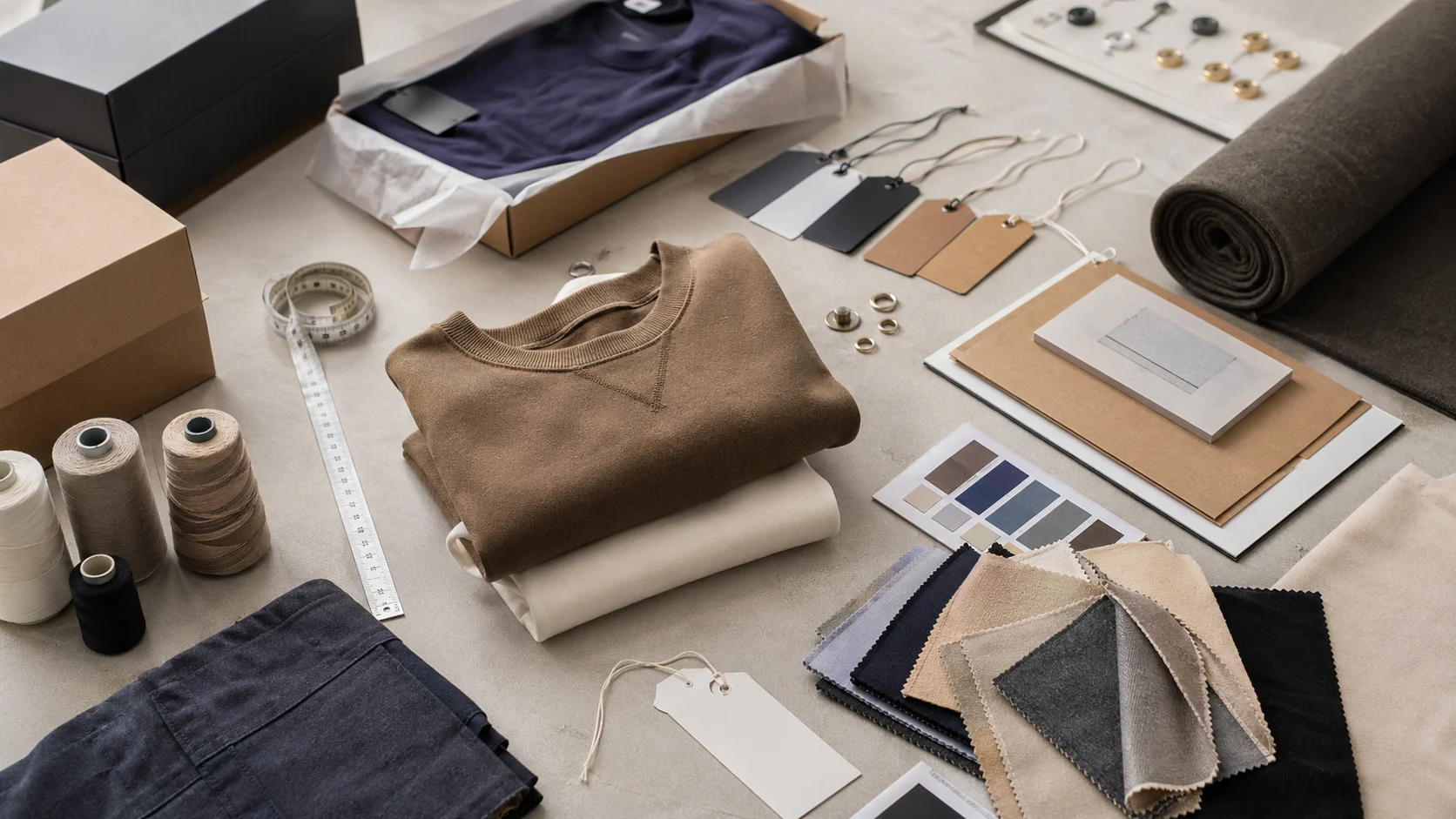
Online Clothing Store Branded Boxes with checks for samples, fit, MOQ, QC evidence, pricing terms, and delivery risk.
Fast answer: Online Clothing Store Branded Boxes: Board, Print, Cost, and Design should be judged by production evidence, not by a generic sourcing promise. The buyer needs sample proof, cost breakdowns, QC checkpoints, and delivery buffers in writing.
Ask for recent sample photos, measurement tolerances, fabric or print test assumptions, decoration test notes, packing examples, and a named inspection checkpoint. These details show whether the team can repeat an approved sample at bulk volume.
Separate garment cost, decoration, labels, packaging, sampling, testing, freight, and rush charges. When every cost line is visible, it becomes easier to reduce colorways, adjust size depth, or reserve more time for sampling.
The box lands before the brand gets a second chance. For online apparel, that first physical touch can decide whether the order feels like a purchase or a personality. When you choose branded packaging boxes for online clothing stores, you are buying more than protection; you are buying perception, memory, and the possibility of a repeat order. I watched a $28 tee arrive in a crushed poly mailer and disappear into silence, while a $42 knit in a printed carton triggered a review, an Instagram story, and a repeat order 19 days later. Not decoration. Revenue behavior.
Across 200+ factory visits in eight countries, I have seen packaging reshape what happens after checkout. A clean box reduces visible damage, yes, but it also lifts perceived quality, which then affects returns, ratings, and shareability. When a customer films an unboxing, one package can travel farther than a paid ad with a $1,500 media spend. The box becomes media.
On factory floors, the contrast is ugly. Mass-market e-commerce mailers often cost $0.12-$0.28 each in high volume, with thin board or low-gsm film, basic one-color print, and almost no structural presence. Premium rigid boxes can run $1.80-$4.50 each at 1,000 units, yet they hold shape, print sharply, and survive rough courier handling better. The difference shows up in perceived quality before the garment is even touched.
A cheap box can damage retention more than a delayed markdown. I have seen brands save $0.20 a unit on packaging, then lose far more when a first-time buyer never comes back because the arrival felt forgettable. A 20-cent upgrade matters if it reduces complaints by even 1% on a 10,000-order month. That is 100 fewer problem tickets, and each ticket has labor attached.
According to WTO data and U.S. trade guidance, apparel trade remains highly price sensitive, which means physical presentation has to do more work at the margin. That is why I treat branded packaging boxes for online clothing stores as a conversion asset, not an accessory. If you buy from a clothing packaging supplier, the box should protect the garment, shorten packing time, and make the customer feel the price they paid was justified.
Luxury labels and mid-market basics rarely buy the same box, and they should not. A $12 cotton tee can survive a $0.22 corrugated mailer, while a $180 blazer usually needs a rigid box or reinforced folding carton that signals care before the garment is unfolded. I have seen denim brands spend $0.48-$0.85 per unit on branded packaging boxes for online clothing stores at 5,000 pieces, while premium knitwear lands closer to $1.20-$2.10 because shape retention matters as much as branding.
Region changes the equation. In Asia, especially China and Vietnam, labor is often cheaper, board sourcing is broad, and print consistency can be excellent at 10,000+ units. In Europe, board quality and environmental documentation tend to be stronger, but labor and finishing costs push unit prices up by 15%-35%. North America often lands in the middle on lead time, but smaller runs can carry steeper setup fees, especially below 1,000 units. I have seen boutique workshops quote $1.70 per rigid box at 1,000 units, then miss delivery by four weeks, while a larger factory in Guangdong delivered within 18 days with tighter color control.
Consistency is the counterintuitive part. Some low-cost regions deliver better repeatability than small premium workshops because they run the same board, same press, and same glue line every day. I rejected $3.20 sample boxes from “luxury” suppliers because the corner wrap varied by 2-3 mm from box to box. That sounds tiny. It is not tiny when a carton is packed at 20,000 units.
Garment type should guide spend. Tees and loungewear can live in simple folding cartons or mailers. Denim often needs stronger boards because of weight, usually 300-450 gsm outer stock or E-flute corrugate. Knitwear benefits from fewer creases and a clean fold, so a box with tissue and a die-cut insert is worth the extra $0.18-$0.40. Accessories are different again; socks, belts, and lingerie often need smaller structures, which is why I pay close attention to custom bra manufacturing programs where delicate product presentation can add real brand value.
At 1,000 units, a printed kraft mailer may cost $0.35-$0.60, a folding carton $0.70-$1.40, and a rigid box $1.80-$4.00 depending on finish. At 5,000 units, those numbers can drop by 20%-40%. At 20,000 units, the gap widens again because tooling spreads out, but freight and storage start to bite.
The material conversation starts with board grades. SBS gives a smooth, bright surface for high-resolution printing and clean brand color, which is why it shows up in premium folding cartons. Corrugated board, usually E-flute or B-flute, adds crush resistance and is better for shipping. Kraft has a natural look and lower coating needs, but print contrast can be softer. Rigid board delivers the heaviest feel and the best unboxing drama, yet it is heavier, more expensive, and harder to recycle if it includes magnets or foam.
Finishes change cost and recyclability in very different ways. Matte lamination usually adds $0.08-$0.18 per unit. Soft-touch coating can add $0.12-$0.30, and it feels rich, though it complicates recycling streams more than a plain aqueous coat. Foil stamping adds sparkle and can cost $0.06-$0.25 depending on coverage. Embossing and debossing are tactile and relatively efficient at scale, often $0.04-$0.15. Spot UV is eye-catching on dark stock, yet it needs precise registration and can fail if the press tolerance slips by even 1 mm.
According to OEKO-TEX, textile buyers increasingly scrutinize chemical inputs, and packaging suppliers are feeling that pressure too. Water-based inks, FSC-certified board, and plastic-free windows are now standard requests in my sourcing notes. A recycled box is not automatically a good box, though. I have seen 100% recycled mailers collapse in transit because the compression strength was too low for a mixed-carrier network with long-haul sorting.
The thing nobody tells you: a recycled box can be less sustainable if it damages garments and forces re-ships. I have seen a 12% damage rate turn a “green” box into the least responsible option on the purchase order.
For lightweight apparel, I prefer FSC kraft with water-based inks and a simple aqueous coating. For premium fashion, SBS with matte lamination and a paper insert usually balances feel and protection. For subscription-style shipments, corrugated with a branded sleeve keeps costs down and survives monthly handling. If you are selling broader apparel assortments through custom baby clothing manufacturing programs, softness and odor-free inks matter as much as structure because parents notice every detail.
I design for the camera before the shelf. Unboxing content spreads because it feels personal, and a box that photographs well can outperform a paid placement that cost 40 times more. That means logo placement should be legible at arm’s length, not buried under busy graphics. A simple front panel, a restrained color palette, and one memorable interior message usually beat a crowded print strategy.
Structure matters just as much. Tissue, a return-ready adhesive strip, and one well-fitted insert do more for customer satisfaction than a dozen decorative flourishes. I like repeatable design systems across SKUs because they reduce artwork errors and shorten production by 3-7 days. One-color print on kraft can look premium if the typography is disciplined and the box proportions are clean. It often costs less than people expect, sometimes by 18%-25% compared with full-bleed CMYK.
Oversized boxes create hidden waste. They raise cubic shipping charges, force in extra filler, and make garments slide around during transit. A dieline that leaves just 5-10 mm of play is usually enough for folded tees and lightweight knits. Too much void fill means more packing labor, more material, and more complaints about “cheap” presentation. The real penalty is not only freight. It is the customer’s first tactile impression.
In my experience, brands that sell tightly edited assortments should standardize box families by garment category: one size for tees, one for denim, one for accessories. That is exactly how I advise teams building private label clothing services programs, because consistency makes forecasting easier and cuts production delays. I have seen a brand shave 11% off packing time simply by reducing box sizes from seven to three.
Plain poly mailers are cheap, but cheap is only one line in the ledger. At 10,000 units, a generic mailer may cost $0.08-$0.14 each, with almost no setup cost. A standard printed mailer typically lands at $0.18-$0.32, depending on ink coverage and thickness. Custom branded boxes are different: sample fees can run $80-$250, plates or tooling $150-$600, and artwork prep $50-$300 before the first production run starts.
Then come the live costs. Printed folding cartons often price at $0.40-$1.20 at 5,000 units, while rigid boxes can sit at $1.50-$4.50. Inserts may add $0.05-$0.35. Freight can add another 8%-20% if the box is bulky or shipped flat from overseas. Storage is another trap. I have seen brands warehouse 20,000 boxes because they chased a lower unit price at the 20,000 MOQ, only to pay rent on unused cartons for six months.
Hidden costs show up in operations. A box with a slower fold can add 8-15 seconds to packing time. That sounds minor until you multiply it by 3,000 orders a week. More cubic volume can raise shipping charges by $0.30-$1.10 per parcel depending on carrier zone and carton dimensions. Damaged goods claims also rise when packaging is light or ill-fitting, and one claim can erase the savings from 100 cheap mailers.
Here is a sample landed-cost view I have used with brands:
At scale, the per-unit drop is real. A box that costs $1.10 at 1,000 units may fall to $0.68 at 5,000 and $0.52 at 20,000, but only if the design stays stable. The mistake I see most often is comparing factory price alone. Compare total landed cost, packing labor, re-shipment risk, and customer perception together. That is where margin actually lives.
I start every sourcing project with one spec sheet. Dimensions, board grade, print method, coating, sustainability criteria, volume, and target ship date all go on paper before I ask for a quote. If two suppliers are not quoting the same structure, their prices are meaningless. A $0.62 quote and a $1.04 quote can be identical value once board thickness, finish, and freight are aligned.
Samples matter more than presentations. I ask for flat samples, assembled samples, and transit-tested samples. Then I check crush strength, print registration, glue performance, and whether the closure opens after vibration and drop testing. For apparel packaging, a tolerance of 1-2 mm can be acceptable on a mailer, but not on a rigid box with a magnetic flap. I also ask for color tolerances by Pantone or LAB target, because a rich navy can drift to purple when one plant swaps ink batches.
Vague artwork files are a classic trap. So is unclear board thickness. I have seen brands approve “350 gsm” without specifying whether they needed SBS, kraft, or coated recycled board, then wonder why the box sagged. Unrealistic turnaround promises are another warning sign. A standard production run usually needs 3-4 weeks after sample approval, plus 7-14 days for sea freight if the factory is offshore. Faster is possible, but not without trade-offs.
Contract terms should cover revision counts, defect thresholds, remake policy, and payment milestones. I ask for 30% deposit, 40% after pre-production approval, and 30% after shipment for established suppliers, though terms vary by region and order size. If you are buying multiple packaging types at once, keep each item separate in the contract. That matters when you are sourcing apparel and lingerie boxes together, or when a run supports custom baby clothing manufacturing alongside adult basics. One sloppy PO can turn into three expensive mistakes.
A 30-day rollout can be done cleanly if the brief is tight. Week 1: audit current packaging, measure damage rate, and calculate pack time per order. Week 2: set a budget band, request three samples, and confirm artwork. Week 3: test with real orders across 2-3 product types and 2 shipping zones. Week 4: review the numbers and decide whether to scale.
I would pilot with hero products first if cash is tight. That could mean premium tees, a top-selling dress, or subscription orders where presentation has high visibility. Use the same box family for the first 500-1,000 units so feedback is easier to read. Track damage rate, packing time, customer feedback, repeat purchase rate, and social mentions. If the box reduces damage from 6% to 2% and adds even 0.4 points to review sentiment, it is already working.
Do not launch on aesthetics alone. I have seen brands get seduced by foil, soft-touch coating, and oversized inserts, only to discover shipping costs rose by $0.80 per parcel and the box took 12 seconds longer to pack. Sustainability claims should be specific: FSC board, water-based inks, plastic-free inserts, recycled content percentage, and where the material is sourced. Broad claims invite skepticism. Precise claims build trust.
If you want the cleanest rollout, start with one box for two use cases, one shipping test, and one KPI dashboard. That keeps the decision honest and the economics visible. The brands that get this right treat packaging as part of product development. That is the difference between a box people remember and a box people bin without thinking.
At 1,000 units, printed folding boxes often cost $0.70-$1.40 each, while rigid boxes can run $1.80-$4.50 depending on finish and structure. At 5,000 units, those costs typically fall by 20%-40%. Freight, inserts, and setup fees are separate.
Most production runs take 3-4 weeks after sample approval. Sea freight can add 7-14 days, while air freight is faster but much more expensive. Complex finishes like foil or embossing can add a few extra days.
Measure the folded garment, then allow only 5-10 mm of play for tees and light knits. Denim and bulky knitwear may need reinforced cartons or inserts. Oversized boxes raise cubic shipping charges and increase void fill costs.
Yes, if you specify FSC-certified board, water-based inks, recycled content, and plastic-free inserts. The box still has to pass compression and transit testing. A “green” box that crushes and causes returns is not truly sustainable.
Use one detailed spec sheet, request comparable samples, and test crush strength, print registration, and glue performance. Ask suppliers to quote the same board grade and finish. Put defect rates, remake terms, and payment milestones in writing.