
A practical compliance-focused outline for security contractors buying custom mono material workwear uniforms, covering fabric choices, decoration, safety standards, durability, recyclability, and documentation.
Mono Material Workwear Checklist for Security Buyers - Fabrikn production reference
Security contractors are under pressure to buy uniforms that look professional, survive daily wear, meet site compliance rules, and support sustainability targets without creating operational risk. Mono material workwear can help, but only when the specification is controlled from fabric selection through trims, branding, testing, inspection, and end-of-life planning.
This checklist is written for security buyers sourcing custom mono material workwear uniform programs. It focuses on practical compliance decisions: what to ask suppliers, what to approve before bulk production, where recycling claims can break down, and how to balance durability, wearer comfort, visibility, identification, and cost.
Mono material workwear is designed so the main fabric, trims, and key components come from one compatible material family. In security uniforms, this usually means a polyester-based system or a cotton-based system. Polyester is more common for circularity programs because it can support durable woven and knitted fabrics, high colorfastness, quick drying, and potential recycling routes when contamination is controlled.
A mono material uniform does not simply mean “made mostly from one fiber.” Buyers need to look at the full garment. Fabric, sewing thread, pocketing, labels, interlining, zippers, buttons, reflective details, heat transfers, embroidery backing, hook-and-loop tabs, elastic, drawcords, and packaging choices can all affect recyclability and compliance claims.
For security contractors, the practical target is usually not perfect purity at any cost. The better commercial target is a uniform that maximizes material compatibility while still meeting operational performance requirements. A jacket that fails in the field is not sustainable. A recyclable trouser that loses shape after ten washes will increase replacement rates and create more waste.
Purchasing judgment: do not approve a mono material claim until the supplier provides a component bill of materials, not just a fabric composition line on a quotation sheet.
Security uniforms carry more risk than basic corporate apparel. They identify staff, support authority, and must remain consistent across shifts, sites, and contract locations. A poorly specified uniform can create confusion, damage a contractor’s image, and increase replacement orders during the contract term.
Sustainability targets are also moving from marketing language into procurement requirements. Public-sector tenders, facilities management contracts, transport hubs, event venues, and commercial property groups may ask suppliers to explain garment composition, recycled content, restricted substances, end-of-life handling, and packaging. Security contractors that can answer those questions with clear specifications are in a stronger buying position.
Mono material workwear can support those answers. It can simplify recycling conversations, reduce mixed-fiber complexity, and make documentation cleaner. It may also reduce variation across garment categories if the buyer builds a controlled fabric and trim library.
The tradeoff is that mono material decisions can restrict design options. A security buyer may need to avoid certain contrast panels, coated badges, PVC patches, metal trims, blended rib cuffs, or decorative details that make the uniform harder to recycle. This is where a checklist helps. It separates useful sustainability improvements from choices that create field problems or hidden compliance gaps.
The following checklist should sit at the start of any custom mono material workwear uniform project for security contractors. Use it before requesting quotations, not after samples arrive.
Compliance Area Buyer Requirement Risk if Missed Material Strategy Define one primary material family for shell fabric, thread, labels, and compatible trims. Garment may be marketed as sustainable but rejected by recyclers or tender reviewers. Uniform Function Confirm indoor, outdoor, mobile patrol, reception, event, or high-visibility use. Fabric may be too light, too warm, not visible enough, or unsuitable for shift conditions. Brand Control Specify logo method, badge placement, color standards, and site identification needs. Inconsistent uniforms can weaken authority and contract presentation. Wearer Safety Check visibility, snagging, pocket placement, closures, and weather protection. Garments may create practical safety issues during patrol or access control duties. Restricted Substances Require compliant dyes, finishes, prints, coatings, and trims for the target market. Bulk goods may fail chemical compliance or customer procurement checks. Durability Set wash, abrasion, seam strength, pilling, and colorfastness requirements. Short garment life can erase sustainability gains and increase uniform spend. End-of-Life Define collection, sorting, branding removal, and recycling assumptions. Uniforms may end up in general waste despite mono material design intent.A clear specification should also name the applicable local safety, labeling, and procurement requirements. Security workwear may not always need specialist protective certification, but it still needs accurate fiber labeling, care labeling, size consistency, and safe construction. If garments include high-visibility elements, flame-resistant claims, water resistance claims, or protective features, testing must match the claim.
Fabric choice is the largest decision in a custom mono material workwear uniform program. For security buyers, the usual options are woven polyester, recycled polyester, polyester mechanical stretch, polyester fleece, polyester softshell, polyester pique, and polyester jersey. Cotton mono material options exist, but they may be less practical for weatherwear, quick-dry polos, and high-volume uniform programs that need stable color across repeated laundering.
Set the fiber rule in writing. A simple specification might say: “100% polyester main fabric, polyester sewing thread, polyester labels where feasible, polyester-compatible trims, no elastane unless approved as a documented exception.” If recycled content is requested, state whether it is post-consumer recycled polyester, pre-consumer recycled polyester, or a blend of recycled and virgin polyester.
Recycled polyester can support sustainability claims, but buyers should ask for transaction documentation or certification where required by the customer. A verbal “recycled fabric” claim is not enough for tender evidence. Certification requirements vary by market and buyer policy, so the supplier should clarify what documents can be provided before the purchase order is placed.
Security uniforms need different fabric weights depending on role and climate. Typical ranges include:
Lower weights can reduce cost and improve comfort in warm environments, but they may fail faster at seat, knee, pocket edge, and shoulder bag contact points. Heavier fabrics improve presence and durability but can be uncomfortable for long indoor shifts. Security buyers should not copy a retail apparel weight without testing it in the actual duty environment.
Security contractors often need navy, black, charcoal, white, hi-vis yellow, or branded corporate shades. Dark colors must hold through repeated washing, sun exposure, and abrasion. Set colorfastness requirements for washing, rubbing, perspiration, and light exposure where relevant.
Shade control matters across reorders. A jacket ordered six months after the first delivery should not look like a different uniform program. Ask suppliers to keep lab dips, approved shade standards, and bulk shade records. For large contracts, it is sensible to approve a fabric lot strategy so that critical garments are cut from controlled lots where possible.
Security staff may stand for long periods, climb stairs, patrol car parks, manage gates, check bags, or respond quickly to incidents. Stretch improves comfort, but elastane complicates mono material design. Mechanical stretch polyester is often the cleaner route because it provides movement without adding a separate elastane fiber.
The tradeoff is performance. Mechanical stretch may not recover like elastane in some applications. If the role needs high mobility, the buyer may accept a small elastane percentage as a documented exception. That decision should be honest. A uniform with 3% to 5% elastane may still be a better operational product, but it should not be overclaimed as a pure mono material garment.
Water repellency, stain release, antimicrobial finishes, anti-static treatments, and coatings can affect compliance. Some finishes also raise chemical management questions. Security buyers should request the finish name, purpose, expected durability, and any restricted substance documentation available.
For outerwear, membranes and coatings need particular attention. A polyester face fabric paired with a non-compatible membrane, mixed lining, metal snap system, and PVC badge patch may no longer support a clean mono material story. Ask early whether the supplier can offer polyester-compatible waterproofing choices and what performance level can realistically be tested.
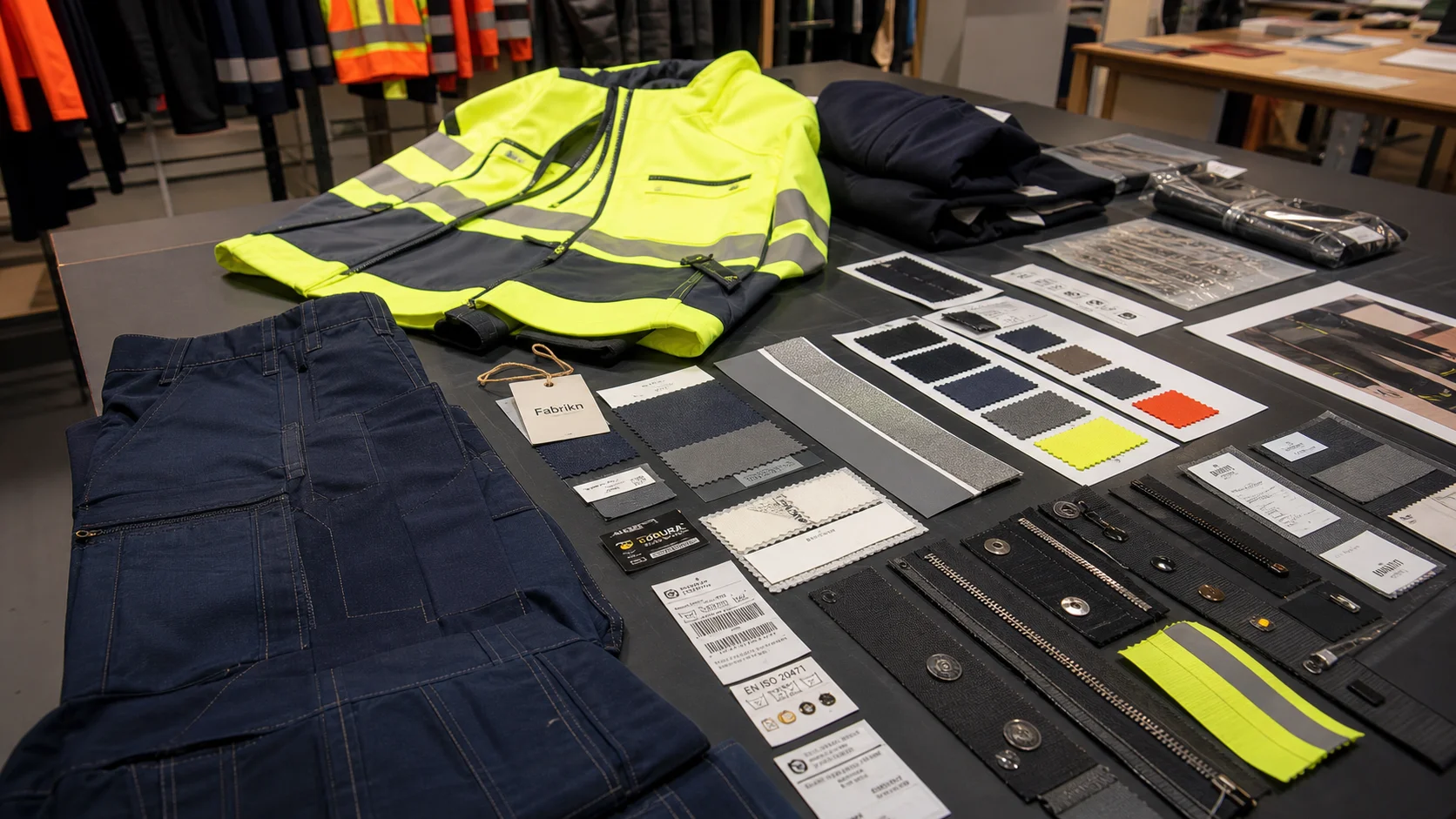
Most mono material workwear projects fail in the trims. The main fabric may be well specified, then the final garment gains mixed labels, coated badges, nylon zippers, rubber pullers, metal snaps, foam shoulder patches, or adhesive prints that complicate recycling.
Security uniforms need clear identification, but branding choices can undermine mono material goals. Embroidery is durable and professional, yet embroidery thread, bobbin thread, backing, and dense stitch areas all need review. Heat transfers can look clean but may involve polyurethane or other polymer layers. Woven badges can be effective if made from the same material family, but borders and backing must be checked.
Buyers should decide which branding elements are essential. A left chest logo, back security text, sleeve emblem, and site badge may all be requested at first. Each added element increases cost, inspection points, and recycling complexity. A simpler branding map is often more consistent and easier to manage across multiple sites.
Purchasing judgment: prioritize identification clarity over decorative branding. Security staff need to be recognized quickly; the garment does not need unnecessary trim complexity.
A security uniform program usually includes several garment types. Each one has its own mono material and compliance risks.
Polos are common for guarding, patrol, events, warehousing, and facilities security. For mono material programs, 100% polyester pique or jersey is the practical starting point. Ask for anti-snag performance if staff work near keys, radios, barriers, or equipment. Check collar and cuff composition, because rib trims may include elastane or mixed fibers.
Formal shirts are used where the security role overlaps with reception, concierge, corporate offices, hospitality, or front-of-house duties. A mono material polyester shirt can be easy care, but it must not look cheap or feel uncomfortable during long shifts.
Trousers carry high durability risk. Seat seams, crotch seams, pocket bags, belt loops, knee areas, and hems all receive regular stress. Polyester trousers can be durable and color stable, but pattern and sewing quality are critical.
Fleece layers are useful for mobile patrol, warehouses, gates, and cooler reception areas. Polyester fleece fits mono material programs well, but pilling, shedding, and shape retention need checking.
Outerwear is where mono material compliance becomes harder. A softshell may include a polyester face, membrane, fleece backing, zipper systems, toggles, cords, reflective details, and seam treatments. A waterproof jacket may add coatings, tapes, linings, drawcords, and hardware.
High-visibility garments require extra care. If the garment makes a safety visibility claim, the correct standard and test requirements must be defined for the target market. Reflective tape, fluorescent fabric, contrast panels, and wash durability are not optional details.
Mono material goals should not override visibility compliance. If certified high-visibility protection is required, choose certified performance first and document any material compromises. Buying an uncertified garment that looks bright is a poor risk decision for a security contractor working around vehicles, loading areas, or public events.
A disciplined sample process reduces production disputes. Security buyers should not move from a rough quotation to bulk order without controlled approvals.
Start with a technical brief. Include garment sketches or reference images, fabric composition, target weight, colors, size range, branding placements, packaging requirements, compliance needs, and end-of-life goals. If the buyer needs help defining the uniform package, a supplier service discussion can be useful. Fabrikn outlines broader manufacturing support through its services page, which is a sensible starting point for buyers building a custom program.
Approve fabric swatches, lab dips, trims, zippers, buttons, reflective materials, labels, and branding samples before garment samples are made. This prevents wasted sample rounds. For mono material programs, ask for composition details at this stage.
The proto sample checks style, fit direction, construction feasibility, and branding layout. It may use substitute fabric or trims if clearly declared. Do not use a proto sample as final evidence of bulk quality unless all materials match the approved specification.
Fit samples should be assessed on the intended wearer profile. Security uniforms need enough movement through shoulders, waist, rise, thigh, knee, and sleeve length. If radios, body cameras, ID badges, utility belts, or access cards are used, test the garment with those items.
A size set checks grading across the full size range. This is important for contractors with varied workforces. A medium sample may look fine while larger or smaller sizes have sleeve, rise, or shoulder issues.
The pre-production sample should use bulk fabric, bulk trims, final branding, final labels, final packaging, and final workmanship method. This is the sample buyers should sign off before cutting bulk. Keep one sealed approval sample with the buyer and one with the manufacturer if possible.
For large security contracts, a limited wear trial is worth the time. A two-to-four-week trial can reveal pilling, heat discomfort, pocket failures, logo issues, seam stress, or shade concerns. Wear trials are not always feasible for urgent orders, but they reduce risk in multi-year uniform programs.
Minimum order quantities vary by garment type, fabric availability, color, trims, and customization level. Buyers should treat any MOQ number as conditional until the supplier confirms fabric sourcing and production capacity.
Garment Type Typical Custom MOQ Range Notes for Buyers Polos and T-Shirts 300 to 1,000 pieces per style/color Lower MOQs may be possible with stock fabric and simple branding. Formal Shirts 300 to 800 pieces per style/color Custom colors, interlining, and buttons can raise MOQ. Trousers 300 to 1,000 pieces per style/color Size spread and fabric availability affect production efficiency. Fleece Jackets 300 to 800 pieces per style/color Stock fleece can reduce risk, but branding and zippers still need approval. Softshells 500 to 1,500 pieces per style/color Membrane, bonding, zippers, and trims often increase MOQ and lead time. Waterproof Outerwear 500 to 2,000 pieces per style/color Testing, seam sealing, and special components add complexity.Lead times also depend on the order path. A stock garment with custom branding may ship much faster than a fully custom mono material uniform. Typical custom development and production timelines can include:
Urgent uniform rollouts often force compromises. Buyers may need to accept available fabric colors, simplify trims, reduce garment variations, or split delivery. A rushed mono material project can still work, but the buyer should not compress testing and inspection below a safe level for the contract risk.
Security buyers should compare total program cost, not just unit price. A cheaper polo that pills quickly may need replacement sooner. A trouser with weak pocketing may generate complaints and emergency top-up orders. A jacket without controlled trims may fail the sustainability documentation expected by a major client.
Inspection should focus on both standard garment quality and security-specific risks. A general apparel inspection may catch loose threads and stains but miss operational details such as incorrect badge placement, weak radio loops, inconsistent back text, or poor pocket reinforcement.
Final inspection should use an agreed acceptable quality level or a clear inspection plan. Common defects in security workwear include twisted seams, uneven collars, poor placket alignment, shade mismatch, skipped stitches, weak bartacks, incorrect logo placement, loose reflective tape, defective zippers, pocket bag failures, and packaging errors by size or site.
Inspection must also check carton marking and allocation. Security contractors often distribute uniforms by branch, site, role, or employee size pack. A production order can pass garment inspection but still create operational problems if cartons are mixed, size ratios are wrong, or site labels are missing.
Purchasing judgment: do not let final inspection focus only on appearance. Security uniforms are work tools, and the inspection plan should reflect how staff actually wear and use them.
Before placing a custom mono material workwear order, security buyers should ask direct questions. The answers will reveal whether a supplier understands compliance or is simply using sustainability language.
Buyers building a new supply program may also want to review a manufacturer’s background, scope, and operating model. Fabrikn provides company information on its about page, and buyers with a defined brief can use the contact page to start a specification-led discussion.
Mono material design only has value if the buyer has a realistic end-of-life plan. Security uniforms cannot always be treated like ordinary used clothing because they may carry logos, security wording, badges, or site identification. Disposal must consider brand protection and misuse risk.
Recycling options vary by region, volume, garment condition, and available processing partners. A small contractor with mixed garments may struggle to secure textile-to-textile recycling. A larger security provider with consistent polyester uniform volumes has a better case. Buyers should avoid promising closed-loop recycling unless the collection and processing route is confirmed.
Brand protection is a serious issue. Old security uniforms with visible logos or “security” markings should not be released into uncontrolled second-hand channels. Mono material design must sit alongside a secure take-back process, controlled destruction of identifiers, or approved recycling partners that can handle branded workwear responsibly.
A practical sourcing workflow keeps the project controlled from brief to delivery. The sequence below is suitable for most security contractors planning custom mono material uniforms.
Stage Action Approval Output 1 Define roles, duty environments, garment list, and sustainability target. Uniform brief 2 Select primary material family and allowed exceptions. Material policy 3 Request supplier bill of materials and costed options. Comparable quotations 4 Approve fabrics, trims, lab dips, and branding methods. Material approval file 5 Develop proto, fit, size set, and pre-production samples. Signed sample approvals 6 Run relevant testing and confirm labeling compliance. Test and label records 7 Inspect production and verify packing by size, site, or contract allocation. Inspection report 8 Collect end-of-life data and manage secure returns. Recycling or disposal recordThis workflow reduces the chance of late surprises. It also gives procurement teams a document trail for client tenders, internal ESG reporting, and supplier performance reviews.
Mono material workwear is a useful direction for security contractors, but it is not a shortcut. The best results come from disciplined specification, honest exception management, and inspection that reflects field use. Polyester-based systems are often the most practical for custom security uniforms because they can cover polos, trousers, fleeces, and some outerwear while supporting durability and potential recycling routes.
Buyers should be cautious with claims. “Recyclable,” “recycled,” “sustainable,” and “mono material” need evidence. A garment can be mainly polyester and still include enough incompatible trims to weaken the end-of-life story. A recycled fabric can still fail if colorfastness, seam strength, or fit are poor.
The strongest buying position is a balanced one: specify mono material compatibility where it makes sense, permit documented exceptions where performance requires them, and maintain a clear approval record. Security uniforms must protect the contractor’s brand, support staff on shift, satisfy client requirements, and last long enough to justify the sustainability claim.
Get a free quote from Fabrikn — your trusted B2B clothing manufacturer with 10+ years of experience. MOQ as low as 200 pieces.
Get a Free Quote →A mono material security uniform is designed around one main material family, such as polyester, across the fabric and as many trims as possible. The goal is to reduce mixed-material complexity and improve the garment’s potential for recycling or responsible end-of-life handling.
For many security contractors, 100% polyester is the most practical option because it can be used in polos, shirts, trousers, fleeces, and some outerwear. It offers good color stability, quick drying, and durability. The final choice should still depend on duty environment, wearer comfort, and compliance needs.
It depends on the materials used. Polyester zipper tape may align with the material strategy, but sliders, teeth, pullers, reflective tape, adhesives, and backing materials need separate review. Buyers should document any components that are not compatible with the primary material family.
Typical custom MOQs often range from 300 to 1,000 pieces per style and color for polos, shirts, trousers, and fleeces. Outerwear can require 500 to 2,000 pieces depending on fabric, membrane, trims, and testing needs. Stock materials and simpler branding can sometimes reduce MOQ pressure.
A full custom project can take several weeks for sampling and 30 to 75 days for bulk production after pre-production approval. Lead time depends on fabric availability, lab dips, testing, trim sourcing, sample rounds, order quantity, factory capacity, inspection, and shipping route.
Common tests include colorfastness to washing, rubbing, perspiration, and light; dimensional stability; pilling; abrasion; seam strength; tear strength; and logo wash durability. High-visibility or protective claims require relevant standard-based testing for the target market.
Recycled polyester can reduce reliance on virgin polyester, but sustainability also depends on garment life, washing performance, replacement rate, trim choices, packaging, and end-of-life handling. A recycled garment that fails quickly may not be the better procurement decision.
The biggest risk is approving a sustainability claim without checking the full bill of materials. Main fabric composition is only one part of the garment. Trims, labels, branding, coatings, and closures can all affect compliance and recyclability.
Old security uniforms should be collected through a controlled process, especially if they carry logos or security identification. Branding may need to be removed, destroyed, or processed through an approved recycling partner to reduce misuse risk.
No. Wearer comfort and operational performance are essential. A mono material specification should support the job, not make the uniform less functional. If a small material exception improves safety, fit, or durability, it may be the better purchasing decision when properly documented.