
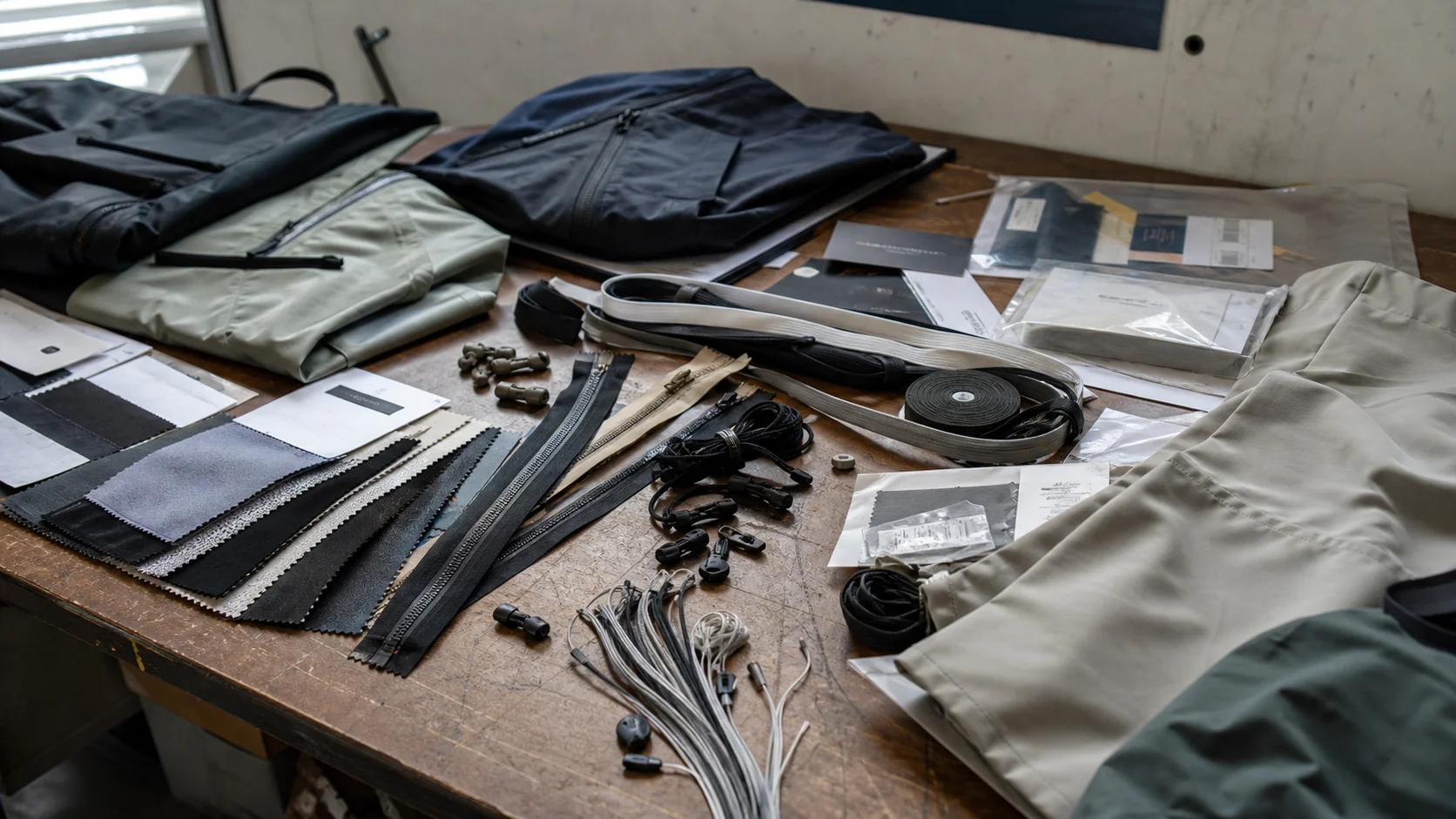
A product-specific sourcing review for fitness club buyers evaluating trims for stretch wind jackets, including zippers, drawcords, elastics, reflective details, branding applications, testing requirements, cost drivers, and production approval checkpoints.
Stretch Wind Jacket Trim Sourcing for Club Buyers - Fabrikn production reference
Stretch wind jacket trim sourcing is often treated as a secondary detail until a club order reaches sampling, costing, or inspection. That is usually too late. For fitness club buyers, teamwear managers, and activewear merchandisers, trims can decide whether a jacket feels premium, performs well during movement, and survives repeated wear by members, coaches, and staff.
A stretch wind jacket is not just a shell with a zipper. It is a moving garment. The base fabric may have mechanical stretch or elastane content, the fit may sit close to the body, and the wearer may use it for warm-ups, outdoor training, travel, or light rain protection. Every trim attached to that garment needs to work with the fabric instead of fighting it.
That includes zippers, pullers, elastic cords, stoppers, binding, reflective tape, heat-transfer logos, snap buttons, zipper garages, pocket bags, labels, drawcords, and seam reinforcement tapes. If one trim is too rigid, too heavy, too sharp, too bulky, or poorly color-matched, the whole jacket can feel cheaper than planned.
For club buyers, the challenge is practical. You need an attractive jacket that fits brand standards, supports movement, meets budget targets, and can be produced at realistic minimum order quantities. You may also need repeat orders across seasons, member sizes, staff uniforms, youth teams, or club retail drops. Trim choices must therefore be reviewed for both first-order quality and long-term repeatability.
This stretch wind jacket trim sourcing review is written for fitness club buyers who need clear purchasing judgment before confirming a production package. It focuses on the commercial decisions that affect cost, MOQ, lead time, inspection risk, and wearer satisfaction.
Buying judgment: do not approve a stretch wind jacket trim package only because it looks good on a flat sample. Test the trims on the body, under movement, after washing, and against the real club logo placement.
A strong trim sourcing process starts with a clear buyer brief. Vague instructions such as “premium zipper,” “nice reflective detail,” or “good elastic” leave too much room for interpretation. Factories may select available trims that meet cost targets but miss the end use. That creates sample revisions and delays.
Fitness club buyers should brief the jacket as a complete commercial product, not just a design sketch. The supplier needs to understand who will wear it, how often it will be washed, whether it is sold as merchandise or issued as staff uniform, and whether the jacket is part of a teamwear set.
Buyers should also clarify what cannot be compromised. For example, a club may accept a standard black zipper but require excellent logo durability. Another club may need a perfectly color-matched front zipper for a premium retail jacket but can use standard internal labels. These priorities help the supplier allocate cost where it matters.
If your team needs help developing a sourcing package before requesting quotes, the service structure at Fabrikn services is a useful reference point for aligning design, product development, and production expectations.
Stretch wind jackets carry more trim risk than many basic activewear items because the shell fabric is lightweight and mobile. Heavy trims can drag the garment down. Stiff trims can distort seams. Poorly selected trims can cause puckering, abrasion, leakage, or color mismatch.
The front zipper is usually the most important trim on a stretch wind jacket. It affects appearance, handling, durability, and perceived value. Common options include coil zippers, reverse coil zippers, waterproof-look coated zippers, molded plastic zippers, and two-way zippers.
For fitness club jackets, reverse coil zippers are often a sensible choice. They look cleaner than standard coil zippers, are lighter than many molded zippers, and work well on lightweight woven shells. Coated waterproof-look zippers can lift the visual level, but they add cost and can feel stiffer. They may also crack or peel if low-grade coating is used or if the jacket is frequently bent and washed.
Two-way zippers are useful for longer jackets or premium travel styles, but they raise cost and increase user error risk. Members may misalign the bottom pin, leading to complaints that are not always manufacturing defects. For a standard club wind jacket, a good one-way reverse coil zipper is usually the safer commercial option.
Zipper Type Best Use Tradeoff Standard coil zipper Budget jackets and basic uniforms Less premium appearance Reverse coil zipper Most club wind jackets Needs good color matching and smooth sewing Coated zipper Premium or weather-inspired styles Higher cost and coating durability risk Molded plastic zipper Heavier outerwear looks Can feel bulky on light stretch shells Two-way zipper Longer jackets and travel styles Higher cost and more handling complaintsZipper pullers are small but visible. They also affect usability when wearers have sweaty hands, cold fingers, or gloves. Options include metal pullers, plastic pullers, cord pullers, rubberized pullers, TPU tabs, and branded pullers.
For club buyers, a cord puller with a small molded or heat-cut tab is often practical. It is lightweight, easy to grab, and can be replaced more easily than a custom metal pull. Branded rubber pullers look stronger in photos but may require higher MOQ and tooling fees. They can also become a bottleneck if reorder volumes are small.
Custom pullers make sense when the jacket is part of a premium retail program or a large multi-location club uniform. For smaller club orders, standard pullers in black, navy, or tonal color normally offer better value.
Side pocket zippers are common on active wind jackets because members need secure storage for keys, cards, and phones. Pocket zippers should be smooth, low profile, and not too rigid against the hip. The pocket bag fabric matters as much as the zipper. Mesh pocket bags reduce weight and improve breathability, while woven pocket bags feel more durable and secure.
A common inspection risk is pocket bag twisting or seam catching near the zipper tape. This happens when lightweight shell fabric, pocketing, and zipper tape are not balanced during sewing. Buyers should check pocket opening shape, zipper smoothness, and whether the pocket bag pulls the side seam out of alignment.
Cuffs on stretch wind jackets usually use one of four constructions: elasticated cuffs, self-fabric cuffs with internal elastic, binding cuffs, or hook-and-loop adjustable tabs. Each has a different cost and performance profile.
Elasticated cuffs are simple and reliable, but they can look basic if the elastic is too narrow or too tight. Self-fabric cuffs look cleaner and are suitable for club retail. Binding cuffs reduce bulk and work well for lightweight shells, provided the binding has enough recovery. Adjustable tabs offer more control but add cost, sewing time, and snagging risk.
For most fitness clubs, self-fabric cuffs with controlled elastic tension provide the best balance between appearance, cost, and comfort. Youth or budget programs may use elastic cuffs to keep pricing manageable.
Drawcords are functional, but they also raise compliance and safety questions. Adult jackets may use hood and hem cords for adjustability. Youth jackets need more careful review because many markets restrict or discourage functional drawcords in certain children’s garments.
Common cord options include round polyester cord, flat drawcord, elastic shock cord, reflective cord, and tipped cord. Elastic shock cord works well at hems because it adjusts quickly and supports movement. Hood cords should be reviewed for safety, comfort, and brand appearance. Cord ends may be heat sealed, tipped with plastic aglets, or finished with metal tips. Metal tips can look premium but add weight and possible corrosion or nickel concerns.
Buying judgment: if the jacket will be sold to youth teams or family club members, avoid unnecessary hood drawcord complexity. A clean hood opening with elastic binding may be safer and easier to produce consistently.
Cord stoppers are easy to overlook. Low-grade stoppers may crack, slip, or lose spring tension. Bulky stoppers can hit the face or bounce during running. For hems, stoppers should be placed where they do not irritate the wearer or create pressure under a backpack.
Buyers should test cord stopper grip after repeated adjustment. The cord should slide when pressed and hold when released. A stopper that looks acceptable on a sample table may fail during active use.
Binding is used at hood openings, cuffs, internal seams, hems, and sometimes pocket edges. For stretch wind jackets, binding tape must match the stretch and recovery needs of the shell. A rigid binding on a stretch fabric can create pulling, rippling, or discomfort.
Options include fold-over elastic, knitted binding, woven binding, and self-fabric binding. Fold-over elastic is widely used for activewear because it is flexible and clean. Self-fabric binding can look elevated but may be harder to sew consistently on curved openings.
Reflective details are common in activewear and teamwear, especially for clubs that promote outdoor running, early morning training, or commuter use. Options include reflective heat-transfer tape, reflective piping, reflective print, reflective zipper tape, and reflective logo elements.
Reflective trims should be treated as performance trims, not just decoration. Buyers should check reflectivity, wash durability, stretch compatibility, and placement. Reflective heat-transfer tape can crack if applied over high-stretch areas without enough elasticity. Reflective piping can stiffen seams and make lightweight jackets feel less flexible.
For fitness clubs, small reflective accents at the back yoke, sleeve, or pocket area are often more practical than large panels. They improve visibility without making the jacket look too technical for general club use.
Labels affect comfort and brand presentation. Neck labels may be woven, printed, heat transferred, or screen printed. Care labels may be satin, nylon, recycled polyester, or printed directly where allowed. Hangtags and barcode stickers are also part of the trim package if the jacket is sold through club retail.
For active jackets, heat-transfer neck labels reduce irritation and feel modern. The risk is peeling or cracking if the transfer quality is poor or the application temperature is wrong. Woven labels are durable but can scratch the neck if the edge is rough. A soft woven label or heat-transfer label is usually better than a stiff satin label for this category.
Trim sourcing cannot be separated from fabric sourcing. A trim that performs well on a stable woven jacket may fail on a stretch wind shell. Club buyers should ask suppliers to test trims on the actual bulk fabric or the approved fabric quality, not only on substitute sample yardage.
Common stretch wind jacket fabrics include polyester mechanical stretch, nylon-spandex plain weave, polyester-spandex ripstop, lightweight stretch dobby, and water-repellent woven shells. Some styles use a thin coating or C0 durable water repellent finish. These finishes can affect heat-transfer bonding, seam appearance, and trim adhesion.
Water-repellent finishes deserve extra attention. Some heat transfers do not bond well to DWR-treated surfaces unless the transfer is specifically selected for that fabric. If a club logo falls off after a few washes, the issue may come from the trim and fabric chemistry rather than the logo artwork.
Embroidery can look premium, especially for staff jackets and coach uniforms. It also punctures the shell fabric and can create puckering on lightweight stretch materials. For packable or weather-resistant wind jackets, heat transfer or silicone transfer often works better than embroidery, provided the transfer is tested properly.
MOQ is one of the most important sourcing issues for fitness club buyers. Clubs often want custom colors, branded trims, and a broad size range, but the total order volume may not support fully custom trim development. The practical solution is to separate must-custom trims from standard trims.
Typical MOQ ranges vary by supplier, trim type, country, and material availability. The following ranges are common commercial reference points, not fixed promises. Buyers should confirm current requirements before costing.
Trim Item Typical MOQ Range Practical Buyer Note Standard zipper in stock color 100-500 pieces Best choice for small club orders Custom color zipper tape 500-1,500 pieces Useful for premium tonal designs Branded zipper puller 1,000-3,000 pieces May need mold or tooling charge Standard elastic binding 100-500 meters Usually manageable for club production Custom jacquard elastic 1,000-3,000 meters Better for large club chains or seasonal programs Heat-transfer logo 50-300 pieces per artwork Good for club names and staff roles Reflective transfer tape 100-500 meters Check stretch and wash grade before approval Custom woven label 500-2,000 pieces Can be shared across multiple styles Custom hangtag 500-1,000 pieces Best if used across club merchandise rangeThe main tradeoff is simple. Standard trims reduce MOQ, shorten lead time, and simplify repeat orders. Custom trims improve brand differentiation but increase cost, approval steps, and inventory exposure. A club ordering 150 jackets should rarely build a trim package like a national retail brand. A club group ordering across multiple locations may justify custom trim investment if the same trims can be used for several seasons.
Buyers should ask whether excess trims can be held for reorders and whether color lots will remain stable. Trim suppliers may not guarantee the same dye lot months later, especially for colored zippers, binding, and elastic cords. Black trims are easier to repeat, but even black can vary in shade and sheen across materials.
Sampling is where trim assumptions become visible. A good sampling process should not only confirm garment shape. It should prove that every trim works with the fabric, construction, branding, and use case.
For club buyers, the pre-production sample is especially important. It should not use “similar” trims unless there is no alternative and the difference is documented. A sample made with a substitute zipper, substitute binding, or substitute transfer does not fully represent production risk.
Buyers should also wear-test at least one sample if timing allows. This does not need to be complicated. A reviewer can zip and unzip the jacket repeatedly, stretch the arms forward, adjust the hem, put a phone in the pocket, wear a backpack, and complete a short training movement routine. Problems often appear quickly.
Buying judgment: if the jacket is a paid club retail item, approve a size set or at least a medium and large production-ready sample. Members judge value by fit and finish, not by the supplier’s explanation of why a trim was difficult to source.
Trim lead time can control the whole jacket delivery schedule. Buyers often focus on fabric delivery and sewing capacity, while a late zipper or custom puller quietly pushes the production date. That is risky for clubs planning season launches, staff onboarding, events, or member merchandise campaigns.
Standard trims may be available within a few days if the supplier has stock. Custom dyed trims may take one to three weeks after color approval. Molded custom pullers, jacquard elastics, special reflective trims, and custom packaging can take longer. Shipping method, supplier backlog, holiday periods, and color rejections all affect timing.
Trim Process Typical Time Range Main Risk Stock trim selection 2-7 days Limited colors or sizes Custom color lab dip 5-10 days Color rejection and re-dip Custom zipper production 10-25 days Tape color mismatch or slider availability Branded puller tooling 15-35 days Mold approval and MOQ commitment Heat-transfer logo production 5-15 days Artwork, color, and adhesion testing Reflective trim sourcing 7-20 days Wash durability and stretch suitabilityThese ranges are not guaranteed. They are planning references. A conservative club buyer should add buffer time when trims are custom, when multiple colors are involved, or when the garment uses water-repellent fabric that needs logo adhesion testing.
If delivery is fixed, simplify the trim package. Use stock zippers, standard pullers, black cords, approved transfer qualities, and shared labels. A jacket delivered late for a club event loses value even if the trims are attractive.
Trim-related defects are common in lightweight active outerwear. Some are cosmetic. Others affect use, comfort, or durability. Club buyers should define inspection points before production starts, especially when the order includes custom branding or multiple sizes.
Inspection should include both garment-level checks and trim-level checks. AQL inspection may catch visible defects, but it may not fully test functional durability. Buyers should request simple function tests during inline or final inspection: open and close zippers, pull cords, check stopper grip, stretch cuffs, rub printed logos, and compare trim colors under consistent lighting.
Wash testing is important if the jackets will be used as staff uniform or sold to members. At minimum, buyers should request care-label-appropriate wash testing for logo adhesion, zipper behavior, shrinkage, and trim appearance. If the jacket has reflective trims, the supplier should confirm wash performance expectations before production.
A practical inspection checklist should be included in the tech pack or purchase order notes. It does not need to be complicated, but it must be specific. “Good quality trims” is not enough. “Front zipper must run smoothly without catching; no visible waviness above tolerance; zipper color to match approved trim card” is more useful.
Fitness club buyers need a sourcing strategy that matches order size and brand ambition. The right trim package for a boutique studio’s 120-piece staff jacket is different from the right package for a national club chain ordering 5,000 units across multiple departments.
For smaller club orders, keep trims simple and controlled. Use stock zippers, standard black or tonal pullers, basic labels, and heat-transfer logos. Avoid custom-dyed zipper tape unless the supplier can support low MOQ without long delays. Choose one trim color that works across all garment colors, usually black, dark grey, or tonal navy.
This approach reduces risk. The jacket can still look professional if the fit, fabric, and logo placement are clean. Spending budget on better fabric and accurate branding often gives better value than spending it on custom pullers.
For mid-size programs, buyers can selectively upgrade trims. A reverse coil zipper, quality cord stopper, soft heat-transfer neck label, and reflective accent can make the jacket feel more considered. Custom woven labels may be worthwhile if they are shared across leggings, tees, hoodies, and jackets.
Color matching becomes more important at this level. Buyers should approve trim cards and lab dips before final sampling. If the club uses a strong brand color, decide whether that color should appear as a main shell, zipper accent, logo, or lining detail. Too many colored trims can make the jacket harder to source and easier to reject during inspection.
Larger orders can justify more custom trim development. Branded zipper pullers, custom labels, club-specific hangtags, and custom-dyed trims may make sense when the volume is high enough and reorders are likely. Buyers should still ask whether each custom trim improves member perception or simply adds complexity.
For large programs, trim standardization is valuable. Use the same zipper puller, label, cord, and packaging across multiple jacket colors if possible. This improves buying power, reduces leftover trim waste, and supports smoother reorders.
Buyers comparing production partners can review company background and sourcing orientation through pages such as Fabrikn about us. For a specific trim package, production schedule, or activewear development request, the most direct route is usually the contact page.
A clear specification package protects both the buyer and the supplier. It reduces interpretation and gives inspection teams a standard to check against. For stretch wind jackets, the trim section should be as detailed as the fabric section.
Replacement control is important. Suppliers may swap trims when stock runs out unless the purchase order requires approval. This can lead to a production run where half the jackets have a slightly different zipper pull or binding shade. For club uniforms, that difference may be noticeable when staff stand together.
Not every trim deserves premium spend. Club buyers should direct budget toward trims that affect daily use, visible quality, and durability. Decorative complexity should come after functional reliability.
Spend More On Save On Reason Front zipper quality Custom zipper branding Smooth function matters more than a logo puller on small orders Logo application quality Excessive print placements One durable, clean logo beats multiple weak applications Comfortable cuffs and binding Novelty cuff tabs Comfort drives repeat wear Secure pocket construction Decorative pocket trims Members expect phone and key storage to work Wash-tested reflective accents Large reflective panels Small reliable details are usually enough for club useFor most fitness club buyers, the best value package includes a reliable reverse coil front zipper, secure zipped pockets, clean cuffs, limited reflective detail, soft labels, and tested logo application. This combination gives the jacket a professional activewear feel without pushing MOQ or lead time too far.
Several trim sourcing mistakes appear repeatedly in club jacket programs. The first is approving trims separately from the garment. A zipper that looks excellent on a trim card may create waves on a lightweight shell. A reflective tape that looks sharp on paper may crack when applied over a curved sleeve.
The second mistake is over-customizing a low-volume order. Custom pullers, custom cords, custom labels, custom reflective tape, and custom packaging can make sense individually, but together they create MOQ pressure and delivery risk. If the jacket order is small, prioritize the trims that improve wear and brand presentation most clearly.
The third mistake is ignoring youth or mixed-age compliance. Many clubs sell apparel to families, junior teams, and youth training groups. Drawcords, toggles, small detachable parts, and sharp metal trims should be reviewed carefully when children may wear the product.
The fourth mistake is failing to approve final bulk trims. Sample trims are sometimes substituted because the final trim was not ready. If the production trim differs from the sample trim, buyers need a clear approval record. Small differences can become expensive if the club rejects bulk goods later.
A stretch wind jacket for fitness clubs should feel light, flexible, secure, and brand-right. The trim package should support that goal instead of adding unnecessary weight or sourcing complexity.
For most club buyers, the safest commercial choice is a controlled trim package: stock or semi-custom reverse coil zippers, functional pocket closures, soft binding or self-fabric cuff finishes, limited reflective accents, tested heat-transfer branding, and simple labels. Add custom trim only when the order volume, brand positioning, and reorder plan justify it.
Premium trims are useful when they improve the wearer’s experience or strengthen the club’s brand identity. They are not useful when they create lead-time risk, high unused inventory, or inspection disputes. The best sourcing decision is not always the most custom option. It is the option that can be produced consistently, delivered on time, and worn confidently by the club’s members and staff.
Get a free quote from Fabrikn — your trusted B2B clothing manufacturer with 10+ years of experience. MOQ as low as 200 pieces.
Get a Free Quote →The most important trims are the front zipper, pocket zippers, cuffs, binding, drawcords, cord stoppers, labels, reflective details, and logo applications. The front zipper and logo method usually need the closest review because they strongly affect function and perceived quality.
Typical MOQ can range from 500 to 3,000 pieces for custom trims such as zipper pullers, custom zipper tape, jacquard elastic, or woven labels. Stock trims may be available at much lower order quantities, often around 100 to 500 pieces depending on the supplier.
Custom zipper pullers are worth considering for larger programs, premium merchandise, or multi-location club uniforms. For smaller orders, standard pullers usually offer better value and lower lead-time risk.
Heat-transfer logos are often better for lightweight stretch wind jackets because they avoid fabric punctures and reduce puckering. Embroidery can work for staff jackets or heavier shells, but it should be tested on the actual fabric before approval.
Yes, reflective trims can be used, but they should be tested for stretch compatibility and wash durability. Small reflective accents are usually safer than large reflective panels on high-movement areas.
Stock trims may add only a few days, while custom-dyed zippers, branded pullers, reflective trims, or special labels may add one to five weeks depending on approval steps and supplier capacity. Color rejections and tooling can extend the schedule.
Inspection should check zipper smoothness, zipper waviness, puller strength, pocket function, binding recovery, cord stopper grip, logo adhesion, reflective cracking, label comfort, and color consistency against approved standards.
A small club order should usually use reliable stock trims, simple branding, and limited custom details. Spend the budget on fabric quality, fit, zipper function, and durable logo application rather than high-MOQ custom trim development.