
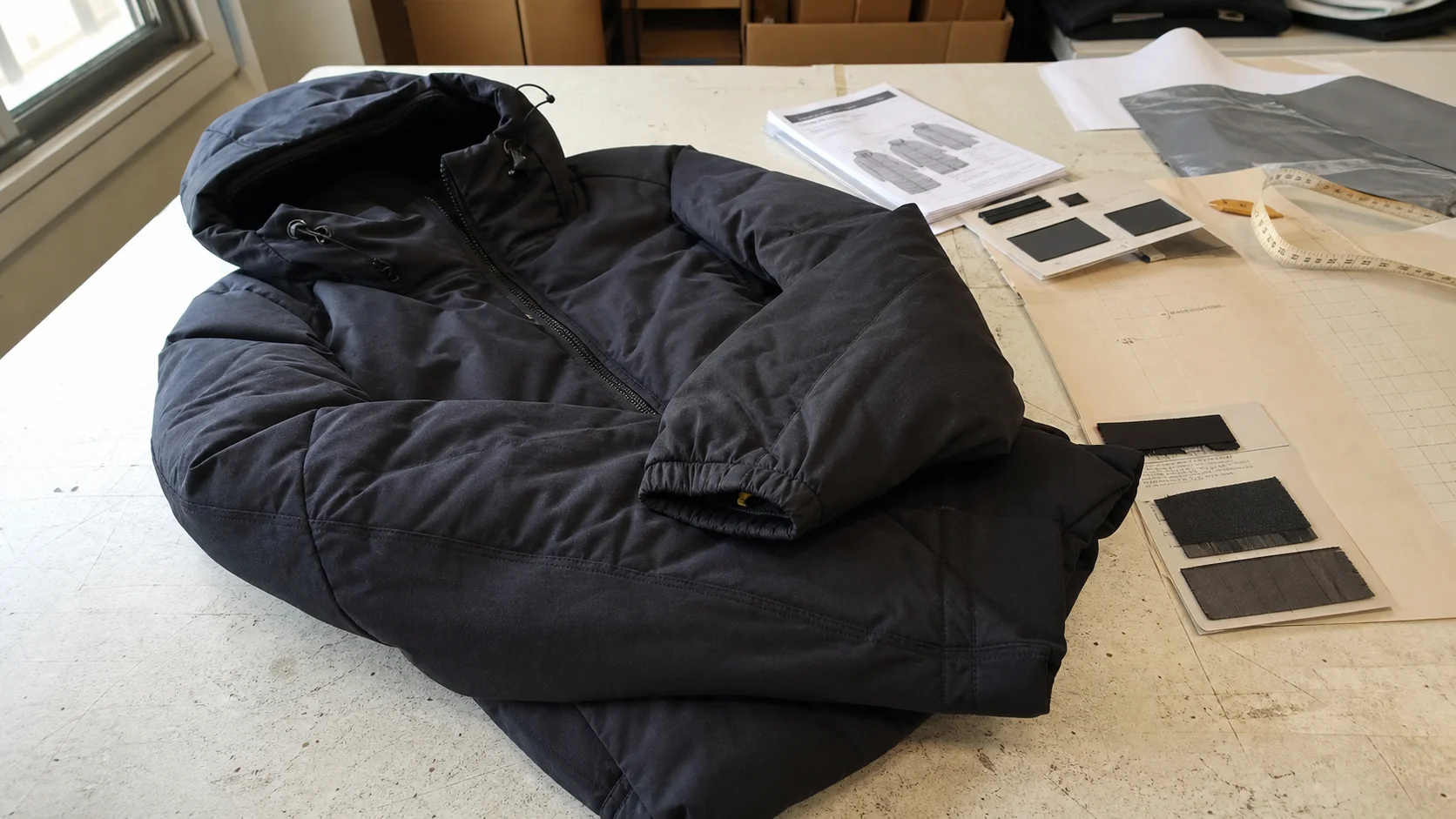
A quality inspection outline for gym program buyers reviewing custom thermal parka size grading, fit consistency, insulation bulk, movement range, and production-ready measurement tolerances before bulk approval.
Custom Thermal Parka Grading Review for Gym Buyers - Fabrikn production reference
Custom thermal parkas look straightforward on a line sheet: shell fabric, insulation, hood, zipper, pockets, logo placement, size range. The real sourcing risk sits in the grading. A parka that fits well in medium can become too short in 2XL, too bulky in XS, tight across the chest in women’s sizes, or uncomfortable through the armhole once insulation is added.
For gym program buyers, that creates more than a fit complaint. It affects staff uniform adoption, team presentation, retail sell-through, exchange rates, and reorder accuracy. A thermal parka is usually a higher-ticket garment than a tee, hoodie, or training short. If the size grading is wrong, the financial impact is larger and harder to absorb.
Size grading is the system used to increase or decrease garment measurements across sizes. In custom thermal parkas, grading must account for body measurements, intended layering, insulation loft, shell fabric behavior, cuff construction, hood coverage, and movement needs. A buyer ordering for coaches, front desk teams, outdoor training staff, athletes, or member retail should review grading with the same seriousness as fabric quality or logo execution.
Purchasing judgment: do not approve a custom thermal parka only because the base sample looks good on one wearer. Parkas need a size-set review, especially when the program includes extended sizes or mixed-gender wearers.
This review is especially important for gyms because wearers are not static. Staff may be greeting members outdoors, coaching in cold training spaces, moving equipment, running events, or layering over hoodies and tracksuits. The garment must be warm, but it also needs enough mobility to feel practical. A parka that looks premium but restricts the shoulders will sit unused.
Gym buyers usually purchase custom thermal parkas for one of three program types: staff uniforms, team or athlete outerwear, and branded retail merchandise. Each program needs a different grading review.
Staff parkas need broad fit tolerance. A gym may buy for reception teams, trainers, cleaning crews, outdoor bootcamp coaches, parking or event staff, and management. The wearer group can span many body shapes. In this case, the safest approach is a practical regular fit with enough room for a mid-layer, rather than a narrow fashion fit.
For staff uniform programs, the size range may run from XS to 3XL or 4XL. Extended sizes must not be treated as an afterthought. Chest width, sweep, sleeve bicep, armhole depth, and length need realistic grade increments. If the 3XL is simply widened without enough front length, sleeve width, or armhole adjustment, the garment may fail on real wearers.
Team parkas are often used over training kits, warm-ups, hoodies, or compression layers. Athletes may prefer longer body coverage, stronger zippers, larger pockets, and generous shoulder movement. Grading should protect range of motion, not just appearance.
A gym that runs competitive programs, youth academies, outdoor conditioning, or winter travel teams should consider whether the parka is intended for sideline warmth or everyday commuting. Sideline parkas may need longer lengths and relaxed sleeves. Everyday member-facing parkas may need a cleaner silhouette.
Retail parkas carry a different risk. Members buy based on perceived value, fit confidence, and brand appeal. Returns and exchanges can damage margin. Retail buyers should request clear finished garment measurements and consider whether the fit is unisex, men’s, women’s, or dual-fit.
A single unisex pattern can work for small runs, but it is not always ideal. It may be too long in the sleeve for smaller wearers and too narrow at the hip for some buyers. A separate women’s block adds cost and development time, yet it can improve retail satisfaction if the audience justifies it.
Brands planning a structured program can review development support through Fabrikn’s apparel services, especially when custom outerwear requires coordinated specifications, sampling, and production oversight.
A good grading review starts before the factory creates the first pattern. Gym buyers should prepare a fit brief that explains the garment’s purpose, wearer profile, layering expectation, and size range. Vague instructions such as “standard fit” or “regular parka fit” leave too much room for interpretation.
The buyer should decide whether the parka is slim, regular, relaxed, oversized, or athletic. These words need measurement support. A “regular fit” in fashion outerwear may not allow enough space over a gym hoodie. A “relaxed fit” may look too bulky for a premium front-of-house uniform.
For most gym programs, a regular-to-relaxed fit is the safest option. It allows layering without looking shapeless. The chest and sweep should have enough ease for a hoodie, but the shoulder, sleeve, and body length should still look intentional.
Thermal parkas are rarely worn over a thin T-shirt only. Buyers should specify whether the wearer will layer over:
Layering changes chest ease, armhole depth, sleeve width, and cuff comfort. If the fit sample is approved over a thin top, bulk may feel tight during actual use.
Grade rules depend on the size range. A range from S to XL is easier than XS to 4XL. Youth and adult crossover sizing adds another layer of complexity. Buyers should confirm the required size range before pattern development, not after the salesman sample is approved.
Typical adult gym parka programs often include XS to 3XL. Retail programs may stop at 2XL if demand is limited. Staff programs often need broader coverage. The tradeoff is inventory risk: wider size ranges improve wearer inclusion but increase SKU count, minimum order pressure, and leftover stock risk.
A custom thermal parka size chart should include finished garment measurements, not only body measurements. Body size charts are useful for end customers, but factories need finished specs to cut and sew consistently.
The first review should focus on the base size. For many adult programs, medium or large is used as the base sample size. Buyers should confirm which size is being sampled and whether it represents the target wearer. If most gym staff are ordering large and XL, approving only a small or medium sample can mislead the decision.
A thermal parka spec should typically include these points of measure:
Not every factory measures in the same way. The measurement method must be defined with diagrams or written instructions. A chest width taken flat across the front will differ if the garment is not smoothed consistently or if insulation shifts during measurement.
Outerwear requires practical tolerances. A common tolerance for major width measurements may be around plus or minus 1 cm to 1.5 cm, depending on fabric, quilting, insulation, and factory capability. Length tolerances may also sit near plus or minus 1 cm to 1.5 cm. Smaller components such as pocket placement, cuff width, or logo position may need tighter control.
Overly tight tolerances may create unnecessary inspection failures. Loose tolerances may allow inconsistent fit. The buyer’s job is to set tolerances that reflect real performance needs and manufacturing reality.
Point of Measure Why It Matters Common Review Risk Chest Width Controls layering comfort and main fit perception Too narrow after insulation is inserted Sweep Width Affects hip comfort and zipper closure Not graded enough in larger sizes Body Length Determines warmth coverage and silhouette Large sizes become wide but not long enough Sleeve Bicep Controls movement over hoodies or warm-ups Sleeves feel tight despite correct chest width Armhole Affects mobility and underarm comfort Armhole too high for insulated garment Hood Opening Controls coverage and comfort Too small when collar is zipped fullyGrade rules define how measurements change from one size to the next. A parka needs balanced grading. If only the chest increases, the garment may still fail because the sleeve, sweep, shoulder, and armhole do not support the larger size.
Typical adult outerwear grade increments vary by market, fit type, and size range. As a general working range, chest circumference may increase by about 8 cm to 10 cm per size, meaning flat chest width may increase by about 4 cm to 5 cm. Body length may increase more modestly, often around 1 cm to 2 cm per size. Sleeve length may increase around 1 cm to 1.5 cm per size in regular adult grading.
These are not universal rules. A fashion parka, staff uniform parka, and sideline team parka may require different increments. The best grade rule is the one that supports the intended wearer and can be verified through a size set.
Chest grading receives most attention, but sweep grading often causes the actual problem. Parkas sit over the hip, not only the upper body. If the sweep is too tight, wearers may struggle to zip the garment while seated, walking, or layering over thick bottoms.
For unisex gym parkas, sweep grading should be reviewed carefully across smaller and larger sizes. A straight body can work for many programs, but it may not suit all wearers. A two-way zipper can reduce stress at the bottom opening, especially for longer parkas, though it adds cost and requires better zipper quality control.
Movement matters in gym environments. Coaches may demonstrate drills, carry cones, open doors repeatedly, load equipment, or stand outdoors for long sessions. A tight armhole or narrow bicep can make an otherwise correct size feel wrong.
Insulation reduces internal space. The wearer feels the inside of the garment, not the outside measurement. A sleeve that measures correctly on the spec may still feel tight if thick padding, quilting, or lining construction reduces usable room.
Buyers should review sleeve bicep, elbow area, cuff opening, and armhole depth together. The sleeve should allow a bent arm without pulling sharply across the upper back. For staff uniforms, comfort usually matters more than a sharply tailored sleeve line.
Length grading is a tradeoff. Longer parkas provide warmth and coverage, but they can restrict movement, increase cost, and complicate packing. Shorter parkas are easier to wear but may not deliver the expected thermal value.
For gym programs, mid-thigh or upper-thigh coverage is common for cold-weather staff and team outerwear. Waist-length insulated jackets may work for lifestyle retail, but they should not be described as parkas unless the buyer and end user share that expectation.
In larger sizes, insufficient length can make the garment look boxy. In smaller sizes, too much length can overwhelm the wearer. The grade must preserve proportion, not simply follow a fixed width increase.
Hoods are often under-reviewed. A thermal parka hood must work with the collar, zipper, drawcord, and lining. If the hood opening is too small, the face area feels compressed. If too large, warmth and coverage suffer.
For gym buyers, hood design depends on use. Outdoor coaching may benefit from an adjustable hood. Retail programs may prefer a cleaner fixed hood. A detachable hood adds flexibility but increases trim cost and quality risks around snaps, zippers, and seam alignment.
Thermal parka grading cannot be separated from material selection. Fabric and insulation change both appearance and internal fit. A size chart developed for a light shell jacket cannot simply be reused for a padded parka.
Common shell options include polyester pongee, nylon taslon, polyester oxford, recycled polyester, or coated woven fabrics. Buyers may specify water-resistant, wind-resistant, matte, ripstop, or cire finishes. Heavier shells can hold shape but may feel stiff. Softer shells may wear comfortably but show quilting tension or seam puckering more clearly.
Fabric weight and coating affect grading because stiffer fabrics require more ease for movement. A crisp coated shell with thick insulation may need more chest and sleeve room than a soft uncoated shell.
Insulation can be synthetic padding, down, down-like fiberfill, or recycled fill. Synthetic padding is common for gym programs because it is easier to manage, usually more cost predictable, and less sensitive than down in routine uniform use. Down may offer premium warmth-to-weight performance, but it requires stricter control on fill power, fill weight, leakage, odor, and care labeling.
Typical synthetic fill weights may vary widely, often around 120 gsm to 240 gsm depending on climate target, price point, and garment design. Heavier fill improves warmth but adds bulk and can reduce mobility. The buyer should not approve size grading without knowing the intended fill weight and distribution.
Lining affects how easily the parka slides over layers. Polyester taffeta linings are common because they are smooth and cost effective. Brushed or fleece linings add warmth but increase friction and bulk. Quilted linings stabilize insulation but may reduce flexibility.
Internal storm flaps, chest pockets, drawcord channels, and waist adjusters also affect fit. A parka may measure correctly externally but feel tight at the waist if an internal drawcord tunnel is bulky or poorly placed.
Grading also interacts with trims. Zipper length changes by size if body length changes. Snap placement, pocket size, drawcord length, cuff rib, hook-and-loop tabs, elastic, toggles, and labels all need size-aware review.
For gym programs, durable trims are usually worth the cost. A low-grade zipper can make the whole parka feel cheap, even if the fabric is good. Two-way zippers, waterproof zippers, branded pullers, and hidden snaps can improve perceived value but add inspection points.
Component Specification to Confirm Purchasing Tradeoff Shell Fabric Fiber content, weight, coating, water resistance, colorfastness Higher durability may mean more stiffness and higher cost Insulation Type, gsm or fill weight, distribution, thermal target More warmth can reduce mobility and increase freight volume Lining Material, weight, quilting, friction, color Smoother lining improves wearability over layers Zipper Gauge, brand level, one-way or two-way, puller type Better zippers reduce complaints but raise unit cost Cuffs Elastic, rib, tab adjuster, opening measurement Tighter cuffs hold warmth but may restrict larger hands or watchesA disciplined sample process reduces grading risk. Gym buyers should avoid jumping from one nice-looking sample straight into bulk production. Thermal parkas have too many variables for that shortcut.
The development sample checks the initial concept, silhouette, construction, fabric direction, and branding approach. It may not use final trims or final insulation. Buyers should treat this sample as a learning stage, not a production approval.
At this stage, review the base size measurements against the spec. Check whether the garment can be worn over the intended layer. Look at shoulder movement, sleeve comfort, hood coverage, zipper operation, pocket access, and logo position.
The fit sample should move closer to final fabric, insulation, and construction. If substitutes are still used, the factory should clearly state what differs. Buyers should be cautious when approving fit based on a thinner substitute fill or lighter shell.
Fit should be reviewed on more than one wearer if possible. A single model can hide issues. If the parka is unisex, test it across different body shapes. If it is staff uniform outerwear, test over the actual uniform layer.
The size set is the core grading review. Buyers should request samples across the size range, not only the base size. For budget reasons, some programs review XS, M, XL, and 3XL instead of every size. Full-size sets are better, but partial size sets can still catch major grading problems.
For size sets, measure each garment flat and compare it with the approved spec. Then try on key sizes where practical. The objective is not only to confirm numbers. It is to confirm proportion, movement, and consistency.
The pre-production sample should represent bulk production. Final shell, lining, insulation, trims, labels, logo method, packaging, and care instructions should be confirmed. This sample is the reference for production and inspection.
Do not approve a pre-production sample with unresolved grading comments. If the chest is approved but the sleeve bicep still needs adjustment, record the correction clearly and request confirmation before cutting bulk fabric.
A top of production sample is taken from the first production output. This step checks whether the factory followed the approved sample and spec. It is useful for thermal parkas because bulk sewing can differ from sample room construction.
If top of production measurements drift, buyers need fast correction before the full order is completed. Once hundreds or thousands of insulated garments are sewn, correction becomes expensive and often unrealistic.
Minimum order quantity for custom thermal parkas depends on fabric availability, color, trim customization, insulation type, size range, and branding method. Buyers should treat any MOQ quote as conditional until the full specification is known.
For custom thermal parkas, typical MOQ ranges may look like this:
These ranges vary by supplier and material. Small orders can be possible, but unit cost rises and fabric options narrow. For gym buyers, the key question is not only “Can the supplier make 100 pieces?” It is “Can the supplier make 100 pieces with proper grading, reliable trims, and acceptable inspection control?”
Thermal parka lead times are sensitive to material sourcing. Typical custom production timelines may range from 60 to 120 days after final sample approval, depending on the season, material availability, factory capacity, and complexity. Sampling can add several weeks, especially if a size set is required.
Lead time depends on:
Winter outerwear should be planned early. Factories become more constrained ahead of cold-weather selling seasons. Late orders often force buyers into stock fabrics, limited colors, rushed sampling, or higher freight costs.
Better grading review may add sampling cost, but it protects the order. Size sets require time and material. Extended sizes consume more fabric and insulation. Separate men’s and women’s blocks increase development cost. These costs are not waste if the program depends on fit satisfaction.
For a one-off promotional order, a stock parka with logo decoration may be the more sensible choice. For a gym brand building a repeatable uniform or retail program, custom grading is worth more because the approved block can support future reorders.
Buyers that need help aligning specifications, development steps, and production feasibility can contact Fabrikn before committing to a final technical package or supplier quote.
Inspection for thermal parkas should cover measurements, workmanship, function, material quality, labeling, packing, and branding. Size grading is one part of inspection, but it connects to many other defects.
Measurement drift happens when bulk garments do not match the approved spec. Causes may include inaccurate cutting, inconsistent seam allowance, insulation thickness variation, quilting tension, poor pressing, or fabric shrinkage. Parkas can be harder to measure than flat woven shirts because padding and loft affect how the garment sits on the table.
Inspection teams should measure garments using the same method defined in the spec. If the parka is puffy, it should be laid flat without excessive compression. Compressing insulation to hit measurement points can hide real fit issues.
Uneven insulation can create cold spots, lumpy appearance, and inconsistent fit. In quilted designs, stitch tension can affect panel size. In channel-filled designs, fill migration can distort the garment after handling.
Buyers should define whether insulation weight is measured by gsm, total fill weight, or panel allocation. If warmth is a key selling point, the inspection plan should include checks for insulation consistency, not only external appearance.
Quilting lines can shrink panels slightly. If grading does not account for quilting take-up, finished garments may come out smaller than expected. This matters across chest, sleeve, and length measurements.
Bulk quilting should be compared against the approved sample. Uneven quilting can alter the silhouette and make larger sizes look poorly proportioned. For gym retail, visible panel distortion can reduce perceived value quickly.
Zipper failure is one of the most visible outerwear complaints. Inspectors should test zipper operation across sizes, especially larger sizes where garment tension is higher. Two-way zippers must align correctly and engage smoothly.
Storm flaps, snaps, hook-and-loop closures, and chin guards should be checked for placement. A zipper that catches lining or storm flap fabric will frustrate wearers, even if it technically passes a visual inspection.
Logo grading is often missed. A left chest embroidery that looks correct on medium may sit too close to the armhole on XS or too high on 3XL. Back logos can also shift visually if body length changes.
Logo placement should be specified by measurement from fixed points, such as center front, shoulder seam, or armhole. For curved or padded surfaces, embroidery quality may vary. Patches may work better than direct embroidery on thick insulated panels, depending on the design.
Parkas often combine shell fabric, lining, rib cuffs, drawcords, zipper tape, snaps, patches, and embroidery thread. Shade mismatch can be obvious. Black is not always the same black across materials. Navy can be especially difficult.
Buyers should request lab dips or color standards for custom-dyed materials. Bulk inspection should compare components under consistent lighting. For gym brands with strict brand colors, trim matching deserves early attention.
A custom thermal parka should not move into bulk production until the buyer has reviewed fit, grading, construction, materials, branding, and inspection criteria. The following checklist is designed for practical purchasing control.
Direct purchasing judgment: if the supplier cannot provide a clear size chart, grade rule, and pre-production sample that matches final materials, the order is not ready for bulk production.
Every custom thermal parka program involves tradeoffs. The best decision is not always the most expensive one. It is the decision that fits the program’s use, budget, timing, and risk tolerance.
A stock body with custom branding is faster and usually cheaper. It works for short-term events, small staff groups, and promotional programs. The downside is limited control over fit, size range, fabric, and trim quality.
Fully custom grading gives better control and repeatability. It suits long-term gym uniforms, premium retail, and team programs. The downside is higher MOQ, longer development time, and more sampling responsibility.
Unisex fit reduces SKU complexity and development cost. It is practical for staff programs where order management must stay simple. The drawback is that some wearers may compromise on sleeve length, hip shape, or shoulder fit.
Separate men’s and women’s fits improve fit satisfaction when the audience is large enough. They also increase pattern work, size sets, inventory planning, and MOQ pressure.
More insulation is attractive on paper, but it can make the parka bulky. Gym staff may prefer a slightly lighter parka that allows movement over a very warm garment that feels restrictive. The buyer should match warmth to real climate and use, not only to marketing language.
Premium trims, shaped panels, waterproof zippers, detachable hoods, internal pockets, and branded hardware can elevate the product. They also add failure points. For large staff programs, simpler construction may deliver better consistency. For retail, premium details may justify a higher selling price if execution is controlled.
A sourcing partner with a clear process can help buyers weigh these tradeoffs. Buyers can learn more about company background and operating focus at Fabrikn’s about page.
A size set review should be organized, not casual. Start with the approved spec and measurement method. Lay each garment flat. Measure in the same order for every size. Record actual measurements against target measurements and tolerance.
Next, review proportions visually. Hang the garments by size order. Look for jumps that seem too large or too small. Check whether the sleeve length, body length, pocket placement, hood scale, and logo position look balanced.
Then conduct wear testing where possible. Ask wearers to zip the parka fully, raise arms, cross arms, sit down, bend slightly, use pockets, adjust hood, and move as they would during work. A parka that only feels good while standing still is not fully approved.
Pay close attention to the largest and smallest sizes. These sizes expose weak grading quickly. XS may have oversized pockets or long sleeves. 3XL may have tight biceps, short length, or a restrictive sweep. The middle sizes often hide these problems.
If the size set shows problems, classify them. Some issues are pattern corrections. Some are construction issues. Some are spec tolerance issues. A tight bicep across all larger sizes needs a grade or pattern adjustment. One garment measuring small may be a sewing or cutting deviation. The corrective action depends on the root cause.
Gym buyers should keep the documentation simple but complete. At minimum, the production file should include a technical specification, approved size chart, grade rules, bill of materials, artwork file, label details, packaging instructions, and inspection criteria.
The size chart should show target measurement, tolerance, and measurement method. The bill of materials should list shell fabric, lining, insulation, zippers, snaps, drawcords, labels, thread, and packaging. Artwork files should include color references, placement measurements, and logo sizes for each placement.
Approval comments should be dated and version controlled. If the buyer requests a sleeve adjustment after the fit sample, that adjustment should appear in the next spec revision. Verbal comments are not enough. In outerwear production, small misunderstandings become expensive mistakes.
A custom thermal parka size grading review is not just a technical formality. It is a buying control point. For gym program buyers, it protects staff comfort, retail margin, brand presentation, and reorder confidence.
The strongest programs start with a clear fit brief, use realistic finished garment measurements, review a size set, confirm final materials before approval, and inspect bulk production against documented tolerances. The weakest programs approve a good-looking base sample and hope the full size range works.
That hope is not a sourcing strategy. Thermal parkas are complex garments with high material content, bulky construction, and visible fit expectations. Buyers should make grading decisions early, document them clearly, and treat size-set review as a required step for any meaningful custom program.
Get a free quote from Fabrikn — your trusted B2B clothing manufacturer with 10+ years of experience. MOQ as low as 200 pieces.
Get a Free Quote →Size grading is the process of increasing or decreasing garment measurements across sizes. In a thermal parka, grading covers chest, sweep, body length, shoulder, sleeve, armhole, cuff, hood, and other measurements. Good grading keeps fit and proportion consistent from the smallest to largest sizes.
Parkas include shell fabric, insulation, lining, zippers, hoods, storm flaps, pockets, and sometimes quilting. These components add bulk and reduce internal space. A hoodie is usually more flexible, while a parka requires more careful ease and construction review.
Unisex sizing can work for staff programs and smaller orders because it simplifies inventory. The tradeoff is fit compromise. If the program has enough volume and a strong retail focus, separate men’s and women’s fits may improve customer satisfaction.
A full size set is best. If budget or time is limited, buyers should review key sizes such as XS, M, XL, and 3XL, depending on the final range. The smallest and largest sizes are especially important because they reveal grading problems quickly.
Typical MOQ may range from about 100 to 300 pieces for low-customization or stock-based programs, 300 to 600 pieces for custom color or fabric programs, and 500 to 1,000 pieces or more for fully custom outerwear. Actual MOQ depends on fabric, trims, colorways, size range, and supplier capacity.
Custom production often takes around 60 to 120 days after final sample approval. Sampling, size-set review, custom fabric, special trims, factory capacity, inspection, and shipping can extend the timeline. Winter programs should be planned early to avoid rushed decisions.
Chest width, sweep, body length, shoulder width, sleeve length, bicep width, armhole, cuff opening, and hood opening are key measurements. Pocket placement and logo position should also be reviewed across sizes.
Insulation reduces usable internal space and adds bulk. A parka can measure correctly on the outside but feel tight when worn. Buyers should approve fit using the intended insulation type and weight whenever possible.
Common issues include measurement drift, uneven insulation, zipper problems, quilting distortion, shade mismatch, loose seams, poor logo placement, and inconsistent cuff or hood construction. Larger sizes can show stress at zippers and seams if grading is weak.
A stock parka with custom branding is sensible for small runs, tight deadlines, or event use. Fully custom parkas are better for long-term staff uniforms, premium retail programs, or repeat orders where fit, materials, and brand details need tighter control.