
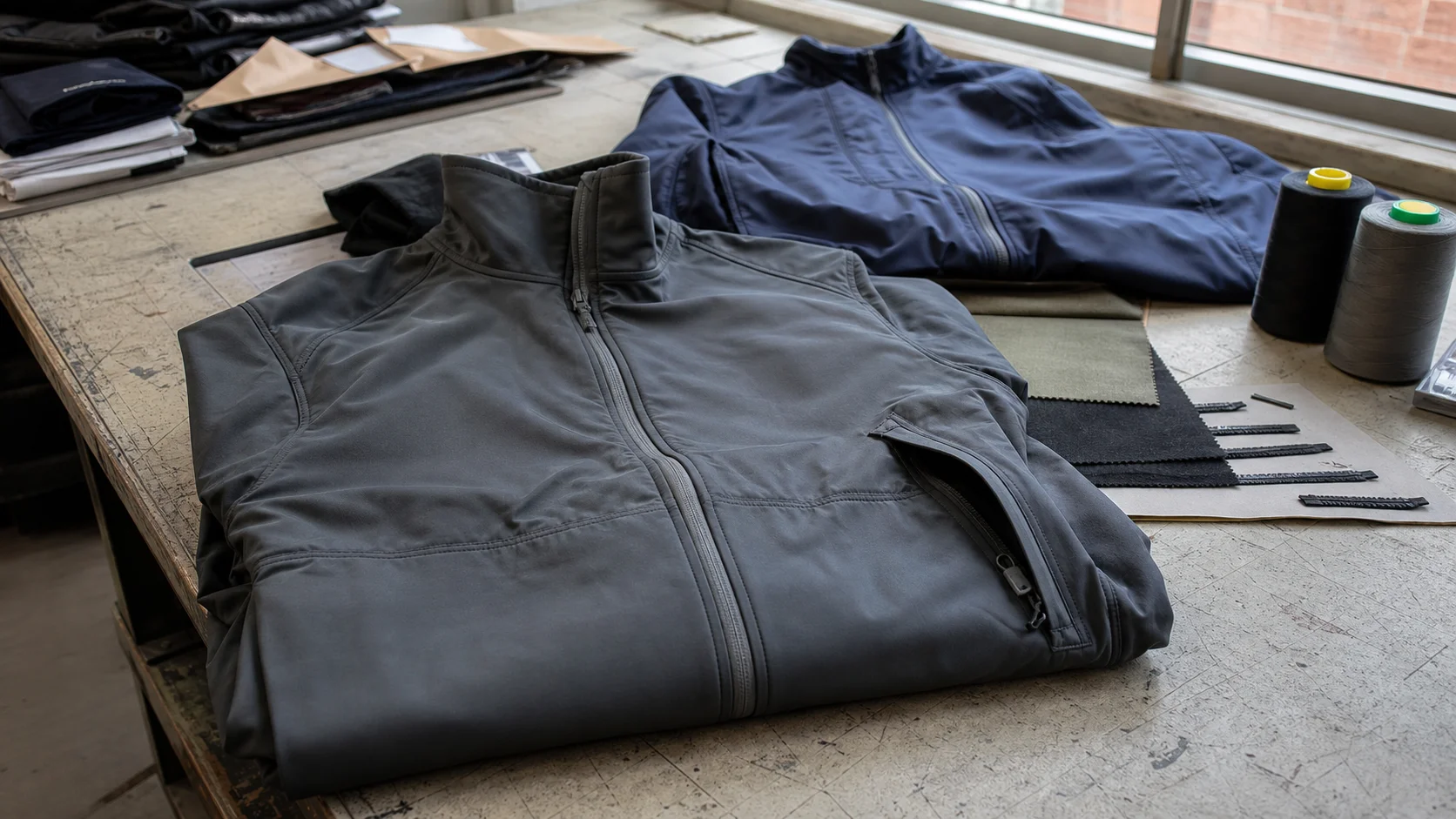
A 2500-word SEO outline for construction safety teams reviewing reorder risks tied to work jacket factories, including fabric consistency, ANSI visibility, sizing, labeling, lead times, and production artifacts before placing repeat outerwear orders.
Work Jacket Reorder Risk Review for Safety Teams - Fabrikn production reference
A work jacket reorder looks simple on paper. The first bulk order was approved, the site teams used the jackets, and the purchasing department now needs more units before the next cold-weather period or project mobilization. In practice, a reorder can carry more risk than the original production run if the factory, fabric mill, trims, color standard, or inspection plan is not controlled properly.
For construction safety teams, the issue is not only appearance. A jacket that arrives with lighter fabric, weaker stitching, poor zipper performance, inconsistent reflective tape, or a changed fit can create complaints across the workforce and may affect site safety expectations. Outerwear is worn over layers, exposed to abrasion, rain, dust, concrete residue, machinery, and repeated washing. Small changes in production can become operational problems quickly.
A factory reorder risk review gives procurement, safety, and operations teams a structured way to check whether the second or third order will match the approved garment. It is a practical purchasing control, not a paperwork exercise. The goal is to confirm what must stay unchanged, what can be improved, and what requires new approval before bulk production starts.
Teams sourcing work jackets from overseas or regional manufacturers should treat every reorder as a controlled production event. The risk is higher when the reorder is placed months after the first shipment, when quantities are smaller, when the original fabric has been discontinued, or when the factory proposes substitutions to meet a tight delivery date. A clear review protects the buyer from avoidable quality disputes and gives the supplier a precise standard to follow.
Direct purchasing judgment: do not release a work jacket reorder only from a previous invoice or style code. Reconfirm the approved sample, technical file, fabric standard, trim list, color references, labeling, packaging, and inspection criteria before the factory cuts bulk fabric.
Many reorder failures happen because the buyer assumes the original factory file is still active and unchanged. In reality, apparel production is built from separate inputs: shell fabric, lining, padding, zipper, snaps, thread, hook-and-loop tape, reflective tape, labels, packaging, and labor allocation. Any one of these can change between production runs.
Common reorder changes include fabric shade variation, coating performance differences, lining substitution, zipper brand changes, revised sleeve length, different rib quality, altered pocket depth, changed embroidery position, and inconsistent carton packing. Some changes are intentional because the supplier is trying to solve cost or availability issues. Others happen because the factory purchasing team sources from a different trim supplier without realizing the buyer considers the original component mandatory.
Work jackets for construction use are especially sensitive because they combine durability, comfort, visibility, and practical storage. A fashion jacket may tolerate minor trim changes if the look remains acceptable. A safety-oriented work jacket has less room for compromise. If reflective tape is narrower, poorly placed, or not certified to the required standard, the garment may fail the buyer’s internal safety requirement. If the outer fabric loses water resistance too quickly, workers may reject it. If sizing shrinks, crews may be unable to layer hoodies or thermal tops underneath.
A reorder review should start with these triggers. If none apply, the process may be straightforward. If several apply, the buyer should slow down and require a stronger pre-production approval stage.
A good reorder review does not need to be complicated. It should answer four questions: what must match, what can change, what must be tested, and what must be inspected before shipment. The review should be shared with the factory in writing, preferably as part of the purchase order package.
For buyers working with a sourcing partner or manufacturing platform, the reorder review should sit alongside the tech pack and commercial order terms. A supplier should not need to guess whether the buyer cares more about shade consistency, waterproof rating, reflective tape compliance, fit consistency, or delivery speed. If the buyer needs support structuring the process, a supplier-facing development and production service such as Fabrikn services can be used as a reference point for organizing requirements across sampling, production, and quality control.
The review should separate “same as previous order” items from “updated by buyer request” items. If the safety team wants to improve sleeve articulation, add radio loops, change logo placement, or increase insulation, the reorder is no longer a pure repeat order. It becomes a revised production order and should go through new sample approval.
Fabric is usually the highest-value input in a work jacket and one of the most common sources of reorder disputes. The buyer may remember the jacket as “black softshell” or “navy padded work jacket,” but that description is not enough for factory control. A reorder should identify the exact fabric specification and acceptable alternatives.
For construction outerwear, common shell fabric options include polyester oxford with PU coating, polyester pongee with padding, cotton-poly canvas, softshell bonded fabric, fleece-lined polyester, and ripstop blends. Each fabric behaves differently in abrasion, water resistance, warmth, breathability, and wash performance. A 300D polyester oxford with PU coating is not the same as a lighter 150D fabric, even if the color and hand feel appear similar during a quick desk review.
Trim control deserves the same attention. Zippers are a frequent complaint point in work jackets because they are handled daily, often with gloves, and may be stressed by bulky layers underneath. A low-cost zipper can save money at purchase order stage and create field complaints within weeks. For high-use construction jackets, specify zipper size, material, slider type, puller design, and whether the zipper must be branded or tested to a cycle standard.
Reflective tape is another high-risk trim. The buyer should define width, placement, color, wash durability, and relevant standard if visibility is part of the safety requirement. The factory should not replace segmented tape with solid tape, or certified tape with general reflective material, without written approval. If a high-visibility classification is claimed, the garment design and tape layout need proper confirmation, not only visual acceptance.
Tradeoff: insisting on the exact same fabric and trims gives better consistency but may increase lead time or MOQ. Accepting equivalents can protect delivery dates, but only if the substitute is reviewed against performance, compliance, and worker acceptance requirements.
Fit risk is often underestimated in work jacket reorders. Construction teams rarely wear jackets over a single thin layer. A practical work jacket must allow movement over base layers, hoodies, high-vis vests, tool belts, harnesses, or bib overalls depending on the job. If the reorder comes in narrower across the chest or shorter in the sleeve, the issue will be noticed quickly.
The buyer should confirm whether the factory still has the original pattern and grading file. If the first order was adjusted during production after a fit sample or pre-production sample, those changes must be reflected in the current pattern. A common mistake is approving changes by email during the first order but failing to update the master measurement chart. The factory then uses an older pattern for the reorder.
Measurement tolerances should be realistic. Outerwear is bulkier than shirts, and padded jackets can be harder to measure consistently. A typical tolerance may range from plus or minus 1 cm for smaller details to plus or minus 2 cm for larger garment dimensions, depending on the size range and construction. The key is to define the tolerance before inspection rather than arguing after shipment.
Size curve changes also deserve review. Construction teams often need larger sizes than retail fashion assortments. If the original order included a high share of XL, 2XL, 3XL, or 4XL sizes, the reorder should be planned around actual usage rather than a generic size ratio. Larger sizes may require more fabric consumption and can influence costing. Factories may also need confirmation that grading remains functional rather than simply expanding width without adjusting sleeve, armhole, and shoulder balance.
Safety teams should be careful with compliance language. A jacket can be bright yellow or orange without automatically meeting a recognized high-visibility garment standard. A jacket can feel warm without meeting a thermal rating. A shell can repel light rain without being waterproof. Reorder documents should describe claims accurately and require supporting documentation where claims matter.
If the work jacket is intended for high-visibility use, the buyer should check background fabric color, reflective tape width, tape placement, garment coverage, and wash performance. If the jacket must meet ANSI/ISEA, EN ISO, or another market-specific standard, that requirement should be in the purchase order and technical file. A lab test report should match the material and garment design being reordered, not a loosely related fabric from a past development.
For flame-resistant, arc-rated, chemical-resistant, or other specialized protective jackets, the risk review becomes more technical. The buyer should not accept material substitution without qualified compliance review. A garment can look identical and perform very differently under hazard conditions. Construction safety teams should involve their internal EHS, legal, or compliance stakeholders before approving any replacement fabric or trim in protective outerwear.
Purchasing should also consider whether a design feature creates site-level risk. Loose drawcords, weak snap attachments, poor hood peripheral vision, or bulky pocket flaps may be irritating at best and unsafe at worst. A reorder is a good moment to review actual wearer feedback before repeating the same detail.
Minimum order quantity is one of the most practical constraints in work jacket reorders. A factory may have accepted a lower quantity for the first order to win the program, then require a higher MOQ for repeats. The real MOQ may come from the fabric mill, dye house, padding supplier, zipper supplier, reflective tape supplier, or packaging vendor rather than the sewing factory alone.
Typical MOQ ranges vary by fabric and customization level. Basic stock-fabric work jackets may be possible around 300 to 500 pieces per color if the factory has fabric access. Custom-dyed fabrics often require 800 to 1,500 pieces per color, sometimes more. Highly customized padded jackets, bonded softshells, or certified high-visibility garments may sit around 1,000 to 3,000 pieces per color depending on material sourcing and testing requirements. Small reorders below 300 pieces may be possible, but buyers should expect higher unit prices, fewer fabric choices, or longer consolidation time.
Reorder Type Typical MOQ Range Main Constraint Stock fabric, standard trims 300-500 pcs per color Factory cutting and sewing efficiency Custom color shell fabric 800-1,500 pcs per color Fabric dyeing and finishing minimums Padded winter work jacket 800-2,000 pcs per color Shell, lining, padding, quilting, and bulk handling High-visibility jacket with certified materials 1,000-3,000 pcs per color Certified fabric, reflective tape, and compliance documentation Small urgent top-up order 100-300 pcs if feasible Available stock materials and factory scheduleLead time depends on material availability, approval speed, factory capacity, and shipping method. A realistic reorder using existing approved materials may take 45 to 75 days after order confirmation. If fabric must be custom dyed, coated, bonded, quilted, or tested, 75 to 120 days is more realistic. Air shipment can reduce transit time but may be uneconomical for bulky padded jackets. Sea freight is usually more cost-effective but requires earlier planning.
Buyers should ask the factory to separate material lead time, sample lead time, production lead time, inspection window, and shipping time. A single promised delivery date is not enough. If the order is needed for winter mobilization, the purchasing team should place the reorder before the peak outerwear production season. Factories fill capacity quickly when multiple buyers rush cold-weather products at the same time.
Direct purchasing judgment: if the reorder is both urgent and below MOQ, do not expect the lowest price and perfect material continuity. Choose the priority early: exact repeat quality, fast delivery, or reduced cost. Pushing for all three usually transfers risk into production.
A reorder does not always need a full development cycle, but it does need controlled confirmation. The level of sampling should match the risk level. If all materials are unchanged, the original sealed sample is available, and the factory has produced the style recently, a pre-production sample may be enough. If any material, trim, fit, or compliance detail changes, the buyer should require approval before bulk cutting.
For repeat work jacket programs, the best practice is to keep a master approval file. This file should include the tech pack, bill of materials, graded measurement chart, artwork, color standards, fabric test reports, trim approvals, care label copy, carton markings, and inspection checklist. The supplier should confirm any deviation from that file before production.
Sample approval should not focus only on appearance. The buyer should zip and unzip the jacket repeatedly, test pocket access with gloves, check whether the hood affects visibility, review sleeve movement, and confirm that the garment fits over expected work layers. If reflective tape crosses pockets or seams, the buyer should check whether it wrinkles, lifts, or distorts after handling.
When using logos or company branding, reorders can create avoidable errors. Embroidery thread shade, logo size, patch position, heat-transfer temperature, and backing material should be confirmed again. A jacket may pass general workmanship inspection but fail brand acceptance if the chest logo is crooked or inconsistent across sizes.
Final inspection is the last practical control before goods leave the factory. For work jackets, inspection must go beyond loose threads and visual defects. Bulk outerwear can hide quality issues because garments are padded, packed tightly, and inspected under time pressure. The inspection plan should be specific to the garment’s risk areas.
AQL inspection is commonly used, but the buyer should define the sampling level and defect classification in advance. Critical defects may include incorrect safety labeling, missing reflective tape, sharp objects, broken zipper function, contaminated garments, or mixed styles. Major defects may include open seams, wrong measurements outside tolerance, poor quilting alignment, defective snaps, shade variation, and incorrect logo placement. Minor defects may include small thread ends, slight pressing marks, or acceptable cosmetic issues that do not affect use.
Inline inspection can be valuable for larger reorders, especially if the first order had defects or if new materials are being used. It allows the buyer or third-party inspector to catch issues after cutting and early sewing rather than waiting until cartons are packed. For padded jackets, inline checks can prevent repeated errors in quilting, sleeve attachment, zipper setting, and reflective tape positioning.
Carton inspection should not be treated as an afterthought. Safety teams often distribute jackets directly to job sites, depots, or regional offices. Incorrect size stickers, mixed color lots, wrong carton ratios, or weak cartons can slow distribution and create unnecessary administrative work. If the order is being split by project, location, or department, the packing plan must be agreed before production ends.
Good sourcing decisions balance risk, cost, and operational urgency. A construction safety team may want the exact same jacket delivered quickly at the same price as last year, but market conditions may have changed. Fabric prices, freight costs, labor availability, and raw material lead times can all move between orders. The buyer’s job is to decide where flexibility is acceptable and where it is not.
For safety-critical features, flexibility should be limited. Reflective tape compliance, high-visibility color, flame-resistant properties, durable closures, and accurate labeling should not be traded away to save a small amount. For non-critical details, controlled substitutions may be reasonable. A slightly different lining color, alternate zipper puller, or revised carton size may be acceptable if documented and approved.
Price comparisons should account for total program cost. A cheaper reorder that produces high return rates, worker complaints, or replacement purchases is not a saving. A higher unit price may be justified if the factory secures the same fabric, maintains fit consistency, and meets the delivery window. Procurement should also consider whether spreading small reorders across multiple suppliers creates inconsistency across the workforce.
Supplier communication should be direct. Ask the factory to identify what is identical to the previous order and what is different. Ask whether the same fabric mill and trim suppliers are being used. Ask whether any subcontracted processes are involved. Ask for production photos, material cards, and a pre-production sample before bulk cutting. If the factory resists basic confirmation, that is itself a risk signal.
Companies reviewing new outerwear production partners can use the supplier’s transparency as an early filter. A suitable manufacturer should be able to discuss MOQ, lead time, sampling, material substitutions, inspection, and packing without vague promises. To evaluate whether a partner is aligned with structured manufacturing expectations, buyers can review company background information through pages such as Fabrikn about us or start a sourcing conversation through Fabrikn contact us.
A disciplined reorder review protects both sides. The buyer reduces operational risk, and the factory receives clearer production instructions. Work jackets are not disposable promotional items when they are used on construction sites. They are part of the daily safety and comfort system for crews. Treating the reorder with the same seriousness as the original development is the practical way to avoid preventable problems.
Get a free quote from Fabrikn — your trusted B2B clothing manufacturer with 10+ years of experience. MOQ as low as 200 pieces.
Get a Free Quote →A work jacket factory reorder risk review is a structured check before repeating a previous production order. It confirms whether the approved sample, fabric, trims, sizing, safety details, labeling, packaging, lead time, and inspection plan are still valid. The purpose is to prevent the reorder from drifting away from the original approved jacket.
A reorder can be risky because materials, trim suppliers, factory staff, subcontractors, and production capacity may have changed. The factory may also use an outdated pattern or substitute components to meet price or delivery pressure. Without a fresh review, these changes may only be discovered after shipment.
Typical MOQ ranges from 300 to 500 pieces per color for stock-fabric jackets, 800 to 1,500 pieces for custom fabric colors, and 1,000 to 3,000 pieces for more technical or certified high-visibility outerwear. Smaller top-up orders may be possible, but usually with higher pricing, limited material options, or longer scheduling constraints.
A straightforward reorder using available approved materials may take about 45 to 75 days after order confirmation. Reorders requiring custom fabric, coating, bonding, padding, testing, or new sample approval may need 75 to 120 days. Shipping method and peak-season factory capacity can change the final timeline.
Not every reorder needs a full development sample, but most should have at least a pre-production sample or material reconfirmation. If fabric, trims, fit, logo placement, safety features, or compliance claims change, new sample approval is strongly recommended before bulk cutting.
The main inspection risks are wrong measurements, weak zippers, defective snaps, poor seam strength, shade variation, incorrect reflective tape placement, uneven padding, wrong labels, and mixed packing ratios. Safety-related features should be treated as higher-risk inspection points than general cosmetic defects.
The factory can use equivalent fabric only if the buyer reviews and approves it. The substitute should be checked for composition, weight, color, coating, durability, shrinkage, wash performance, and any required safety or visibility standard. Verbal approval is not enough for a controlled reorder.
Procurement, safety, operations, and quality teams should be involved when the jacket affects field use. Compliance or EHS stakeholders should review any high-visibility, flame-resistant, arc-rated, or other protective claims. The factory should provide samples and written confirmations before production starts.