
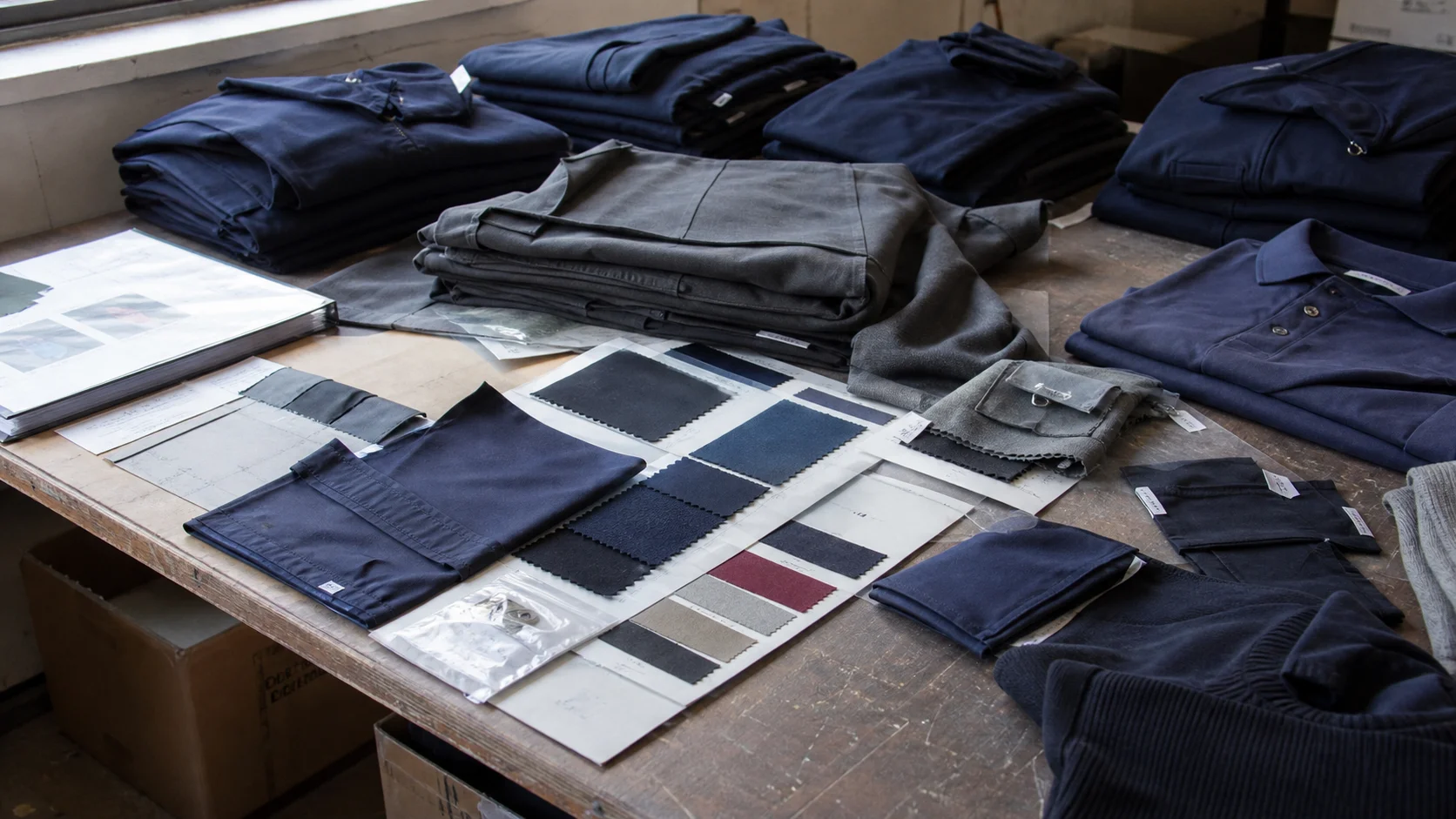
A buyer-focused outline for outdoor school teams reviewing reorder risks, MOQ exposure, cost drivers, and production artifacts before committing to workwear uniform suppliers.
Workwear Uniform Reorder Risk Review for Schools - Fabrikn production reference
Outdoor school buyers face a different uniform sourcing problem from standard classroom apparel buyers. Workwear uniforms are expected to handle wet grass, mud, storage rooms, playground supervision, maintenance work, outdoor learning, transport duty, and frequent washing. The first purchase often gets the most attention, but the reorder is where many supply problems become visible.
A reorder can look simple on paper: same jacket, same trouser, same fleece, same embroidery, same colors. In practice, every reorder carries risk. Fabric lots change. Trim suppliers discontinue zips. Size curves shift after a year of student intake. Minimum order quantities may rise. A supplier may still offer the style but no longer hold greige fabric, reflective tape, elastic, or branded labels in stock. For schools buying outdoor workwear uniforms, the reorder risk review should be treated as a buying control, not an administrative formality.
This article is written for procurement teams, school business managers, uniform coordinators, outdoor education buyers, and academy trust sourcing staff reviewing workwear uniform supplier reorder risk. The focus is MOQ, cost, and sourcing discipline: how to identify weak points before they disrupt availability, inflate cost, or force rushed substitution.
Outdoor school uniforms and workwear items sit in a demanding category. They are not purely fashion garments, and they are not always full industrial PPE either. Many items fall into the middle ground: durable jackets, waterproof trousers, softshells, fleeces, gilets, cargo trousers, polos, hi-vis tabards, aprons, maintenance tops, and staff outerwear with school branding.
The reorder risk comes from this mixed role. A school may need consistent visual identity, acceptable durability, child-safe construction, weather resistance, and budget stability at the same time. The supplier may be sourcing from a garment factory, fabric mill, embroidery unit, print shop, and accessories vendor. Any change in that chain can affect the next delivery.
For outdoor school buyers, the practical question is not simply, “Can the supplier reorder this?” The better question is, “Can the supplier reorder this to the same specification, in the right size mix, within the required term schedule, without unexpected cost or quality drift?”
A reorder should be reviewed like a controlled repeat production run. If the specification, components, and production route are not locked, the school is exposed to avoidable risk.
Schools also face fixed calendar pressure. A delayed commercial workwear order can sometimes be pushed into the next warehouse cycle. A delayed school uniform reorder may collide with term starts, outdoor education trips, maintenance schedules, induction weeks, and parental purchase windows. Small delays become visible quickly.
A strong reorder review separates risk into practical buying categories. This helps buyers avoid vague supplier reassurance and ask for evidence instead. The main areas are MOQ, price, specification continuity, size availability, branding consistency, production capacity, inspection controls, and delivery timing.
Risk Area Typical Problem Buyer Control MOQ Supplier raises the minimum quantity or requires color-level commitment. Confirm MOQ by style, color, size, and fabric before approving forecast. Cost Fabric, freight, labor, or decoration costs change after the first order. Request a cost breakdown and validity period for reorder pricing. Specification Fabric weight, coating, tape, zip, rib, or thread changes without approval. Keep an approved spec sheet and require written deviation approval. Branding Embroidery size, badge placement, color, or print hand-feel shifts. Use artwork files, placement diagrams, and signed counter samples. Lead Time Production overlaps peak school uniform season or fabric booking delays. Build a backward calendar from required delivery date. Inspection Quality issues are found only after delivery to school or parents. Set inline and final inspection points with measurable tolerances.The reorder review should be documented before the purchase order is issued. Verbal supplier confirmation is not enough. A short risk review file with the current specification, last order performance, open quality issues, revised cost, and delivery plan gives the buyer a reference point if the reorder starts to drift.
MOQ is one of the most common reorder problems in school workwear. A supplier may quote a manageable MOQ on the opening order because the fabric is available, stock garments can be decorated, or production can be combined with another program. On reorder, the same item may require a higher minimum because the remaining stock has been sold, the mill has a minimum dye lot, or trims must be purchased again.
Typical MOQ ranges vary by product type and sourcing route. Stock-based embellished garments can sometimes reorder from 10 to 50 pieces per style or color, depending on supplier stock and decoration setup. Cut-and-sew custom workwear often starts around 300 to 500 pieces per style and color. More technical outerwear, bonded softshells, waterproof jackets, or custom-dyed fabrics may require 500 to 1,000 pieces per color, especially if fabric is produced to order. Accessories such as caps, beanies, or simple tabards may sit lower, while custom woven badges, molded zippers, or special reflective trims can create separate component MOQs.
These are market ranges, not guarantees. The buyer should ask whether the MOQ is driven by garment production, fabric dyeing, trims, decoration, or supplier policy. That distinction matters. A supplier may be flexible on sewing quantity but unable to reduce a 500-meter fabric minimum. Another may accept small garment quantities but charge a high decoration setup fee across fewer units.
School workwear orders often suffer from poor size curve planning. Outdoor programs may need child sizes, youth sizes, adult staff sizes, and extended fits in the same style. Reordering only the sizes that sold out can seem economical, but it may trigger inefficient production and leave the school with unbalanced stock.
A practical reorder review should compare:
The safest buying judgment is to avoid reordering only the fastest-moving sizes without checking supplier size-pack rules. Some factories require balanced cutting ratios because fabric utilization, marker planning, and labor efficiency depend on it. If the school needs 80 small jackets and only 5 extra-large jackets, the supplier may still quote a ratio-based production run. That can increase excess inventory unless negotiated early.
Stock garments reduce MOQ risk but increase dependency on the supplier’s catalog continuity. Custom production improves control over color, fabric, and branding, but usually raises MOQ and lead-time exposure. Neither route is automatically better.
For schools with modest annual volumes, stock-based workwear with controlled decoration may be the practical route. The key is to choose styles that are likely to remain available for several years and to confirm acceptable substitutes in advance. For schools, trusts, or outdoor programs with larger volume, custom production may justify the MOQ because the buyer can lock fabric, pocketing, color, labels, and design features.
More guidance on production routes, supplier structure, and apparel sourcing support can be reviewed through Fabrikn’s services page.
Reorder pricing can change even when the garment looks identical. Fabric cost, dyeing cost, labor, exchange rates, freight, trims, packaging, and decoration charges may all move between production cycles. Buyers should be cautious when a supplier says, “same as last time,” without confirming the cost basis.
The reorder review should identify whether the original price was based on a launch discount, a larger opening order, shared production, old stock, or an expiring fabric cost. A repeat order at half the original quantity may not hold the same unit price. The buyer should expect some movement, but unexplained increases should be challenged.
Cost Driver Why It Changes What to Ask Fabric Yarn, dyeing, finishing, coating, and mill MOQ changes. Is the same fabric code still available at the same weight and finish? Trims Zippers, snaps, reflective tape, drawcord, labels, and badges may change supplier. Are all trims identical to the approved sample? Labor Complex outerwear construction requires skilled sewing and seam handling. Has the factory route changed since the last order? Decoration Embroidery stitch count, print screens, heat transfer films, and badge quantities affect price. Are logo setup charges repeated or already amortized? Freight Air freight, sea freight, courier delivery, and carton volume vary by urgency. Is the quoted price landed, delivered, or ex-works?A good buying practice is to request pricing by quantity tier. For example, ask for 100, 250, 500, and 1,000 units where relevant. This does not commit the school to a larger order, but it shows where the price breaks sit. Sometimes a small increase in quantity unlocks a more sensible unit cost. In other cases, holding a lean reorder is better because storage, cashflow, and obsolescence risk outweigh the price saving.
Outdoor school buyers should evaluate total cost. A cheaper jacket that fails waterproofing, fades quickly, loses zip function, or becomes unavailable after one season can cost more than a stable mid-priced item. Total cost includes replacement rate, complaint handling, emergency orders, decoration rework, storage, and staff time.
For school procurement, the lowest unit price is not always the best sourcing decision. The better target is controlled cost with predictable continuity. Buyers should be direct with suppliers: if the school needs a three-year supply plan, the quote should reflect continuity planning, not only a one-off sale.
The supplier capability review should happen before the school sends a purchase order. The first order may have been successful because the supplier had stock, production capacity, or favorable timing. The reorder must confirm that those conditions still apply.
Useful supplier questions include:
For higher-risk programs, buyers should also request a current production capacity view. This does not need to be complicated. It can be as simple as asking whether the order falls into peak season, whether fabric is booked, and whether decoration capacity is reserved. The supplier should be able to provide a credible production timeline with decision points.
Schools evaluating sourcing partners can also review company background, values, and operating model through Fabrikn’s about page. A supplier’s ability to explain process is often as important as its product catalog.
A reorder risk review is only as strong as the specification being repeated. If the first order was approved through photos, emails, and a loose product description, the reorder has too much room for interpretation. School workwear needs a documented specification that can survive staff changes and supplier personnel changes.
Fabric should be recorded in measurable terms. “Navy waterproof jacket fabric” is not enough. The spec should define fiber content, fabric weight, weave or knit type, coating or membrane, water resistance target if applicable, breathability target where relevant, color reference, finish, and care instructions.
Typical examples include polyester pongee with PU coating for lightweight jackets, polyester oxford for more robust outerwear, bonded polyester softshell with fleece backing, cotton-rich twill for trousers, or polycotton pique for polos. Each has different reorder risk. Coated fabrics can vary in hand-feel and water resistance. Twill fabrics can shift in shade and shrinkage. Softshells may change bonding quality or face fabric finish.
Buyers should ask for fabric swatches from the current bulk lot before production where the order is custom. For stock garments, buyers should request confirmation that the supplier has not changed fabric composition, GSM, coating, or fit since the approved sample.
Trims often cause hidden reorder problems. Zippers, snaps, buckles, elastic, drawcord, reflective tape, Velcro-style closures, labels, and toggles can all change between production runs. In outdoor school workwear, trim failure is highly visible because students and staff handle these components daily.
The reorder file should identify trim type, color, size, placement, and performance requirements. For reflective elements, buyers should be careful not to assume a decorative reflective-looking tape meets a safety standard. If visibility performance is required, the relevant standard and test expectation should be defined with the supplier. Where the garment is not certified PPE, marketing language should be controlled to avoid overclaiming protection.
School branding must be tightly controlled. A small change in embroidery thread color, badge size, chest placement, or heat transfer finish can make the reorder look mismatched against existing stock. This matters when students stand together, staff represent the school offsite, or parents compare purchased garments.
The branding spec should include logo artwork file, thread references or print colors, stitch count where relevant, badge dimensions, placement measured from seams, backing material, and approved decoration method. Embroidery is durable but can affect waterproof panels if placed incorrectly. Heat transfers can look clean but may crack, peel, or show edge lift if the film, pressure, or wash compatibility is poor. Woven badges can support consistency but add component MOQ.
Reorders should not skip sample approval simply because the style was bought before. The level of sampling can be lighter than a new development, but there should still be a control point. The right approach depends on whether the reorder uses stock garments, semi-custom decoration, or full custom production.
Sample Stage Purpose When Needed Reference Sample Confirms the approved previous garment for comparison. Every reorder where continuity matters. Current Stock Sample Checks whether catalog garment has changed. Stock-based or distributor-led orders. Pre-Production Sample Confirms fabric, trims, fit, branding, and construction before bulk. Custom or high-value reorders. Decoration Strike-Off Approves embroidery, print, transfer, or badge before full application. Any branded school uniform reorder. Size Set Checks grading and fit across key sizes. When size complaints, new blocks, or custom patterns are involved.The approval process should be written into the reorder calendar. Buyers often lose time because the sample is requested after the purchase order, then sits waiting for internal approval. A practical sequence is: confirm spec, confirm MOQ and price, approve current sample or pre-production sample, approve decoration strike-off, release bulk production, conduct inspection, then dispatch.
For many school programs, the most useful sample is a sealed counter sample. This is the physical garment held as the approved standard. The supplier and buyer can both refer to it if there is a dispute over shade, hand-feel, logo placement, pocket shape, or stitching quality.
Lead time is not one number. It is a chain of dependencies. A supplier quoting “six weeks” may mean six weeks after artwork approval, fabric arrival, deposit, lab dip approval, size confirmation, or production slot booking. Buyers need to clarify the start point.
Typical lead-time ranges depend on the route. Stock garments with decoration may take 1 to 3 weeks if stock and decoration capacity are available. Imported stock replenishment can take longer if the distributor is waiting for container arrival. Custom cut-and-sew workwear often runs 8 to 14 weeks after approval, and technical outerwear can take longer if fabric is custom dyed, coated, bonded, or tested. Air freight may shorten shipping time but can damage the budget. Sea freight is more economical but requires earlier planning.
School buyers should build a backward calendar from the required in-hand date. If garments are needed before September, the reorder review should not start in late summer. It should begin when the school still has time to approve samples, correct issues, and avoid panic freight.
The best buying judgment is to treat supplier lead times as conditional until each dependency is confirmed. A quoted delivery date without fabric status and approval dates is not a reliable plan.
Inspection risk is often underestimated on reorders. Buyers assume the second production will match the first. That assumption can be expensive. Reorders may be made from a different fabric lot, by a different sewing team, or during a busy production period. Inspection should focus on the points most likely to affect school use.
Outdoor school workwear should be inspected for function, not only appearance. A jacket can look acceptable in a carton but fail because the hood fit is poor, the zip catches the storm flap, the cuff elastic is weak, or the embroidery punctures a water-resistant panel without proper control. Trousers can pass a quick visual check but fail at the seat seam after repeated outdoor activity.
The buyer should agree the inspection method before production starts. At minimum, the supplier should check measurements, workmanship, branding, packing, carton marks, and quantity. For larger or higher-risk orders, inline inspection can catch problems before the full batch is completed. Final inspection should use an agreed sampling approach and a defect classification system.
Schools may not need a complex industrial inspection manual for every reorder. They do need clear acceptance criteria. For example, measurement tolerance, logo placement tolerance, acceptable shade variance, seam strength expectation, packaging format, and labeling rules should be defined in writing.
If the school cannot define what “acceptable” means before production, it will be harder to reject or correct problems after delivery.
Commercial controls protect both the buyer and the supplier. The aim is not to make the process bureaucratic. The aim is to prevent avoidable misunderstanding before money is committed.
The purchase order should reference the approved specification, color, size breakdown, branding method, unit price, delivery date, shipping terms, packaging requirements, and inspection expectations. It should state whether substitutions are allowed. If substitutions are allowed, they should require written approval before production or dispatch.
Buyers should avoid vague lines such as “same as previous order” unless the previous order is clearly identified by style code, date, approved sample, and specification version. Staff changes on either side can make “same as last time” unreliable.
Reorder quotes should include a validity date. This is especially important when fabric, freight, or exchange rates are volatile. The quote should also state whether pricing depends on the exact quantity, a quantity band, or a style/color MOQ.
If the school expects repeat purchases, a framework price can be useful. The supplier may offer tiered pricing for expected annual volume, call-off orders, or held stock. Buyers should weigh the cost of stockholding against service reliability. A supplier-held stock agreement can improve availability, but it may come with commitment clauses if the school does not purchase the forecast volume.
Any change in fabric, trim, fit, branding, packaging, factory route, or delivery method should require written approval. This rule is particularly important for outdoor workwear because small material substitutions can affect performance. A zip swap, coating change, or reflective tape change may seem minor to a sales team but matter in use.
Schools seeking practical sourcing support, quote review, or supplier discussion can use Fabrikn’s contact page to start a more detailed conversation.
A reorder risk checklist should be short enough to use but detailed enough to catch real issues. The checklist below is suitable for school workwear uniforms where continuity, cost, and delivery matter.
There are times when the right decision is to pause rather than place a fast reorder. Warning signs include a supplier refusing to confirm fabric details, unexplained price increases, discontinued trims without samples, vague delivery dates, or pressure to accept substitutions without review. A short pause can prevent a costly mismatch.
Buyers should also pause if the previous order generated unresolved complaints. Common examples include leaking jackets, logo peeling, poor fit, seam failures, or significant shrinkage. Reordering before reviewing the cause repeats the problem and weakens the school’s position with parents, staff, or internal budget holders.
A pause does not always mean changing supplier. It may mean requesting a sample, revising the specification, adjusting the size curve, or splitting the order. In some cases, a partial reorder of urgent sizes plus a planned full production run gives better control than a rushed full order.
The strongest sourcing approach combines continuity planning with realistic flexibility. Schools should identify which elements are non-negotiable and which can be adjusted. Brand color, logo placement, garment function, fit, and safety-related features may be fixed. Packaging format, minor internal labels, or delivery split may be flexible.
A good supplier should be able to explain the tradeoffs. If the school wants a low MOQ, the supplier may recommend stock garments. If the school wants exact color and trim control, the supplier may recommend custom production with higher MOQ. If the school needs guaranteed availability before term starts, the supplier may recommend earlier ordering, held stock, or a core style with long-term continuity.
For outdoor school buyers, reorder risk review is not about making sourcing difficult. It is about preventing predictable failures. The schools that manage reorders well usually have clear specifications, disciplined approval steps, realistic lead times, and a supplier who communicates constraints before they become problems.
Workwear uniform reorder risk review for schools should be treated as a structured sourcing task. The reorder may look familiar, but the supply chain behind it can change between seasons. MOQ, cost, fabric availability, trims, branding, production capacity, lead time, and inspection all need fresh confirmation.
The best purchasing decision is not always the cheapest reorder or the fastest promise. It is the reorder that protects continuity, keeps cost predictable, and delivers garments fit for outdoor school use. Buyers should document specifications, challenge vague supplier answers, approve samples, and inspect against clear criteria. That discipline reduces emergency buying, parent complaints, stock imbalance, and budget surprises.
For schools and outdoor education programs, a careful reorder review is a small investment compared with the cost of failed uniforms arriving at the wrong time.
Get a free quote from Fabrikn — your trusted B2B clothing manufacturer with 10+ years of experience. MOQ as low as 200 pieces.
Get a Free Quote →A reorder risk review is a structured check before placing a repeat uniform order. It confirms whether the same garment can still be supplied to the approved specification, price, MOQ, size mix, branding standard, and delivery date.
Stock garments with decoration may be available from around 10 to 50 pieces, depending on supplier stock. Custom workwear often starts around 300 to 500 pieces per style and color. Technical outerwear or custom-dyed fabrics may require 500 to 1,000 pieces or more. Buyers should confirm the MOQ driver before ordering.
The visible garment may be the same, but fabric, trims, labor, freight, exchange rates, and decoration costs can change. The original price may also have been based on a larger quantity, launch discount, or available stock that no longer exists.
Yes, at least a reference sample or current stock sample should be checked. For custom workwear, a pre-production sample and decoration strike-off are safer. Reorders can drift in shade, fit, trims, and branding if sampling is skipped.
The main risks are shade mismatch, wrong logo placement, weak seams, zipper failure, poor waterproofing, size variation, loose stitching, and packing errors. Outdoor garments should be checked for function as well as appearance.
Planning should begin well before the required term or trip date. Stock decorated garments may need a few weeks, while custom production can require 8 to 14 weeks or longer after approvals. Earlier planning reduces the need for expensive rush freight or poor substitutions.
Stock garments usually reduce MOQ and speed up reorders, but style continuity depends on the supplier’s catalog. Custom production gives more control over color, fabric, trims, and branding, but it raises MOQ and lead-time risk. The better route depends on volume, budget, and continuity requirements.
The purchase order should include style code, specification version, fabric, color, size breakdown, branding method, approved sample reference, unit price, delivery date, shipping terms, inspection requirements, packaging rules, and substitution controls.