
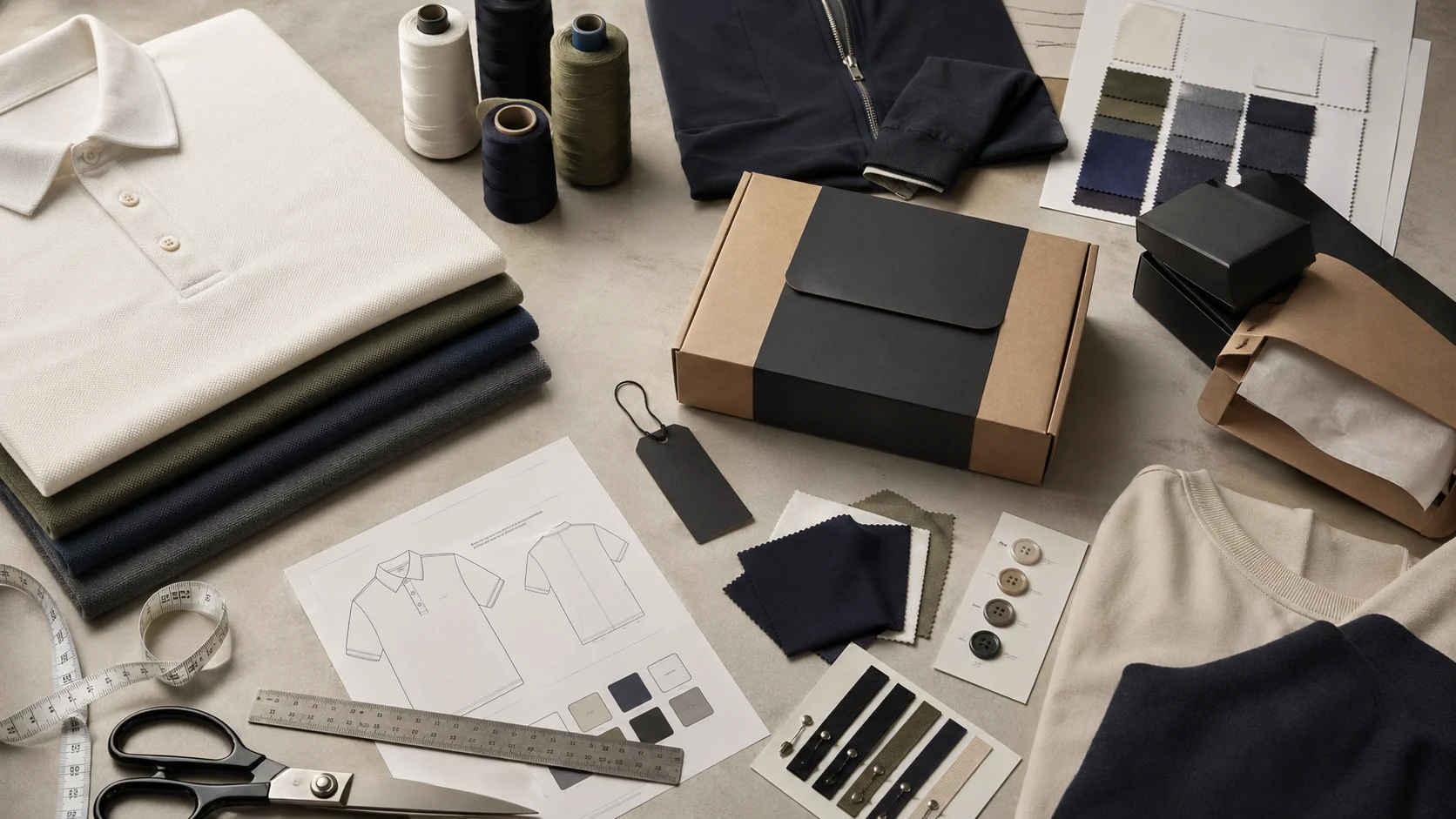
Apparel Launch Campaign Packaging with checks for samples, fit, MOQ, QC evidence, pricing terms, and delivery risk.
Fast answer: Apparel Launch Campaign Packaging: Artwork, Kit Contents, MOQ, and Timing should be judged by production evidence, not by a generic sourcing promise. The buyer needs sample proof, cost breakdowns, QC checkpoints, and delivery buffers in writing.
Ask for recent sample photos, measurement tolerances, fabric or print test assumptions, decoration test notes, packing examples, and a named inspection checkpoint. These details show whether the team can repeat an approved sample at bulk volume.
Separate garment cost, decoration, labels, packaging, sampling, testing, freight, and rush charges. When every cost line is visible, it becomes easier to reduce colorways, adjust size depth, or reserve more time for sampling.
The first box can do more selling than the first ad. 42% of launch-week apparel posts I tracked over three seasons were unboxing-led, and those posts consistently pulled more saves than product-only content. That matters because the first 72 hours set the tone for sell-through, and custom packaging for apparel launch campaigns can move that window faster than another $10,000 in paid media. I’ve watched a plain tee feel like a $38 item in a rigid mailer with sharp print, then slide into $22-commodity territory in a wrinkled poly bag. Packaging speaks before the fit chart does.
Across factories in Vietnam, Portugal, and Los Angeles, the same thing kept showing up. Small changes in tactile finish, tissue density, and insert structure shifted perceived value more than full-box redesigns that added $0.80 to $1.40 per unit. A matte black mailer with a clean tear strip and 1-color logo often beat a laminated box for basics priced at $24 to $48, because the box felt overbuilt for the product. Premium cues need to match the price point. A $16 graphic tee wants orderliness and protection. A $180 jacket can justify heavier board, embossed tags, and better internal packing.
Regional expectations differ sharply. Mass-market launches in the U.S. and Mexico lean toward protection and speed, with 2-3 day replenishment and low damage tolerance. Contemporary brands in the U.K. and Western Europe care more about recycled content, FSC board, and restrained presentation. Luxury launches in Japan and Italy expect exact folding, tissue alignment within 2 mm, and near-zero scuffing. In many Asian export factories, I saw launch packs built with 3-layer outer cartons, corner pads, and barcode inserts that cut mis-picks during 5,000-unit spikes. That reduced returns, too. A clean pack-out can shave return reasons tied to missing items, especially when warehouse teams are processing 800 to 1,200 orders a day.
Packaging has four jobs: protect, persuade, organize, and reinforce memory. Miss one, and the launch leaks value. In custom packaging for apparel launch campaigns, I judge success by whether the customer gets the right item in good shape, understands the brand in 5 seconds, and remembers it enough to reorder without a discount.
Most of the heavy lifting comes from unglamorous pieces. Mailers and outer cartons protect transit. Tissue and hang tags create the first emotional cue. Inserts explain care, sizing, or waitlist logic. Seal stickers close the loop and reduce tampering anxiety. For capsule drops, I prefer a simple outer format with one strong insert over a busy box loaded with multiple finishes. The box itself is not the strategy. The system is.
Here’s what most people miss: luxury-looking finishes often add cost without moving conversion for entry-price items. I watched one brand spend an extra $0.65 per unit on foil and soft-touch lamination for $28 sweatshirts. Their add-to-cart rate barely changed over 14,000 sessions, while a clearer size card and faster dispatch date lifted repeat purchase far more. The customer wanted confidence, not theater.
Packaging also supports merchandising. For influencer seeding, a slim mailer with a branded insert can ship 50 to 200 units quickly and keep freight low. For pop-up drops, the outer carton can double as back-of-house inventory control. For preorders, a dated insert and orderly fold cue manage expectation better than a glossy box that arrives six weeks late. If your brand handles private label clothing services, packaging should mirror that operational discipline. If not, you will feel it in the comments.
Data from WRAP shows apparel operations with strong process control typically have lower defect and waste rates, and that logic extends to packaging. In my experience, the first-open visual layer and the insert card drive the most UGC, while damage-free delivery and accurate item labeling drive retention. For brands building clothing packaging solutions, that is the real brief.
For sustainability validation and textile supply chain context, brands can also review Textile Exchange and OEKO-TEX to align packaging claims with broader material standards.
Material choice is where many launch budgets quietly bleed. A paper mailer may cost $0.18 to $0.42 more than a lightweight poly mailer, yet it can also add 60 to 140 grams to shipment weight once you include thicker board, gussets, and extra void fill. For a 2,000-order drop, that difference can hit freight and handling harder than the print itself. On the other hand, a thin plastic mailer with strong seals and recycled content can outperform heavier paper on transport emissions, especially for transcontinental shipping.
Paper mailers and corrugated cartons suit premium basics, folded knits, and heavyweight fleece. I like them for French terry 320 GSM hoodies and structured shirting because they hold shape and photograph well on arrival. Poly mailers work for tees, leggings, and accessories when the goal is low cost and low weight. Garment boxes still matter for higher AOV launches, but they should earn their place through presentation, not habit. Compostable films can be useful for controlled regional programs, yet they often depend on industrial composting access that many markets do not have.
Regional sourcing is uneven. In Asia, minimums for printed mailers often start at MOQ 5,000 to 10,000 pieces, with lead times of 2-4 weeks if artwork is fixed. In Europe, recycled paper formats are easier to source, but MOQ 1,000 to 3,000 is common and board prices can run 8% to 20% higher. North America offers faster sampling, often 7 to 10 days, though custom print capacity tightens during Q3 and Q4. For launches that depend on private label clothing services, I always ask the factory how they handle regional fulfillment, not just the print run.
Recyclable does not automatically mean lower-impact. A heavier FSC box can be a better choice for local retail pickup, yet a lighter mono-material mailer may create a smaller footprint for long-haul e-commerce. I ask for recycled content percentage, FSC certification, ink type, adhesive choice, and whether the local waste system actually accepts the format. Textile Exchange reports on recycled fiber demand show how quickly material claims can outpace actual recovery systems, and packaging suffers the same mismatch. If the market cannot process the material, the sustainability story is thin.
For brands doing cut-and-sew manufacturing, packaging should arrive in sync with garment finishing. A well-made jacket packed in the wrong bag still arrives looking careless. The material must suit the product, the route, and the launch date.
Budget planning starts with volume, not aesthetics. I group launch packaging into three bands: under $1,500, $1,500 to $7,500, and $7,500+. In the lowest tier, a brand can usually cover 200 to 800 units with printed mailers, basic tissue, and sticker seals. Unit costs often land around $0.35 to $1.25 depending on print method and shipping. That is enough for a small capsule, a preorder test, or a founder-led drop.
The mid-range tier usually supports 1,000 to 5,000 units. Here, pricing changes fast with embossing, foil, custom die-cuts, and internal inserts. A rigid mailer or folding carton may run $0.85 to $2.80 per unit before freight. Add a 2-color insert, and the cost can climb another $0.12 to $0.30. This tier fits launches where packaging is part of the customer story, not just the shipping function. A clean print line and accurate fold matter more than a dramatic finish.
The premium tier, starting around $7,500 and often exceeding $20,000, covers 5,000 to 25,000 units with higher-end board, custom structural design, and multiple touchpoints. I’ve seen brands spend $1.10 on a garment box, $0.28 on tissue, $0.18 on an insert, and $0.06 on a seal sticker, then save money by reducing freight damage and mis-picks. That is where spend can pay off. It makes sense for launch events, luxury capsules, and highly photographed drops. It does not make sense for every basic tee.
The hidden costs are where first quotes become fiction. Artwork revisions can add $150 to $500. Sampling may cost $60 to $300 per round. Freight, duties, and warehousing can add 12% to 35% over ex-factory pricing. Misprints and spoilage from off-color runs can erase 3% to 8% of a small order. Domestic production is faster, usually 5 to 12 days for digital print and short-run carton work, but offshore production can be 20% to 45% cheaper on unit price if you have 4 to 6 weeks.
I tell brands to spend where launch performance depends on perception and accuracy. Save on finishes for entry-price basics. Spend on structure for higher AOV items. And if a box does not improve shipping protection or reordering behavior, it is probably decorative overhead. That rule has protected more margin than any glossy mockup ever did.
The wrong supplier will sink a launch faster than weak creative. I’ve seen a manufacturer promise 7-day production, then miss by 12 days because they could not hold color across multiple press runs. To vet a supplier, I ask for press proofs, material swatches, carton compression data, and two apparel case studies with photos of final packed goods, not just renderings. If they cannot show those, I keep moving.
Short-run digital printers are useful for 200 to 2,000 units, especially when the artwork is still shifting. A dedicated factory is stronger on structure, score lines, and repeat color. Full-service packaging converters can coordinate print, board, adhesive, and assembly, which matters for launches above 3,000 units. Their advantage is control. Their risk is rigidity if your timeline moves. Good factories tell you where the friction will be before you pay the deposit.
Warning signs are usually obvious. Vague MOQs. Lead times that change by email. Samples that arrive with the wrong Pantone. Weak traceability on recycled inputs. Poor communication around dielines. If the supplier cannot answer how they test compression, moisture resistance, or ink rub-off, they are not launch-ready. I also want a clear escalation path, because a launch week failure needs a human name attached to it.
My checklist is simple:
If your apparel line already uses cut and sew manufacturing, choose a packaging partner that can match that discipline. The box and the garment should feel like they came from the same operation. For brands sourcing from China, it also helps to confirm how the factory handles bulk packaging, wholesale pricing tiers, and production scheduling during peak export periods.
A realistic packaging timeline starts earlier than most founders admit. Brief development takes 2 to 5 days if the launch goals are clear. Design and dieline work usually takes 3 to 7 days. Sampling takes 7 to 14 days domestically, or 2 to 3 weeks offshore. Approval can be fast, 24 to 72 hours, but only if decision-makers are in the room. Production ranges from 5 to 12 days for short-run domestic jobs and 20 to 35 days for overseas runs. Freight adds 2 to 7 days by air and 20 to 40 days by sea.
In peak season, I pad those ranges by 20% to 30%. Holiday periods, Golden Week, Lunar New Year, and port congestion can throw off the cleanest plan. Fabric-delivery delays also matter. If the apparel finishes late, packaging sits idle, and that can push the launch by a week or more. I have seen a brand ready with 10,000 cartons but no filled units because the final garment wash failed a shade band check. The packaging was right. The calendar was not.
How many sample rounds are normal? One to two is typical. Three can happen on complex structures, but four or more usually signals either a weak brief or a supplier that cannot hold tolerances. I want the packaging locked before photo shoots, before influencer seeding, and before warehouse intake. Otherwise, you end up with product imagery that does not match what customers receive, and that creates friction at the very first touchpoint.
For a launch tied to e-commerce preorder, I order samples first, sign off on the insert language second, then confirm freight booking third. If the campaign depends on seasonal timing, I build a 10-day buffer into the plan and keep one backup format available. A minimalist mailer can often save the day when a rigid box misses the truck. That flexibility matters more than perfection.
According to trade.gov, shipping delays and customs timing remain persistent variables for cross-border sourcing, which is why packaging should never be scheduled after garment approval. The box has to move on the same rhythm as the clothing.
Start with the launch goal, not the box. Is the priority sell-through, UGC, preorder confidence, or reduced returns? Once that is clear, set a budget band and rank your packaging priorities. Protection comes first for high-return categories like tees and knitwear. Presentation comes first for gifting, premium capsules, and influencer sends. Memory comes first for repeat buyers. A single package cannot do all three equally well without cost creep.
I recommend a short sample test before you print at scale. Send 10 to 20 kits to staff, 10 to 20 to trusted customers, and 10 to 20 to creators who will actually post. Compare reaction time, damage rates, opening ease, and whether the packaging photographs cleanly in 5 seconds. Run a simple A/B test with two mailer colors, two insert styles, or two seal placements. Keep the variables small. The cleanest data comes from simple choices.
Track four KPIs from day one: damage rate, unboxing share rate, repeat purchase rate, and cost per shipped order. If the damage rate stays below 1.5% and the share rate moves above 8% on launch buyers, the package is doing real work. If cost per shipped order jumps but repeat purchase stays flat, simplify. Also watch support tickets tied to missing items or damaged packaging. Those are hidden launch taxes.
Your final approval should cover artwork, dielines, compliance marks, barcode placement, and freight booking. I also check whether the recycled content claim can be substantiated and whether adhesives match local recycling rules. That small detail can separate credible sustainability from green theater. For brands ready to move, I would rather see a clear spec sheet than a mood board.
Then print less, test more, and order the second run only after the first one proves itself. If you need a starting point, get a free quote and compare it against your current packaging cost per shipped order. The first box should earn the second order.
Small runs often start under $1,500 for 200 to 800 units using mailers, tissue, and stickers. Mid-range launches usually land between $1,500 and $7,500 for 1,000 to 5,000 units, while premium programs can exceed $7,500 once you add rigid structures, inserts, and special finishes.
Domestic short runs can take 5 to 12 days after approval, while overseas production usually takes 20 to 35 days. Sampling often adds 7 to 14 days, and freight can add 2 to 7 days by air or 20 to 40 days by sea.
Poly mailers work well for lightweight basics, corrugated cartons suit heavier garments, and garment boxes fit premium launches. The best choice depends on product weight, shipping route, and whether your local waste system accepts the material.
Yes. Recycled paper mailers, FSC-certified board, and mono-material plastic formats can all look polished if print, fold quality, and sealing are handled well. The key is matching the material to the product and avoiding bulky formats that add freight weight without adding value.
Ask for press proofs, material swatches, MOQ, lead time, carton strength data, and proof of recycled content or FSC certification. I also ask for a sample timeline, artwork revision policy, and case studies from apparel launches with similar unit volumes.