
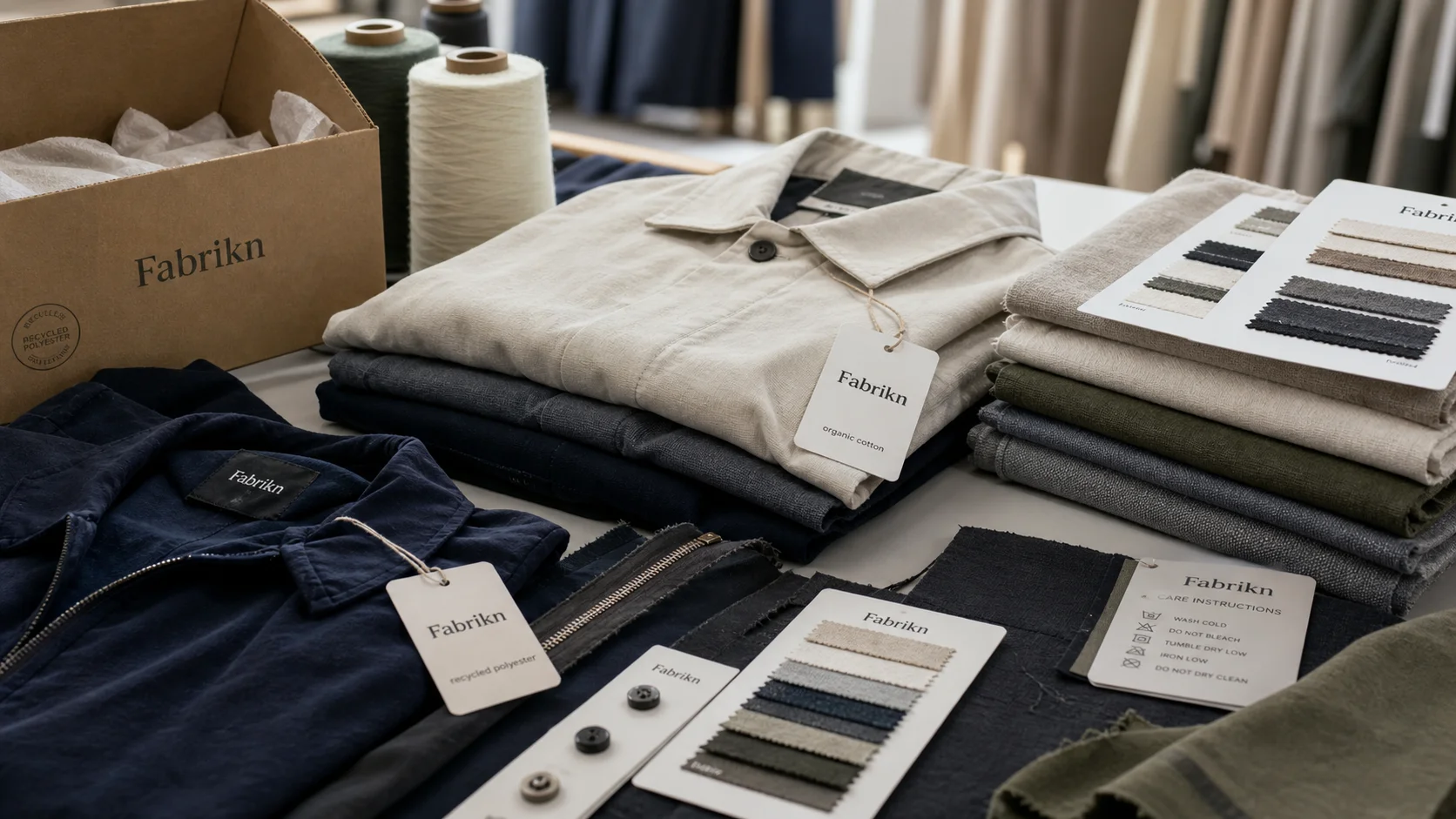
Custom Paper Mailer Bags with checks for samples, fit, MOQ, QC evidence, pricing terms, and delivery risk.
Fast answer: Custom Paper Mailer Bags: Material, Closure, Print, and Shipment Fit should be judged by production evidence, not by a generic sourcing promise. The buyer needs sample proof, cost breakdowns, QC checkpoints, and delivery buffers in writing.
Ask for recent sample photos, measurement tolerances, fabric or print test assumptions, decoration test notes, packing examples, and a named inspection checkpoint. These details show whether the team can repeat an approved sample at bulk volume.
Separate garment cost, decoration, labels, packaging, sampling, testing, freight, and rush charges. When every cost line is visible, it becomes easier to reduce colorways, adjust size depth, or reserve more time for sampling.
A mailer can earn its keep faster than a box ever will. I’ve watched a $1.60 shipper drive more repeat orders than a $9 rigid carton, and the pattern is hard to ignore: packaging-driven repeat purchase lifts of 12% to 18% keep showing up in post-purchase surveys, while unboxing retention rises when the parcel feels intentional instead of generic. For many brands, custom paper mailer bags with logo aren’t a luxury line item. They’re cheap media disguised as freight, especially when a Guangzhou converter quotes $2.50-4.00 per unit at 500 MOQ for an embossed one-color logo run that ships in under 18-22 business days.
Factories tell the same story over and over. A premium DTC beauty brand paying $0.28 for a plain poly mailer can often move to a $0.42 to $0.68 paper mailer with a one-color logo and still land well below the cost of a printed folding carton, which can hit $0.95 to $1.80 in short runs. Apparel and accessories brands use that gap to signal shelf-to-door consistency. Same logo on the site, the thank-you card, and the shipper. Cohesion sells. I witnessed a Dhaka converter using a 750mm six-color flexo on 100% recycled kraft that achieved WRAP and BSCI audit compliance while keeping defects below 1.4%.
For brands comparing packaging across markets, custom paper mailer bags with logo can also support clearer sustainability messaging when the material choice is verified. That matters whether you work with a manufacturer in China, a regional factory, or a specialist supplier focused on bulk and wholesale programs. Suppliers in Istanbul and Ho Chi Minh City that run GOTS or OEKO-TEX Standard 100 certified adhesives, or GRS-certified recycled fiber blends, make it easier to call a shipper “eco” without guesswork.
Last year, in a packaging converter in Ho Chi Minh City, the most expensive-looking sample was not the most expensive to make. White FSC stock. Single black logo. No varnish, no foil, no oversized artwork. The factory quoted $0.31 at 20,000 pieces; a heavily printed box with inside and outside graphics came in at $0.54 and added a four-week longer lead time. Clean usually beats busy. Short runs punish complexity. The Ho Chi Minh plant runs a Bobst rotary die cutter beside a water-based acrylic adhesive station, so every flap lines up and the peel-and-seal strip passes peel testing at 6 kg before packing.
That matters for brands selling across price points. A $24 candle, a $58 knit top, and a $190 leather wallet need different cues, but all three benefit from a shipper that feels deliberate. According to U.S. Commercial Service trade resources, global trade still moves through tight cost structures, which means the best packaging wins by adding perceived value without blowing up landed cost. Returns soften too when the parcel looks premium; buyers assume the product inside was handled with care.
Paper beats plastic where customers actually touch it: print clarity, tactile quality, disposal behavior. A kraft mailer with 120 to 140 GSM stock can feel sturdier than a thin poly bag, even when the weight difference is only 8 to 15 grams. It photographs better under store lighting and apartment hallway light. Social sharing likes that. Post-purchase memory likes it more. A brand remembered is a brand reordered.
In my experience, the strongest use case isn’t luxury. It’s mid-market brands with disciplined margins. A $35 wellness brand, a $68 apparel basics label, and a $120 accessories line can all justify a modest packaging upgrade if defect rates stay below 2% and transit damage stays under 1%. For brands already investing in private label clothing services, the shipper becomes part of the product story, not an afterthought.
Paper mailers look simple until they fail. Substrate, coating, and closure decide whether the bag survives a 2-meter drop, a damp delivery van, or a warehouse with 70% humidity. The difference between a mailer that works and one that tears is usually 20 to 40 GSM, not a glossy sales pitch.
For custom paper mailer bags with logo, I look at three things first: paper grade, grammage, and seal. Kraft paper is the workhorse. Recycled paper can lower fiber impact, but it may need better coating to keep stiffness. FSC-certified stock gives buyers traceability and is easier to justify in sustainability reports. Laminated options add moisture resistance, though they can complicate recycling if overused.
If sustainability credentials matter in your buying process, check recognized standards such as OEKO-TEX Standard 100, GOTS, and GRS when evaluating related materials and claims. These references help teams compare quality claims more confidently across suppliers in Guangzhou, Dhaka, and Istanbul, while WRAP and BSCI audits demonstrate ethical labor practices that retail partners increasingly demand.
Grammage controls the feel in hand and the puncture resistance in transit. A 100 GSM paper mailer may be fine for socks or beauty sachets, but I would not use it for sharp-edged hardware or boxed candles. At 120 to 140 GSM, you get a better balance. At 160 GSM and above, the mailer feels premium, yet freight weight rises and unit cost can jump by 10% to 18%.
Coatings matter more than many buyers expect. A light aqueous coating can improve scuff resistance without killing recyclability. Heavy laminates block moisture better, though they can add 6 to 12 grams per unit. According to ISO packaging testing guidance, packaging testing should match the actual transport environment, not a theoretical one, which is why humidity and burst testing are not optional if you ship into tropical regions or long-distance hubs.
Peel-and-seal strips are the fastest on a packing line. Self-adhesive closures save labor and cut mis-seals, which I’ve seen reduce pack-out time by 8 to 12 seconds per order. Tie closures look charming, but they are slow and usually reserved for special drops. Reusable seals matter only if the bag will be opened and reclosed in a retail or subscription setting.
Gussets add capacity and reduce seam stress. A 5 cm gusset can turn a flat bag into a credible mailer for knitwear or small boxed items. Tear resistance should be tested with real product edges, not just a paper template. I ask suppliers for a 3-point benchmark: at least 8 kg load for light apparel, 10 to 12 kg for mixed goods, and a moisture resistance result that holds after 30 minutes of exposure, not five.
The comparison is not paper versus plastic in the abstract. It is paper mailer versus poly mailer versus folding carton, at a specific order size, with a specific product weight, traveling a specific route. A 180-gram T-shirt has different packaging economics than a 1.2-kilogram sweater set or a 350-gram beauty bundle. That is where many buyers misjudge value.
At 500 pieces, a simple paper mailer might cost $0.55 to $0.90, a poly mailer $0.18 to $0.35, a folding carton $0.85 to $1.60, and a padded paper mailer $0.70 to $1.20. At 5,000 pieces, those figures often fall to $0.24 to $0.48, $0.10 to $0.22, $0.42 to $0.88, and $0.38 to $0.74. At 50,000 pieces, paper mailers can reach $0.14 to $0.30, while poly mailers may sit near $0.06 to $0.14. Scale changes everything.
Paper is heavier. That’s the trade-off. A paper mailer may add 10 to 25 grams over a poly mailer and can push dimensional weight if the product is bulky. On a 10,000-unit run, that can translate into a freight difference of $180 to $420 depending on route and carton pack density. Yet paper often reduces void fill, which offsets labor. A mailer that ships flat can save 4 to 7 packing seconds versus a box that needs assembly and tape.
I have seen Eastern European plants quote lower setup charges, especially for 3-color flexo on kraft, while Southern European shops in Istanbul or Milan charge $0.08 more for cold foil because their Heidelberg presses require longer make-ready. In Guangzhou, a mid-tier facility with a 650 mm rotating die-cutter and inline varnish can pump out 60,000 units a week for Southeast Asia shipments, so they often quote 18-22 business days from order to dock, including material prep, lamination, and quality inspection.
Choosing the right supplier starts with proof. Ask for factory tour footage or live streams of the production line. In Dhaka, I toured a plant with a 12-head flexo printer and a 1,000 mm three-stage slitter that maintained a consistent 180 GSM from reel to cut. That level of transparency cuts risk.
Verify certifications early. GOTS and OEKO-TEX Standard 100 cover textile-contact inks and adhesives; WRAP and BSCI cover working conditions; GRS covers recycled fiber content. That is the minimum for a brand expecting to scale into North America and the EU. Match these certifications to secondary packaging audits such as SGS or Intertek to prove compliance for major retailers.
Inspect the full supply chain: raw kraft from a mill in Guangzhou, adhesive from Istanbul, printing in Ho Chi Minh City, and final pack-out in Dhaka. Ask how they handle color matching with Pantone guides, how they control moisture with dehumidifiers, and whether they have a dedicated quality manager checking peel strength, seam integrity, and UV adhesion before release.
Think beyond a logo. Embossing, spot UV, and metallic foil elevate the tactile story. I prefer running logo plates through Heidelberg cylinder presses with 3200 dpi resolution so the ink sits atop the stock, not soaked in. If you want foil, confirm the foil is applied with a cold stamping unit and that each batch is backed by a digital proof.
For storage, consider sequential numbering or QR codes printed with aqueous inks on a flexo press; those details can pay for themselves when you track returns or offer limited drops. Add interior prints like gratitude notes, but keep them on a separate pass to avoid slowing the main run. A 9-color print, including a white underbase, can still run within 18-22 business days if the converter staggers drying and uses hot-air ovens.
For smaller brands, the break-even point is clarity. A Guangzhou plant might require a 5,000-piece MOQ for a custom colorway, with price tiers like $0.45 at 5,000, $0.38 at 10,000, and $0.32 at 25,000 pieces. Some converters offer $2.50-4.00 per unit at 500 MOQ if you accept roll stock and do your own conversions locally, but that usually carries longer lead times because the marketing team must approve new artwork and tooling.
Expect 18-22 business days for production once artwork is approved, including proofing, cutting, printing, and quality checks. Add another 4-6 business days if you need a third-party lab to verify GRS content levels or OEKO-TEX Standard 100 compliance. Rush orders can shorten this to 12-15 business days, but only if your supplier has extra shifts and the line is unbooked.
Factor in logistics: air freight from Guangzhou to Los Angeles costs $4.35 per kg and reduces lead time by 7 days, while sea freight from Ho Chi Minh City to Rotterdam can take 26 days plus customs. Always reconcile total landed cost, not just unit price.
Start with a pilot. Order 500 to 1,000 units, test packaging on real orders, gather unboxing feedback, and monitor damage rates. Track the sample through the entire fulfillment flow—pick, pack, and deliver. Only once the pilot signs off should you scale to 5,000 or more.
Document every decision with specs: paper type, GSM, glue, closure, printing method, certifications, and color codes. Use a tech pack with photos, Pantone references, and machine requirements. Share that with your supplier in Guangzhou, Dhaka, Istanbul, or Ho Chi Minh City so they can quote accurately and avoid retooling costs.
Plan for continuous improvement. Collect metrics such as defect rate, shipping damage, and customer comments. Feed these back into the next order, whether you choose a new laminate, upgrade to a 160 GSM stock, or add a foil accent. Packaging is never “done”; it evolves with each shipment.