
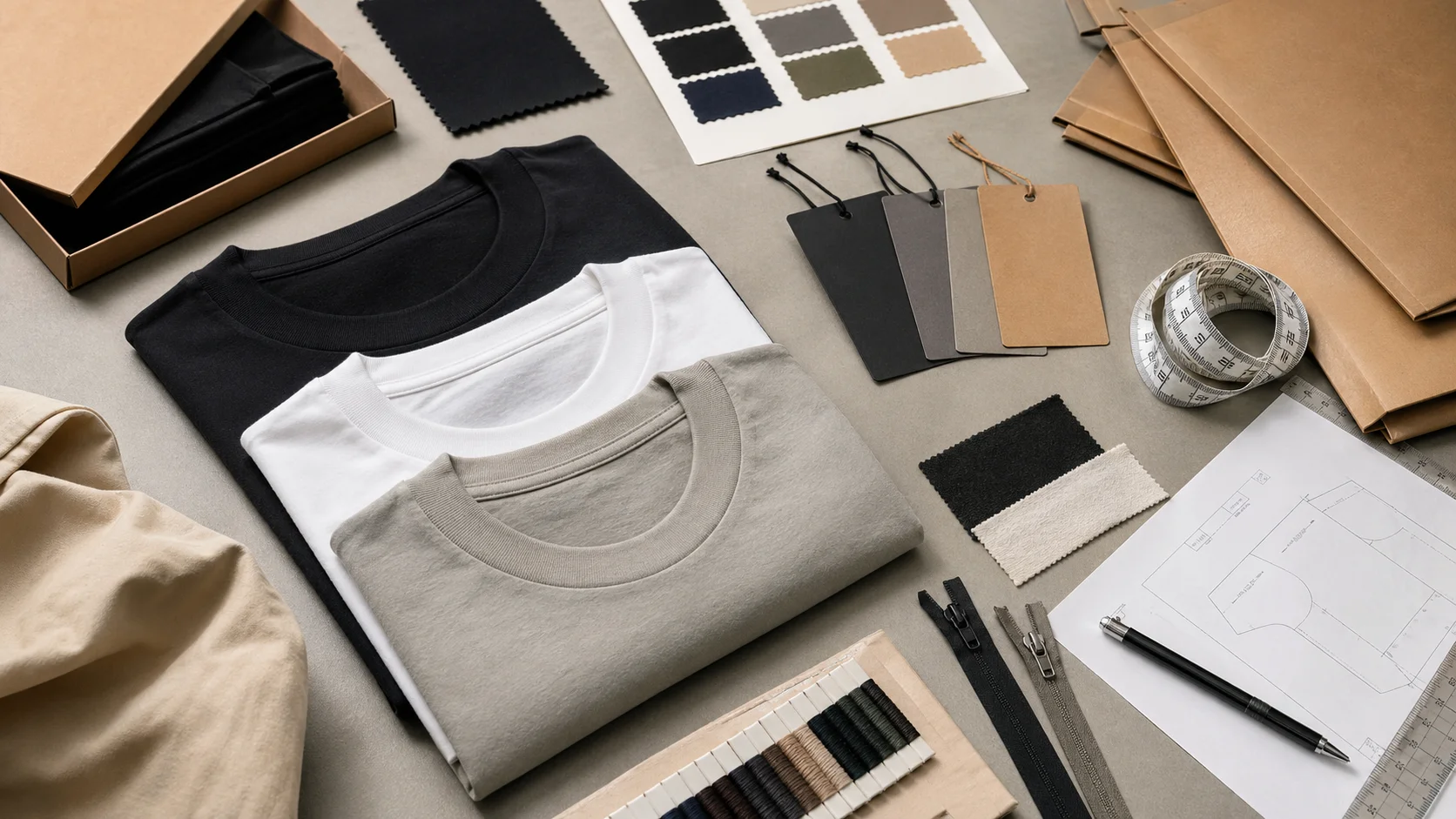
Custom Paper Packaging for Clothing Orders with checks for samples, fit, MOQ, QC evidence, pricing terms, and delivery risk.
Fast answer: Custom Paper Packaging for Clothing Orders: Costs, Quality, Impact should be judged by production evidence, not by a generic sourcing promise. The buyer needs sample proof, cost breakdowns, QC checkpoints, and delivery buffers in writing.
Ask for recent sample photos, measurement tolerances, fabric or print test assumptions, decoration test notes, packing examples, and a named inspection checkpoint. These details show whether the team can repeat an approved sample at bulk volume.
Separate garment cost, decoration, labels, packaging, sampling, testing, freight, and rush charges. When every cost line is visible, it becomes easier to reduce colorways, adjust size depth, or reserve more time for sampling.
The box is not the bonus anymore; it is part of the bill. Custom paper packaging for clothing orders now sits beside returns, freight, and service costs in the real math of apparel, because a weak mailer can quietly become the most expensive thing in the room. A branded pack that adds $0.18 can save $1.40 in service time. At 10,000 units, that stops being trivia.
Brands with a 28% return rate on premium denim love to blame the carrier when boxes arrive crushed. Fine. The carrier is part of the story. So is the pack spec. Data from the U.S. Commercial Service on trade and sourcing and retail benchmarks from trade reports point to the same pressure: customers expect the first physical touchpoint to match the price they paid, especially above the $60 order value threshold.
What surprised me most in factory visits was not that paper can outperform plastic. It was that a higher-end paper mailer, at $0.32 to $0.55 per unit versus a $0.09 polybag, often reduced complaints because it felt deliberate, not disposable. That matters in premium DTC, where repeat purchase rates can improve by several points when unboxing feels considered. In mass retail, the return is weaker unless the brand is using packaging to cut labor or shipment damage.
At one packaging plant serving both a $24 basics label and a $220 outerwear brand, the lesson was blunt. The cheaper brand used generic poly mailers and saw more wrinkling, more “item arrived used” emails, and more repacks. The premium client paid for custom paper packaging for clothing orders with reinforced seams and printed sizing cues, then saved 12 to 15 seconds per pack at fulfillment. Sounds tiny. At 50,000 orders, it is not.
Four stakes keep showing up: branding, protection, sustainability, and speed. Ignore one and the others suffer. A package that looks environmentally correct but slows packing by 8 seconds per order can erase savings quickly. A package that protects but feels cheap can drag conversion. And a package that photographs well but fails a 2-meter drop test becomes a customer service problem within 3 days of launch.
Most buyers start with “a box,” then discover there are five decisions hiding inside it. Paper mailers suit soft goods and low-return basics. Folding cartons work for tees, socks, and accessories. Rigid boxes are for gifts, limited drops, and premium sets. Tissue wraps, sleeves, and belly bands help the unboxing feel intentional without adding much weight. For brands already using clothing packaging solutions, the point is matching format to product, not copying a competitor’s box.
Gram weight and board grade decide how the pack behaves. A 250 gsm carton board is fine for a folded tee. A 400 to 500 gsm SBS or kraft-lined board handles sharper edges, like zippers or belt hardware. Coating matters too. A matte aqueous coating keeps recyclability friendlier than heavy plastic lamination, while a light aqueous or water-based varnish still gives scuff resistance. According to ISO standards for material testing and quality, test methods for material performance should be consistent, or you will compare weak samples against strong production runs and misread the result.
Branding lives in print, finishes, inserts, and seals. Spot color printing can keep Pantone reds from drifting into orange. Embossing adds texture without much extra material. Compostable tapes help the sustainability story, though I always ask for proof, not slogans. Insert cards can carry sizing, care, and return instructions, which reduces customer service friction by a measurable margin. In one mid-market warehouse, incorrect-size tickets caused 7% of inbound queries; better inserts cut that to 2% in six weeks.
The tradeoff is presentation versus shipping efficiency. Folded tees can ship in a mailer measuring 10 x 13 x 1.5 inches. Denim often needs a slightly wider format, especially if the brand wants a clean fold edge and fewer creases. Knitwear is softer, but bulkier than it looks. I’ve seen brands over-box sweaters in 12 x 9 x 4 rigid packs when a reinforced fold carton would have saved 18% in cube. That extra cube matters on every truck.
One-size-fits-all packaging creates waste, higher freight bills, and more damaged corners than most brands admit. For light basics such as jersey tees, a 9 x 12 inch mailer or a 250 to 300 gsm folding carton usually works, especially if the order is one item and under 1.2 pounds packed. For denim, I prefer 300 to 350 gsm board with internal tissue, because denim weight and metal trims create edge pressure. For premium sets or gift orders, a 1.5 to 2 mm rigid box makes sense only if the perceived value justifies the cost.
Order profile changes everything. Single-SKU DTC orders are predictable. Mixed carts with tees, socks, and knitwear need more headroom, but not much. Subscription boxes need repeatability across 3 to 6 months, which means die-lines must be locked early. Wholesale shipments are different again; they care about stackability and outer carton efficiency more than presentation. I worked with a brand that sold both DTC and boutique wholesale, and they used one outer shipper with two interior formats, keeping MOQ 500 pieces for the branded layer while standardizing the outer case.
Oversized packaging often increases crush risk. In one factory in Vietnam, I watched a 14 x 11 x 5 mailer fail compression at the corners because the product floated inside. A tighter 11 x 9 x 3 pack, with a folded insert, passed the same test and cut postage by 6% to 9% depending on the zone. Bigger felt safer. It wasn’t.
For practical specs, ask suppliers to quote by garment type and packed weight. A single knit sweater under 1.8 pounds may fit in a 300 gsm fold carton with a 0.5 inch perimeter buffer. A heavy hoodie at 320 GSM French terry, folded with a care card and tissue, might need a 10 x 13 x 2.5 inch mailer. Outerwear with zippers, snaps, or padded components should be tested in packs that hold up to 3-meter handling, not just the “looks good on the table” sample.
Brands doing custom baby clothing manufacturing usually need gentler folds, cleaner print, and lower ink transfer, because parents notice every scuff. For premium labels using private label clothing services, the packaging brief should also specify whether the pack must survive retail touchpoints, not just courier handling.
Stock packaging looks cheap until you count the labor. A plain off-the-shelf mailer might cost $0.08 to $0.15, but custom paper packaging for clothing orders can land between $0.18 and $0.65 per unit depending on format, print count, and board grade. Rigid gift boxes can climb from $1.20 to $3.50 before freight. The real mistake is comparing unit price alone. A $0.24 custom mailer with no extra tape, faster packing, and fewer complaints can beat a $0.11 stock bag every day of the week.
Break the budget into tooling, plates, printing, board, inserts, freight, testing, and storage. Tooling for a new dieline may be $150 to $600. Printing plates can add $80 to $300 per color in some regions. Inserts and tissue can add $0.03 to $0.14 each. Freight varies wildly, but a carton loaded with flat-pack mailers can add 8% to 22% to landed cost if you are importing small volumes. Storage also matters; 20,000 folded boxes take far less space than 20,000 rigid boxes.
Regional pricing differs, but not in a simplistic “cheap versus expensive” way. China often offers the widest range, from $0.18 mailers to premium printed cartons, with low setup friction and deep finishing options. Vietnam tends to be slightly higher in paper converting on small runs, but strong on flexible lead times. India can be competitive on board and print, especially for kraft and recycled stock. Turkey and the EU usually carry higher labor and compliance costs, yet they can win on shorter transit and easier audit access. European production can be the fastest for urgent replenishment, but not the lowest cost.
MOQ changes the real budget more than many founders expect. A supplier quoting MOQ 1,000 may give you a great unit rate, but if you only need 400 orders this season, your cash sits in a warehouse for months. Larger retailers can absorb 10,000 to 50,000 units and negotiate better board pricing. Smaller brands should calculate landed cost per order, not per unit. If packaging adds $0.30 and a 3% defect rate costs another $0.12 per order, your true packaging cost is $0.42, not $0.30.
Ask for the quote in three layers: ex-works price, shipping to your warehouse, and expected spoilage allowance. If a supplier refuses to separate those, I treat that as a warning sign. Good buyers also model a 5% variance on freight and a 2% variance on packing waste. That discipline keeps surprise charges from turning a promising launch into a margin leak.
The most common failures I’ve seen are boring, which is exactly why they hurt. Ink rub appears when dark print scuffs onto garments after 48 hours in transit. Misfolding happens when a die-line is off by 2 to 4 mm and the box won’t sit square. Weak adhesive shows up in humid rooms, especially when glue lines are thin or rushed. Dimensional drift is a silent problem; a carton that measures 10 x 13 on paper can arrive as 9.6 x 12.7 and break the packing line.
Before approval, request drop tests, compression tests, color tolerance charts, and moisture resistance data. I ask for a 1-meter drop on all six faces for light packaging, and 3-meter handling for premium or export cartons. Compression should be tested at both 50% and 85% relative humidity. Color tolerance should be checked against Pantone or a signed lab dip. If the packaging will cross borders, ask for transit simulation, not just a glossy sample.
Sustainability claims need documents, not slogans. FSC certification should be backed by a valid chain-of-custody number. Recycled content should be stated as a percentage, not “eco paper.” Compostability claims should specify industrial or home compost conditions, because the difference is enormous. I also want to see whether inks are soy-based, water-based, or UV-curable, since each affects recyclability differently. Materials standards from OEKO-TEX guidelines for chemical and materials safety are useful only if the factory can show current certificates, batch numbers, and scope.
Low-cost factories often pass visual checks but fail after 72 hours in a humid warehouse. Premium factories are not automatically perfect, though they usually control glue lines, cut tolerance, and print consistency more tightly. I’ve watched a $0.41 mailer outperform a $0.22 alternative simply because the higher-priced unit used better board caliper and cleaner folding. That is the sort of counterintuitive result that only shows up when you stop judging packaging by the sample table.
Supplier selection should be a scorecard, not a gut feeling. I rate cost, lead time, customization depth, compliance, and communication speed on a 1-to-5 scale. China often scores highest on customization depth, with 3 to 7 finish options on a single line and sampling in 7 to 10 days. Vietnam can score well on flexibility and English communication. India often does well on board variety and print cost. Turkey is strong for shorter lead times into Europe and the UK. Europe scores highest on compliance access and audit convenience, but costs more.
Do not flatten the regions into stereotypes. A factory in Guangdong with a disciplined QA team can outperform a poorly managed plant in any country. The same is true in reverse. I’ve seen a Turkish converter miss deadlines because the prepress team was overbooked, and I’ve seen an Indian mill deliver perfect recycled kraft on a 4-week cycle. The difference is management, not just geography.
Communication speed matters because packaging moves fast once design is approved. If a supplier takes 3 days to answer a dieline question, that is a red flag. Sampling reliability matters even more. If the first sample differs from production by more than 5% in color or fold behavior, expect trouble later. I also check labor practices, not because it sounds noble, but because poor labor systems correlate with missed shipments and sloppy assembly. For cut-and-sew brands, that same discipline carries over to cut and sew manufacturing, where lead time and quality are tied to line control.
My scorecard is simple enough to use in under a week:
Shortlist only suppliers who score at least 18 out of 25 and who can send a real production sample, not just a render. That filter saves weeks.
A 30-day rollout is realistic if you keep the brief tight. Days 1 to 3: write the packaging brief with product dimensions, folded garment weight, print colors, sustainability requirements, and annual volume. Days 4 to 7: send the dieline and request pricing for 500, 1,000, and 5,000 units. Days 8 to 14: review samples, mark changes, and ask for a corrected round. Days 15 to 21: test compression, drop, rub, and warehouse handling. Days 22 to 30: approve pilot production and ship a small batch.
Your pilot shipment should measure four things: damage rate, customer feedback, packing time, and freight cost. I want at least 100 orders in the test, because 20 orders can hide a bad failure mode. Track whether pack time drops below 18 seconds per order, whether damage stays under 1%, and whether customers mention the unboxing positively or not at all. If the pack slows fulfillment by more than 5 seconds, the design needs another pass.
Write the brief like a buyer, not a dreamer. Include exact dimensions in inches and millimeters, board grade, target weight, print count, finish type, and whether inserts are required. State if the box must work with folding machines, manual pack stations, or both. If you want matte coating, say matte aqueous, not “premium finish.” If you want recycled content, specify 70% post-consumer waste or whatever your target is. Ambiguity costs money. Precision saves it.
Pause if a supplier gives vague sustainability claims, refuses to share material specs, or will not provide test data. Pause if the sample is beautiful but the factory cannot explain glue type, board source, or color control. Pause if lead times change every time you ask the same question. In my experience, those are not minor process issues. They are cost multipliers.
Choose the package that protects the garment, keeps the warehouse moving, and reinforces the brand at a price you can repeat for 12 months. If two options tie, take the one with better test data and cleaner documentation. Custom paper packaging for clothing orders is part of the product promise, and your customers can feel the difference in 10 seconds.
Simple paper mailers usually run $0.18 to $0.65 each depending on size, print, and board grade. Rigid gift boxes often range from $1.20 to $3.50 before freight, inserts, and testing. Small runs carry higher setup costs, so MOQ matters as much as unit price.
For tees and basics, folding cartons or reinforced paper mailers are usually the most efficient. For denim and knitwear, board strength and internal tissue matter more than a fancy exterior. Premium gift sets may justify rigid boxes, but only if the order value supports the extra cost.
Sampling usually takes 7 to 14 days, and production often takes 3 to 6 weeks after approval. Faster turnaround is possible in Europe or Turkey for urgent jobs, while larger runs in Asia may need longer freight time. Complex finishes can add another week.
Ask for board grade, gram weight, coating type, exact dimensions, MOQ, lead time, and all setup fees. Request drop test, compression test, and moisture resistance data, plus certification proof for FSC or recycled content claims. If the supplier cannot share specs, do not place the order.
Yes, but only if the material claims are verified. Look for FSC chain-of-custody, stated recycled content percentages, and clear guidance on recyclability or compostability. A matte aqueous coating and water-based inks usually make end-of-life handling easier than plastic lamination.