
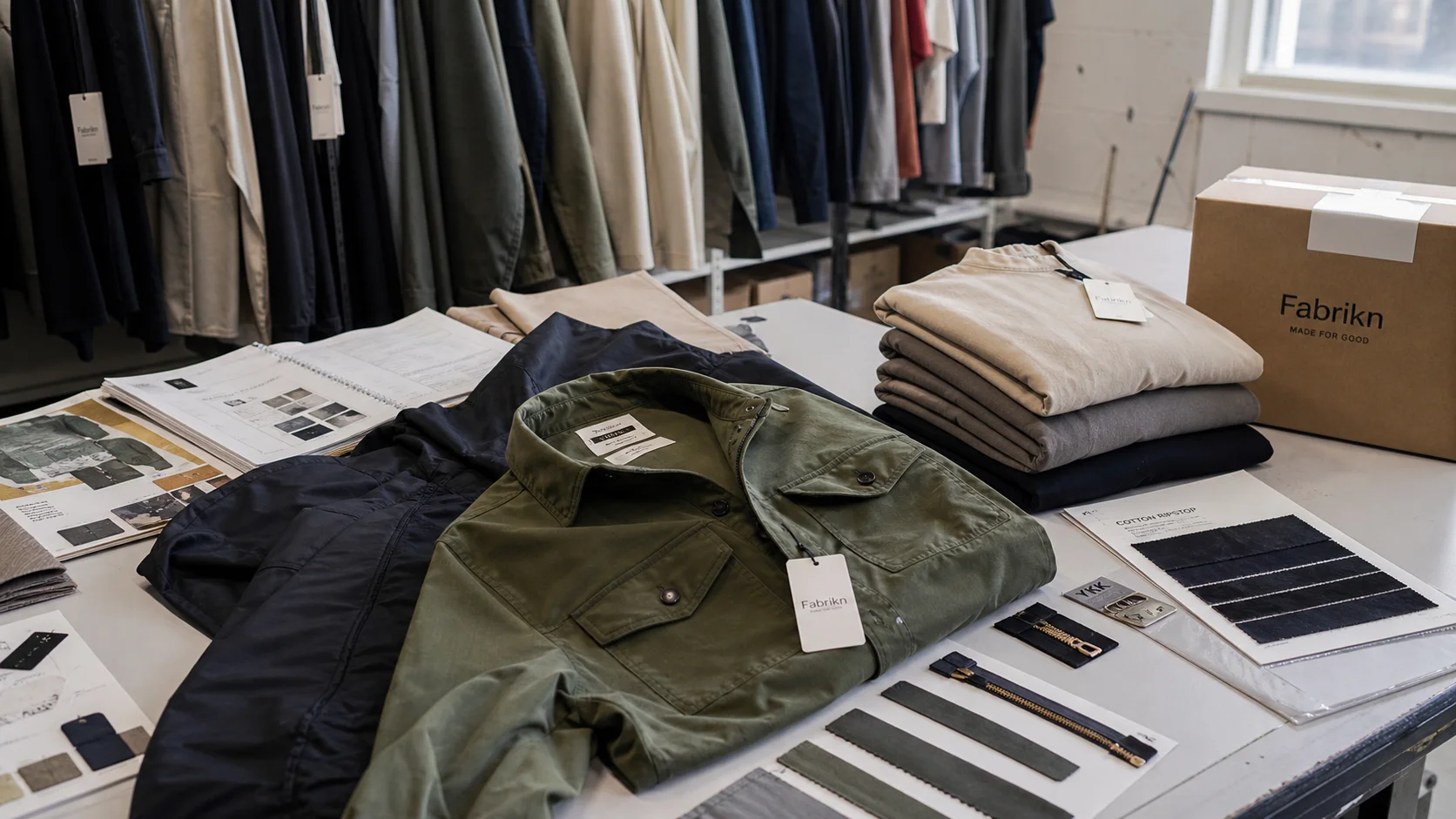
Custom Polo Shirt Manufacturer Low MOQ with checks for samples, fit, MOQ, QC evidence, pricing terms, and delivery risk.
Fast answer: Custom Polo Shirt Manufacturer Low MOQ: Fabric, Fit, Sampling, and Cost should be judged by production evidence, not by a generic sourcing promise. The buyer needs sample proof, cost breakdowns, QC checkpoints, and delivery buffers in writing.
Ask for recent sample photos, measurement tolerances, fabric or print test assumptions, decoration test notes, packing examples, and a named inspection checkpoint. These details show whether the team can repeat an approved sample at bulk volume.
Separate garment cost, decoration, labels, packaging, sampling, testing, freight, and rush charges. When every cost line is visible, it becomes easier to reduce colorways, adjust size depth, or reserve more time for sampling.
A startup in Jakarta needed 120 polos for a launch. A golf club in Manchester wanted 80 for a charity event. A school in Texas asked for 240 in four sizes. Nobody wanted 1,000 shirts sitting in boxes. That is the real reason the search for a custom polo shirt manufacturer low MOQ keeps climbing.
The math is brutal. A 1,000-unit polo order at $6.20 landed cost ties up $6,200 before a single shirt sells. A 100-unit run at $8.10 ties up just $810, leaving room for ads, fit testing, or a second colorway. Smaller runs also reduce size-risk; I have seen brands lose 18% to 28% of stock value because they guessed wrong on XL versus L. And the timing is kinder: 3 to 4 weeks to test demand instead of locking into a 10- to 14-week season plan.
DTC brands, schools, clubs, merch sellers, and corporate buyers with uneven size curves all lean on low MOQ. If you need 50 to 300 units, a custom polo shirt manufacturer low MOQ can be the difference between a controlled launch and a warehouse mistake. First orders often start with polos instead of tees for a reason: polos read premium, sell at $18 to $45 retail, and take embroidery well. Clean. Practical.
Regional behavior is all over the map. In China, many factories will quote 100 to 300 pieces if they already stock pique and rib trims. Vietnam is often comfortable at 150 to 500 pieces, especially for performance polos. Bangladesh usually prefers 300 to 1,000 units because line setup and fabric booking make more sense at scale. Turkey sits in a different lane: smaller, faster, pricier, with many workshops willing to take 50 to 150 premium units if the customer accepts a sharper unit cost.
The thing nobody tells you: I visited factories that charged 8% to 12% more per piece yet accepted lower MOQ because their cutting, embroidery, and packing lines were organized enough to run without the usual friction. Cheap factories are not always flexible. Efficient factories often are.
According to World Trade Organization trade data, global trade is still being shaped by lead-time pressure and inventory caution, not just price. That matches what I have seen on factory floors across four countries: buyers want fewer units, better certainty, and a faster yes-or-no on demand.
Low MOQ is not one number. I have seen factories quote 30 pieces for a stock-fabric embroidery job, 50 pieces for a simple corporate polo, 100 pieces for a custom colorway, 150 pieces for a more detailed retail spec, and 300 pieces once the buyer wants custom trims. The threshold depends on fabric source, knitting method, and decoration.
Basic pique cotton polos are the easiest place to start. A 220 GSM pique knit with a flat knit collar, two buttons, side vents, and a simple chest logo can be produced at 50 to 100 units without drama. Performance polos use polyester interlock or birdseye mesh, often 150 to 180 GSM, and can be done at similar minimums if the fabric is already in stock. Premium fashion polos complicate the picture because they may use mercerized cotton, rib collar engineering, contrast tipping, or enzyme wash treatment. Those details push the order closer to 150 to 300 units.
Decoration changes the equation. Embroidery is the most common choice because a logo can be stitched at 30 to 50 units if the digitizing fee is absorbed. Screen print can work at 50 to 100 units, though multiple colors increase setup. Heat transfer is useful for variable names or numbers, but it raises rejection risk if the garment stretches badly. Woven labels, hem tags, and neck prints are all manageable at low MOQ. Custom buttons, custom-milled fabric, and yarn-dyed stripes are not. Those usually demand 300 to 1,000 units because suppliers want to spread development cost across more pieces.
On the factory floor, I have seen basic polos assembled in 12 to 18 operations, while premium styles climb to 22 to 30 operations because of plackets, reinforcement stitches, and collar shaping. That extra labor is why a supplier may quote $4.80 for a stock polo and $9.50 for a fashion version even when the silhouette looks similar from three feet away.
For buyers comparing product types, the practical rule is simple. Basic pique polos are easiest for a custom polo shirt manufacturer low MOQ to accept. Performance polos sit in the middle. Premium fashion polos carry the highest minimums because every design choice adds risk, from custom rib to specialty dyeing. If the factory says yes to 50 pieces on a complex spec, ask exactly what is in stock and what is being substituted.
If your project is closer to a broader apparel program, private label clothing services can help you bundle polos with matching tees or sweatshirts so sampling effort is spread across more styles.
Price per piece is only the headline. The real cost of a 50-unit polo run can look like this: $7.40 garment cost, $35 embroidery digitizing, $22 sampling fee, $68 freight per carton, and another $24 in duty and customs handling. That means the effective cost is closer to $9.20 to $10.10 per shirt, not the quoted factory rate. At 100 units, the same order might land at $6.10 to $6.80 per piece after fixed fees are diluted. At 300 units, it could drop to $4.90 to $6.00, depending on fabric and origin.
I have compared quotes where the cheapest factory was the worst deal. One supplier offered $3.80 per polo, but charged $85 for samples, $60 for each label revision, $120 for lab dips, and refused to split freight. Another quoted $4.65, yet included two samples, one round of fit corrections, and carton marking at no extra cost. The second factory ended up 14% cheaper once landed.
Region matters. In China, labor is often more expensive than Bangladesh, but fabric sourcing is faster and sampling is usually more reliable. Vietnam sits in the middle on cost and often does well on performance fabrics. Bangladesh can give aggressive unit pricing on 300-piece and up orders, but small-batch development can be slow if the mill minimum is high. Turkey often lands in the $8 to $16 range for premium polos, but for buyers in Europe the lower freight and shorter transit can offset part of that gap.
Hidden charges are where budgets break. I always ask about embroidery digitizing, pattern revisions, lab dips, hangtags, carton marks, barcodes, and rejected samples. A three-color logo can add $25 to $60 in digitizing. Color approval can take two to three rounds if Pantone references are vague. A single correction to a collar measurement can trigger a new sample run and add 7 to 10 days.
The right comparison is total landed cost at 50, 100, and 300 units. That tells you which custom polo shirt manufacturer low MOQ can actually support your launch, not just your spreadsheet.
For buyers who need an alternate construction path, cut and sew manufacturing is the cleanest route when a stock polo base will not match your collar, placket, or fit target.
Before you send artwork or money, ask direct questions. What is the true MOQ for this exact fabric? Is the fabric in stock, or will it be knitted after approval? How many embroidery heads, sewing lines, and QC staff do you run? What is your sample lead time, and how many revisions are included? Can you show me a recent spec sheet, not a sales deck? If a supplier answers vaguely, treat that as a warning, not a negotiation tactic.
Compliance is not optional, even for 50 units. Ask for social audit records, fiber content testing, colorfastness results, and barcode or carton accuracy checks. According to OEKO-TEX testing standards, textile testing around harmful substances and product safety should be documented, not implied. I have visited workshops where the sample room was excellent but the bulk line ignored carton labels and mixed sizes in the same case. That mistake turned a 200-unit order into a week of repacking.
Watch for conditional low MOQ promises. Some factories say yes to 100 units, but only if you choose from stocked fabrics in 6 to 10 colors and accept their standard buttons. That is not true made-to-order capability. It is a stock-supported program, which is fine if you know that upfront.
Credible suppliers show proof. They should share sample photos of real production, not only mood boards. They should have a clear QC process, with inline checks at 20%, 50%, and 100% completion. They should give transparent lead times, often 7 to 14 days for samples and 20 to 35 days for production on small runs. They should also provide references from at least two to three clients in the last 12 months. When I visited one factory in Guangdong, the best sign was not a polished showroom. It was a binder of past failures and the corrective actions taken.
China is still the most balanced option for speed, fabrication, and communication. Many factories can handle 50 to 200 units on stock fabric, with embroidery lead times of 7 to 12 days and full production in 20 to 30 days. The advantage is access to trims, labels, and a deep supplier network. The weakness is that some factories are so busy with larger programs that low MOQ orders get pushed into quieter production windows.
Vietnam performs well for performance polos, athletic fits, and cleaner sewing on mid-market orders. It often works best at 150 to 500 units. Labor is not the cheapest, but consistency is strong, and many suppliers are used to export compliance. Bangladesh is the cost leader for larger runs, especially 300 to 1,000 units, but I have repeatedly seen a bias toward bigger booking volumes because smaller orders interrupt cutting efficiency. That does not make Bangladesh weak. It makes it more selective.
Turkey surprised me most. In multiple workshops near Istanbul, I found a willingness to do 50 to 150 premium polos with tighter fit tolerances, better collar shape, and faster communication in European time zones. Prices are higher, often $8 to $16 per unit on small runs, but for brands selling at $60 to $120 retail, the margin can still work. For premium cotton, mercerized finishes, and boutique clubwear, Turkey often beats lower-cost regions on perception.
Here’s the decision framework I use after factory visits. If your budget is tight and the target is 300 to 1,000 units, Bangladesh deserves a look. If you need 50 to 200 units quickly with stable quality, China is usually the strongest starting point. If your polo is performance-led and you need 150 to 500 units, Vietnam is often the best fit. If your brand sells on fit, hand-feel, and premium positioning, Turkey is the more convincing option for smaller runs.
None of these regions is automatically best. The right custom polo shirt manufacturer low MOQ depends on the product, the margin, and how much production risk you can tolerate.
A clean tech pack saves money. I want measurements, fabric GSM, collar type, button count, logo placement, Pantone references, size ratio, and packaging instructions in one file. For a polo, that means chest width, body length, shoulder width, sleeve length, placket depth, and rib or self-fabric collar notes. If the brief is vague, the sample room guesses. Guessing creates 2 to 4 extra revisions, and each revision can add 3 to 7 days.
Ask for a production-friendly spec sheet, not just a sales quotation. Confirm whether the factory will work to a tolerance of +/-1 cm or +/-1.5 cm on key measurements. Verify the size run before deposit: for example, 10 S, 20 M, 30 L, 25 XL, and 15 XXL on a 100-piece launch. If the brand wants embroidery at left chest and sleeve, confirm the exact size in millimeters and the thread colors by Pantone or thread chart.
I also push buyers to request one fitting sample before bulk production. A pre-production sample is usually enough for a small run if the design is simple. If the polo uses contrast tipping, a structured collar, or a specialty wash, I prefer a second approval checkpoint. Keep that approval process tight. A delay of 5 days on sample sign-off can easily become 15 days once fabric booking and line allocation shift.
For a clear handoff, share the quote request, confirm the sample fee, ask what is included in the first round, and make sure the deposit terms are written down. That is where the relationship with a custom polo shirt manufacturer low MOQ becomes practical: precise brief, precise answer.
When the product mix includes multiple silhouettes, I use the browse our product catalog page to align polo specs with tees, hoodies, and uniforms before I lock the size curve.
Use a 7-day sourcing plan. Day 1, send the same brief to 3 to 5 factories. Day 2, compare total cost, not just unit price. Day 3, ask for sample timelines and certifications. Day 4, review fabric options and trim substitutions. Day 5, order samples from the top two suppliers. Day 6, check stitching, collar shape, shrinkage risk, and label accuracy. Day 7, choose the factory with the best mix of cost, speed, and communication, then confirm lead time in writing.
The sequence matters. Inquiry comes first, then quote, then sample, then purchase order, then pre-production approval, then bulk. I never skip the sample stage on a first order. A 100-unit mistake costs less than a 1,000-unit mistake, but both hurt the launch if the collar collapses after washing or the embroidery puckers around the placket.
Negotiate, but do it cleanly. Ask for a lower MOQ only if you are willing to accept stock fabric, standard trims, or a color from the mill’s existing palette. If you want split shipments, confirm whether the factory can hold 30% to 40% of the order without affecting packing accuracy. If payment terms are tight, a 30/70 split is common for small orders, though some buyers can secure 20/80 once trust is established.
My practical expectation for a small-batch launch is simple. Start with 50 to 150 pieces, test sell-through for 2 to 4 weeks, then reorder fast if the response is real. That is how a custom polo shirt manufacturer low MOQ becomes a launch partner instead of a one-time vendor. The goal is not to buy the most shirts. It is to buy the right number, at the right time, with enough margin left to try again.
Typical low MOQ ranges from 30 to 300 units, depending on fabric, decoration, and whether the factory uses stock materials. Simple embroidered polos can start at 30 to 50 pieces, while custom fabrics and trims often push the minimum to 150 to 300 units.
For small runs, I usually see $4.80 to $10.00 per polo, with premium or performance styles reaching $12 to $16. Sampling, digitizing, freight, duty, and label setup can add $1.00 to $3.00 per piece in effective cost on 50-unit orders.
Sample approval often takes 7 to 14 days, and bulk production usually runs 20 to 35 days for stock-fabric polos. If the order needs custom dyeing, special trims, or lab dips, plan for 5 to 10 extra days.
Ask for spec sheets, recent sample photos, client references, and compliance documents before paying a deposit. A reliable supplier will state whether the MOQ is real or only possible with stock fabric, and will give clear QC checkpoints.
Yes, and that is usually the smartest strategy. Many brands start with 50 to 150 units, measure sell-through for 2 to 4 weeks, then reorder 100 to 300 more once the fit and colorway are proven. Reorders are faster if your first sample and tech pack are accurate.