
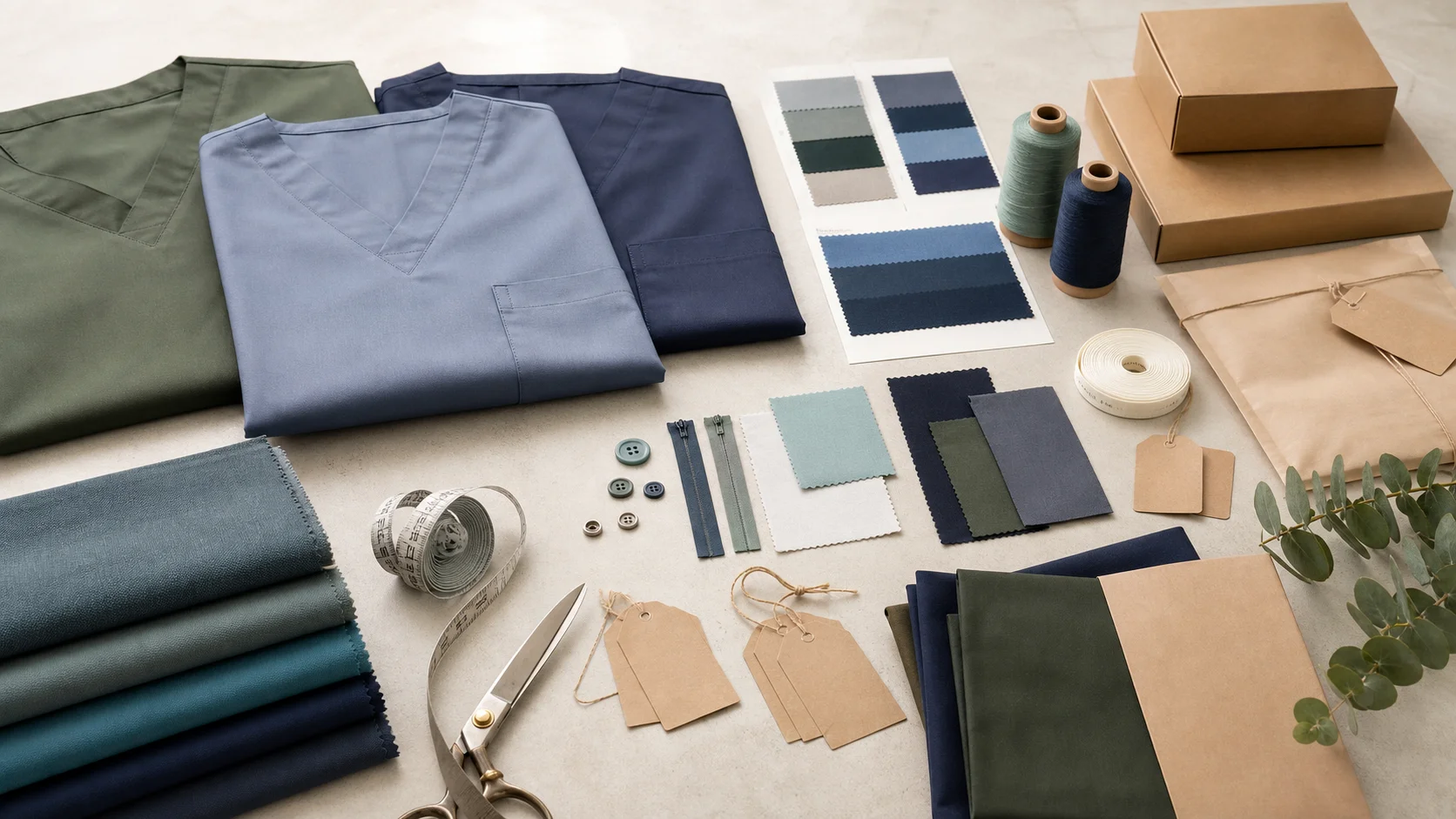
Custom Recycled Paper Packaging for Apparel with checks for samples, fit, MOQ, QC evidence, pricing terms, and delivery risk.
Fast answer: Custom Recycled Paper Packaging for Apparel: Costs, Specs, Wins should be judged by production evidence, not by a generic sourcing promise. The buyer needs sample proof, cost breakdowns, QC checkpoints, and delivery buffers in writing.
Ask for recent sample photos, measurement tolerances, fabric or print test assumptions, decoration test notes, packing examples, and a named inspection checkpoint. These details show whether the team can repeat an approved sample at bulk volume.
Separate garment cost, decoration, labels, packaging, sampling, testing, freight, and rush charges. When every cost line is visible, it becomes easier to reduce colorways, adjust size depth, or reserve more time for sampling.
Apparel brands are moving fast on custom recycled paper packaging for apparel because the old plastic-heavy playbook looks lazy now, and expensive too. On factory floors in Vietnam, Portugal, India, and China, I’ve watched recycled cartons move from side note to standard issue for tee brands at $18 and outerwear brands at $180. Buyers are not chasing virtue points. They’re trying to protect margin while making the package feel intentional.
Speed helped push the shift. Many paper suppliers can turn short runs in 7-14 days, and a basic folding carton can be faster than a cut-and-sew sample once the artwork is locked. The weak spot is usually board consistency. I’ve seen a 350 gsm recycled sheet print beautifully on Monday and crack at the fold on Wednesday because the mill delivered uneven caliper across the run.
Shoppers see the package before they read the hangtag. In one retail test I reviewed, identical basics inside a premium-feeling box were judged worth 12% more, even though the garment cost under $10 to make. That’s framing at work. Heavy board, clean typography, disciplined proportions — suddenly a $24 sweatshirt feels closer to $38. A flimsy sleeve does the opposite.
Pack format shifts by price tier. Mass-market basics usually need a low-cost belly band, polybag replacement, or a simple hang tag under $0.15. Premium DTC labels often choose a one-color carton, tissue wrap, and rigid mailer that can land between $0.45 and $1.80 depending on volume. Heritage brands spend more on structure and restraint than decoration because the customer already trusts the name. The package has to confirm the promise, not shout over it.
That is why clothing packaging solutions now sit closer to product strategy than office supplies. When I visited factories supplying both value chains and luxury labels, the best packages were rarely the most expensive. They were the ones where sourcing, board strength, and print finish matched the product story.
Recycled paper can look premium, but only when structure, print finish, and sourcing line up. If one drifts, the package reads cheap fast.
Custom recycled paper packaging for apparel is a family of formats, not a single material. Recycled paperboard is the workhorse for folding cartons, hang tags, sleeves, and inserts. Corrugated mailers handle ecommerce transit better. Rigid cartons sit at the premium end. Tissue, belly bands, and inserts add presentation without much weight, which matters when a parcel crosses 2,000 miles and every extra gram gets billed somewhere.
The recycled content label needs scrutiny. A board with 30% recycled fiber is not the same as 50%, 70%, or 100% post-consumer content. Post-consumer content means the fiber came from used paper recovered after consumer use. Pre-consumer scrap comes from offcuts and manufacturing waste. That difference matters because a 70% recycled board can still behave very differently from a 70% post-consumer board in print and fold performance.
In business terms, the key specs are strength, caliper, burst resistance, folding endurance, and printability. Caliper is thickness. Higher caliper can feel more luxurious, but if the fiber is weak, the fold line can crack after 2-3 openings. Burst resistance tells you how much pressure the sheet tolerates. Folding endurance tells you whether it survives repeated handling in the warehouse and during returns processing. Good printability means the ink sits cleanly and doesn’t fuzz on a rough surface.
Regional sourcing changes the menu. Asian mills often offer wider board options and more aggressive pricing across 500-5,000 piece runs. European suppliers tend to lead on traceability and certification language, especially for brands that need tighter documentation. North American mills are often stronger on faster replenishment and shorter truck routes, which helps when a replenishment carton is needed in 10-14 days instead of 30.
Different apparel items call for different structures. Tees and underwear work well in sleeves or light folding cartons. Denim benefits from heavier tags and reinforced inserts because the product is bulky and abrasive. Shoes need corrugated or rigid cartons with stronger corners. Swimwear usually travels in a slim mailer or belly band. Premium knitwear deserves higher-caliper board because compression marks show up easily on soft fabric like merino or brushed cotton.
If a brand is building private label assortments, I often steer the team toward packaging choices that match product architecture. For example, the same manufacturer that handles cut and sew can usually help the buyer think about how the garment folds, stacks, and ships, which keeps packaging from fighting the product at the final mile. When a supplier understands both the garment and the packaging, production becomes smoother and quality control gets easier.
Premium feel comes from proportion, typography, embossing, and structural discipline more than from lavish materials. I’ve stood in showrooms where a plain kraft box beat a coated black carton because the type was spaced correctly and the edges were crisp. A strong package often uses less. That’s the part many brands resist.
Some coatings and embellishments can sabotage recyclability. Heavy lamination, mixed-material windows, glitter varnish, and foil that covers large areas make recovery harder in common paper streams. Water-based coatings, soy-based inks, and restrained spot varnish are usually safer choices, though local recycling rules still vary. When a brand insists on metallic detail, I push for small zones, not full coverage. A 5% accent can carry the look. A full wrap can turn a recyclable carton into a headache.
Structure matters just as much. Right-sizing reduces freight waste and crushed corners. Fold patterns should lock the garment without over-compressing it. Die-cuts can hold a tee in place, but too many cutouts weaken the board. Inserts should stop movement in transit, especially for ecommerce apparel brands shipping 1-3 units per order. A jersey dress that slides inside a box arrives wrinkled, and then the customer blames the garment, not the packaging.
Luxury packaging and value-focused retail solve different problems. Luxury relies on tactile restraint. Value retail relies on efficiency and speed. The first can afford a 2-part rigid box, a dust sleeve, and a tight unboxing sequence. The second needs a fold-flat carton that can be assembled in under 15 seconds. Both can use recycled paper. The design logic is not the same.
Photography also pushes decisions. Social media unboxing has trained customers to expect layers, but ecommerce apparel does not always need theatrics. A clean carton, one tissue wrap, and a crisp hang tag can photograph better than a crowded package with three inserts. I’ve seen brands spend $0.60 more per order trying to look premium, then lose the visual clarity that made the garment look expensive in the first place.
Here’s what most people miss: a restrained structure often reads more premium than a complex one because buyers read precision as quality. A fold that closes at 90 degrees, a logo that sits exactly 8 mm from the edge, and a board that keeps its shape after 3-4 handling cycles can outclass a package loaded with special effects.
For brands comparing packaging partners, it helps to review custom apparel packaging options early in the process so the box style, print finish, and recycled content targets all align before production starts.
Packaging cost is not one number. It’s a stack of format, volume, region, and print choices. For mailers, I’ve seen recycled corrugated units land around $0.28-$0.65 at 5,000 pieces, then drop toward $0.16-$0.32 at 25,000 pieces. Folding cartons often run $0.12-$0.40 at 3,000-10,000 units depending on board weight and color count. Swing tags can sit at $0.03-$0.12 each, while tissue usually falls near $0.05-$0.18 per sheet. Rigid boxes are the expensive outlier, often $1.10-$3.50 and up.
The price moves fast with MOQ. A 500-piece carton run can cost 2-3 times more per unit than a 5,000-piece run because setup gets spread over fewer pieces. Board weight matters too. A 250 gsm recycled sheet prints cheaply, but a 400 gsm board with better feel can add 15%-30% to the unit price. Print method changes the bill as well. Digital is better for short runs and 4-6 color variability. Offset is cheaper at scale. Foil stamping and embossing add tooling and labor, and both require tighter registration control.
Regional order volumes create different economics. Asian suppliers often quote lower unit prices on large runs, especially above 10,000 pieces, but longer lead times and ocean freight can offset savings. European suppliers may quote 10%-20% higher per unit, yet traceability is stronger and transit can be shorter for regional brands. North American runs can cost more per piece, though they reduce replenishment risk if a brand needs 2,000 cartons in a hurry.
Hidden costs show up everywhere. Die tooling can add $80-$350 per design. Plate fees may run $60-$200 per color. Sampling can consume $50-$300 before approval. Warehouse space becomes a real cost if cartons arrive flat in 8 pallets and sit for 6 weeks. Damage rates matter too. A carton that saves $0.02 but increases crush failures by 3% is not a saving. It’s leakage.
For apparel brands, packaging should be judged against product margin bands. In mass-market basics, packaging may be 1%-2% of COGS. In mid-tier DTC, it often lands near 2%-4%. For premium outerwear or shoes, it can climb to 4%-5% if the carton doubles as a retail presentation piece. Last year I worked with a brand pricing a $42 knit tee, and shifting from a rigid box to a reinforced mailer cut packaging spend from 4.6% of COGS to 2.1% without hurting perceived value.
If you’re comparing suppliers, remember that the cheapest quote is rarely the cheapest landed cost. Freight, breakage, and reprint risk can turn a low unit number into a bad margin decision quickly. That is why brands with private-label programs often ask for a broader production view, not just a carton price. Many start by reviewing private label clothing services so packaging, garment specs, and merchandising stay aligned.
The production path starts with fiber sourcing and sheet formation at the mill. Recovered paper is pulped, cleaned, pressed, and rolled into board. From there, converters print, die-cut, crease, glue, and pack. That sounds tidy on paper. On the floor, there are dozens of moments where quality can slip by 1-2 mm and still create a visible issue once 10,000 pieces hit a warehouse shelf.
Quality control should happen at every checkpoint. I look for color match under standard lighting, board density consistency, adhesive strength on glued seams, and carton tolerance on the final fold. A carton that is off by 0.8 mm may still assemble, but if it ships in a set of 20, the stack can lean. That becomes a retail problem fast. Good factories test crease memory, fold angle, and packing speed before the order is released.
The counterintuitive part is this: some low-cost facilities outperform premium plants on simple folding accuracy because they run narrower product ranges and repeat the same carton all day. Meanwhile, some high-end factories struggle at high speed, especially when a 6-color job is pushed through a line that was set up for 2 colors. I’ve seen a polished plant miss on consistency, then a modest converter deliver 50,000 identical sleeves with almost no variance.
Lead times differ by factory type. Small artisanal converters can be nimble for 1,000-3,000 unit runs and special finishes, but they may struggle above 20,000 units. Large-volume packaging plants are stronger on throughput and repeat orders, yet they sometimes need 3-4 weeks just to lock tooling and queue the job. Reliability matters more than romance. A factory that delivers 15,000 cartons on day 18 is more valuable than one that promises artistry and misses the ship date.
Compliance and traceability should not be optional. Brands should demand FSC or equivalent chain-of-custody documentation where relevant, recycled content certificates, and proof of adhesive and ink compliance for the destination market. I also ask for batch records, which help trace a defect back to a mill lot or a printer setting. Data from ISO, OEKO-TEX, Textile Exchange, and Trade.gov supports the value of consistent testing, chemical transparency, and responsible sourcing, especially when packaging touches finished garments inside sealed cartons.
Good sourcing starts with proof, not promises. I ask for recycled content certificates, test methods, monthly capacity, and references from brands that run similar volumes. A custom packaging supplier that makes 200,000 swing tags a month may still be a poor choice for rigid cartons if they lack the right creasing equipment. Capacity must be specific. So must the product category.
The questions buyers ask reveal real capability. What is the maximum board caliper you can run without cracking? Which moisture resistance treatments are available? How do you test drop performance for ecommerce mailers? Can you hold color within a Delta E range of 2.0 or tighter? What happens if a 10,000-piece order arrives with 4% warp? The answers should be numeric, not vague.
I prefer a four-step sampling workflow. First comes the concept sample, which checks look and feel. Then the structural sample, which proves fit and fold. Next is the pre-production proof, which locks artwork and tolerances. Finally, a pilot run of 200-500 units catches assembly issues before the full release. Skipping any one of these steps usually costs more later. Reprints are far more expensive than samples.
Contract terms matter as much as the design. Tolerance ranges should be written clearly for dimensions, color, and warp. Delivery windows should include buffer days, not just ship dates. Replacement policy needs to say who pays if 2% or 5% of the cartons fail incoming inspection. Payment milestones should match risk. I prefer 30/40/30 or 20/40/40, not 100% upfront for a first order.
Regional sourcing has tradeoffs. Asia can be cost-effective for larger runs and broad board options. Europe often provides stronger traceability and shorter routes into nearby markets. North America can reduce replenishment risk and make 7-10 day reorders possible. Brands can lower risk with dual sourcing or regional split production. I’ve seen one label keep a primary manufacturer in Malaysia and a backup in Poland, which saved them during a port delay that would have frozen 18,000 units.
For buyers who want speed on both garment and packaging programs, it helps to align the packaging search with the apparel partner early. A cleaner product brief, tighter spec sheet, and fewer late-stage changes make supplier conversations faster. When the team is ready to move, they can get a free quote and compare packaging options against the garment calendar instead of treating them as separate projects. If you are sourcing from a wholesale packaging partner in China, ask for factory photos, production records, and landed-cost estimates before you commit to bulk production.
Use the next 30 days to turn packaging from a vague sustainability goal into a working spec. Start by auditing what you use now. Count cartons, sleeves, inserts, tissue, and hang tags. Measure the weight of each component in grams. If your current pack wastes 18 grams per order across 12,000 monthly shipments, you’re sending more than 200 kg of extra material through the system every month.
Then set two targets: one sustainability target and one budget target. A good sustainability target might be 70% recycled content with no full-wrap lamination. A good budget target might be keeping packaging under 3% of COGS on mid-tier apparel, or under 5% for premium shoes and outerwear. After that, choose the format. Mailer, folding carton, rigid box, or a hybrid. Do not approve a format until you know how it folds, ships, and opens.
Short-list 3-5 suppliers. Ask each for a quote, a sample, and a production timeline. Compare minimum order quantity, print limits, board options, and freight terms side by side. If one supplier only accepts 10,000 units and another can start at 1,000, note the flexibility even if the lower MOQ costs more per piece. Flexibility can be worth real money during product testing.
Here is the spec sheet I want on my desk before any quote goes out:
Then use a simple decision rule. If price is the main driver, keep the structure flat and the print limited to 1-2 colors. If brand image matters more, spend on structure before decoration. If recyclability is non-negotiable, avoid heavy laminations and mixed materials. Track three numbers after launch: damage rate, customer feedback on unboxing, and re-order timing. Those numbers tell you whether the packaging is supporting the product or just taking up space.
Brands that measure packing quality with the same discipline they apply to fabric GSM, shrinkage, and seam allowance usually make better choices. The packaging should earn its place. Not with noise. With performance. Start there, and custom recycled paper packaging for apparel becomes a brand asset instead of another line item to explain away.
Costs vary by format and volume. Recycled swing tags can start around $0.03-$0.12 each, folding cartons often run $0.12-$0.40, and corrugated mailers may land around $0.16-$0.65 depending on MOQ and print complexity. Rigid boxes usually cost $1.10-$3.50 or more.
A practical target is 70% recycled content, but the right number depends on the product and print requirements. Post-consumer content is stronger from a sustainability standpoint than pre-consumer scrap, and the two should not be treated as equivalent. Ask for certificates and the exact fiber breakdown.
Simple cartons and tags can often be produced in 7-14 days after approval, while more complex rigid boxes may take 3-4 weeks or longer. First orders usually take longer because sampling, proofing, and tooling add time. Reorders are typically faster.
Yes. Premium usually comes from structure, typography, board quality, and print discipline rather than heavy decoration. A well-proportioned carton with clean edges, restrained color, and accurate folding can look more expensive than a fully laminated package.
North American mills and converters are often stronger on faster replenishment, especially for 1,000-5,000 unit reorders. Europe can be strong for traceability, and Asia often offers broader board options and lower unit costs on larger runs. The best choice depends on your delivery window and shipping route.