
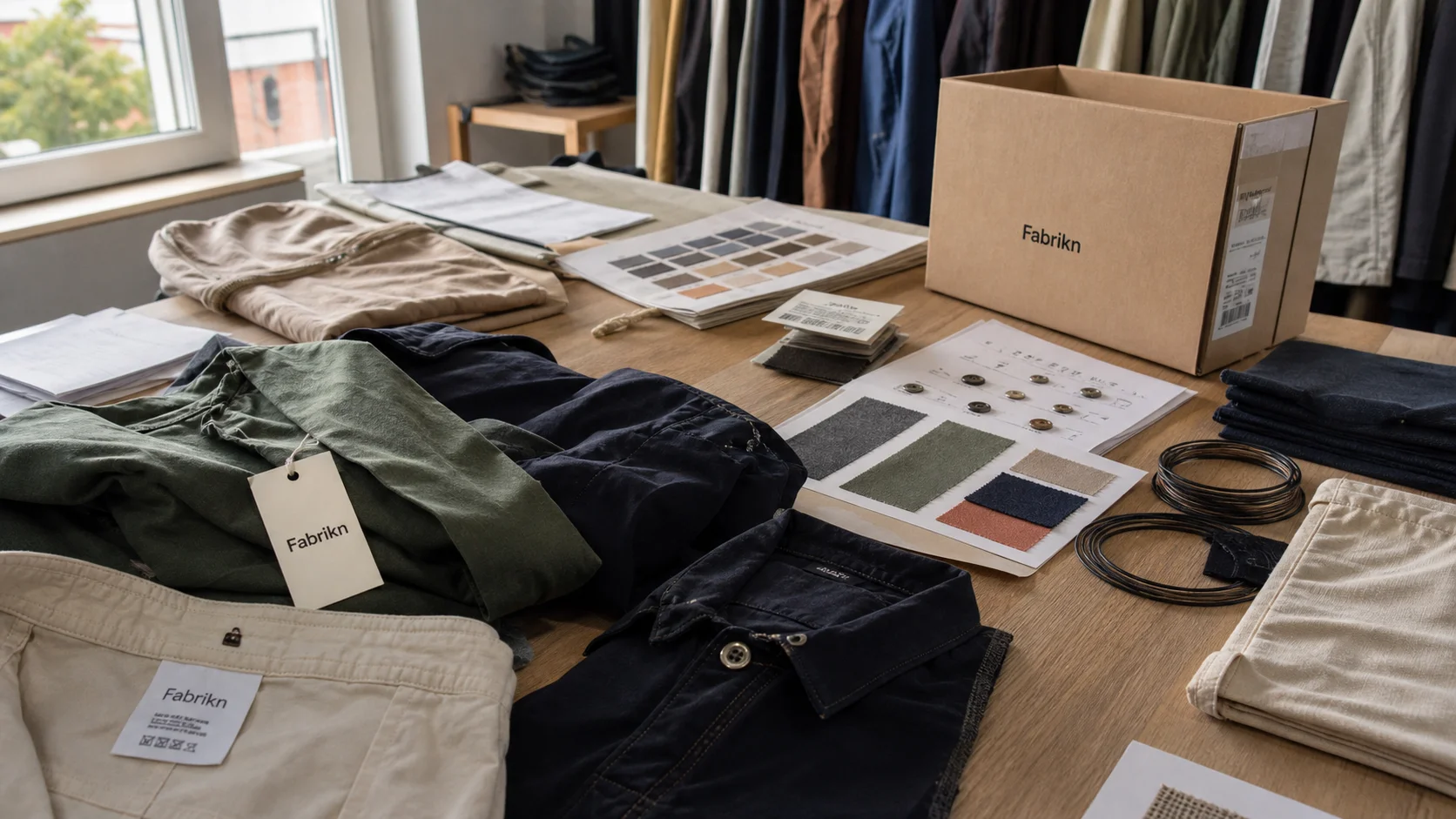
Custom Swing Tags for Apparel Brands with checks for samples, fit, MOQ, QC evidence, pricing terms, and delivery risk.
Fast answer: Custom Swing Tags for Apparel Brands: Strategy, Cost, Impact should be judged by production evidence, not by a generic sourcing promise. The buyer needs sample proof, cost breakdowns, QC checkpoints, and delivery buffers in writing.
Ask for recent sample photos, measurement tolerances, fabric or print test assumptions, decoration test notes, packing examples, and a named inspection checkpoint. These details show whether the team can repeat an approved sample at bulk volume.
Separate garment cost, decoration, labels, packaging, sampling, testing, freight, and rush charges. When every cost line is visible, it becomes easier to reduce colorways, adjust size depth, or reserve more time for sampling.
I’ve watched shoppers lift a $42 knit dress, read the swing tag for three seconds, and put the dress back without touching the fabric. Tiny pause. Big money. In 200-plus factory visits across eight countries, the same retail truth kept showing up: custom swing tags for apparel brands shape the first impression before hand feel, fit, or seam quality ever enter the conversation.
Fast-fashion stores move fast because the tag does half the explanation. Contemporary labels use it to justify a 15-30% premium. Premium brands use it to protect margins that can run 60-70% above factory cost. The tag carries sizing, fiber content, care, origin, and the little story that makes a $28 tee feel less like commodity cotton and more like a considered buy. Not decoration. Conversion work.
Buyers do not read every line. They scan for weight, finish, color logic, and whether the tag feels aligned with the garment’s price. In Bangkok, I saw a 220 GSM card tag on a $14 resort shirt make the item feel underpriced. In Portugal, a recycled board tag on a $78 overshirt did the opposite: rough texture, muted ink, quiet confidence.
The numbers in store are blunt. A tag is usually one piece among 6-10 visible branding cues, yet it often determines whether a shopper spends the next 10 seconds or moves on. For entry-level basics at $8-18, a tidy tag can lift perceived value by a meaningful margin. For premium outerwear at $180-350, it keeps the product from looking careless. That gap is why factories that also handle custom bra manufacturing and intimate apparel obsess over small print details; the margin stakes are different, but the psychology is the same.
A logo is recognition. A swing tag is explanation. On a hanger rail, the logo says who made it. The tag tells me why it costs $26 instead of $12. At a denim plant in Vietnam, the best-selling brand on the wall had no oversized chest mark at all. It sold because the tag showed 12 oz denim, enzyme wash, metal hardware, and a repair guarantee. The garment felt engineered, not merely branded.
Tags also carry the practical evidence buyers want: fabric blend, country of origin, size range, and care instructions. A well-structured tag can compress four jobs into one square panel. That is why I treat them as part of private label clothing strategy, not an afterthought. For brands doing custom swing tags for apparel brands, the smartest move is usually not louder design. It is sharper information, cleaner hierarchy, and a material choice that matches the price point.
I’ve held tags that felt like stationery and tags that felt like packaging from a jewelry house. The substrate does more than carry ink. It signals durability, price point, and brand discipline. Across factory floors in China, Turkey, and Italy, the same garment looked more credible with the right tag stock, even when the print file was identical.
For custom swing tags for apparel brands, the material choice usually starts with card stock, kraft, or recycled board. Standard card stock, often 250-350 GSM, prints cleanly and holds crisp edges. It is the most flexible for rich color and photo-heavy layouts. Kraft stock sends a more natural signal, usually for casualwear, heritage denim, or outdoor basics. Recycled board tells a sustainability story, but the texture is less polished and the ink density can be lower. Trade-off, not flaw.
Card stock is the safe pick for premium basics, knitwear, and fashion-forward apparel. It keeps color true and works well with matte or soft-touch lamination. Kraft fits when the brand wants an earthy, workwear, or artisanal tone. Recycled board suits labels that want lower-gloss storytelling and a visible fiber mix.
Durability varies more than most buyers expect. A 300 GSM virgin board can survive repeated handling better than a thinner recycled sheet, but a 320 GSM recycled stock from a strong mill may outperform a cheap 350 GSM virgin board. Here’s what most people miss: on runs under 2,000 pieces, recycled paper sometimes costs more than virgin paper because the mill minimums are smaller, color matching is harder, and spoilage rates rise by 2-4%.
That showed up in a factory I visited outside Ho Chi Minh City. A brand ordered 1,500 recycled tags and paid 12-18% more per unit than a neighboring brand ordering 8,000 virgin-board tags with the same size and one-color print. Scale matters. Waste rate matters too. So does where the tag sits in the product mix. Denim jackets and premium knits can absorb a higher tag cost. Children’s apparel, priced at $16-24, usually cannot.
Finishes send louder signals than paper alone. Foil says premium, though too much foil can look like discount packaging. Embossing and debossing add tactile depth and work well on heritage denim, wool outerwear, and heritage-inspired menswear. Spot UV is sharp for modern branding, but it can feel cold if the base design is already dense. Lamination protects the tag, yet it can reduce recyclability and create glare under retail lighting.
For activewear, I prefer soft-touch lamination or a clean matte board with one restrained accent. For premium basics, a 300-350 GSM uncoated board with blind embossing feels expensive without shouting. Children’s apparel needs readability first; rounded corners, a durable matte finish, and lower-contrast printing keep the tag practical. On denim, a kraft or recycled board with foil text and a sewn-in string can feel honest and premium at once. Don’t pile on effects. Make each one earn its keep.
Good tag design is ruthless. It clears space for the eye. I’ve seen brands ruin a $120 jacket with six font styles, a giant logo, three badges, and a sustainability paragraph that read like legal copy. Busy, because the file tried to do everything at once. That failure shows up often in custom swing tags for apparel brands, especially when product, marketing, and compliance all revise the same layout.
The front should answer one question fast: what is this, and why should I care? The back should carry only the essentials. For most apparel, that means brand name, product name, size, fiber content, care icons, and a concise origin line. Secondary panels or foldouts can hold QR codes, traceability notes, or a short brand message. Keep the most visible side under 20-30 words whenever possible. The eye likes order.
Hierarchy matters more than ornament. Put the brand mark first, then the product descriptor, then one proof point. If a tag has a claim like “organic cotton” or “made in Portugal,” make it specific and support it. The more claims you add, the more they compete with one another. A 4-panel fold tag can work for a technical outer layer, but a basic tee often needs only 2 panels. I have seen factory teams trim 15-20 seconds off packing time when tags were simplified, which matters when a line is shipping 5,000-10,000 pieces per day.
Use no more than 2 fonts. Keep contrast strong enough to read under fluorescent retail lighting. Avoid oversized logos unless the brand is already established at a $150+ price point. For smaller brands, a 70 mm x 120 mm tag is often enough. Hole placement should sit 6-8 mm from the edge so the string does not tear the card during handling. Cotton string feels more premium than plastic fasteners, but plastic can be better for mass-market basics where speed matters.
QR codes can help, but only if they do real work. I use them sparingly for story pages, fit guides, or traceability data. A QR code on a $22 hoodie should not replace clear sizing. Brands that do cut and sew well already understand that detail lines matter, which is why cut and sew manufacturing and tag design should be aligned from the first proof. If the garment feels minimal, the tag should feel minimal too.
Tag pricing looks simple until the quote arrives. Then the line items multiply. In my experience, buyers tend to focus on the unit price and ignore setup, tooling, and freight. That is how a $0.12 tag becomes a $0.28 landed cost. For custom swing tags for apparel brands, the actual bill usually includes paper, printing, finishing, die-cutting, stringing or attachment, proofing, packing, and shipping.
On a 1,000-piece run, a simple 1-color tag on 300 GSM card might cost $0.16-$0.32 per piece before freight. Add foil, embossing, or special die-cuts, and the price can rise to $0.40-$0.85. At 10,000 pieces, that same tag may drop to $0.05-$0.14 depending on region, stock availability, and how many colors are in the artwork. The economics are not linear. They reward volume.
Setup fees usually include plate costs for offset printing, which can run $40-$180 per color, plus die-cutting charges of $75-$250 depending on shape complexity. Digital printing lowers setup pressure for 500-2,000 piece orders, but unit cost stays higher. Specialty finishes raise both labor and spoilage risk. A soft-touch laminate on a 2,500-piece order may add $0.06-$0.14 per unit; hot foil can add another $0.04-$0.18.
Asia remains the cheapest for large-volume tags, especially in China and Vietnam, where integrated print houses can bundle card, string, and packing. Europe often prices higher, usually 15-35% above comparable Asian quotes, but may offer tighter color control and lower communication friction for local brands. North America sits between them, with faster turnaround and higher labor costs. A 5,000-piece run can land at $650-$1,200 in Asia, $900-$1,700 in North America, and $1,100-$2,100 in parts of Europe, depending on finish complexity and freight.
Small runs punish complexity. A 300-piece launch can make sense if you need to test fit and sell-through, but the unit price often doubles compared with a 5,000-piece order. That is where brands overspend: they order elaborate tags before proving the product. A modest increase in tag cost, from $0.10 to $0.18, can still improve retail credibility if the garment is priced at $48 or above. Below that threshold, the tag should earn its cost through clarity, not embellishment.
For brands planning their first seasonal line, I usually tell them to quote the tags alongside packaging and garment production so the landed cost picture is honest. A strong tag can carry a collection. A bad one can make a good collection look cheap.
A well-run tag order usually takes 2-4 weeks from final artwork to delivery. Digital printing can shorten that to 7-12 days for simple jobs. Offset printing, die-cutting, foil, and complex folding can push it to 3-5 weeks. If the supplier is waiting on approved artwork, the clock stops. If the buyer keeps changing the Pantone code, it stops again. That is where delays live.
Factory reality is simple. Clean briefs make clean tags. Proofing should check dimensions, color, hole position, edge trimming, and whether the string or fastener matches the garment weight. On a batch of 10,000 pieces, a 1.5 mm hole shift can cause visible misalignment across the rack. A slight color drift can turn a brand’s soft black into a tired gray.
For 500-1,000 pieces with one-color digital print and no finish, I expect 7-10 working days in a responsive factory. For 3,000-5,000 pieces with foil or embossing, 15-25 working days is realistic. For 10,000 pieces with custom die-cut shapes and multiple panels, 20-30 working days is normal, plus shipping. Rush orders can cut that by 20-30%, but only if the art is final and the mill has the stock on hand.
I check three things first: color accuracy, cut accuracy, and attachment accuracy. Then I look at pack counts. A tag order with a 2-3% shortage can cascade into garment delays, especially when every piece is pre-ticketed before packing. Good factories pull random samples from the first 50-100 pieces, then inspect another sample before carton sealing. That approach catches most defects before they become expensive reprints.
The biggest delay is not printing. It is approval drift. One revised logo file can add 2 days. One late compliance edit can add 4. Brands that work across multiple factories learn quickly that tags, labels, and garment tickets should be approved together. Otherwise the calendar slips, and the season does not care why.
Sustainability on tags is only useful if it can survive a supplier audit. I’ve seen brands print “eco-friendly” on a recycled tag made with virgin inks, plastic coating, and no proof of chain of custody. Not a climate statement. A liability. The better approach is specific, documentable, and boring enough to defend.
FSC-certified paper, recycled content, and soy inks are credible claims when backed by invoices or certificates. According to FSC, certified paper can help brands trace forest-based materials through the supply chain. Data from Textile Exchange also shows that more apparel buyers are demanding material traceability, not vague green language. For brands selling custom swing tags for apparel brands at scale, it helps to align the claim with the supplier, manufacturer, and factory documents before anything goes to print. The buyer on the shop floor does not need a manifesto. They need trust.
Recycled content is most defensible when the percentage is printed clearly, such as 30%, 60%, or 100% recycled fiber. FSC paper is widely available in Europe and parts of Asia, though minimums vary. Soy inks can reduce petroleum content, but they do not make a tag sustainable on their own. A matte recycled board, uncoated finish, and water-based adhesive usually support a more credible claim than a glossy laminated tag with recycled content buried in small print.
Factory practice varies. In Taiwan and parts of Germany, recycled board sourcing is often smoother and waste rates are lower. In some lower-cost mills, recycled stock availability fluctuates by 500-1,000 sheet lots, which can disrupt color consistency. Waste rates of 2-5% are common on specialty finishes; that number rises if the design is too complex or the paper stock is unstable.
Write claims in plain language. “Made with 60% recycled paper” is better than “planet-positive.” “Printed with soy-based inks” is better than “sustainable inks.” If you mention a traceability QR code, make sure the landing page shows actual data, not a marketing pitch. Avoid piling on certificates that do not apply to the actual material. Regulators and retailers both notice the gap.
Compliance-friendly copy is specific, measurable, and current. If a claim cannot be verified by the mill invoice, certification number, or supplier declaration, it should not appear on the tag.
Ordering tags well is a project, not a purchase. I start with the garment range, price point, and the job the tag must do. Is it selling a $18 tee, a $78 knit, or a $220 coat? The answer changes the paper, finish, and tone. Then I move to measurements, artwork, and the order count. The more complete the brief, the fewer rounds of proofing.
Before requesting quotes, prepare these files and details: final logo in vector format, exact tag size in millimeters, front and back copy, Pantone references, quantity by size or style, paper preference, finish preference, and delivery date. If the garment is part of a larger launch, align the tag with woven labels, polybags, hangers, and carton markings. Tags should not arrive while the rest of the package is still in draft.
Ask for 2-3 paper samples, 2 finish options, and one pre-production proof. If the supplier offers a test print, use it. It costs less than a reprint. The strongest briefs also explain where the product will sit in the market: fast fashion, contemporary, or premium. That context helps the factory choose stock and recommend whether a heavier board or a simpler card is the smarter fit. If you are buying custom swing tags for apparel brands in bulk, ask for the MOQ early so the quote reflects real production planning.
My launch sequence is straightforward: approve garment prototype first, lock tag copy second, sign off artwork third, then print. After that, confirm packing method, carton count, and receipt date. If you need a first run of 500-2,000 units, keep the finish simple. If you are scaling to 10,000 units, you can add higher-impact details without wrecking the unit economics. For first-time buyers, the safest move is to test one clean design, measure sell-through, and only then add more finish complexity.
For sourcing support, compare options from a custom apparel manufacturer and a custom bra manufacturer, because the same production discipline usually applies across trims, packaging, and garment programs. If you are validating supplier standards, review third-party guidance from OEKO-TEX and trade.gov for quality and compliance context.
When brands source custom swing tags for apparel brands, the best partner is usually the one that understands both print production and garment workflow. A supplier can take orders, but a factory with real production control can manage quality, packing, and timing more reliably. If you need wholesale or bulk pricing, ask how the manufacturer handles pre-press checks, plate setup, attachment methods, and carton protection before you compare unit costs.
China remains a major sourcing hub because many factories there can bundle custom printing, die-cutting, and packaging under one roof. That said, local communication, freight time, and sample speed may matter more than the lowest quote. The right partner will explain MOQ, lead time, and spoilage risks clearly, rather than hiding them inside a vague price sheet. The goal is not to find the cheapest tag. It is to find one that does its job without drama.
For a 1,000-piece order, simple custom swing tags usually land around $0.16-$0.32 per piece before freight. Add foil, embossing, or specialty dies, and the price can rise to $0.40-$0.85 per tag. Large runs of 10,000 pieces often drop to $0.05-$0.14 per piece.
Simple digital jobs can take 7-12 days after artwork approval. Offset or specialty-finish orders usually take 2-4 weeks, and complex die-cut tags can take 3-5 weeks. Shipping time is separate and can add 3-10 days depending on origin and destination.
Card stock works best for sharp print and premium basics, kraft fits denim and heritage styles, and recycled board supports sustainability claims. Most tags use 250-350 GSM stock. For added durability, matte lamination or soft-touch coating is common, though it can reduce recyclability.
Yes, but only if the claims are documented. FSC-certified paper, recycled content percentages, and soy inks are credible when backed by certificates or supplier records. Avoid vague words like “eco-friendly” unless you can prove the specific material and process behind the claim.
Send a complete brief with vector artwork, exact measurements, Pantone colors, quantity, finish choice, and delivery date. Approve the garment prototype before locking the tag copy. Final artwork, proof approval, and packaging decisions should all happen before print starts, or the schedule will slip.