
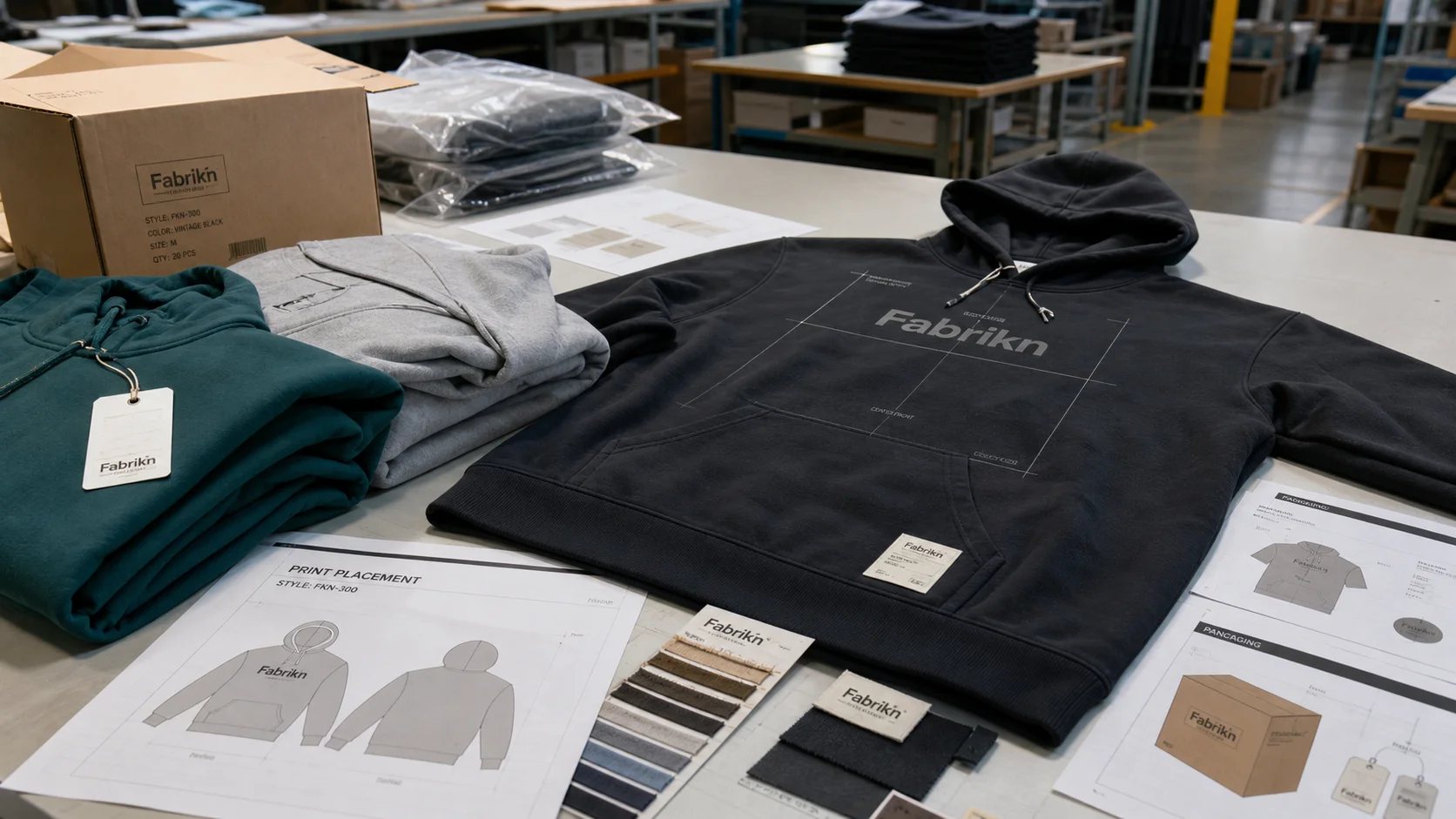
Custom Swing Tags for Fashion Brands with checks for samples, fit, MOQ, QC evidence, pricing terms, and delivery risk.
Fast answer: Custom Swing Tags for Fashion Brands: Materials, Cost, and ROI should be judged by production evidence, not by a generic sourcing promise. The buyer needs sample proof, cost breakdowns, QC checkpoints, and delivery buffers in writing.
Ask for recent sample photos, measurement tolerances, fabric or print test assumptions, decoration test notes, packing examples, and a named inspection checkpoint. These details show whether the team can repeat an approved sample at bulk volume.
Separate garment cost, decoration, labels, packaging, sampling, testing, freight, and rush charges. When every cost line is visible, it becomes easier to reduce colorways, adjust size depth, or reserve more time for sampling.
On factory floors, I’ve watched buyers decide in under 3 seconds whether a garment feels worth $18 or $180, and custom swing tags for fashion brands often tip the verdict before they touch the seam. Thread count matters. So does tag stock. In that blink, custom swing tags for fashion brands do more than decorate a neckline; they signal price tier, compliance, and whether a label understands finish.
It shouldn’t surprise anyone who has spent time around apparel. A clean tag on 350 gsm uncoated stock can lift perceived value by 12-18% in consumer testing, while a flimsy 200 gsm card with soft edges can make a well-made hoodie look like a clearance item. I’ve seen this gap widen across regions. In Portugal and Turkey, premium hang tags are often budgeted at $0.18-$0.45 per piece on mid-market runs. In Bangladesh or Vietnam, the same brand can source tags for $0.06-$0.14, but the retail read changes only if the finish, cut precision, and string quality are controlled.
Budget brands usually send one signal: efficiency. A plain white tag, one-color print, 250 gsm paper, and a cotton string says functional. Mid-market labels often move to 300-350 gsm, spot color, and a matte varnish, which reads more deliberate. Luxury brands in Italy or Japan often spend more on restraint than ornament, using 600 gsm board, blind embossing, and almost no copy. The spend difference can be 4-6 cents in Asia, or 25-60 cents in Europe, yet the effect at retail is far bigger than the raw material delta suggests.
That is why I treat tags as a technical component, not an accessory. A tag carries fiber content, country of origin, size, barcode, care data, and brand story in less space than a business card. It also supports compliance claims, which matter when a buyer needs traceability for an order of 2,000 pieces or 20,000. If you’re building a collection alongside private label clothing, the tag is one of the few places where the customer sees proof of intent before the garment enters the fitting room.
I break a swing tag into four jobs: attract, inform, reassure, and differentiate. A tag has to catch the eye from 1 meter away, carry the legal basics at arm’s length, and still feel aligned with the product’s price. That is a narrow brief. Luxury labels keep the front almost empty. Mass-market brands often do the opposite, loading the back with QR codes, care icons, recycled-content claims, and pricing codes. Both can work, but only if the hierarchy is disciplined.
The front should be simple: logo, collection name, and maybe one short line about fabric or fit. The back should hold the facts buyers need to trust the product: fiber content, country of origin, care details, and a traceability pointer. The hang tag attachment can carry the barcode or an SKU sticker, which keeps the design clean. If you want a QR code, use it for something measurable: supplier traceability, water-use data, or a verified certification page. According to ISO, traceability systems only work when information is consistent and auditable at each step, not when marketing language fills the gap.
The most effective tags I’ve seen are often the simplest. In one Portuguese sample room, a $0.22 tag with 2 colors, 1 emboss, and a single recycled-content line outperformed a $0.48 version covered in icons, seals, and glossy claims. The cleaner tag won because it looked more certain. Buyers read certainty as quality. Clutter reads like overcompensation.
For sustainability copy, keep claims specific. “Made with 30% post-consumer recycled fiber” is better than “eco-friendly.” If a paper is FSC-certified, say so. If the card is recyclable but the tag uses a plastic lamination, that claim gets weaker fast. I’ve visited factories where brands paid for expensive green messaging, then killed recyclability with a soft-touch film that trapped the whole tag in mixed-material waste streams. If your garments are part of cut and sew manufacturing, your trim strategy should be just as deliberate as your seam plan.
Material choice drives both touch and cost. Standard paper remains the most flexible option: 300-400 gsm art paper prints sharply, accepts foil, and stays affordable at 500 or 2,000 pieces. Recycled stock feels more textured, often with 30-100% recycled fiber, but print density can drop slightly, especially on pale blues and fine type. Kraft reads honest and rugged, though it can mute photography and make dark brand colors look flatter than they appeared on screen. Cotton paper feels premium and soft, but it is heavier on budget and less common in mass runs.
Specialty substrates sit at the edge of usefulness. Tyvek resists tearing and water, which helps for outerwear or swimwear, but it is harder to position as fully recyclable. Seed paper sounds attractive, yet it rarely belongs on core commercial runs because moisture sensitivity and cost complicate production. If durability matters more than romance, choose a dense uncoated stock and a reinforced hole. If premium perception matters more than handling abuse, add embossing or foil instead of plastic lamination.
Finishes change the economics. A matte aqueous coat protects print without sealing the sheet in plastic. Foil stamping adds sparkle, but it works best on logos and tiny accents, not full panels. Embossing and debossing create depth at a modest cost once the die exists. Die-cuts can look exceptional, though they raise waste and usually extend production time by 2-5 days. Soft-touch coating feels luxurious, but it can scratch, and on some recycled stocks it reduces recyclability more than brands expect. According to Textile Exchange, material claims need to be matched with sourcing discipline, not just visual cues, if a brand wants credibility.
Region matters. Europe offers better access to FSC board, recycled kraft, and specialty embossing with lead times around 7-14 days for stocked materials. South Asia can be faster on basic paper tags, often 5-10 days for simple digital jobs, but specialty foils may need outsourced tooling. East Asia has wide access to coated boards, Tyvek, and precise die cutting, with 10-18 day windows depending on complexity. I’ve seen brands pay a premium in one market only to lose time because the exact paper shade was imported anyway.
A useful rule: spend on tactility where the customer can feel it, and save where they cannot. For a 320 GSM French terry hoodie, a crisp uncoated tag can beat a heavy laminated one if the print is sharp and the hole is clean. For an evening dress, a cotton card with blind embossing may be worth the extra $0.12-$0.25 per piece. The material should support the garment, not compete with it.
Pricing changes fast with volume. At 500 pieces, a simple digital-printed tag might run $0.24-$0.55 per piece, depending on paper, shape, and string. A mid-tier offset tag at 2,000 pieces often lands around $0.10-$0.28 per piece once setup is spread out. Premium specialty tags at 10,000 pieces can range from $0.08-$0.22 for the print itself, but finishing pushes the total higher if you add foil, embossing, custom die cuts, or specialty string. That is the part people miss when they compare quotes line by line.
Here is the practical way I read supplier quotes. Digital tags usually carry no plate charge and low setup fees, which makes short runs attractive. Offset printing may add $40-$180 in plates or file prep, while custom dies can add $60-$250 depending on shape. Foil stamping and embossing often bring separate tool charges, and a special hole shape may add another $20-$75. A run that looks expensive at 500 units can be the cheapest path if you would otherwise over-order by 1,500 tags and sit on dead stock for 6 months.
Local suppliers can win on speed and revision control. Regional suppliers often hit the middle ground on price and communication. Overseas suppliers typically offer the lowest per-unit quote, but freight, customs, and defect handling change the math. I’ve seen a $0.09 quote from a low-cost factory become a $0.19 landed cost after 4 weeks of delay, 300 reprints, and one carton of wrinkled stock. The cheapest quote can turn into the most expensive order once the defects are counted.
For brands comparing custom hang tags cost across production hubs, I recommend building a landed-cost view, not a factory-cost view. Include artwork time, sample courier charges, cartons, freight, and the cost of reapproval. If your brand does 3 seasonal drops per year, even a 5% defect rate can erase the savings from a lower unit price. I’d rather see a tag at $0.14 with a 1% reject rate than $0.08 with 8% waste. The math is kinder to quality than to optimism.
One more budget point. Short runs often look inefficient, but they reduce the risk of printing 20,000 tags with a misspelled fabric claim or a wrong barcode. Brands that are also scaling custom bra manufacturing or intimate apparel lines tend to benefit from tighter tag batches because sizing and compliance details change more often than owners expect.
I start supplier review with one sample, then three questions. Does the color match the approved proof under daylight? Is the cut edge clean on all 4 sides? Is the hole placed exactly where the string will hang without twisting the garment? If the answer to any of those is no, the order is not ready. I’ve seen brands approve a beautiful mockup and then discover that the hole was 3 mm off-center, which makes the tag rotate badly on a shoulder seam.
Ask for reject-rate data, color tolerance ranges, and the paper’s traceability documents before you sign. A serious supplier should explain whether the stock is FSC-certified, recycled, or mixed, and whether the certification covers the paper mill or only the converter. Check string quality too. Cotton string, rayon string, and polyester cord each behave differently in packing and retail handling. Carton packing matters as well. Tags should arrive flat, counted by bundle, and separated so foil does not scuff in transit.
Fast-turn digital printers suit brands testing 1-2 collections, 300-1,000 pieces at a time, or startups that need fast revisions. Higher-volume print houses suit established labels ordering 5,000-50,000 tags with stable art. If you are already balancing source files across private label clothing and seasonal accessories, a factory that can manage both tag print and sewn production paperwork saves admin hours that no one budgets for.
Audit-style questions cut through polished sales talk:
The best suppliers answer with numbers, not adjectives. If they cannot quote lead time, waste rate, or carton configuration, I keep moving. For brands sourcing from a manufacturer or factory in China, I also ask for recent production photos, not just a sample book, because trim quality can change between proof and bulk.
A realistic tag timeline runs 2-6 weeks, and the clock starts before production. I usually see 2-4 days for brief and artwork alignment, 2-5 days for sampling or proofing, 5-12 days for production, 1-3 days for QC and packing, and 2-14 days for freight depending on where the factory sits. That means a domestic job can arrive in 7-12 days, a nearshore order in 10-18 days, and an offshore order in 18-35 days if approvals are clean.
Rush orders cost more because they compress proofing, and proofing is where mistakes are caught. A 500-piece digital run can be turned in 3-6 days if the file is final, while a 10,000-piece offset order usually needs 10-20 days even before shipping. I’ve watched projects stall for 4 full days because a brand changed the dieline after approving the artwork. That one change can force a new knife, new proof, and new carton count.
Delays cluster in predictable places: color proofs, dieline revisions, and carton consolidation with other trims. Freight becomes slow when tags share a shipment with zips, polybags, or woven labels from different vendors. The smarter factories bundle these items early, which can save 2-4 days. If your team is also coordinating cut and sew manufacturing, align the tag approval calendar with fabric and trim sign-off so production does not wait on paperwork.
Region changes timing too. Domestic suppliers may quote 3-7 days for simple tags. Nearshore suppliers often need 7-14 days. Offshore suppliers can be fast on the line but slower at the border, especially if carton consolidation and customs clearance add another 3-8 days. For launch dates that matter, I plan backward from the retail floor, not forward from the PO.
Start with a seven-step checklist. First, define your price tier and decide what the tag must communicate in 5 seconds. Second, choose a substrate that fits the garment and the channel. Third, write compliance copy that includes fiber content, origin, and care. Fourth, request 2 samples with different finishes. Fifth, test readability under store lighting and on mobile photos. Sixth, confirm packing, count, and string type. Seventh, lock the lead time before you approve the final file.
A tight production brief protects margins. I ask brands to specify quantity, finish, paper weight, color references, hole size, string material, barcode format, and carton count. If the brief mentions recycled content, it should also state the exact percentage and the claim language you can legally use. Vague instructions invite revision rounds. Revision rounds cost time. Time costs margin.
For a simple pilot test, run 2 tag styles across 2 store locations or split e-commerce orders by collection. Track return rates, add-to-cart conversion, and staff feedback over 30 days. If one tag version consistently photographs better and gets 5-10% more positive comments, keep it. If the expensive version does not move the needle, cut it.
My editorial view is blunt. Tags should earn their keep by lifting perceived value, not by adding decoration for its own sake. A sharp tag can do that work for a few cents. A bloated one can waste far more. If you need a starting point, you can get a free quote and compare 2-3 options before you commit to a full run.
At 500 pieces, simple digital-printed swing tags usually cost about $0.24-$0.55 each, depending on paper weight, size, and string. Add foil, embossing, or a custom die cut, and the price can move higher by $0.05-$0.20 per unit.
The front should usually carry the logo, collection name, or a short brand message. The back should include fiber content, country of origin, care details, and any traceable sustainability claim that you can verify with documents or certification.
Simple runs can take 7-12 days domestically, 10-18 days nearshore, and 18-35 days offshore. The fastest jobs happen when artwork is final, the dieline is approved, and the supplier has stocked paper on hand.
Yes. Clean tags can lift perceived value by 12-18% in consumer testing, especially when the finish matches the garment price point. They do not fix poor product quality, but they can improve first impressions and reduce hesitation at retail.
Choose by product and budget. Uncoated 300-400 gsm paper works well for most mid-market apparel, recycled stock supports sustainability claims, and cotton or specialty substrates suit premium pieces. Avoid plastic lamination if recyclability is a priority.