
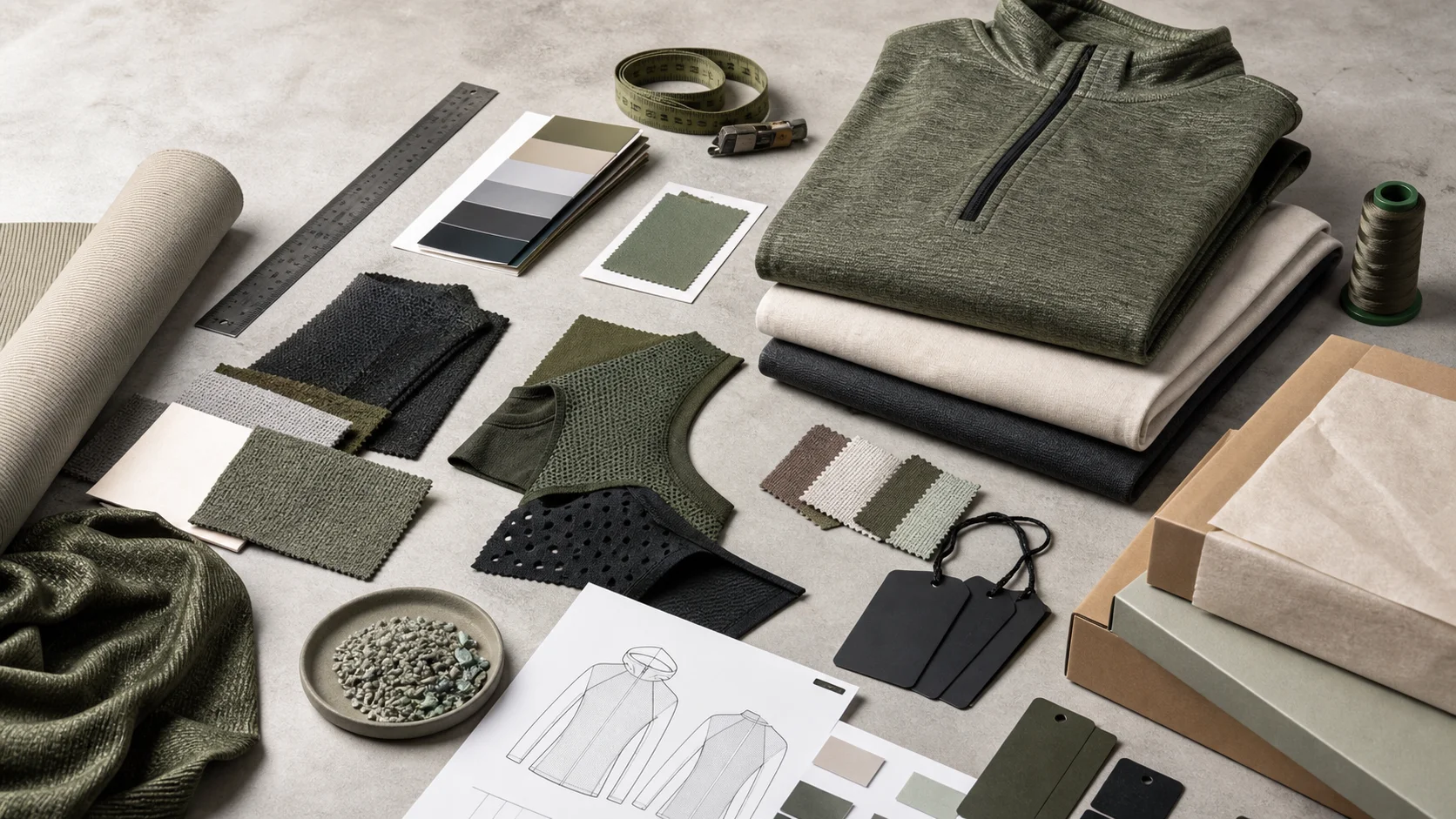
Swing Tags for Clothing Brands compared by sample evidence, fabric or trim specs, MOQ, AQL terms, cost lines, delivery timing, and rework responsibility.
Fast answer: Swing Tags for Clothing Brands: Tech Pack, Sample Gate, MOQ, and QC Terms should be judged by production evidence, not by a generic sourcing promise. The buyer needs sample proof, cost breakdowns, QC checkpoints, and delivery buffers in writing.
Ask for recent sample photos, measurement tolerances, fabric or print test assumptions, decoration test notes, packing examples, and a named inspection checkpoint. These details show whether the team can repeat an approved sample at bulk volume.
Separate garment cost, decoration, labels, packaging, sampling, testing, freight, and rush charges. Clear cost lines make it easier to reduce colorways, adjust size depth, or reserve more time for sampling.
A tag can turn a passing glance into a purchase. I’ve seen it happen on crowded shop floors, in e-commerce unboxings, and again in resale listings where a clean tag photograph adds credibility before the garment is even worn. That is why what are swing tags for clothing brands matters far beyond printing. Tiny cards, big job.
Factories in Vietnam, Portugal, Turkey, and India kept showing me the same mistake. Brands would obsess over fabric, stitch count, and wash finish, then approve a tag in ten seconds. Backward. The buyer sees the tag first on the hanger, then again at checkout, and sometimes a third time in a parcel box at home. If the tag feels flimsy, the garment feels cheaper.
A swing tag can show price, size, care, origin, barcode, and story in one glance. It can also do quieter work: reduce returns by clarifying fit and care, support resale by proving authenticity, and sharpen perceived value across price points from $15 tees to $300 outerwear. I’ve seen the same 180 GSM card lift conversion for a premium knit and undercut trust for a sustainable basics brand because the messaging was cluttered and the finish looked disposable.
The retail moment is brutally short. In store, a shopper may spend 4-7 seconds with a product before deciding to touch it. Online, the tag appears in the first unboxing frame. On resale, it becomes evidence. Swing tags do more than decorate. They set the first story.
Swing tags are the removable tags attached to a garment by string, ribbon, plastic loop, or pin. They are not the same as woven labels, care labels, or stickers. Woven labels live inside the seam. Care labels tell the consumer how to wash the item. Stickers usually stay on packaging. Swing tags sit outside the product and work as the front-of-house message, which is why they matter so much at the point of sale.
So, what are swing tags for clothing brands doing in practice? Four jobs: branding, product information, legal compliance, and merchandising. That means logo, type treatment, colour, tone, size, fabric composition, country of origin, barcode, QR code details, SKU, pricing tier, seasonal drop, and replenishment codes. In many markets, fiber content and origin claims must be accurate and legible, and store staff need the right information fast when styles are moving through the warehouse.
In e-commerce fulfilment, swing tags help too. I’ve seen pickers use them to confirm colourways and size runs when cartons arrive mixed, and that matters when a launch has 12 SKUs, 3 size ratios, and a 48-hour dispatch promise. For basics, the tag often carries plain utility: composition, fit note, barcode. Premium denim may use a heavier folded card with vintage-style typography, an indigo dye story, and a wash code. Activewear often needs sweat and stretch claims, plus QR-linked care guidance. Accessories use tags to show dimensions, hardware finish, and origin details, especially when one collection includes hats, belts, and small leather goods.
Luxury and mass-market brands frequently use the same tag stock weight, often around 300-350 GSM. The difference is finish. A luxury label may choose soft-touch lamination, blind emboss, and matte foil. A mass brand may use the same board with plain varnish and a basic string. The material feels similar in hand, but the signal is completely different.
That is why swing tags are more than paper. Tiny sales tools. Compliance tools. Inventory tools. All at once.
Most swing tags begin with paper stock, and the differences are sharper than many buyers expect. Uncoated card is easy to write on and usually costs less, often in the $0.04-$0.12 range per tag at scale. Coated card gives richer colour and sharper imagery, which helps when you need strong brand photography or deep black ink. Recycled stock can lower virgin fiber use, though quality varies from 200 GSM to 400 GSM, and print consistency can shift by mill. Kraft stock reads earthy and low-intervention, which suits natural-fibre brands and smaller runs of 300-1,000 units. Seed paper looks attractive on a pitch deck, but it is brittle, often expensive, and rarely ideal for apparel tags that need a clean hang and a sharp die-cut.
Synthetic tags, including polypropylene or other plastic alternatives, can improve water resistance and tear strength. I have seen them used on swimwear and workwear where humidity, handling, or warehouse abrasion is a real issue. They also complicate end-of-life disposal, so they need a strong use case. According to Textile Exchange, recycled inputs only matter if the full material system supports lower-impact outcomes. A recycled content claim does not automatically mean a lower-impact tag if the finishing makes it unrecyclable. When brands ask what are swing tags for clothing brands made from with sustainability in mind, the answer usually starts with fewer materials and fewer coatings.
That is where coatings and embellishments become a problem. Laminations, foil stamping, spot UV, heavy varnish, and plastic windows can block recyclability or make paper recovery more difficult. Embossing and debossing are less troublesome because they change the surface mechanically rather than adding another material layer. I’ve seen European suppliers in Portugal and Poland hold stricter limits on mixed-material finishes and shorter runs, often 500-2,000 pieces, while mills and converters in China, Bangladesh, and Vietnam can offer a wider menu of finishes, quicker tool changes, and more decorative options. In Asia, I’ve quoted 6-8 finishing combinations in one sample round. In parts of Europe, the same project was narrowed to 2-3 choices because environmental rules and machine setups were tighter.
Buyers should test four things: tear strength, print fidelity, hanging performance, and end-of-life disposal. A tag that looks beautiful but curls in humidity is a failure. A tag that tears at the string hole after 20 seconds on the rail is worse. For babywear, I usually steer brands toward safer inks and simpler boards, the same thinking that underpins custom baby clothing manufacturing where touch, safety, and wash durability matter from the start. If you are sourcing from a factory or supplier, ask for a sample board before approving bulk production.
If sustainability is the brief, the best tag is often the one with fewer materials, fewer finishes, and a clear path through recycling streams. Not glamorous. Effective. Buyers comparing a custom tag program with wholesale or bulk production should always check the factory’s quality controls, MOQ, and print consistency before placing the order.
Pricing swings hard by quantity. For a basic one-colour tag on 300-350 GSM card, 500 units may land around $0.18-$0.35 each, before shipping and setup. At 1,000 units, that can drop to $0.10-$0.22. At 5,000 units, the range often tightens to $0.05-$0.14. At 10,000 units, I’ve seen simple runs fall as low as $0.03-$0.09 per tag, depending on region, finishing, and carton pack-out. For premium tags with foil, embossing, or specialty die-cuts, those figures can double or triple.
Material choice moves the needle, but it is not the only factor. A tag with print on both sides costs more than one side. A tag with a drilled hole, eyelet, and string assembly costs more than a flat card with no attachment. Variable data, such as SKU-specific barcodes or QR codes for 24 styles, can add setup time even if the unit price barely changes. A 2-colour offset run will usually beat digital print at 5,000 pieces, while digital is often better for 250-1,000 pieces, especially when artwork changes every week.
Regional differences matter. Domestic quick-turn orders in the US or UK may cost 20-40% more per unit, but they can reduce lead time to 3-7 days and cut freight risk. Offshore bulk orders may take 3-5 weeks from approval to delivery, yet the landed cost can be much lower when you are ordering 10,000 or 25,000 tags across multiple SKUs. I have worked with brands that paid $280 for art setup and proofing, then forgot to budget $90-$180 for courier samples, customs, and a second proof after colour correction. For sourcing teams asking what are swing tags for clothing brands costing at scale, the answer depends on production region, factory setup, and whether your supplier prints in-house or outsources finishing.
Hidden costs are where margins leak. Artwork setup, dieline changes, metal eyelets, color proofing, shipping, and compliance rework can add 10-25% to the quoted price. If the team changes the garment composition after the tags are printed, you may have to reprint the whole batch. That is especially painful for seasonal lines with 4-6 week merchandising windows. Brands that do private label work at scale know this well, which is why private label clothing services often include packaging coordination from the beginning rather than as an afterthought.
My rule is simple. Judge swing tags on total landed cost, lead time, and the revenue signal they send on the rail. If you are comparing suppliers, ask for MOQ, sample charges, and bulk pricing in writing before you approve production.
Design changes behaviour before a shopper touches the fabric. Typography, texture, colour, and information hierarchy all affect whether a garment feels like a $15 basic or a $300 outer layer. A cheap-looking tag can flatten the value of a strong product. A polished tag can support a modest garment, but only if the design feels honest rather than theatrical.
For fast fashion tees priced at $12-$25, the tag should be direct: logo, size, composition, barcodes, and maybe a short brand line. Keep it to 1-2 colours and a clean hierarchy. For premium apparel in the $60-$150 range, the tag can carry more texture: heavier stock, muted foil, a short sustainability note, and a QR code to care or traceability content. For luxury outerwear priced at $250-$600, the tag often behaves more like a miniature brand object. Heavy board, precise finishing, and restrained copy matter more than volume of text.
QR codes and traceability claims can build trust, but only when they do not clutter the front. Data from ISO standards work reminds buyers that consistency and accuracy matter more than decorative claims. A QR code linked to mill origin, wash test results, or repair advice can reduce customer service questions by 5-10% in some categories, especially activewear and outerwear. Still, if the code sits next to four paragraphs of copy, the tag starts to look defensive.
I’ve seen expensive-looking tags raise perceived value on modest garments by 15-20% in buyer testing. I’ve also seen overdesigned sustainable brands lose credibility because the tag looked too glossy, too foiled, and too polished for a recycled cotton tee. That mismatch is fatal. The product should support the tag, and the tag should support the product. Not the other way round.
One design mistake repeats across categories: unreadable type. Another is tag-to-garment mismatch. A tiny crop top with a huge tag looks clumsy. A heavyweight wool coat with a postcard-sized tag looks underbought. The best tags tell the truth in the right voice.
A clean brief saves weeks. I start with dimensions, stock, finish, hole position, string type, print method, quantity, and whether the tag needs variable data like SKU numbers or retail pricing. A good brief also names the garment category, because a swing tag for a knit tee behaves differently from one for leather goods or headwear. For hats, for example, the hang point and tag size need to suit the curve of the brim, which is one reason custom hat manufacturing projects require tighter pack planning. A manufacturer or factory will usually quote faster when those details are clear.
File prep matters. Send vector artwork, a dieline with bleed and safe zones, and a version that shows the finished fold if the tag is double-sided or tented. I ask for PDF, AI, or EPS files, not screenshots. Then I insist on a proof. Digital proofs catch layout issues. Physical samples catch everything else, from paper feel to hole alignment to how the string twists once packed in bundles of 100.
Turnaround depends on process. Digital print can move in 5-10 business days for simple runs of 500-2,000 pieces. Offset print usually needs 2-4 weeks once plates and colour matching are approved. Specialty finishing like embossing, foil, or soft-touch lamination can push the schedule to 3-5 weeks. In factories, I check colour consistency, cut accuracy, hole placement, and adhesion testing if a label uses glued inserts or layered boards. A 1.5 mm hole misplacement can make a tag hang crooked on the rail. Small. Still matters.
Common procurement errors delay launches by 1-3 weeks. The worst ones are changing fiber content after the tags are approved, forgetting country-of-origin language, and approving a finish that cannot be sourced in the target quantity. I have seen teams lose an entire shipment because the barcode was printed too close to the trim edge and could not scan cleanly. Good production planning helps, especially when your supplier is handling both custom and wholesale orders across multiple SKUs.
Factories are usually willing to help, but only if the brief is specific. Vagueness creates rework. Rework costs time. Time costs sales. If you need compliance guidance for exports, the U.S. Commercial Service at trade.gov is a useful starting point for market and import information.
Before requesting quotes, I use a short checklist. Define the tag’s purpose. Set a ceiling budget. Choose the stock. Confirm legal copy. Decide whether the tag must support resale, e-commerce unboxing, or retail display. Then request 3 quotes from suppliers in different regions so you can compare not just price, but also lead time, MOQ, proofing speed, and sustainability paperwork.
Ask for documentation. I want recycled content claims, FSC or comparable chain-of-custody proof where relevant, ink information, and a clear explanation of what happens to foil, lamination, or synthetic components at end of life. Compare suppliers on MOQ too. One converter may offer 500 pieces with a 7-day turnaround. Another may quote 5,000 pieces with a 4-week lead time and much lower unit cost. Both can be right for different launches. In a seasonal business, that difference can determine whether you hit a drop date or miss it by 10 days.
Test before you commit. I recommend a small sell-through batch of 100-300 units when the design is new or the finish is untested. Watch how the tag hangs, whether the hole tears, whether the print scuffs in transit, and whether customers comment on it in store or online. For brands balancing sustainability targets with premium presentation, a simple matte board with careful typography often beats a heavily finished card that looks impressive but fights your values. The same restraint helps in other categories too, from lingerie to accessories, where the product should stay central.
My decision framework: choose value if the tag must be cheap, compliant, and fast. Choose speed if the launch date is fixed and the run is small. Choose lower-impact materials if the brand promise depends on credible environmental claims, even if that means fewer finishes and a slightly higher unit price.
The smartest buyers treat swing tags as a revenue tool, not an afterthought. Get the brief right, and the tag earns its keep on the shelf, in the parcel, and in the resale photo. If you are still deciding what are swing tags for clothing brands in your own line, start with the job they need to do, then build the tag around that brief.
Swing tags carry branding, pricing, size, fiber content, country of origin, and SKU data. They also help with merchandising and can support resale or traceability through QR codes. In stores, they often influence first impressions within 4-7 seconds.
For simple card tags, 500 units may cost about $0.18-$0.35 each, while 10,000 units can drop to $0.03-$0.09 each. Foil, embossing, eyelets, and variable data raise the price. Shipping, proofs, and setup can add 10-25% more.
Common materials include uncoated paper, coated card, recycled stock, kraft, seed paper, and synthetic alternatives. The best choice depends on tear strength, print quality, and recyclability. A recycled tag with heavy lamination may be harder to recycle than a simpler virgin-fiber card.
Digital print can take 5-10 business days for small runs. Offset print usually needs 2-4 weeks, and specialty finishes can stretch to 3-5 weeks. If artwork changes after proof approval, add 1-3 weeks for rework and reapproval.
Yes. A well-made tag can raise perceived value by making a garment feel more considered and trustworthy. Texture, typography, and clear information matter most. Overdesign can backfire, especially for sustainable brands that need the tag to match the product’s values.