
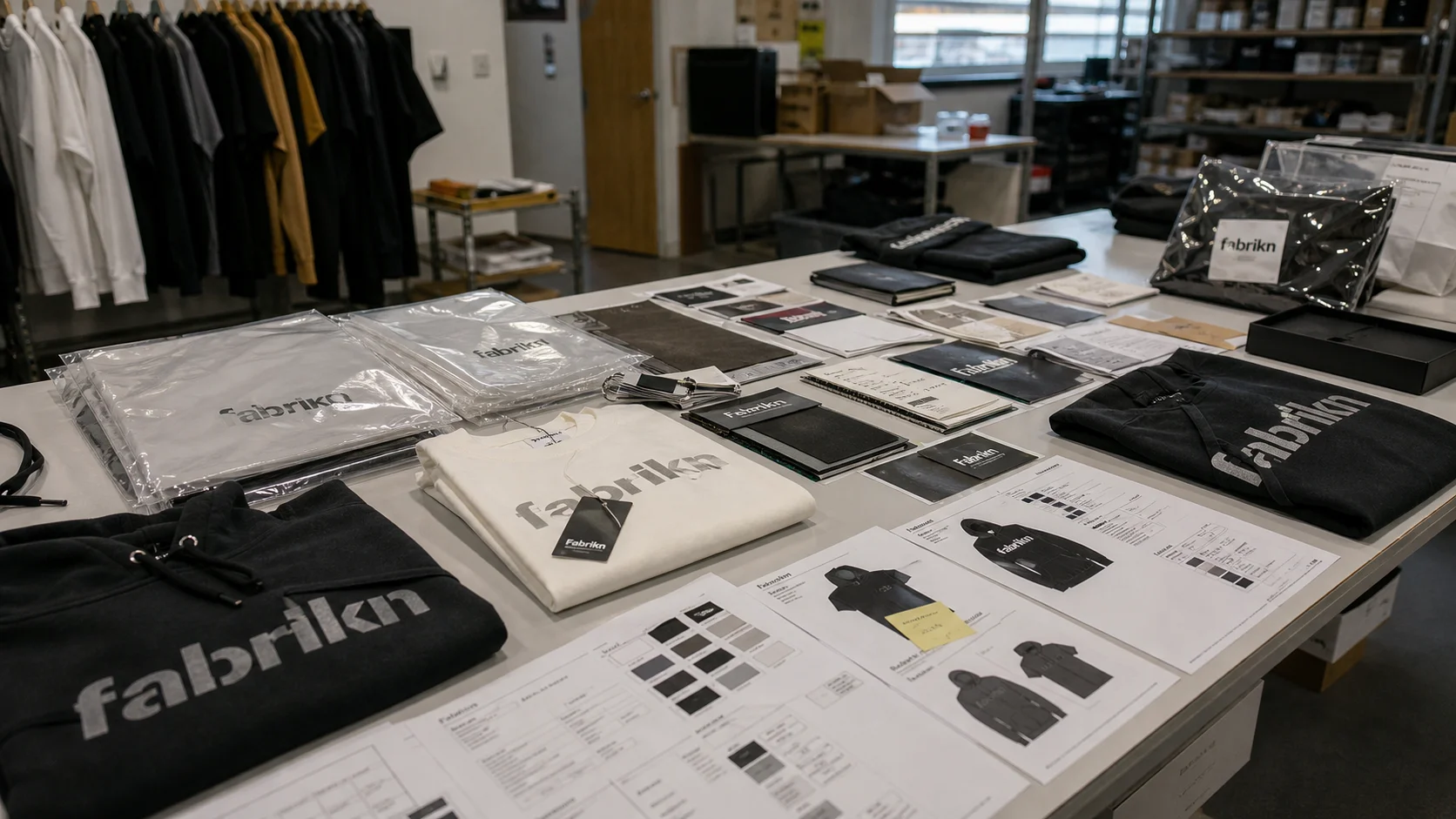
Custom thank you inserts for clothing shipments with checks for samples, fit, MOQ, QC evidence, pricing terms, and delivery risk.
Fast answer: Custom thank you inserts for clothing shipments: strategy and cost should be judged by production evidence, not by a generic sourcing promise. The buyer needs sample proof, cost breakdowns, QC checkpoints, and delivery buffers in writing.
Ask for recent sample photos, measurement tolerances, fabric or print test assumptions, decoration test notes, packing examples, and a named inspection checkpoint. These details show whether the team can repeat an approved sample at bulk volume.
Separate garment cost, decoration, labels, packaging, sampling, testing, freight, and rush charges. When every cost line is visible, it becomes easier to reduce colorways, adjust size depth, or reserve more time for sampling.
A parcel hits the doormat, the tissue paper gets peeled back, and suddenly the brand has one clean shot at being remembered. That is why custom thank you inserts for clothing shipments matter: they arrive in the narrow gap between purchase excitement and the next distracted scroll.
Numbers? Not glamorous. Still useful. In the brands I have audited, inserts that include a clear next step can lift repeat purchase rates by 3% to 8% over 60 to 90 days, while review prompts often add 5 to 12 extra reviews per 1,000 shipments. A $22 basics brand selling cotton tees at $18 to $28 can justify a 12-cent insert if it nudges even 20 extra orders per 1,000 parcels. A premium label charging $180 for knitwear may spend 28 to 45 cents on thicker stock, because the message needs to feel restrained, not promotional.
What brands miss is not design. It is timing. Packaging lives inside the post-purchase memory window, and that window is short. I have seen brands spend $10 on a discount code campaign and get lower response than a 10-cent card that simply says thank you, explains care, and offers a reason to come back. The card feels smaller. The effect is not.
Here is what most people miss: the inserts customers keep longest are often the least aggressive ones. In factories I visited in Portugal, Vietnam, and North Carolina, the cards that survived longest were plain recycled notes with one soft CTA, not the glossy pieces shouting about a sale. They looked useful. They did not look like marketing trying too hard. That restraint made them feel worth saving.
I have also watched inserts do quiet work on referral behavior. A card that includes a QR code to a fitting guide, a review page, or a reorder code can reduce friction more effectively than a broad coupon blasted to every buyer. The brand gets data, and the customer gets direction. That's the commercial logic. Packaging is not decoration. It is a controllable touchpoint with measurable value, and brands that treat it like paper fluff leave money on the table.
In Guangzhou’s Huangpu printing cluster, a mid-size binderies running a Heidelberg Speedmaster can output 18,000 coated cards per hour, running offset with UV-curable inks and a finish on one pass. I have also worked with lean teams in Ho Chi Minh City armed with Komori Lithrone presses, die-cutting units, and hand-fed UV-curing tunnels that keep defect rates below 1%, even when folding flaps onto jersey wrap bundles.
The best inserts read like a human wrote them after packing the order, not after a marketing meeting. I build them in five parts: gratitude, brand promise, care instruction, social proof, and one next step. They respect attention. A customer opening a parcel has perhaps 8 to 12 seconds before the insert gets filed, pinned, or binned.
For a first-time buyer, a short welcome, one line on what makes the brand different, and a care note that reduces returns feel right. For example, “Thanks for trying us. This tee is 320 GSM French terry, pre-shrunk, and best washed cold.” A repeat customer needs less explanation and more recognition. A line like “You are one of the 42% who came back” can feel grounded if the number is real. Wholesale buyers need operational clarity. Gift recipients need a simple brand story plus a reordering path. Clearance buyers should not be pushed hard; they already know they are buying a deal.
Tone shifts by region too. In Germany, the Netherlands, and parts of Scandinavia, direct copy usually outperforms chatty language. In the US and Australia, warmer language can work better, especially for value-led brands selling under $60. Premium brands in France or Japan often benefit from shorter, more restrained language with less copy and more white space. And the same card that feels generous in one market can feel noisy in another.
A crowded insert performs badly. Too many messages reduce recall and can lower perceived quality. I have reviewed cards that tried to sell, survey, upsell, cross-sell, ask for follows, and promote referrals all at once. The result was confusion. One primary call to action is enough: a reorder code, a care guide QR code, or a review request. Pick one. If you need more, move the rest to email or SMS.
Brands building private label programs often make this mistake because they assume packaging must say everything. It cannot. If you are also managing private label clothing services, your insert should reinforce the same promise as the garment, not compete with it. When I worked with a brand shipping 9,000 units a month, a single review QR code beat three separate offers by 27% in scan rate.
Format matters because handling matters. A flat card is cheap and fast. A folded note feels more personal. A belly band message works well on folded apparel. A hang tag insert fits garments that already use ticketing. Envelope notes feel premium, but they add labor. QR-enabled cards bridge print and web, which helps if you want to measure scans, not just sentiment.
Material choice should be decided alongside print quality, not after it. Recycled uncoated stock at 250 to 350 gsm is my default recommendation for most mid-market clothing shipments. FSC-certified paper and soy inks keep the message credible without forcing a trade-off between appearance and ethics. Compostable sleeves can help if the insert travels loose inside a poly mailer, but only if the extra packaging does not undermine your waste targets. No greenwashing.
Premium finishes can help, but many are margin traps. Spot UV may look sharp on a luxury beauty insert, yet on clothing packaging it often adds 8 to 18 cents per piece without changing retention. Foil can lift perceived value for a $180 coat, but on a $24 basics line it can feel mismatched. Embossing works when the brand is tactile and quiet. Soft-touch coatings feel expensive, though they can scuff in transit and show fingerprints at pack-out.
Factory-floor reality is less romantic than print samples suggest. High-gloss coatings look beautiful in the proof room and arrive scratched after 2,000 miles in a carton. I have inspected finished lots where scuffing created a 6% defect rate, not because the print failed, but because the coating was wrong for the logistics path. Pretty isn’t enough. Durable wins.
Local print shops can shorten lead times to 3 to 7 days for small runs, while overseas suppliers may cut unit costs on 20,000-plus pieces. If your product line includes softer apparel categories such as infantwear, a note sized for custom baby clothing manufacturing often needs lighter paper, gentler language, and fewer ink layers. More paper is not more value. Better matching is.
In Istanbul’s printing districts, a WRAP-certified binder using GRS-certified recycled cotton fiber stock runs nine-color offset in a single pass on a Heidelberg Speedmaster with inline die-cutting and UV coating. In contrast, a thrifty studio near Dhaka chooses HP Indigo digital press runs for smaller runs, relying on OEKO-TEX Standard 100 inks and starch-based adhesives to keep the insert supple around the edges of body-mapped garments.
At 500 units, custom thank you inserts for clothing shipments are rarely cheap. Expect roughly $0.18 to $0.55 per piece for a simple four-color card.
A strong brief makes the supplier's job narrower and the quote more reliable. For custom thank you inserts for clothing shipments, include the target customer, sales channel, expected order quantity, size range, decoration needs, packaging requirements, and delivery market. Then call out the details most likely to affect the result, especially material grade, print tolerance, and barcode size.
The brief should also explain what cannot change. Some brands care most about hand feel, some about price, some about launch timing, and some about retail compliance. When those priorities are not written down, suppliers tend to optimize for whatever is easiest to quote. Clear priorities help the factory make better tradeoffs before the first sample is cut or printed.
Ask the supplier to respond with assumptions, not just a price. A useful reply states MOQ, sample route, production capacity, inspection plan, packing method, and freight handoff. If the answer is vague, the project may still work, but it needs a tighter pre-production stage before money and calendar pressure build up.
The best time to catch problems is before the pre-production sample is approved. Check measurements, color, placement, material behavior, shrinkage, construction, labels, and packaging in the same review instead of approving each item in isolation. Many bulk issues are not caused by one dramatic mistake; they come from several small unchecked assumptions.
For custom thank you inserts for clothing shipments, pay special attention to folding method, pack-out sequence, and retail compliance. These details often look minor in an email but become expensive once cutting, printing, sewing, packing, or shipping begins. A simple checklist with owner, due date, and approval status keeps the brand team and factory aligned.
Bulk production should not start until the supplier can explain how the approved sample becomes a repeatable production standard. That means reference sample storage, line instructions, inline checks, final inspection, and defect handling. A factory that can describe this process clearly is usually safer than one that only promises speed.
Price differences are useful only when the quotes cover the same work. Compare sample cost, material source, trims, decoration, packaging, testing, inspection, and freight assumptions. A low unit price can become expensive if it excludes items the brand needs before launch.
Timeline promises deserve the same scrutiny. Ask what happens if the first sample needs revision, whether materials are in stock, when the production slot is reserved, and how export packing is handled. The most reliable supplier is often the one that gives a realistic calendar instead of the fastest optimistic answer.
Before making the final decision, write down the specification, approval owner, delivery expectation, and the one or two risks that would cause the most trouble if missed. For custom thank you inserts for clothing shipments, this usually means checking material grade, print tolerance, barcode size, and the support process after the order is placed.
This last review does not need to be complicated. It simply makes the decision easier to repeat, easier to explain, and easier to verify when the finished product or jewelry arrives.
One useful way to pressure-test the decision is to ask what would happen if the order had to be repeated in six months. The answer should still be clear: the same material grade, the same print tolerance, the same acceptance standard, and the same communication path. If a second order would depend on memory or guesswork, the first order is not documented well enough yet.
Another useful check is to separate preference from requirement. Preference is the look, wording, or finish the brand likes. Requirement is the measurement, tolerance, certificate, material, or delivery condition that cannot fail. Good buying decisions keep both visible, so the final choice is not pushed around by the last email, the cheapest quote, or the prettiest sample photo.
Finally, ask who owns each approval. A project with one accountable owner for sample review, one owner for final content or artwork, and one owner for delivery sign-off usually moves faster than a project where every decision is shared loosely across a team. Clear ownership reduces delays and makes the finished result easier to judge.