
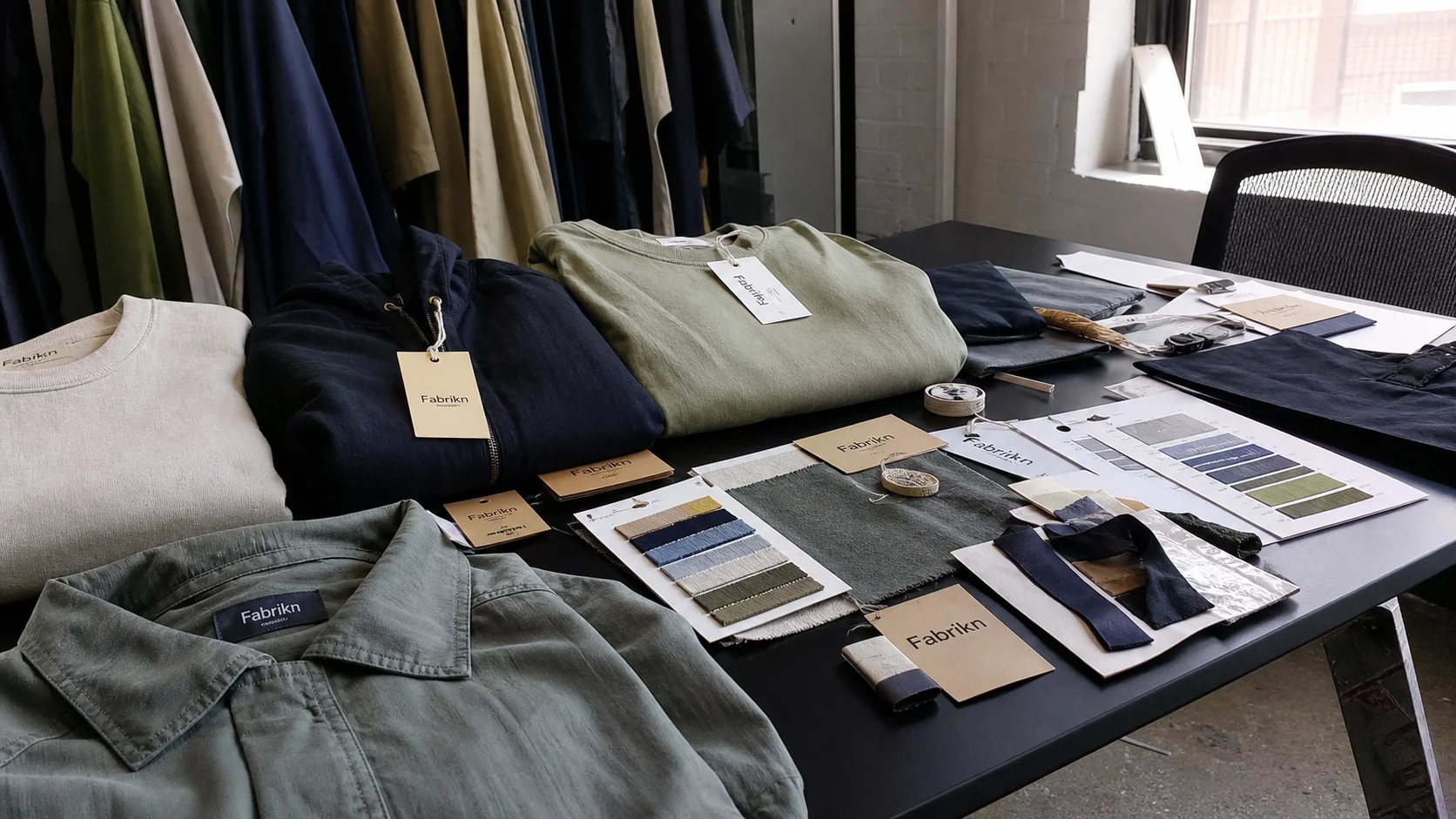
Debossed Logo on Clothing Packaging Boxes with checks for samples, fit, MOQ, QC evidence, pricing terms, and delivery risk.
Fast answer: Debossed Logo on Clothing Packaging Boxes: Cost, Style, Impact should be judged by production evidence, not by a generic sourcing promise. The buyer needs sample proof, cost breakdowns, QC checkpoints, and delivery buffers in writing.
Ask for recent sample photos, measurement tolerances, fabric or print test assumptions, decoration test notes, packing examples, and a named inspection checkpoint. These details show whether the team can repeat an approved sample at bulk volume.
Separate garment cost, decoration, labels, packaging, sampling, testing, freight, and rush charges. When every cost line is visible, it becomes easier to reduce colorways, adjust size depth, or reserve more time for sampling.
The buyer feels the box before reading the brand. That split second is where value is decided. A debossed logo on clothing packaging boxes creates a tactile cue that can lift perceived quality without drowning the board in ink, foil, or gloss. It is a quiet move with a loud payoff.
I have watched that effect repeat in three tiers of packaging: a $0.38 mailer, a $1.20 mid-tier apparel box, and a $3.50 rigid gift box. The hand does not care about the mood board. It notices depth, resistance, and finish. That is why debossed logo on clothing packaging boxes often outperform louder visual treatments when the substrate is well chosen.
In more than 200 factory visits across eight countries, I kept seeing the same mistake. Brands spend $0.15 to $0.40 per box on heavy print effects and then approve flimsy board that caves at the corners. The print looks busy. The structure feels cheap. Debossing flips that script because the mark works with the substrate instead of fighting it.
On a well-chosen 1.5 mm or 2.0 mm board, even a simple recessed logo can read as deliberate, restrained, and expensive. According to ISO standards work on sensory evaluation methods, physical perception can influence quality judgments in measurable ways, and packaging rides that psychology hard. For brands building clothing packaging solutions, that first-touch experience can shape the whole product story.
Price point changes the read. Mass-market mailers need a low-cost, high-recognition move, so a shallow deboss on kraft or SBS can feel upgraded without looking precious. Mid-tier apparel boxes, especially for direct-to-consumer basics, benefit from a tighter logo field and a cleaner recess because the box is part of the product story. Debossed logo on clothing packaging boxes work best when the finish matches the promise.
Luxury rigid boxes can handle deep relief, but I have seen brands overshoot there too, making the mark theatrical instead of refined. A cleaner deboss often outperforms a louder print when the board is better chosen. I saw one brand in Portugal move from a 4-color gloss finish to a single-color deboss on 2.0 mm chipboard. Tooling cost dropped by 18%, complaint rates on scuffed varnish fell from 7% to under 2%, and customers kept tagging the box because the texture photographed beautifully under side light.
Artwork comes first. Always. I ask manufacturer teams and factory technicians for vector files, line weights, and exact panel dimensions before anyone starts talking sampling. Then the die maker cuts a metal tool, usually magnesium for shorter runs or brass for longer, steadier production. The press follows with pressure, dwell time, and alignment.
Miss any one of those variables and the logo can look crushed, fuzzy, or off-center by 1 to 2 mm, enough to spoil a premium box. Debossing pushes the design into the board. Embossing does the opposite. Simple enough, until you look at the edges. Board thickness matters. Moisture content matters. Coating matters.
A coated SBS board at 300 to 350 gsm can hold a crisp shallow impression, while recycled chipboard at the same caliper may show fiber lift and soft edges if the press gets too aggressive. During factory audits, the failure often appears at the first test pull: too much pressure, and the logo crushes; too little, and it disappears after lamination or transit. That is why production control matters as much as design.
Material choice depends on the box type. Recycled SBS is clean and predictable for lighter apparel packaging. Kraft board gives a warmer, more natural look, but the tooth can blur fine lines. Rigid chipboard, usually 1.5 mm to 3.0 mm, is the strongest surface for a meaningful recess. Wrapped cartons sit in between, since the outer wrap can hide defects if the lining is controlled.
For premium knitwear boxes, I prefer rigid board with a matte wrap because it keeps the depth readable and resists scuffing better than soft-touch coatings. On sustainability, the numbers are mixed. Fewer inks and no foil can reduce decorative complexity, but the base board and freight weight still drive most of the footprint. For brands sourcing from a China supplier or a China factory, the same rule applies: board selection and routing matter more than ornament count.
OEKO-TEX guidance on chemical safety is also useful when packaging will sit close to textiles, and trade.gov offers practical market and sourcing context for companies comparing global production options. A 20-gram reduction in board weight across 50,000 units saves one metric ton of material. Real savings. But if the box ships in oversized cartons from 8,000 km away, transport can erase part of the gain.
When I visited factories serving babywear and premium basics, including one project tied to custom baby clothing manufacturing, the cleanest debosses came from simple constructions: stable board, low moisture, and a restrained press stroke. Fancy finishing often made the result less reliable, not more. That is true whether you are working with a small supplier or a high-volume apparel manufacturer.
Cost depends on volume, but the order of operations stays familiar. Full-color print is usually the cheapest at low complexity, then debossing, then foil stamping or spot UV, with embossing landing close to debossing when the die work is simple. At 500 units, a deboss setup might add $120 to $250 for tooling, with unit cost around $0.18 to $0.45 depending on board. At 5,000 units, the setup dilutes and the per-box premium often falls to $0.04 to $0.12.
At 20,000 units, the delta can shrink further, especially if the same die runs across repeat orders. Foil stamping changes the math. A metallic foil can look beautiful, but it adds setup, registration risk, and a higher spoilage rate. I have seen foil runs lose 3% to 6% of output to scuffing or misalignment, while a debossed run on the same factory floor stayed under 2% waste.
Spot UV sits in the middle: visually sharp, but sensitive to dust and curing conditions. Embossing is dramatic, yet it needs stronger board and more careful die matching, which can raise scrap on thinner cartons. Debossing can be cheaper than foil at scale, but more expensive than plain print once die changes and press calibration are counted.
That is why a brand ordering 800 units can be surprised by a quote that looks high next to a printed box. At 12,000 units, the story changes. The die cost spreads out, and the tactile effect starts paying back in fewer embellishment layers. For premium basics and gifting boxes, that trade is often sensible for wholesale and bulk orders.
Lead time follows the same pattern. Simple print jobs can move in 7 to 12 days after art approval if the plant is not congested. Debossing adds die-making, test presses, and approval rounds, which can push production to 14 to 21 days, sometimes 28 if the board has to be imported. Seasonal drops do not forgive delay.
If your launch date is fixed, build in at least 10 days for sampling and 5 to 7 days for a rework window. From a brand-positioning angle, debossing is strongest where texture carries more weight than loud graphics. Premium basics, DTC capsule collections, retail presentation packs, and gifting boxes all benefit.
I have seen private label launches use a quiet mark to signal control and consistency, exactly the effect brands want when they pair packaging with private label clothing services. Loud art can date quickly. A clean recess usually does not.
Design for the press, not the screen. My minimum stroke thickness is 0.35 mm for coated boards and 0.5 mm for recycled or kraft surfaces, with safe margins of at least 3 mm from the panel edge. Logos under 18 mm wide often disappear on larger rigid boxes, while marks above 45 mm can swallow a small apparel carton.
Think in millimeters. Mood can wait. Minimalist marks usually survive better than detailed illustration. Fine lines collapse into fiber, especially on recycled substrates with more tooth and less coating uniformity.
A monogram with three strong shapes will often print cleaner than a detailed crest with tiny serifs and nested borders. Factory operators know this before the design team does. I have watched them widen a line by 15% and reduce depth by 0.2 mm after the first sample because the digital proof promised detail the press could never hold.
Negative space is your ally. A deboss needs room to breathe or the impression reads muddy. When the panel is crowded with copy, care symbols, or oversized barcode blocks, the logo loses authority. For shirts, a centered mark on the lid usually works best. For underwear, smaller boxes need a tighter recess and a simpler shape.
Accessories and premium knitwear can take a deeper mark because the box walls are stiffer and the viewer expects a more deliberate object. The packaging format changes how the mark behaves. Shallow cartons can flex under pressure, which flattens the deboss after stacking. Rigid lids keep the form better, especially at 1.8 mm to 2.5 mm board thickness.
On one cut and sew line I visited, where the company also handled cut and sew manufacturing, the team tested three depth levels across 24 sample boxes before choosing the middle option. The deepest version looked dramatic in the studio. The middle one survived freight, shelf handling, and 2 weeks of warehouse stacking.
Use the prototype to expose weak decisions early. If the first sample looks slightly soft, that softness usually gets worse in production, not better. A good brief names the exact logo size, recess depth, board grade, and acceptable variance, such as ±0.3 mm on depth and ±1 mm on placement.
That sounds picky. It is cheaper than remaking 10,000 boxes. This is especially true when working with a custom manufacturer or a supplier serving multiple regions and reorders.
Debossing is not automatically greener. Fewer inks and no foil help, but a heavier rigid box can erase the benefit fast. I have seen 2.5 mm chipboard gift boxes weigh 140 to 180 grams each, while a lighter folded carton may sit closer to 30 to 45 grams.
That difference matters at 25,000 units. The right question is not whether the finish is tactile. It is whether the whole package uses material wisely. Factory visits in Asia, Europe, and North America showed clear regional differences in sourcing, recycling access, and production efficiency.
Many Asian mills can source recycled content at scale, but energy grids vary and so do waste rates. In parts of Europe, recycled board availability is strong and water-based adhesive use is common, yet unit pricing can be 8% to 15% higher. North American plants often move faster on short runs, though I have seen more variability in recycled liner quality from batch to batch.
The footprint is local, but the trade-off is global. A restrained deboss on a recycled board may outperform a heavily printed premium box on both carbon and recycling ease. A plain kraft board with a shallow recess, FSC-certified stock, and water-based glue can be easier to recover than a laminated box with metallic inks and soft-touch film.
For buyers, the spec sheet matters: ask for FSC-certified boards, lower-coverage graphics, and adhesives that do not interfere with repulping. In my experience, the worst sustainability offenders are oversized formats and glossy laminations. A box 15% larger than necessary consumes more board, more freight volume, and more warehouse space.
One brand I audited shaved 12 grams off each box by resizing the insert and reducing the lid overhang by 4 mm. On 60,000 units, that saved 720 kg of board before shipping was even counted. Small reductions become large very quickly. If the goal is responsible presentation, use texture as the statement and keep the rest quiet.
That works especially well for brands balancing packaging with product ethics, a challenge I see often in clothing packaging solutions. The package should support the garment, not compete with it.
Start with the basics: who owns the die, what is the MOQ, and can the supplier handle carton making and finishing in-house. I ask for board options, sample fees, color tolerances, and the exact freight dimensions before I request a quote. A factory that controls both printing and finishing can usually tighten lead time by 2 to 4 days, while a brokered setup may add hidden handoffs.
Speed matters less than control, but both show up in the invoice. For a custom order, ask whether the manufacturer can repeat the same depth across reorders and whether the supplier has in-house quality checks for press pressure and registration. A strong factory will explain the production sequence clearly.
For the first prototype, inspect depth consistency across the panel, edge crush at the corners, logo registration, and scuff resistance after a transit simulation. I want to see whether the deboss remains clean after 3 to 5 warehouse-style drops and a 24-hour rest period under stack weight. That test tells you more than the studio sample ever will.
If the mark blurs after the box sits under load, the packaging is telling you the board is too weak or the press is too aggressive. Small local converters can be excellent for 300 to 1,500 units, especially if you need rapid sampling and direct communication. Larger export factories usually offer better price stability at 5,000 units and above, plus stronger access to board grades and die makers.
I would not choose by prestige. I would choose by order volume and re-order frequency. If a brand is scaling, a plant that understands repeatability beats a plant that only makes a pretty sample. That is the same logic I use when comparing a boutique supplier with a high-capacity China production partner.
Watch the hidden costs. Reruns, custom tooling, freight on oversized cartons, and storage surcharges can shift the economics quickly on low-volume runs. I have seen a quote of $1.10 per box turn into $1.58 once die work, air freight, and repackaging were added. If the supplier cannot separate tooling from unit pricing, ask them to do it again.
Clarity saves money. Confusion spends it. For buyers comparing options in China or elsewhere, the best supplier is the one that documents quality, MOQ, and production timing in plain language.
Build the brief before you ask for price. Define box size, board grade, logo depth, order quantity, sustainability target, and target landed cost. I would also set a ceiling for tooling, such as $150 to $400 for a small run, so the quote does not drift while the project is still in art review.
If the numbers are fuzzy, the supplier will fill the gap with assumptions, and assumptions are expensive. Order two sample versions. One should use conservative depth, usually around 0.4 mm to 0.6 mm on thinner boards. The other can push stronger relief, closer to 0.8 mm or 1.0 mm where the board allows it.
Compare them under real handling, not under perfect studio light. Feel the surface. Stack the boxes. Slide them in and out of cartons. The better version is the one that holds up, not the one that photographs best. That is the clearest way to choose among debossed logo on clothing packaging boxes before committing to production.
Map your timeline backward from launch. Artwork lock should happen before die making, die approval before sampling, sampling before production sign-off. For many projects, that means 3 to 4 weeks end to end, or 5 to 6 weeks if board sourcing is tight.
Build decision gates at every step. No one wants to discover a warped recess after 8,000 boxes are already in motion. That is how margins disappear. The best debossed box is not the fanciest one.
It is the one that matches product value, shipping reality, and customer expectation. A $28 shirt does not need a theatrical package. A premium knit set may justify it. The test is simple: if the box feels honest in the hand, the brand will feel more credible on the shelf.
At 500 units, debossing often adds about $0.18 to $0.45 per box plus $120 to $250 in tooling. At 5,000 units, the added cost can fall to roughly $0.04 to $0.12 per box, depending on board type, production setup, and the supplier's press calibration.
Simple print jobs can take 7 to 12 days after artwork approval. Debossed projects usually need 14 to 21 days, and complex board sourcing or re-sampling can extend that to 28 days. A China factory or local manufacturer may shorten or extend this based on MOQ and material availability.
Rigid chipboard at 1.5 mm to 3.0 mm holds the deepest, cleanest impression. Coated SBS at 300 to 350 gsm works well for lighter cartons, while recycled kraft is best for simple marks with wider lines. The right choice depends on quality targets and custom production needs.
Yes, if the box uses recycled or FSC-certified board, water-based adhesive, and limited coatings. Debossing reduces ink and foil use, but oversized boxes and heavy rigid constructions can still raise material and transport impact. A responsible supplier should be able to explain the trade-offs clearly.
Ask about die ownership, MOQ, board options, sample fees, color tolerances, and whether carton making and finishing are done in-house. Also confirm freight dimensions, bulk pricing, and whether the supplier can repeat the same deboss depth across reorders.