
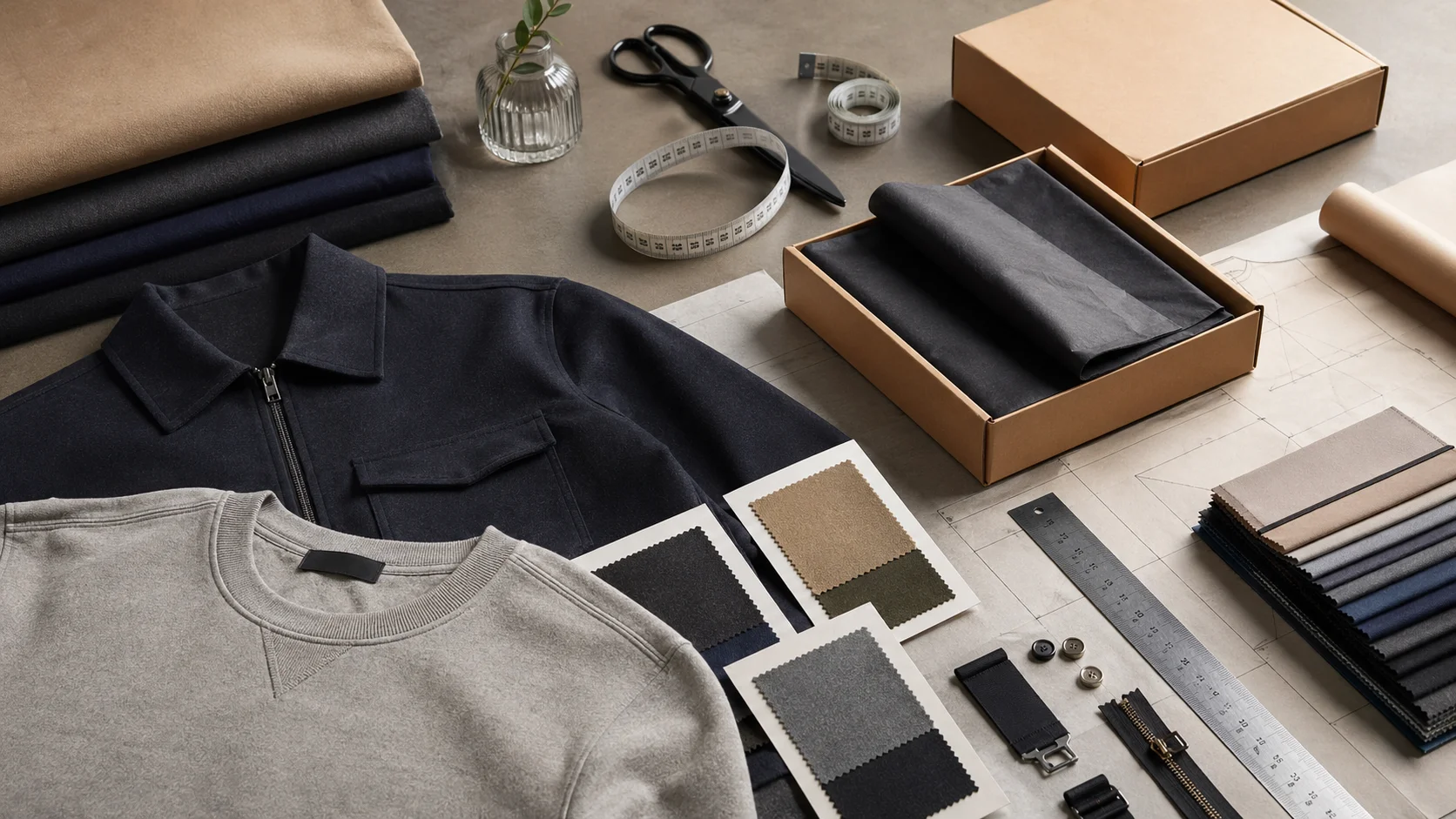
Design Foil Stamped Swing Tags for Fragrance compared by sample evidence, fabric or trim specs, MOQ, AQL terms, cost lines, delivery timing, and rework...
Fast answer: Design Foil Stamped Swing Tags for Fragrance: Tech Pack, Sample Gate, MOQ, and QC Terms should be judged by production evidence, not by a generic sourcing promise. The buyer needs sample proof, cost breakdowns, QC checkpoints, and delivery buffers in writing.
Ask for recent sample photos, measurement tolerances, fabric or print test assumptions, decoration test notes, packing examples, and a named inspection checkpoint. These details show whether the team can repeat an approved sample at bulk volume.
Separate garment cost, decoration, labels, packaging, sampling, testing, freight, and rush charges. Clear cost lines make it easier to reduce colorways, adjust size depth, or reserve more time for sampling.
If you’re building a fragrance line, your swing tag is doing a lot more work than most people realize. It is not just a price carrier or a tiny brand label hanging from a neck loop. It is often the first tactile, visual, and emotional cue a customer gets before they even open the box. For a foil stamped swing tags fragrance line, that little piece of card can quietly say premium, elegant, modern, romantic, niche, or luxury in a split second.
I’ve seen fragrance launches win attention on-shelf because the tag felt expensive in the hand. I’ve also seen beautiful scents lose momentum because the hang tag looked cheap, crowded, or mismatched with the bottle and outer packaging. Design matters here. A lot. In retail production, a 0.5 mm shift in foil registration or a 1–2 mm die-cut tolerance can be the difference between “luxury” and “made in a rush.”
Fragrance is one of the most emotional categories in packaging. Buyers are not just evaluating ingredients. They are buying identity, memory, mood, and aspiration. That is why the packaging has to carry more than information. It has to create atmosphere.
A foil stamped swing tag helps because it adds contrast. Matte paper and metallic foil play against each other beautifully. The reflection catches light. The tag reads as premium even before anyone smells the product. In a crowded retail setting, that matters. In e-commerce, the same visual luxury helps with product photography, influencer content, and unboxing. A hot-stamped Pantone 871 gold on 400–600 gsm board will photograph much more consistently than a laminated metallic ink, especially under ring lights and softboxes.
For independent brands, the swing tag can also be a cost-efficient way to elevate perceived value. A well-made custom tag typically lands around $2.50–4.00 per unit at 500 MOQ, depending on board, foil, die-cut complexity, and stringing. That is often a smart spend when compared with redesigning the bottle mold or secondary carton. In Guangzhou, many packaging factories can quote this range quickly if you provide final size, spot-color callouts, and a print-ready dieline.
Fragrance packaging often suffers from over-explaining. The tag is tiny. Trying to cram in the brand story, notes pyramid, barcode, batch code, sustainability claims, legal copy, and social handles all at once is a fast way to ruin the design. Choose the essentials.
If you need technical information, place it on a back panel or separate label. The front should breathe. In practice, most premium swing tags stay legible when the main brand line sits in 8–12 pt type and the secondary copy is no smaller than 5.5–6 pt after foiling and die cutting are finalized.
Foil stamped swing tags are tactile objects. People hold them, flip them, and feel the edges. That means paper weight, corner shape, soft-touch coating, and emboss depth all affect the perception of quality.
In my experience, a 600 gsm premium card with a crisp hot foil stamp and clean edge finishing beats a flimsy laminated tag every time. Thin stock can save money, but it rarely saves the brand image. A properly made magnesium or brass die on a Heidelberg or Kluge-style press gives a much cleaner edge on fine serif logos than a low-pressure digital finish.
A floral fragrance line should not use the same visual language as a dark oud collection. This sounds obvious, yet I see brands reuse one generic template across multiple scents and wonder why the line feels flat.
The tag should feel like it belongs to the same world as the bottle, carton, and display unit. A jasmine-and-bergamot composition in a frosted glass bottle with a cotton-filled necker can look completely different from a leather-and-amber scent sold in a rigid box, so the tag’s finish should echo that positioning instead of fighting it.
The material you choose has a direct effect on how the foil stamps. Not every stock takes foil equally well.
Material Typical Weight Best For Notes Art card 350–600 gsm Clean premium look Very common, good for sharp foil detail; 450 gsm C1S art card is a common sweet spot for fragrance tags Textured paper 300–450 gsm Luxury artisanal brands Beautiful, but fine foil lines can lose crispness; cotton blend stocks and mold-made papers need a stronger hit on press Black card 400–700 gsm High-contrast foil stamping Popular for silver, gold, and holographic foil; use opaque core stock so the edge does not show gray when die cut Kraft board 350–500 gsm Natural or eco positioning Works best with matte metallic foil, not too ornate; recycled kraft often needs a test pull because fiber direction affects foil adhesionIf the fragrance line is positioned as modern luxury, I usually recommend a coated or soft-touch art card with a heavier feel. If the brand leans botanical or hand-crafted, a lightly textured stock can be more honest to the identity. For sustainable lines, look for FSC-certified board paired with water-based varnish; brands that also sell apparel often ask for GOTS or OEKO-TEX references on the broader packaging program, especially when the same supplier manages textile accessories or dust bags.
Standard rectangles are safe, but fragrance packaging rarely needs to play safe. Oval tags, arched tops, rounded corners, and custom die-cuts can make a line feel more memorable. The key is restraint. A complicated shape can look gimmicky if the brand story is too serious.
Edge painting can also work well. A narrow metallic edge on a black tag feels expensive. A dyed edge in dusty rose or forest green can tie the tag into the fragrance palette. This detail adds cost, so it needs to earn its place. In factory terms, edge painting usually adds one extra pass after die cutting and needs a 24–48 hour drying window before stringing and QC.
For most premium fragrance tags, hot foil stamping remains the best choice. It produces a clean, durable, reflective finish and works beautifully on heavier paper stocks. Digital foil is useful for short runs or when timelines are tight, but it usually lacks the depth and sharpness of true foil stamping.
If you are producing a launch of 3,000 to 20,000 units, hot foil is usually the better long-term decision. For a 500-piece boutique trial run, digital foil may be acceptable if the budget is tight. Most factories in Guangzhou, Dhaka, and Ho Chi Minh City will ask whether you want a flat foil hit, emboss-plus-foil, or holographic foil before they price the job, because each one changes the tooling and press time.
I will be blunt here. Overusing gold is one of the easiest ways to make a fragrance line look generic. Gold can be beautiful, but it is not a strategy by itself. Use it because it supports the brand, not because it feels safe. A narrow 3–5 mm foil border or logo-only hit is usually enough; flooding the entire tag with foil can make even a premium brand look like mass-market gift wrap.
One of the most effective combinations for a fragrance swing tag is blind embossing with selective foil. The emboss creates a tactile surface. The foil highlights the brand mark, scent name, or key icon. This layered approach feels expensive without becoming loud.
For example, a 50 x 90 mm tag in 600 gsm black card with a blind embossed logo and a centered silver foil name can look far more premium than a full-color printed tag with random metallic accents. Less is often more. A good press operator will often run a make-ready sheet first to calibrate pressure so the emboss depth sits around 0.3–0.5 mm without crushing the board.
The strongest fragrance tags usually have a very clear visual order. The eye should know where to land first, second, and third. That means brand, fragrance name, and variant information should not compete for attention.
Spacing matters as much as typography. If every line is treated equally, the tag becomes noisy and unmemorable. A 2–4 mm safe margin around the die line is standard, and most packaging teams will keep foil elements at least 1.5 mm away from the trim to reduce scuffing after stringing and carton packing.
Typography for fragrance needs discipline. Decorative type can work, but it must be readable at small scale. I usually advise brands to pair one distinctive display font with one highly legible supporting font.
Fine lines and tiny serif details can disappear in foil stamping if the die is not made properly. That is a technical issue, not just a design issue. Good prepress matters. On press, anything under about 0.25 pt line weight can break up, especially on textured stock or when the foil release temperature is too high.
Fragrance tags work best with controlled color. Often, one base color plus one foil color is enough. Too many inks make the tag feel like a cosmetics label rather than a fragrance accessory.
Common premium combinations include:
For process control, many brands will specify Pantone 7527 C, 425 C, or 476 C as the paper print base, then lock the foil to a matching metallic swatch. That kind of detail matters when the same artwork is being sampled in Bangladesh, Vietnam, and South China across different board lots and coating systems.
Once the design is approved, production is usually straightforward, but it is not instant. A standard foil stamped swing tag order with custom die cutting, hot foil, hole punching, and stringing typically takes 18–22 business days after artwork approval and deposit. If the factory has to make a new brass die and match a custom PMS ink, allow closer to 25–30 business days.
Typical factory quotations will also vary by location. Guangzhou suppliers are often fastest on tooling and sampling; Dhaka factories can be very competitive on labor-heavy assembly and stringing; Ho Chi Minh City is often a strong middle ground for shorter runs with decent finishing control. For a 500 MOQ, you may see $2.50–4.00 per unit depending on whether the tag includes cotton string, bead, wax seal, or edge paint.
Key production specs that insiders usually confirm before signing off include die-cut tolerance of ±1 mm, foil registration tolerance of around 0.5–1 mm, and string hole diameter, which is commonly 3–5 mm depending on the cord or satin loop. If the tag will hang on a bottle neck, don’t forget the loop length and knot style; a loose loop can shift the front panel off-center in retail display.
Factories with WRAP, BSCI, or OEKO-TEX-related compliance systems may be preferable if the tags are part of a broader apparel, home fragrance, or gift program where buyers request audited labor and material traceability. Those certifications do not make the tag prettier, but they can matter a lot in procurement.
Foil should support the design, not rescue it. If the layout is weak, metallic stamping will not fix it. It will just make the weakness shinier.
Very rough paper can be lovely, but if your logo has hairline strokes, a heavy texture may ruin the result. In sampling, always test the exact stock lot you plan to run, because even two “same spec” papers from different mills can behave differently on a foil press.
The most common mistake is trying to make the swing tag do the work of the carton, the label, and the back-of-pack legal panel. It should not. A fragrance tag is a signal piece. Keep it elegant.
A tag can be beautifully designed and still look wrong once attached. The top hole location, string length, and bottle neck width all affect how the tag sits. For narrow-necked eau de parfum bottles, a 6–8 cm loop often hangs more cleanly than a longer cord, especially if the tag is heavy.
Brands now ask for sustainability claims on almost every project, and that is fair. But not every eco decision makes sense for every fragrance line. The best sustainable choice is the one that still protects brand quality and survives production without unnecessary waste.
Recycled board, FSC-certified paper, soy-based or vegetable-based inks, and water-based coatings are practical options. If you want a premium look without plastic lamination, consider aqueous coating or a soft-touch water-based finish instead of film lamination. That keeps the tag recyclable in more markets.
Be careful with heavy lamination, mixed-material cords, and oversized embellishments. A paper tag with cotton cord and a clean hot foil finish is usually easier to recycle than one with plastic film, glitter, and glued-on metal pieces. In many factories, the more complex the embellishment stack, the more likely it is to trigger reject rates above 3–5% during final QC.
The fastest way to get a good result is to send a complete spec sheet. Include final size, stock choice, foil color, pantone references, string type, hole position, print side, finish, and packing method. If you want samples, ask for a 1-up digital proof and a physical foil strike on the chosen board before full production.
A good supplier will also ask practical questions that reveal experience: whether the tag has one or two foil hits, whether the logo is reversed out, whether the cord is waxed cotton or rayon, and whether the tag will be polybagged in sets or bulk packed 1,000 per carton. Those details affect labor more than most brands expect.
If you are sourcing globally, Guangzhou is often the best place to prototype complex foil and die-cut work, Dhaka can be strong for cost-sensitive bulk assembly with certified labor programs, and Ho Chi Minh City is commonly chosen for tighter lead times and balanced finishing quality. Ask for factory photos of the foil press, die room, and QC station, not just a glossy showroom deck.
Get a free quote from Fabrikn — your trusted B2B clothing manufacturer with 10+ years of experience. MOQ as low as 200 pieces.
Get a Free Quote →Common sizes are 50 x 90 mm, 60 x 100 mm, and 70 x 120 mm. Smaller tags feel more refined, while larger tags give you space for scent names and variant information. If the bottle is under 50 ml, 50 x 90 mm is often a good starting point.
It adds cost, but not necessarily a lot. At scale, the difference may only be a small premium per unit depending on tooling and finish. At low MOQ, expect a meaningful jump because the die, setup, and press calibration are spread across fewer pieces.
Yes, but test it. Recycled fibers can be less uniform, which affects foil adhesion and emboss clarity. A coated recycled board usually performs better than an uncoated one.
Gold, champagne, and silver are the safest premium choices. Black foil can also look very luxury if the rest of the design is restrained. The best option depends on whether the fragrance is floral, woody, gourmand, or niche and experimental.
If budget allows, yes. Embossing adds a tactile layer that makes the tag feel more considered. Even a shallow blind emboss can elevate a simple foil mark if the paper stock is thick enough.
In the end, the best foil stamped swing tags fragrance designs are not the ones with the most decoration. They are the ones that balance material, finishing, hierarchy, and production discipline so the tag feels inevitable. When the details are right, the customer may not consciously notice the swing tag. But they will absolutely feel the brand.
Use these related guides to compare specs, costs, quality checks, and buyer decisions before making the final call.