
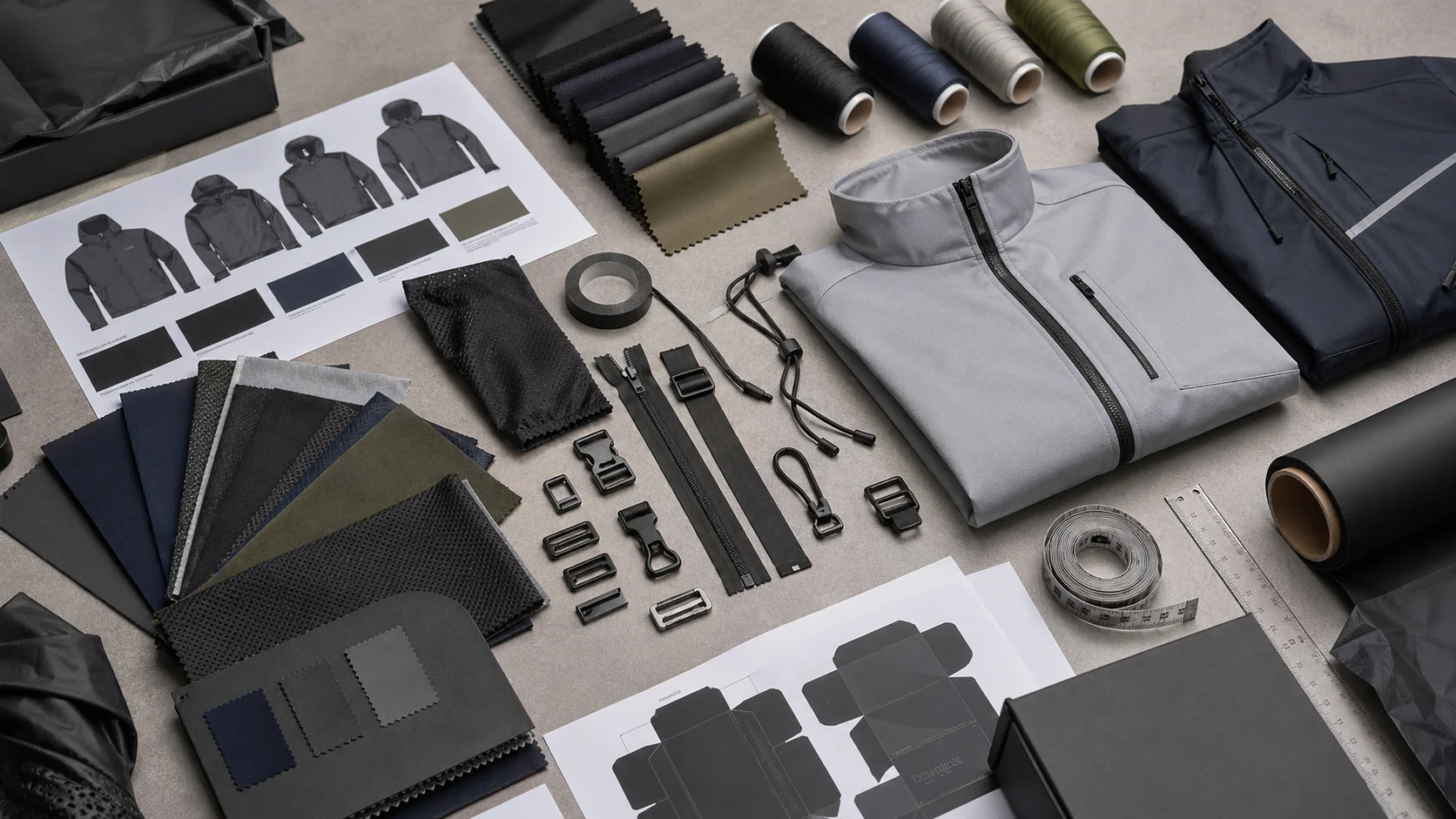
Check Clothing Manufacturer Legitimacy compared by sample evidence, fabric or trim specs, MOQ, AQL terms, cost lines, delivery timing, and rework...
Fast answer: Check Clothing Manufacturer Legitimacy: Sample Evidence, MOQ, Capacity, and Rework Terms should be judged by production evidence, not by a generic sourcing promise. The buyer needs sample proof, cost breakdowns, QC checkpoints, and delivery buffers in writing.
Ask for recent sample photos, measurement tolerances, fabric or print test assumptions, decoration test notes, packing examples, and a named inspection checkpoint. These details show whether the team can repeat an approved sample at bulk volume.
Separate garment cost, decoration, labels, packaging, sampling, testing, freight, and rush charges. Clear cost lines make it easier to reduce colorways, adjust size depth, or reserve more time for sampling.
The slickest supplier page is often the shakiest factory story. I’ve walked through more than 200 factories in eight countries, and if you’re learning how to check clothing manufacturer legitimacy, start there: charm is not capacity. In my notes, about 1 in 4 “manufacturers” turned out to be brokers, trading desks, or small workshops borrowing someone else’s photos. That’s before the first alarm bell rings.
Glossy homepages, polished salespeople, and promises of 20,000 pieces a month can all sit on top of a rented office and six sewing machines. I’ve seen factories in Vietnam running 120 machines on paper but only 34 on the floor, while a smaller Turkish plant with 48 machines quietly shipped 60,000 units a month because its line balance was disciplined and its QC system actually worked.
The first red flags rarely look dramatic. They’re small mismatches. A factory claims denim expertise but shows only knit samples. It says it makes “premium streetwear” yet has no bar-tack machine, no washer, and no pattern room. It promises MOQ 300 pieces for a fully custom hoodie, then later says the real minimum is 1,200 once fabrics are confirmed. Those gaps tell you more than any slogan.
Stock photos, recycled certification badges, and phrases that sound like capacity but aren’t — that’s how weak operations hide in plain sight. I once visited a so-called “vertical manufacturer” in South Asia whose Instagram feed showed dyeing, knitting, and finishing. On site, the dyeing was subcontracted 80 kilometers away, the knitting mill was unrelated, and the finishing room held one steam iron and a broken tagging gun. Not vertical integration. A relay race of hidden risk.
Control is the most common mismatch between marketing and reality. Real factories control people, machines, and process flow. Fake ones control introductions. They can produce a sample in 3 days because a nearby sample room does the work, then miss a 30-day bulk promise because the production floor isn’t theirs. For custom baby clothing manufacturing, that gap is even more dangerous, because compliance, fabric softness, and seam safety are non-negotiable.
Before you send a deposit, look for evidence, not charm. Ask for corporate documents, factory licenses, and live production proof. A good buyer isn’t the one who gets the fastest reply. It’s the one who asks for records within 24 hours and knows how to read what comes back.
The paper trail is where many supplier stories collapse. A real factory should provide a business registration certificate, tax ID or VAT number, export license where applicable, and the name of the legal entity exactly matching the bank account. I ask for these within the first 48 hours, before any sample payment, because the name on the invoice and the name on the door are not always the same.
To check clothing manufacturer legitimacy, verify the registration number in the local company database, then cross-check it against third-party records such as trade registries, customs listings, or chamber-of-commerce references. In China, that may mean checking the Unified Social Credit Code. In India, GST and IEC records matter. In Bangladesh, I want to see the company registration, trade license, and BGMEA or relevant association membership if they claim it. A PDF scan is not enough. I’ve seen edited certificates with changed addresses, fake seals, and expired dates hidden by cropping.
Certifications should match the product and the market. Children’s apparel needs stricter proof than basic adult tees. For organic claims, check the chain-of-custody standard, not a logo pasted on a website. For chemical safety, I look for OEKO-TEX or equivalent documentation that can be verified through the issuer’s database, not just a JPEG. According to OEKO-TEX, certificates are issued to specific sites and product scopes. That’s exactly why vague claims should set off alarms.
Insurance gets ignored all the time, yet it tells me whether a supplier understands real risk. Product liability coverage, cargo insurance, and workers’ compensation coverage are useful signals, especially for private label orders where your brand name is on the label but the factory controls the sew line. If you sell through private label clothing services, this becomes a commercial issue, not just a compliance one.
Legitimate factories usually have paperwork that points outward, not inward. They can show export declarations, bank references, and tax filings that make sense together. A broker can often produce a convincing certificate folder, but cannot reconcile 3 different addresses across 2 countries, 1 bank account, and 1 shipment record. That inconsistency is where the trail breaks.
I also check whether the documents fit the product category. A factory making flame-resistant workwear should show testing aligned with the relevant standards. A denim supplier should have wash safety, colorfastness, and shrinkage records. A cut-and-sew operator should be able to show production permits, labor compliance records, and subcontractor declarations. If they offer cut and sew manufacturing but cannot show a registered production address, walk away.
Capacity is visible if you know where to look. A factory that claims 50,000 pieces per month should have enough machines, operators, and floor space to make that number believable. I compare claimed output with the count of single-needle machines, overlocks, coverstitches, buttonholes, bartacks, and pressing stations. A line making 300 T-shirts a day usually needs about 10 to 14 operators, not 3 people and a prayer.
When I visited factories in South Asia and Eastern Europe, I saw how wage levels and automation change the math. In Bangladesh, lower labor costs can support larger, labor-heavy lines with lead times of 4 to 6 weeks. In Portugal or Poland, higher wages often mean tighter automation, smaller batches of 200 to 800 pieces, and more realistic scheduling. If someone in a high-cost region promises 15-day bulk delivery on complex knits, I ask how many subcontractors are hiding behind the quote.
Sample rooms can fool buyers. A sample room is built to impress. It may have the best machinists, the best steam tools, and one person who can solve anything from a French terry 320 GSM hoodie to a fully lined jacket. Bulk production is different. It’s where fatigue, operator turnover, and line balancing expose the truth. I’ve seen perfect samples followed by bulk orders with uneven seam tension, missed measurements, and 7% reject rates.
Common broker signs are easy to spot once you’ve seen enough sites. They keep moving you away from the actual floor. They talk in generalities, not machine counts. They cannot show work-in-progress. They quote from a laptop in a showroom 20 minutes from the real site. And they tend to promise huge flexibility without showing a marker of control: no cutting table, no QC station, no fabric warehouse, no visible batch coding.
There’s also a regional nuance buyers ignore. In Italy, Japan, and parts of Turkey, smaller factories may charge more but show stronger process discipline and lower defect rates. In Pakistan, India, and China, scale can be enormous, but the spread between excellent and mediocre plants is wide. I’ve seen a 75,000-piece plant with excellent needle control and a 500-piece workshop that could not keep a hem straight. Size is not proof. System is proof.
Any factory claiming to handle complex product development should be able to show pattern-making capability, grading charts, and at least a few active production lines. If they cannot explain how a 3,000-piece run is staged over 2 weeks, or how they keep fabric rolls tracked by lot number, that tells you more than the sales pitch. Numbers on a brochure are cheap. Floor space is not.
Price is one of the fastest ways to detect fiction. For a basic 180 GSM cotton tee, I’ve seen quotes range from $2.10 to $5.80 per piece depending on country, fabric source, print method, and compliance. A hoodie in 320 GSM French terry can swing from $8.50 to $18.00, and that gap isn’t random. It reflects labor cost, trims, finishing, testing, and margin. If one factory is 30% cheaper than every comparable quote, I ask which line item disappeared.
To check clothing manufacturer legitimacy through pricing, compare low-cost, mid-tier, and premium suppliers on the same spec sheet. Same stitch type. Same fabric weight. Same wash. Same labeling. Same packing requirements. For example, enzyme wash versus stone wash can shift cost by $0.35 to $1.20 per garment. A branded woven label may add $0.08 to $0.25. Hangtags, polybags, carton markings, and compliance testing can add another $0.20 to $0.90.
Lead times tell a similar story. A genuine cut-and-sew order with fabric procurement, sampling, approval, bulk cutting, sewing, finishing, and inspection usually takes 30 to 60 days, sometimes 75 days for complex product. If a supplier promises 10 days for a 5,000-piece customized run, either they have stock fabric, they will subcontract parts of the job, or they plan to rush and hide defects. Fast is not always fake, but impossible is almost always fake.
The cheapest quote often leaves out one painful line item, then claws it back later through “unexpected” surcharges. I’ve seen factories add fees for lab dips, pattern revisions, thread matching, carton changes, and even photo approvals after the deposit landed. A clean quote should break out labor, fabric, trims, testing, packaging, and freight terms. If you want a baseline benchmark, use get a free quote only after your tech pack is complete. Otherwise you’re comparing guesswork to guesswork.
I tell buyers to build a comparison table with five columns: unit price, MOQ, sample turnaround, bulk turnaround, and included services. Add a sixth column for red flags. A $3.90 tee that includes fabric sourcing, 7-day sampling, and 35-day bulk is not the same as a $3.40 tee that excludes testing and needs 65 days. Price alone cannot carry the verdict.
Regional context matters too. Trade data from the U.S. International Trade Administration shows how sourcing flows shift by category and country, which is why a quote from one region cannot be judged in isolation. A knit top in Central America may cost more than the same piece in Asia, but shorter transit and lower duty exposure can offset the unit gap. A smart buyer prices landed cost, not just FOB.
Audits should tell you how the factory really works, not how tidy the reception area looks. A proper onsite review covers ownership, staffing, machine condition, maintenance logs, safety exits, QC checkpoints, warehouse controls, and subcontracting disclosure. I want to see where fabric arrives, where it is inspected, where defects are recorded, and where rejected lots go. If an audit only tours the showroom and sample room, it’s theater.
Sample testing is equally revealing. I compare the pre-production sample against the tech pack, then ask whether the same machine set, thread count, and finishing process will be used in bulk. For activewear, I check stretch recovery and seam integrity. For denim, I look at shrinkage, crocking, and wash consistency. For childwear, I inspect neck openings, seam bulk, and label placement. Good samples from weak factories are common. The point isn’t to admire the sample. It’s to prove the sample is manufacturable at scale.
Traceability is where sustainability claims either hold or break. A supplier saying they use recycled polyester should be able to show fiber origin, spinner documentation, dye lot records, and batch allocation. If a fabric roll appears without lot numbering, traceability is already compromised. According to Textile Exchange, preferred material claims depend on chain-of-custody records, not marketing language. I ask for fabric invoices, mill names, and shipping documents that connect the dots from yarn to garment.
Chain of custody also helps expose subcontracting. If the factory says all sewing is in-house, but carton labels show a different production address or the shade of stitching changes mid-order, something moved offsite. I’ve seen orders split across 2 plants without disclosure because one plant had capacity for cutting and another quietly handled sewing. That isn’t always illegal, but it is a risk if you expected one controlled process.
Sustainability claims become more believable when they’re tedious. A factory that tracks dye lots, stores fabric swatches for 12 months, keeps inspection sheets for 3 years, and can produce waste logs is usually serious. A factory that only repeats “eco-friendly” three times in a sales call usually isn’t. Records beat slogans every time.
Audit reports should name findings, not just scorecards. A pass/fail summary can hide poor needle safety, missing calibration, or poor chemical storage. If a supplier claims compliance with international standards, ask them to point to the exact audit date, scope, and corrective actions. Then verify whether the issuer recognizes the site listed, not just the corporate headquarters.
Here is the sequence I use when I vet a supplier. Step 1: request legal registration, tax ID, export paperwork, and the exact company name that will appear on the bank account. Step 2: ask for photos or video of the production floor, not the showroom. Step 3: compare machine counts, labor count, and claimed monthly output. Step 4: request 2 customer references with matching product type and order size. Step 5: confirm sample capability against bulk capability. Step 6: verify certification numbers with the issuer. Step 7: structure payment around milestones, not trust.
The questions matter. I ask: Who owns the factory legally? Which address is the registered manufacturing site? How many sewing lines are active this month? What percentage of orders is subcontracted? Which processes are in-house? What is the real MOQ for my fabric weight and construction? What happens if fabric fails inspection? Who signs off on QC? If the answers are vague, delayed, or constantly revised, I treat that as data.
Deposit terms should protect the buyer from paperwork fiction. For a first order, I prefer 20% deposit, 40% after pre-production sample approval, and 40% after final inspection or before shipment, depending on Incoterms and trust level. On larger orders, I push for milestone payments tied to fabric arrival, cutting completion, and packing photos. Add a clause that blocks unauthorized subcontracting, requires written approval for material changes, and allows third-party inspection. If the supplier refuses, that’s a decision point.
I’ve seen brands lose 5-figure deposits because they rushed. I’ve also seen them save entire seasons by pausing for 72 hours and checking one document. That pause is cheap. A delayed container can cost $1,500 to $4,000 in storage and port charges, and a bad production run can burn far more once returns start.
Use this rule: pass if the legal, production, price, and traceability checks all align. Pause if one area is unclear and the supplier is cooperative. Reject if the story changes twice, the documents do not reconcile, or the factory refuses verification. That is how to check clothing manufacturer legitimacy without paying for someone else’s fantasy.
A legitimate clothing manufacturer should provide a business registration certificate, tax ID or VAT number, export license where relevant, and a bank account in the same legal name. I also ask for insurance documents and certification numbers that can be verified with the issuer. If the paperwork cannot be cross-checked in 24 to 48 hours, I treat it as weak evidence.
Start with legal registration, then verify the production address, machine count, and subcontracting policy. Ask for recent photos or live video from the factory floor, not the showroom, and compare the quote against 2 to 3 other suppliers with the same spec. Only pay after the documents, sample, and capacity all line up.
Desk verification can cost $0 to $300 if you do the research yourself, while third-party audits often run from $500 to $2,500 depending on country and scope. Site visits are more expensive once flights and hotels are included. For a first order, that cost is usually small compared with a failed production run.
For most cut-and-sew apparel, bulk production takes 30 to 60 days after sample approval and fabric confirmation. Complex items, special washes, or imported fabric can push that to 75 days or more. A promise of 10 to 15 days for customized bulk goods usually means stock material, subcontracting, or rushed output.
Use local company registries, customs records, certification databases, and a third-party inspection service if you cannot visit the site yourself. Ask for a live factory walk-through with machine counts, active workers, and work-in-progress on camera. For overseas suppliers, I also verify the bank name, address, and export paperwork before any payment.