
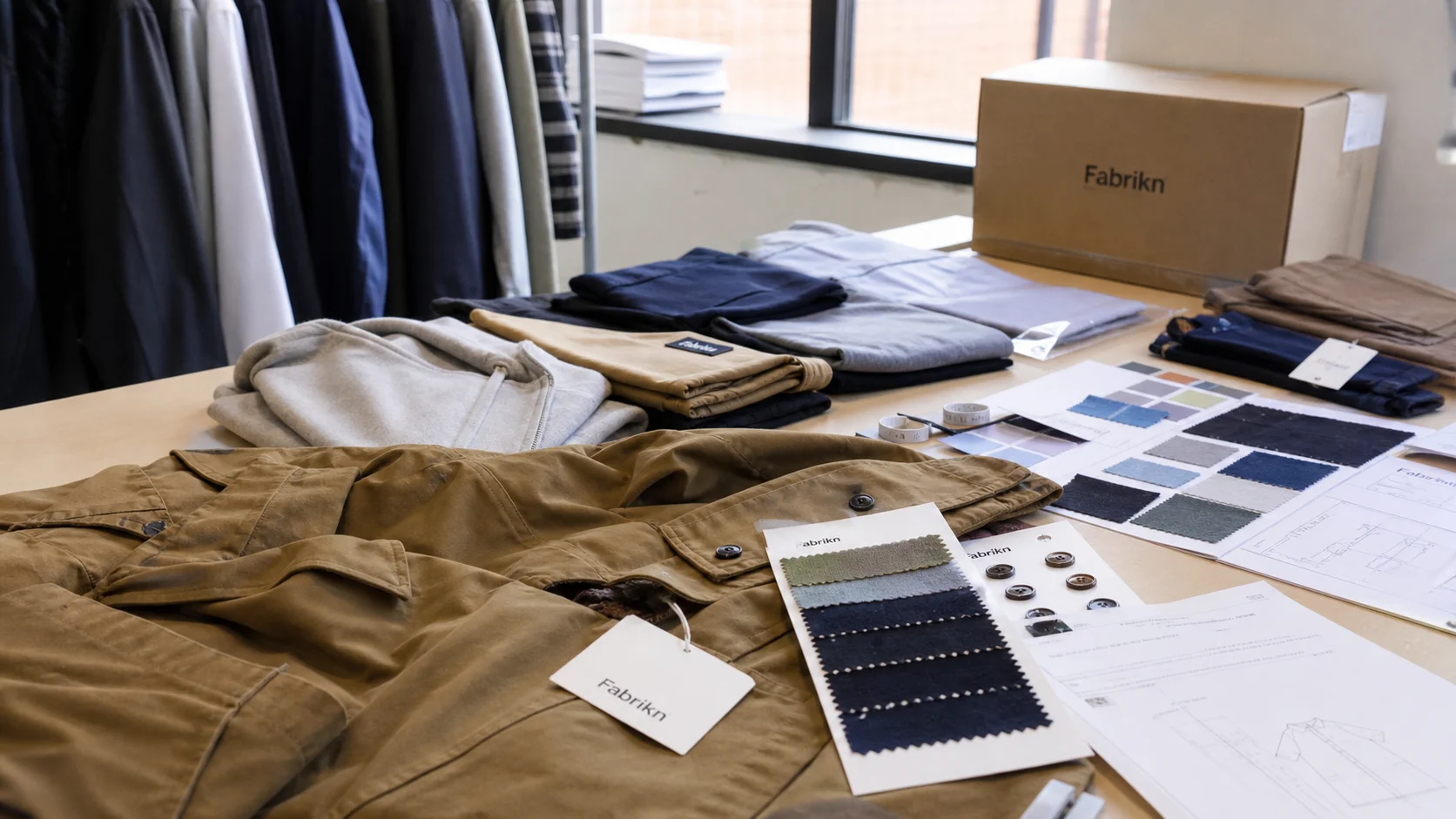
OEM vs ODM Clothing Manufacturer with checks for samples, fit, MOQ, QC evidence, pricing terms, and delivery risk.
Fast answer: OEM vs ODM Clothing Manufacturer: Design Control, MOQ, IP, and Timeline should be judged by production evidence, not by a generic sourcing promise. The buyer needs sample proof, cost breakdowns, QC checkpoints, and delivery buffers in writing.
Ask for recent sample photos, measurement tolerances, fabric or print test assumptions, decoration test notes, packing examples, and a named inspection checkpoint. These details show whether the team can repeat an approved sample at bulk volume.
Separate garment cost, decoration, labels, packaging, sampling, testing, freight, and rush charges. When every cost line is visible, it becomes easier to reduce colorways, adjust size depth, or reserve more time for sampling.
I’ve watched small brands burn $12,000 to $40,000 before a single unit sold, all because product development got treated like a mood board exercise. If you’re learning how to choose between oem and odm clothing manufacturer, the real issue is not jargon; it is cash flow, timeline, and risk. During factory visits across Bangladesh, Vietnam, Portugal, Turkey, China, and Peru, the same mistake kept showing up: brands assumed they could afford more customization than they really could, then acted surprised when sampling, trims, and fabric approvals dragged on.
OEM means the factory builds the product from scratch around your idea. You bring the sketch, tech pack, measurements, fabric direction, and trim details; the manufacturer develops patterns, samples, and production steps. ODM moves faster. The supplier brings an existing or semi-developed style, and you tweak it with fabric, color, label, fit, or a small construction change. One route can take 8-14 weeks from concept to a saleable sample. The other can shrink to 3-6 weeks if the factory already has the block.
Margins shift right there. OEM usually asks for 2-4 sample rounds, more pattern revisions, and a higher first-run development bill, sometimes $300-$1,500 per style before production. ODM can push setup cost down to $50-$300 per style, which matters when you’re testing demand with MOQ 300-800 pieces instead of 1,000-3,000 pieces. Cheap setup can still become expensive if you sit on dead stock for six months.
Here’s what most people miss: in several ODM programs I audited, defect rates were lower than in rushed OEM projects because the factory had already stabilized the pattern, sewing order, and finishing process. A well-run ODM line can move with fewer surprises than a stressed OEM line trying to invent fit, construction, and costing at once. Counterintuitive? Yes. Important? Absolutely.
At a mid-sized knitwear factory outside Izmir, the manager laid out two identical order books. The OEM brand paid more per sample, waited 11 weeks longer, and still missed launch by a season. The ODM buyer launched in 5 weeks, sold through 72% of the first drop in 30 days, then reordered with better data. That is the strategic split: not just operations, but positioning, inventory exposure, and how much control you need before the market has validated your idea. If you want broad customization later, you can still start with private label clothing services and evolve the line once sell-through proves the concept.
The right answer changes by business model. A premium label, a technical activewear startup, and a marketplace seller do not need the same factory setup, even if they are all buying the same French terry hoodie or rib tank. Ask a simpler question: how much originality can your customer actually feel, and how much invention can your cash flow survive before revenue shows up?
When you are deciding how to choose between oem and odm clothing manufacturer, start with your brand promise. OEM fits brands that need a clear signature. Technical apparel. Premium tailoring. Elevated denim. Design-led collections where silhouette, stitch detail, or functional construction is part of the promise. If your value proposition depends on a specific waistband, engineered seam, or custom wash recipe, OEM protects that identity better. It also suits teams with an in-house product developer, a strong tech pack, and working capital for 2-3 development cycles.
ODM fits faster-moving DTC brands, trend-led basics, and sellers who want to test a category before locking into inventory. Launching 5-10 SKUs in one season? Betting on price and speed more than novelty? ODM cuts friction fast. Same goes for marketplace sellers who need repeatable products in MOQ 250-500 pieces rather than a deep custom line.
Region and price point matter too. In low-cost production zones, factories often push ODM because it lowers sampling labor and keeps lines full. In higher-end factories, especially in Portugal and Turkey, OEM tends to win for complex garments because the teams are used to precision grading and stronger construction standards. Vietnam sits between those poles: efficient OEM in knits and sportswear, plus some ODM programs for basics. Cheapest is rarely smartest when the category needs a strong fit block.
Mismatch hurts. I’ve seen brands use OEM for a low-margin tee line and then wonder why cash vanished into fit approvals on a $6.20 unit. I’ve also seen founders pick ODM for a hero product, then realize the style was too close to a generic block and had no reason to exist. Baby lines raise the stakes again. Compliance, softness, trim safety — those matter more than trend, which is why some founders pair decision-making with custom baby clothing manufacturing early in the process.
Unit price is only one line in the spreadsheet. Development, sampling, testing, packaging, freight, and the cost of being wrong show up too. In my experience, brands usually compare factory quotes without tracking the hidden work between concept and carton.
A practical comparison looks like this. OEM: development cost $500-$3,000 per style, sample cost $80-$250 per round, lead time 8-14 weeks for sampling plus 30-75 days for bulk, MOQ often 500-2,000 pieces depending on fabric and construction, margin impact higher upfront but better differentiation. ODM: development cost $0-$800 per style, sample cost $30-$150, lead time 3-6 weeks for sampling plus 20-50 days for bulk, MOQ often 200-1,000 pieces, margin impact lower setup but less exclusivity.
Those numbers shift by category. Basic tees, fleece sets, and leggings can often go lower on MOQ because the factory already has a block and fabric relationships. Outerwear, bonded knits, and technical shells climb fast, sometimes to 800-1,500 pieces, because zippers, seam taping, and fabric sourcing add complexity. In one denim factory I visited, MOQ jumped from 400 pieces to 1,200 pieces the moment the buyer asked for a custom enzyme wash and branded rivets.
Hidden costs are where margins disappear. Pattern corrections after fit review can add 1-2 weeks. Packaging changes can trigger new carton minimums. If a fabric mill has a 3-4 week dyehouse queue, a “quick” order slows immediately. And if you overorder by 20%-30%, unsold stock can wipe out the savings from a cheaper per-unit quote. I’ve watched brands save $0.40 on sewing and lose $4,000 in storage and markdowns.
Cut-and-sew programs get even more specific because every stitch path affects labor. That’s why buyers comparing structured styles should review cut and sew manufacturing options alongside fabric cost and trim availability. Clean price sheet? Not enough. You need the factory to spell out sample policy, fabric reserve time, and whether the quoted lead time includes labeling and carton packing.
Simple silhouettes lean ODM. A crewneck tee in 180 GSM cotton, a fleece hoodie in 320 GSM French terry, or a ribbed tank can often be built from an existing factory block with modest changes to neck rib width, label placement, or wash finish. Familiar garment, familiar process — the factory has already solved fit, stitching order, and shrinkage behavior for that base.
Complex garments belong closer to OEM. Outerwear, performance wear, lingerie, denim, and products with a unique fit need more testing. I’ve seen a supposedly simple windbreaker fail because the sleeve cap pulled after wash, and a sports bra miss support targets because elastic recovery was wrong by 8%. Those aren’t cosmetic errors. They create returns, complaints, and repeat sampling.
The factory-side reality is blunt. Complex garments fail when buyers treat them like private label basics. Grading can break at size XL and above. Seam strength can fail at stress points. Fabric behavior changes after a 60°C wash or an aggressive stone wash. Denim with a high-twist yarn reacts differently from a loopback fleece. A factory that knows the category will flag these issues early; a less experienced one will make them later, after you’ve already approved the sample.
Regional specialization is real. Portugal and Turkey have many factories that can handle low-MOQ complex OEM work, especially for premium knitwear, structured jersey, and refined outerwear. Vietnam often performs well in activewear and knit programs where consistency matters. Parts of China still dominate mass-market ODM, especially for commodity basics and trend-led styles with fast replenishment. None of that means one region is “better.” It means the wrong match can cost you 2 extra sample rounds and 6-8 weeks of delay.
Price should not seduce you. A factory quoting $7.80 for an ODM hoodie may beat a factory quoting $9.40 on paper, but if the cheaper line cannot hold shrinkage under 3% or misses color consistency across 500 pieces, the apparent saving disappears. Pick the option that fits the garment’s technical demands and your sales channel. Not the lowest number in the spreadsheet.
Ownership shifts with the model. In OEM, your brand usually owns the concept, tech pack, and product direction, while the factory may own the production pattern unless your contract says otherwise. In ODM, the factory often owns the base pattern, the mold for certain trims, and sometimes even the core construction logic. If you don’t ask who owns what, you may pay for a product you can’t reuse freely.
That is where intellectual property risk starts. ODM can be efficient, but if the style is too close to an existing factory template, your product may be easy to copy and hard to protect. I’ve seen founders change only a print and colorway, then wonder why the market found a near-identical version six weeks later. Distinctive fit, trims, labeling, and packaging matter if the silhouette itself isn’t original.
Compliance is not a side issue. According to OEKO-TEX, chemical safety and restricted substance testing remain central to apparel sourcing, especially for skin-contact products. Better factories keep test reports ready for fabric, trims, and finished goods. According to Trade.gov, export readiness depends on documentation, correct labeling, and trade compliance controls that reduce shipment delays. According to Textile Exchange, responsible material sourcing is becoming a key buying criterion for wholesale and bulk programs. Those standards matter more than a glossy showroom.
Factory audits also expose an uncomfortable truth. A well-run ODM factory can outperform a poorly managed OEM supplier on defect rates and shipping consistency. I’ve measured lines where ODM orders shipped with 1.5% defect rates while custom OEM orders from a less disciplined site sat at 4%-6%. Reason was simple: stable process, clear SOPs, fewer moving parts. The OEM factory, despite charging more, had too many open revisions.
Before production, review contract clauses for sample approval, QC checkpoints, and responsibility for delayed fabric, rework, and replacements. Ask who signs off on shrinkage, color fastness, seam slippage, and carton count. If a supplier cannot show labeling compliance, test reports, and batch traceability, move on. I’d rather lose a quote than inherit a customs hold or a recall.
Brand identity is not only silhouette. Customers notice fabric handfeel, fit consistency, color depth, logo placement, and whether the garment looks intentional. They usually do not care whether you used OEM or ODM. They care whether the product feels worth the price. Useful distinction, because it gives brands room to start faster without sounding generic.
You can protect identity inside ODM by changing several variables at once. Fabric weight. Garment wash. Rib structure. Zipper quality. Thread color. Hangtags. Carton design. Fit ease. A standard hoodie can feel like your hoodie if you move from 280 GSM to 320 GSM, switch from enzyme wash to garment wash, tighten the rib cuff, and specify custom drawcord tips. Small changes stack up.
The threshold for meaningful customization is commercial, not decorative. If a detail cannot be seen, felt, or measured by the buyer, it probably won’t move conversion. Luxury and premium customers expect more original DNA because they’re paying for design authority. Value shoppers respond more to availability, reliable fit, and a sharp price point, sometimes at $14.99 rather than $49.00. Different price points reward different levels of originality.
I’ve worked with brands that launched with ODM to prove demand, then moved the best-selling style into OEM once reorder data was in hand. Smart path. First prove the market with 300-500 pieces. Then upgrade the hero SKU with custom pattern work, proprietary wash, or a new fabric developed from scratch. The reverse happens too, and it’s expensive: founders choose OEM because it sounds more serious, then discover they cannot support 12-16 weeks of development every season.
Nothing noble about slow development if the business model can’t carry it. If your customer buys basics, consistency and replenishment may matter more than original construction. If your customer buys a signature piece, the opposite is true. That’s why the smartest founders treat OEM and ODM as tools, not identities.
The most efficient buyers turn theory into a checklist. I use seven decisions before I request samples: budget, timeline, product complexity, MOQ, IP risk, compliance, and growth plans. Budget under $5,000? ODM often makes more sense. Launch window under 45 days? ODM wins again unless the factory already has your OEM block. If the style needs custom grading or performance testing, OEM should move up the list.
Score each factory from 1 to 5 on product fit, communication, sampling speed, and transparency. A factory that replies in 24 hours, explains fabric sourcing honestly, and shows cost breakdowns is usually better than one that promises the moon in one email. I also ask for sample policy, line sheet, test reports, pricing breakdown, and a written lead-time commitment. If a supplier refuses to name the fabric mill or cannot estimate shrinkage targets, that is a warning sign.
Then run a pilot order. Keep it small, often 200-400 pieces, even if the factory pushes for more. That lets you test fit, packaging, and reorder speed without tying up too much cash. If you’re unsure where to start, ask for a quote and compare the numbers against your channel plan. You can get a free quote before committing to samples, which is cheaper than guessing.
My sourcing sequence stays the same: shortlist, audit, sample, test, negotiate, and place the first purchase order. I always test wash performance, seam integrity, and carton accuracy before scaling. For complex categories, I also compare the first factory against a second source so I know whether the quote is competitive or just convenient. That discipline saves weeks and protects margin.
When the decision feels fuzzy, return to the business model. Fast launch and lower development cost point toward ODM. Strong design identity, technical construction, and long-term defensibility point toward OEM. The right factory model is the one that matches your cash, category, and calendar. If you are still weighing options, revisit how to choose between oem and odm clothing manufacturer with your budget in one hand and your launch date in the other; the answer tends to get clearer when the numbers are honest.
Startups usually benefit from ODM if they need to launch in 3-6 weeks and keep sampling under $500. Choose OEM if the product needs a unique fit, technical construction, or a design you plan to defend for multiple seasons.
ODM is usually cheaper upfront because sample rounds and pattern work are lower, often $30-$150 per sample and less setup cost. OEM can cost more before bulk, especially if you need 2-4 fit revisions or custom fabric development.
ODM can move from approved sample to bulk in about 20-50 days, depending on fabric availability and factory load. OEM is slower, often 30-75 days after sampling because pattern, fit, and sourcing need more checks.
Yes. Many brands launch with ODM, test demand on 300-500 pieces, then move best-selling styles into OEM once sales data is clear. That reduces risk and helps you spend custom development money only on proven products.
OEM is usually safer for IP because you can own the original concept, tech pack, and development direction. ODM can still work if you change enough details, but you should review ownership clauses, pattern rights, and exclusivity before production.