
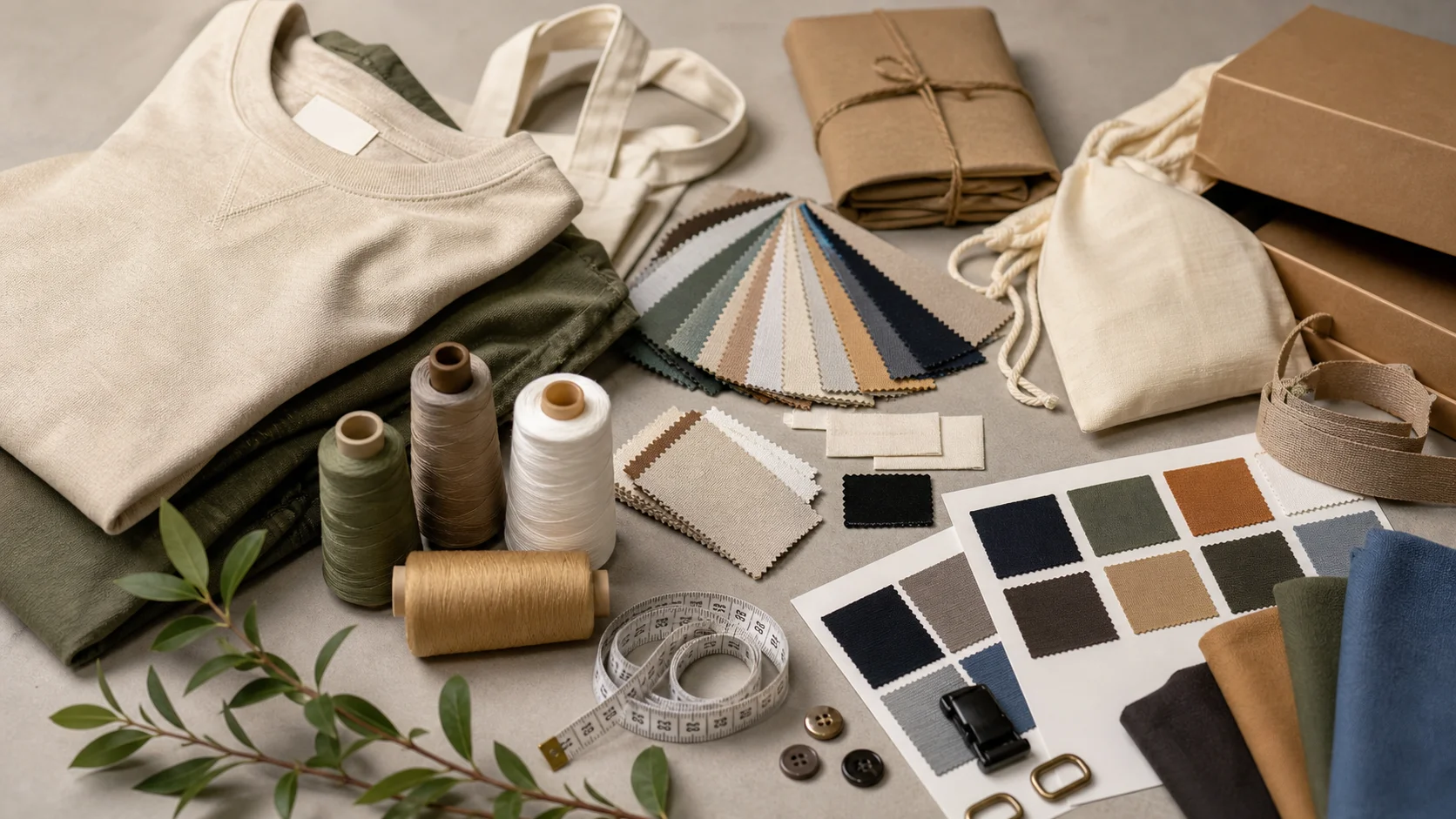
Box Inserts for Clothing Shipments with checks for samples, fit, MOQ, QC evidence, pricing terms, and delivery risk.
Fast answer: Box Inserts for Clothing Shipments: Fit, Material, and Packing should be judged by production evidence, not by a generic sourcing promise. The buyer needs sample proof, cost breakdowns, QC checkpoints, and delivery buffers in writing.
Ask for recent sample photos, measurement tolerances, fabric or print test assumptions, decoration test notes, packing examples, and a named inspection checkpoint. These details show whether the team can repeat an approved sample at bulk volume.
Separate garment cost, decoration, labels, packaging, sampling, testing, freight, and rush charges. When every cost line is visible, it becomes easier to reduce colorways, adjust size depth, or reserve more time for sampling.
If you want garments to arrive looking intentional rather than tired, how to choose box inserts for clothing shipments is where the work begins. The outer carton is just the shell; the insert controls motion, pressure, and the first 15 seconds of unboxing. I once opened a carton that looked flawless from the outside and found a $180 knit polo folded into a hard crease, shifted two inches off-center, with its collar crushed against a divider. That shipment had traveled 1,400 miles and passed through three sortation hubs. The box survived. The presentation did not.
Factory floors make this obvious. In Vietnam, I watched operators pack 600 units an hour with simple corrugated pads and tight fold discipline. In Italy, a tailoring plant packed only 120 units an hour, but every jacket sat in a fitted tray with tissue, corner protection, and a measured 8 mm of clearance. In the United States, I saw mid-market brands split the difference, using flat dividers for tees and heavier trays for outerwear.
The numbers tell the story: the more the garment moves in transit, the more the brand pays later in steam time, repacking labor, and returns. Even premium apparel arrives wrinkled when the insert is wrong. A rigid-looking carton can hide a soft failure inside. Garments rub, slide, and compress during vibration; I have measured 4-6 mm of movement in thin cartons after a 2-meter drop test, enough to deform collars and sleeve rolls.
The return cost is bigger than most buyers admit. A single damaged presentation can trigger rebagging, restocking, and customer service time that costs $3.50 to $8.00 per order before postage ever enters the calculation. I have seen brands spend $0.14 more on an insert and save $0.90 in labor, plus another $1.20 in avoided return handling. That is what happens when the pack line stops fighting the product.
Garment type should drive insert choice, not the other way around. Tees, polos, and lightweight knits usually do best with a simple folded divider or a paperboard sleeve because they need restraint, not architecture. Denim is heavier, so it needs a stiffer base or a shallow tray to stop sagging at the fold line. For activewear, I prefer low-profile inserts that hold a compact fold without adding bulk, since stretch fabrics can develop pressure marks after 24-48 hours in transit.
Dresses, jackets, and structured pieces demand more care. A crepe dress can survive in a flat insert if the fold plan is correct and the tissue count stays low, but a blazer or padded coat often benefits from a rigid tray with shoulder support. I have seen tailoring factories use 2-part paperboard systems for jackets priced at $150 to $400, while mass-market warehouses used a single corrugated partition for $18 sweatshirts. Both worked, because the insert matched the garment’s shape and the handling speed on the line.
Luxury and mass-market packaging do not follow the same logic. A $20 basic should be packed for speed, consistency, and low damage risk. A $200 premium piece needs a better reveal, but that does not always mean more material. In one Korean factory, I watched a cashmere brand reduce its insert stack from four components to two and cut packing time from 52 seconds to 31 seconds per unit. The garments came out smoother because there was less handling, fewer folds, and less friction.
The thing nobody tells you: expensive garments often need fewer inserts, not more. Extra layers can create pressure points, trap moisture, and force workers to reopen and refold the item twice. If your line touches a blouse six times instead of three, you are paying for every touch in labor and in wrinkle risk. That is why how to choose box inserts for clothing shipments should start with the fold sequence, then the shipping distance, then the visual standard. I have seen this hold true from Portugal to North Carolina, across SKUs priced from $22 to $260.
For brands built around children’s wear or baby basics, the standards get even stricter because small pieces shift more easily and consumer scrutiny is high. If your line includes smaller sizes or bundled sets, it helps to review custom baby clothing manufacturing specs early, since fit and pack format must match from the first sample run. The wrong insert can turn a neat 3-piece set into a tangled return.
Paperboard is the workhorse. It is cheap, easy to print, and usually clean enough for apparel that needs a neat face-up presentation. Corrugated dividers add crush strength and are better for heavier garments or longer routes, especially when cartons travel 5-7 days through mixed climates. Molded pulp sits between those two: more protective than thin board, less polished than premium paperboard, and often a good fit for brands trying to balance structure and cost.
Plastic still shows up, especially PET and PP trays, because they hold shape in humid weather and resist deformation under load. I have seen plastic inserts perform well in Southeast Asia, where relative humidity can sit above 80% for weeks, and in transoceanic shipments where cartons may see repeated compression. The trade-off is disposal. A clear PET tray may look efficient, but if the buyer’s customer cannot recycle it locally, the brand has simply moved the waste downstream.
Recycled content claims need scrutiny. A supplier can say “30% recycled” and still ship an insert with mixed adhesives, a glossy coating, and a plastic film that blocks curbside recycling. According to OEKO-TEX, material transparency matters because chemical finishes and component mixes affect end-of-life outcomes as much as fiber content does. I also cross-check packaging assumptions with standards and trade sources such as Trade.gov, Textile Exchange, and ISO when comparing sourcing regions and material flows.
Moisture and crush strength deserve equal attention. A recycled board insert that looks perfect in a dry sample room can warp after a 12-hour port delay in humid weather. Ask for caliper, compression strength, and rub resistance, not just recycled percentage. In my factory visits, I have seen recycled paperboard at $0.07-0.11 per piece outperform a fancy coated insert at $0.16 because the cheaper board stayed flat and the line workers did not fight it. Surface finish matters too. Too smooth, and garments slide. Too rough, and knits snag. That sweet spot is narrower than most sales sheets suggest.
If your brand uses private label or cut-and-sew programs, insert choices should be reviewed alongside garment construction, not after production is done. I often see teams that also manage private label clothing services or cut and sew manufacturing treat inserts as an afterthought, then pay for it in repacking. They should not.
Unit price is the easiest number to quote and the least useful one to rely on. A flat paperboard insert might cost $0.04 to $0.08 in volume, while a custom molded tray can run $0.18 to $0.42 depending on tooling and order size. But the real bill also includes packing minutes, dimensional weight, and damage-related returns. If an insert saves 10 seconds on the line and you pack 20,000 orders a month, that is about 55 labor hours recovered monthly. At $18 an hour, the labor savings alone can exceed the material upgrade.
Small batches are punishing. At 500 units, a custom insert might cost $0.38 each because tooling is spread over too few pieces. At 10,000 units, the same part can drop to $0.14 or less. Flat inserts rarely change as dramatically, which is why they suit test runs, capsule collections, and seasonal drops. I have seen a $0.03 savings disappear when a cheap insert added 12 seconds of folding time and 2% more rejects.
Freight changes the equation too. A bulky insert can increase carton height by 8-15 mm, which sounds trivial until dimensional weight pricing turns it into a real charge. On a 2,000-shipment run, a few millimeters can push a box into the next pricing tier and add hundreds of dollars. That is why the cheapest insert on paper is not always the cheapest in the warehouse.
For a practical comparison: a $20 basic tee can usually live with a $0.05-$0.09 insert if damage rates stay under 1%. A $75 knit sweater may justify $0.12-$0.20 to reduce returns and improve presentation. A $200 jacket can support $0.18-$0.35 if the insert reduces handling time and preserves structure. If you need cost clarity from the start, request a free custom packaging quote and ask suppliers to show unit cost, assembly minutes, and freight impact in the same sheet.
Brand value starts the moment the carton opens. A tidy insert can make a $45 shirt feel considered and a $180 dress feel worth the wait. That effect is real, but it does not require excess. I have seen brands win stronger customer reviews with a well-placed divider, clean fold, and one tissue sheet than with three layers of branded fluff. Presentation is about control, not volume.
Sustainability is not just about recycled content. It is about total material mass, local disposal behavior, and whether the insert is actually used again or tossed immediately. Paper-based systems usually have an advantage because customers understand them and recycling systems can handle them more easily. Plastic-based systems can be durable, but if they arrive as a mixed-material assembly, the disposal story gets messy fast. The strongest claims I trust are the ones backed by measured fiber use, low reject rates, and straightforward end-of-life instructions.
Regional sourcing changes the footprint in ways brochures rarely mention. A closer supplier can cut freight by 3-5 days and reduce transport emissions, but if its reject rate is 8% and the farther supplier runs at 2%, the math can flip. I saw this in Europe, where a Dutch converter with shorter trucking distances still lost on total waste because its die-cut tolerance was too loose. Meanwhile, an Eastern European plant with better yield and tighter 1.5 mm tolerances came out ahead, even after longer transit.
Luxury cues can be delivered with structure, not just material mass. A rigid tray, sharp fold, and consistent dimensions often signal quality better than oversized inserts and branded plastic windows. I am skeptical of over-packaging because it usually masks poor process control. If the line needs 30 grams more board to feel expensive, the brand may be paying to hide inconsistency. Customers notice smooth opening, clean alignment, and garments that look untouched. They do not count how many layers were added.
Start with a garment audit. List each SKU by fabric, fold count, thickness, and target carton size. A 320 GSM French terry hoodie needs a different insert than a silk blouse or a structured blazer. Measure the garment after folding, then add clearance in millimeters, not guesses. I usually ask for carton internal dimensions, insert depth, and the allowed movement range in a simple spec sheet.
Then test the physical performance. Request fit checks, crush tests, drop tests from 1 meter, rub tests, and a 24-hour moisture exposure test if the route is humid. Track assembly time to the second. If one sample takes 18 seconds and another takes 29 seconds, the labor gap may matter more than the material gap. Run 100 to 500 shipments as a pilot before approving a final design, and compare return rates, wrinkles, and customer photos.
Ask suppliers direct questions before quoting: What is the lead time, 2 weeks or 6? Does the insert need tooling, and if so, what is the MOQ, 1,000 or 10,000? Are there certifications for recycled content or chemical compliance? Can they hold a tolerance of 1-2 mm? Those numbers matter because a pretty sample that cannot scale will slow your launch. I have seen brands lose a full sell-through window because their insert approval arrived three weeks late.
If your order structure is still evolving, keep the spec flexible enough to support both trial production and full-scale ordering. That means defining the measurements, the assembly sequence, and the approved material range before you lock the art. The fastest teams I have worked with treat packaging like manufacturing, not decoration. Good manufacturers, factory planners, and suppliers build this into production from the start, especially for custom and wholesale or bulk programs in China and other sourcing hubs.
The most common mistake is buying by price alone. The second is ignoring labor. The third is customizing every SKU until the warehouse becomes a museum of one-off parts. I have watched teams order 14 insert variations for 9 clothing styles, then wonder why the pack line slowed and procurement could not keep stock. Complexity looks small in a spreadsheet and ugly on a production floor.
Standardize where you can. Build 2 or 3 insert families that cover the bulk of your range: one for soft tops and knits, one for mid-weight garments, one for structured pieces. That approach simplifies purchasing, reduces training time, and lowers the odds of the wrong insert reaching the wrong order. If your line already supports broader production methods, a shared insert system can pair well with modular packing instructions and cleaner SKU forecasting.
Custom tooling makes sense when volumes are stable and the garment needs real support. I would consider it for 5,000 units or more per style, or when damage rates exceed 2% and the insert is clearly part of the problem. Below that, a modular system is usually smarter. The best insert is not the fanciest one. It is the one that protects garments, fits the line, and avoids waste. That is the standard I keep returning to after 200-plus factory visits.
Use flat paperboard dividers or light corrugated inserts for shirts and knitwear. For most tees and polos, a $0.04-$0.08 insert is enough if the carton fits tightly and the fold plan is consistent. Knits usually need restraint more than rigidity.
Flat paperboard inserts often range from $0.04 to $0.10 each at volume, while custom molded or rigid tray systems can run from $0.14 to $0.42. Labor, freight, and damage risk can add more cost than the insert itself, so compare total packing cost per order, not just unit price.
Choose inserts that limit movement and avoid over-handling. A snug divider, correct fold sequence, and minimal internal friction usually work better than piling on extra layers. In my factory visits, fewer touches almost always meant fewer wrinkles.
Simple stock-based inserts can be sourced in 1-3 weeks, while custom tooling and approval cycles often take 3-6 weeks or longer. If tooling is required, add time for sampling, fit tests, and a pilot run before full production.
Yes, and it is often the smartest move. Standardizing on 2 or 3 insert families across related SKUs lowers procurement complexity, speeds packing, and reduces storage burden. Use custom inserts only when a garment’s shape, weight, or damage rate clearly demands it.