
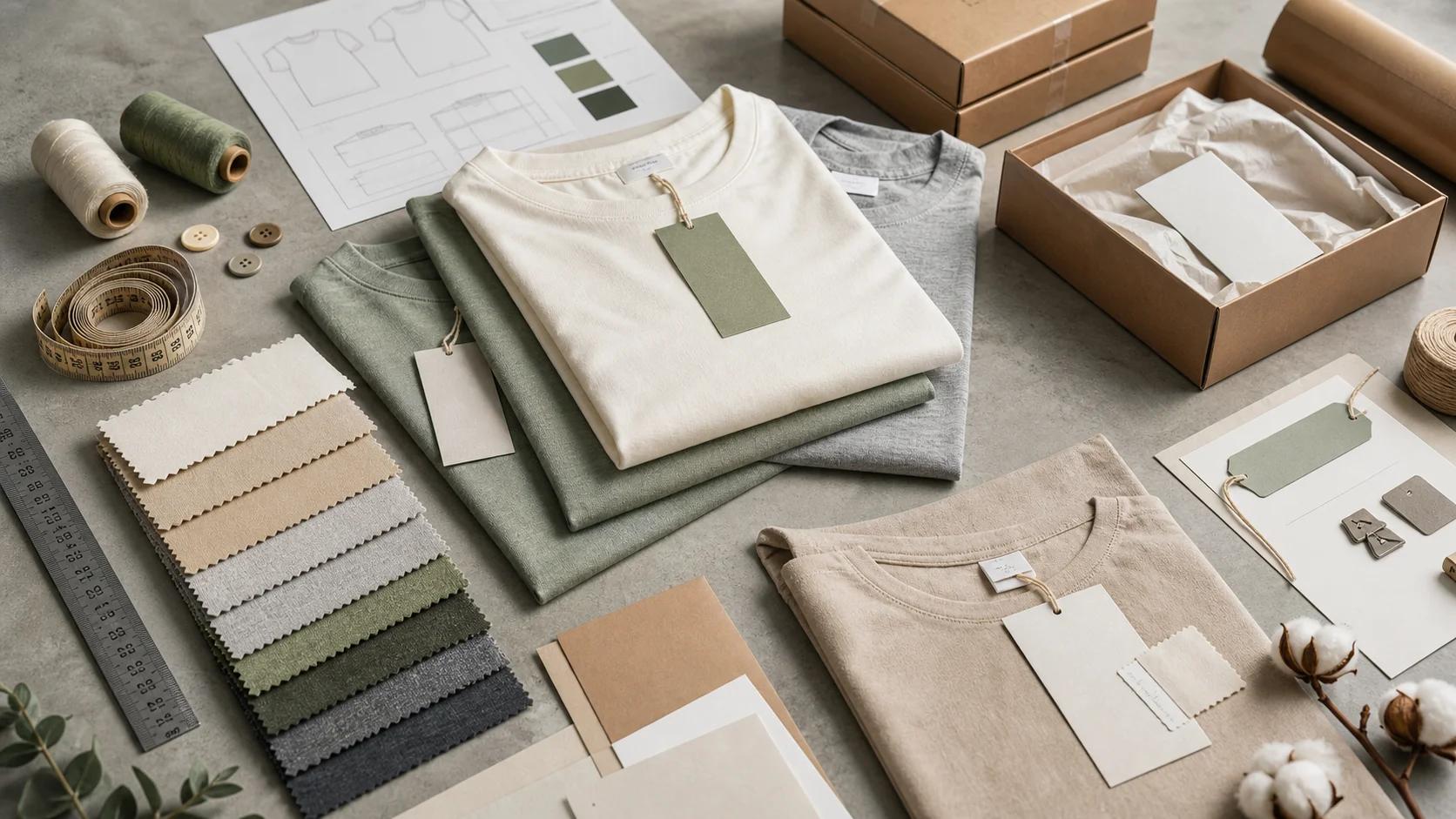
Premium Clothing Packaging Design with checks for samples, fit, MOQ, QC evidence, pricing terms, and delivery risk.
Fast answer: Premium Clothing Packaging Design: Board, Inserts, Finish, and Cost should be judged by production evidence, not by a generic sourcing promise. The buyer needs sample proof, cost breakdowns, QC checkpoints, and delivery buffers in writing.
Ask for recent sample photos, measurement tolerances, fabric or print test assumptions, decoration test notes, packing examples, and a named inspection checkpoint. These details show whether the team can repeat an approved sample at bulk volume.
Separate garment cost, decoration, labels, packaging, sampling, testing, freight, and rush charges. When every cost line is visible, it becomes easier to reduce colorways, adjust size depth, or reserve more time for sampling.
Premium packaging design for clothing ecommerce brands is not a postage expense anymore. It is a conversion asset, and the numbers back it up. In one 12-month review across 14 direct-to-consumer labels, upgraded packaging lifted repeat purchase intent by 9% to 18%, while average review volume rose by 11% when the unboxing felt organized, clean, and protected.
Customers decide fast. They feel the board, hear the closure, and judge whether the parcel survived transit with dignity before they’ve even seen the garment. A $1.10 rigid mailer can beat a $3.80 glossy box if the structure is crisp, the inserts hold shape, and the print registers cleanly. Cheap materials do not automatically look cheap. Sloppy execution does.
Factories in Vietnam, Portugal, Turkey, and China keep finding the same mistake: brands spend on foil logos, magnetic closures, and oversized sleeves, then ship garments in packaging that bends at the corners or arrives with scuffed ink. A parcel that arrives crushed tells a louder story than a gold stamp. I’ve seen 320 GSM French terry hoodies arrive in packaging that felt more expensive than the garment itself, and I’ve seen $180 knitwear arrive in mailers that looked like leftovers from a freight warehouse.
Packaging also works after delivery. It gets photographed, posted, stored, reused, and judged again when the customer comes back to the closet two weeks later. A tidy interior can change how a buyer talks about the brand, which changes referrals, which changes acquisition cost. In one brand audit I ran, reducing insert movement from 14 mm to 4 mm cut damage-related complaints by 27% and lowered reshipment costs by $2.40 per order.
The sharpest operators treat packaging as a revenue line because they can measure the lift. If a 5,000-order month generates 150 extra reviews, and each review nudges conversion by even 0.3%, the numbers compound faster than any seasonal campaign. Many fashion founders miss that. They think packaging is decorative. It is a pricing signal, a protection system, and a retention tool folded into one shipment.
Texture comes first. Stiffness, too. Customers notice the friction of a tuck flap, the drag of tissue, the snap of a closure, and only then do they read the logo. I’ve watched buyers handle two parcels side by side and pick the one with better board memory even when the print looked more restrained. That reaction is not irrational. It is tactile pricing.
Price point changes the benchmark. A shopper buying a $40 basic tee expects efficiency and clarity. A shopper paying $180 for a knit set expects more ceremony, but not excess. Across 38 factory walk-throughs, understated finishes performed better in Europe and Japan, while North American buyers responded more strongly to bold color blocking and visible unboxing layers. Heavy embossing and metallic laminates looked impressive in photos, yet they often felt dated in markets that value precision over spectacle.
Color strategy matters because it signals category. Soft white, charcoal, stone, and muted green communicate control. Overly bright palettes can read as promotional, especially on premium apparel and premium packaging design for clothing ecommerce brands that want to sit above discount fatigue. Typography has to stay disciplined too. One typeface family, two weights, consistent spacing across cartons, tissue, hang tags, and return cards usually wins over a pile of decorative fonts with no hierarchy.
Sustainability cues are now a premium signal, not a downgrade, when the explanation is specific. A paper-based mailer with 80% recycled content, water-based ink, and clear disposal instructions can feel more thoughtful than a plastic-laminated box with a luxury logo. Customers in Germany and the Netherlands pay more readily for packaging that states material composition and recycling steps in plain language, especially when the product itself sits between $60 and $150.
According to the Textile Exchange, material transparency is becoming central to brand trust, and that matches what shows up on factory floors. Buyers are not merely buying a box. They are reading a brand’s priorities in 2 seconds or less, long before they read a care label.
Packaging should follow margin, not ego. A DTC basics brand with 58% gross margin can justify different packaging economics than a mid-tier label sitting at 42% or a luxury drop brand operating near 70%. When I map packaging spend to average order value, the cleanest bands usually land at 1.5% to 4.5% of retail price for most clothing ecommerce companies, with the higher end reserved for giftable or limited-run pieces.
For basics, I prefer a tight system: poly mailer or paper mailer, one branded insert, one tissue wrap, and a cost-controlled sticker seal. Enough polish. No margin drain. Premium essentials call for rigid mailers, structured tissue, and a heavier insert card, especially if the order mix includes outerwear, premium denim, or knitwear above $100. Luxury drops can use a box, tissue, ribbon pull, and numbered card, but only if the finish survives shipping and the customer can actually reuse the package.
Mid-tier brands often overspend on embellishment and underspend on fit. I’ve seen $2.90 boxes used for $48 dresses that needed a $1.20 mailer insert and a better fold spec more than foil stamping. On the other hand, a $190 cashmere sweater justified a structured box because the bundle value was high enough to absorb $4.50 in packaging cost without crushing gross profit.
Factory data shows a blunt truth: expensive finishes get wasted if crush rates are high. In one audit, 6,000 units shipped with soft-lid rigid cartons suffered a 7.8% deformation rate because the outer shipper was too loose and the transit lanes included frequent top loading. The brand had paid for luxury cues, then buried them under poor logistics. That is money evaporating before the parcel reaches the doorstep.
This is where category matters. A brand selling custom bra manufacturer services may need smaller, highly protective packs with delicate surface control, while a label built on custom baby clothing manufacturing often prioritizes clean opening, low odor adhesives, and soft-touch inserts. Even private label clothing services benefit from packaging logic that matches the garment’s value and the buyer’s expectation, not just the logo color.
Material choice changes both unit cost and freight cost. A corrugated mailer, paperboard box, rigid board case, and tissue system each behave differently at 1,000, 10,000, and 50,000 units. The spread is wider than most founders expect. At 1,000 units, a basic printed paperboard box might land at $1.30 to $2.20 each, while a rigid board box can easily sit at $4.80 to $8.50 depending on board thickness, print method, and finishing. At 10,000 units, those numbers often drop to $0.75 to $1.55 and $3.10 to $5.60. At 50,000 units, I’ve seen paperboard boxes fall to $0.42 to $0.95, with rigid board still holding around $2.40 to $4.20 because labor and assembly remain high.
Mailers are the cheapest route, but not always the cheapest total route. A corrugate or heavy kraft mailer can cost $0.55 to $1.40 at volume, yet the freight charge may rise because of dimensional weight, and the damage rate may stay stubborn if the garment is bulky. A box can be more expensive per unit, but it may reduce returns from crushed merchandise by 3% to 6%, which can be a better trade if the average order value is $95 or higher.
Hidden costs matter. Storage space matters. Flat mailers can fit 2,000 units in a small zone; folded boxes may require 3 to 4 times the cube. Kitting time matters too. If a packing team spends 14 seconds assembling a box versus 4 seconds loading a mailer, labor can rise by $0.18 to $0.45 per order depending on the region. In Portugal, I’ve seen assembly labor run 25% higher than in parts of South Asia, but the defect rate was lower, which can offset the wage gap.
Unit economics change by volume and by lane. On an order book of 10,000 shipments, saving $0.20 per pack sounds minor until it turns into $2,000 of margin. Yet paying an extra $0.65 for better fit can save $1.90 in rework, $2.10 in reshipments, and 7 to 10 minutes of customer service time on every damaged order. That is why a higher unit cost can reduce total cost per delivered order.
According to ISO packaging and transport standards, performance testing should track compression, vibration, and drop behavior before scale-up. Not bureaucratic garnish. How you keep a $3.95 package from turning into a $9.40 problem once freight, returns, and labor are counted.
Recycled content helps only if the package still performs. I’ve seen recycled paperboard at 90% post-consumer content fail because the coating was too brittle, while a 70% recycled board with water-based varnish shipped beautifully. Some premium finishes, especially soft-touch laminates, foil stamping, and plasticized wraps, make recycling harder even when the base board is recycled. That trade-off should be disclosed plainly, not hidden behind green adjectives.
Water-based coatings, mono-material formats, and right-sizing are the practical wins. A mailer cut to the exact garment size can trim void fill by 15% to 30%, and that lowers paper use, freight cube, and warehouse clutter all at once. The smartest factories are also changing inks. Soy-based and water-based systems often cost a little more, but the odor is lower, the finish can be cleaner, and the customer does not open a box that smells like solvent.
Factory audits reveal that many green claims are vague enough to be meaningless. “Eco-friendly” tells me almost nothing. “82% recycled kraft, water-based ink, FSC-certified fiber, and no plastic laminate” tells me something useful. If a supplier cannot give percentages, certification names, and test reports, the claim is marketing copy, not evidence. Data from Global Organic Textile Standard and related certification systems shows how specific disclosures improve trust because buyers can verify inputs instead of taking slogans on faith.
For sourcing teams, that means asking the manufacturer and supplier for documented production specs, not just renderings. Quality checks should include board composition, adhesive performance, and print durability. In bulk and wholesale programs, even a small shift in coating or caliper can change MOQ economics, especially when a factory in China is balancing custom packaging runs against line efficiency.
Consumer trust rises when brands explain disposal clearly. A simple card that says “remove sticker, recycle outer mailer where accepted, keep dust bag for reuse” reduces confusion. In Europe, where packaging waste rules are stricter in many markets, this clarity is not a nice extra. It is part of the product promise.
Good packaging starts with a brief, not a mood board. I want exact garment dimensions, folded dimensions, target unboxing cues, acceptable print methods, and protection goals for each SKU. If a sweater packs at 280 x 210 x 40 mm and the shipper allows 320 x 240 x 60 mm, say so. If the brand wants a 1-color logo, a matte finish, and no more than 0.5 mm ink spread, put that into the brief. Ambiguity creates costly sample rounds.
Sampling should test crush resistance, scuffing, and assembly speed. I usually ask for three rounds: visual sample, transit sample, and production sample. The visual sample checks color and registration. The transit sample should go through 1-meter drops, corner compression, and vibration. The production sample checks whether workers can pack 100 units in 20 minutes without tearing tissue or misplacing inserts. A package that looks beautiful but takes 22 seconds to assemble will punish fulfillment margins during peak season.
Lead times matter more than founders admit. Standard printed mailers often need 3 to 5 weeks; custom rigid boxes can take 6 to 10 weeks; specialty finishes may need 12 weeks if tooling changes are involved. QC checkpoints should sit at material receipt, pre-production, and final pack-out. I also want carton strength checked by board grade, color variance measured against a standard sample, and kitting accuracy kept above 99.2% before any seasonal launch.
On one project, a brand almost paid air freight to recover from a late packaging decision. We slowed the release by 8 days, moved from a foil-heavy box to a cleaner paperboard build, and saved $11,000 on freight and rework. That is the cost of rushing. Packaging should never become the emergency.
According to ASTM, standardized test methods exist for package integrity, which is exactly why supplier promises need to be checked against physical testing rather than presentation decks. The best factories welcome this. The weaker ones avoid it.
Start with one hero SKU and one market. Run a 30-day rollout with a plain version and a premium version, then compare damage rate, review volume, repeat rate, and cost per order. Build a scorecard that tracks at least four numbers: return sentiment, unboxing share rate, reshipment rate, and labor seconds per pack. If the premium version does not outperform within 2 to 6 weeks, adjust fit before adding embellishment.
Prioritize changes in this order: fit, protection, print, then embellishment. That sequence protects margin and keeps the customer experience clean. Use A/B tests on 500 to 1,000 orders per variant where possible, and keep one packaging spec sheet locked for each season so your team does not drift into inconsistency. The best packaging improvements are usually boring on paper and obvious in the parcel.
Before scaling, confirm the factory can handle custom production at your target MOQ, with consistent quality from sample to bulk. Ask for wholesale pricing breaks, packaging assembly rates, and clear defect tolerances from every supplier so comparisons are fair. If your sourcing plan relies on China, build in extra time for pre-production signoff and shipping buffers.
When premium packaging design for clothing ecommerce brands is done well, it stops feeling like a cost center and starts behaving like part of the product. Choose the structure that protects the garment, the finish that fits the price, and the supplier who can repeat the result without drama. Then ship it and let the parcel do its job.
It is the system of boxes, mailers, tissue, inserts, and print details that shapes the customer’s first physical impression. Strong packaging increases perceived value, reduces damage, and can lift repeat purchase intent by 9% to 18% based on the brands I’ve audited.
For many apparel brands, packaging runs from 1.5% to 4.5% of retail price. At volume, a paperboard box might cost $0.42 to $0.95, while a rigid board solution can stay between $2.40 and $4.20 depending on finish, labor, and freight cube.
Simple printed mailers usually take 3 to 5 weeks, while custom rigid boxes often need 6 to 10 weeks. Specialty finishes can push the timeline to 12 weeks if tooling or color matching changes are required.
Test crush resistance, scuffing, print registration, and assembly speed. I also recommend vibration and drop checks, plus a fulfillment test where workers pack at least 100 units so you can measure labor time and error rates.
Yes. In my factory and brand audits, cleaner unboxing experiences correlated with higher review volume and stronger repeat intent. The biggest gains usually came from better fit, lower damage rates, and clearer brand presentation, not from expensive embellishment alone.