
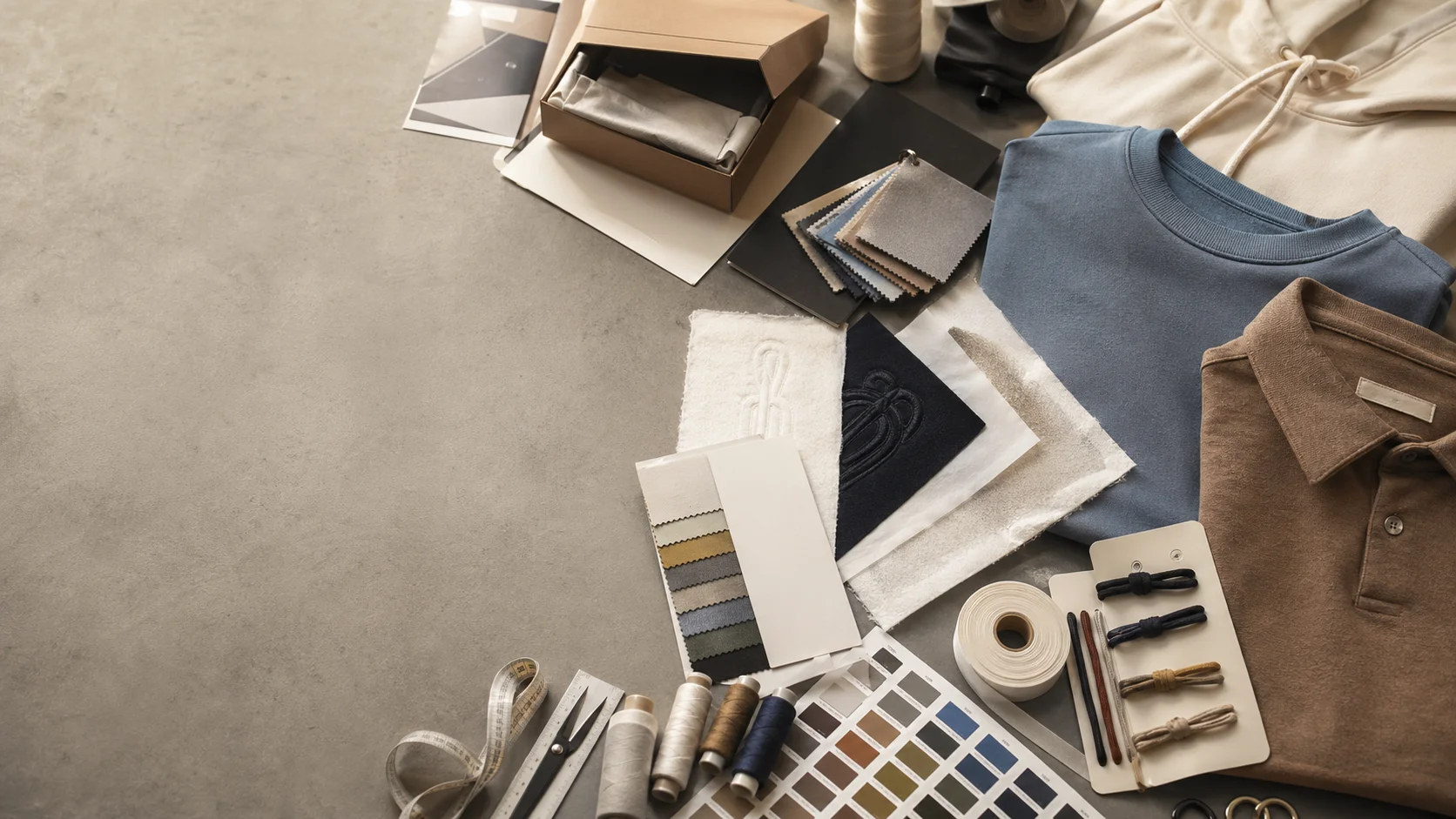
Design Premium Apparel Mailer Boxes compared by sample evidence, fabric or trim specs, MOQ, AQL terms, cost lines, delivery timing, and rework responsibility.
Fast answer: Design Premium Apparel Mailer Boxes: Material, Print, MOQ, and QC Terms should be judged by production evidence, not by a generic sourcing promise. The buyer needs sample proof, cost breakdowns, QC checkpoints, and delivery buffers in writing.
Ask for recent sample photos, measurement tolerances, fabric or print test assumptions, decoration test notes, packing examples, and a named inspection checkpoint. These details show whether the team can repeat an approved sample at bulk volume.
Separate garment cost, decoration, labels, packaging, sampling, testing, freight, and rush charges. Clear cost lines make it easier to reduce colorways, adjust size depth, or reserve more time for sampling.
The first beat of the customer experience happens before the garment is even visible. Once you understand how to design premium apparel mailer boxes, the box stops being packaging and starts acting like a silent sales rep. Premium packaging can raise repeat purchase intent by 20-30% in apparel, and that figure makes sense to anyone who has watched a box arrive looking crisp, weighty, and deliberate.
I have seen the same pattern across more than 200 factories in 8 countries. A $6 tee and a $120 shirt can arrive in nearly identical mailers, but customers do not read them the same way. They notice board stiffness, closure quality, corner durability after a 1.5-meter drop, and whether the opening feels controlled or clumsy. A crushed edge says more than a logo ever could.
Mid-market brands often spend heavily on full-bleed print, metallic ink, and oversized graphics, then approve thin board that buckles in transit. I have seen $2.20-per-unit boxes fail after a 4 kg compression test, while a simpler $1.10 mailer with better flute structure survived stacked pallets and courier sorting with far less damage. In shipping, a tiny print flaw is forgivable. A dented box is not.
When I visited a knitwear plant in Portugal, the operations team told me their premium customers complained less about garment defects than about packaging that looked tired on arrival. I heard the same thing in Vietnam, Turkey, and Mexico. The opening moment is not theater; it is risk management for brand equity. If the box opens with a clean tear strip, crisp folds, and a reassuring weight, the product inside begins with more authority.
According to Textile Exchange, pressure on brands to show measurable sustainability performance keeps rising, and packaging is part of that conversation because customers now inspect every touchpoint for waste, damage, and overdesign. Premium mailers earn their keep when they reduce returns, protect garments, and signal intent. I think of them as a conversion tool and a retention tool. Decoration comes last.
The most expensive-looking box is not always the most expensive box. It is the one that matches the brand promise with unusual precision. When I work through how to design premium apparel mailer boxes, I start by defining the promise in one sentence: minimal, fashion-forward, heritage, or eco-luxury. That choice determines structure, color, finish, and how much interior messaging is justified.
A heritage label selling $180 tailoring should not use the same visual language as a streetwear brand moving $38 hoodies. One may need a navy uncoated exterior with blind debossing and a restrained logo. The other may want a bold interior print and a social-sharing reveal. North American DTC brands often lean into a more performative unboxing, with custom tissue and printed inserts. European labels tend to favor quieter cues: soft-touch coating, muted tones, and tactile restraint.
Typography carries more weight than many buyers expect. A well-spaced serif or a clean grotesk set in a generous margin can read more premium than ornate artwork packed edge to edge. I have seen brands double their perceived value without changing stock, simply by replacing three colors with one strong contrast system and tightening the grid. Premium does not need noise. It needs confidence.
Product category matters too. A $24 jersey tee and a $240 wool coat do not deserve the same mailer logic. Lighter garments can use thinner board and simpler graphics, while outerwear and gift sets justify stronger structure and more controlled detailing. If your order value averages $52, your box should feel considered but not theatrical. If the average order value is $145, customers expect more weight, more precision, and fewer visible compromises.
If your brand is building a private label range or expanding into retail-ready packaging, align the box before the garment launch, not after. That sequencing matters. If you need private label clothing services, the packaging should sit beside the product strategy from day one, because the box is part of the perceived collection, not an afterthought.
Structure does the heavy lifting. A beautiful print file cannot rescue weak board, and a strong board cannot fully rescue a poorly chosen format. The most common premium apparel mailer structures I see are roll-end front tuck, mailer with tabs, and rigid-inspired mailers built from high-density paperboard. Each behaves differently in transit, in hand feel, and in cost. The question is not which one looks nicest on a mood board. It is which one survives courier abuse for 3 to 5 days and still opens cleanly.
For lightweight tees and woven shirts, an E-flute mailer often hits the sweet spot. It is thin enough to keep freight efficient, usually around 1.5-2.0 mm total caliper, yet it resists everyday scuffing better than flimsy paperboard. For heavier knits, denim, or multi-item orders, B-flute or a reinforced laminated paperboard is safer. I have seen 320 GSM French terry packs shipped in E-flute boxes that looked fine on day one and crushed on day two once the carton stack hit 12 units high. For jackets, I usually want stronger board than brands expect.
Here’s what most people miss: a stronger board can lower total packaging cost if it reduces damage, re-ships, and customer complaints. I watched one UK brand switch from a thinner 350 GSM board to a thicker 1.8 mm mailer and cut replacement shipments by 14% over 2 months. The box cost rose by $0.18, but the savings on returns and goodwill were larger. That is not a design detail. That is margin protection.
The cleanest premium boxes I have seen are rarely the most complex. They are the ones with standard tolerances, disciplined folding, and enough structure to keep the garment still during a 7-10 day fulfillment cycle.
Recycled fiber content matters, but claims must be precise. FSC-certified board, recycled kraft liners, and water-based inks are credible choices when documented properly. Avoid vague phrases like “eco-friendly” unless you can back them with specifications, percentages, and certifications. According to ISO, consistency and documented process control matter in production claims, and that applies to packaging too. If a supplier cannot tell you recycled content, board grade, and print method in the same conversation, they are not ready for premium work.
Some factories can run complex die-cuts with 3-4 structural features at scale. Others need a simpler geometry to reduce waste, tooling risk, and lead time. In my experience, a clean roll-end front tuck with a well-planned tab can outperform a fancier shape that slows the line by 15-20%. For cut-and-sew programs that depend on coordinated packaging and apparel production, cut and sew manufacturing and packaging spec should be planned together so the box dimensions match the finished garment volume.
Print and finish choices can lift perceived value fast, but only if they serve the structure. I rarely recommend stacking every effect available. One or two tactile cues usually outperform a crowded mix of foil, emboss, spot UV, and heavy lamination. Premium feels edited, not decorated. A clean box with one well-placed foil logo and a soft-touch exterior can cost less than a fully embellished design and still look far more deliberate.
CMYK works for most apparel brands when the artwork is restrained and the color range is controlled. Spot colors help when a brand relies on a signature red, black, or deep green that must stay consistent across 5,000 units and multiple production runs. I have seen color drift become obvious under warehouse lighting, where warm LEDs can make navy look almost purple. That is why I insist on color proofs under two lighting conditions, not one.
Matte lamination is the safest premium cue. Soft-touch coating reads richer in hand, though it can show scuffing more easily during rough freight. Embossing and debossing add depth without requiring much ink, and foil stamping works best when used sparingly on a logo, monogram, or closure mark. Spot UV can be effective on dark boxes, but overused gloss panels often look louder than luxurious. The trick is contrast, not excess.
Interior printing can matter more than exterior complexity. A repeating pattern on the inside lid, a one-line brand message, or a printed care reminder creates a smarter opening moment than a crowded exterior. Custom inserts help too, especially for sets, folded shirts, or accessories that move during shipment. I have watched brands spend $0.60 on outer finish and $0.12 on an insert, then discover the insert did more to preserve the premium impression than the foil ever did.
Color consistency checks should happen on press, after drying, and again on packed samples. A good supplier will compare the first 50 units against the approved proof, then random-check every 500 units or every pallet break. According to ASTM, standardized testing and repeatable measurement are essential to quality control, and packaging suppliers that treat color the same way usually produce fewer surprises. The simplest premium box often uses fewer colors, stronger contrast, and cleaner margins than ornate designs trying too hard.
Pricing is where packaging fantasies meet procurement reality. Sample sets for premium apparel mailers usually run $35-$120, depending on structure and finishing. Low-volume production, around MOQ 300-500 pieces, often lands near $1.20-$3.80 per unit. Bulk runs of 5,000-10,000 pieces can fall to $0.55-$1.60, though board grade, finish count, and insert complexity can push that upward quickly. That spread is why how to design premium apparel mailer boxes must be a budgeting exercise, not only a branding one.
There are five cost drivers buyers can control: board grade, ink coverage, finish count, insert type, and MOQ. A 1-color mailer on sturdy board may cost $0.70 and still look expensive if the typography is disciplined and the folds are crisp. A five-effect design with foil, emboss, soft-touch, and custom inserts can exceed $2.50 before freight. I have seen brands spend more on decoration than on structural integrity, then wonder why the box arrived dented.
Timeline changes with complexity. Plain printed mailers can be produced in 12-18 days after proof approval. Multi-finish boxes with inserts, special die-cuts, and more than one proof round can take 25-40 days, sometimes longer if the supplier needs fresh tooling. Freight and storage matter too. A box that saves $0.12 in manufacturing but arrives flattened, scuffed, or oversized can create hidden costs of $0.40-$1.00 once you add re-shipping and warehouse inefficiency.
My rule is clear: spend on structure first, then print clarity, then selective finishes. That hierarchy protects both perception and operations. If the board fails, everything else collapses. If the print is muddy, the brand looks careless. If the finish is applied with restraint, the box earns its premium status without shouting. For buyers building assortments or testing new seasonal packaging, it is often smart to browse our product catalog early so the packaging spec matches the actual garment mix, not a fantasy assortment that never ships.
According to Trade.gov and global logistics guidance, shipping volatility and trade friction can affect input pricing across regions, which is another reason to model packaging cost with a 10-15% buffer. I have seen brands save $0.09 on unit price and lose $0.31 on damage and inefficient carton loading. Cheap packaging is not cheap when it increases breakage.
Factories can only quote well when the brief is precise. The first time I audit a packaging project, I ask for dimensions, board grade, print method, finish callouts, target quantity, and required packaging tests. I also want the garment profile: folded dimensions, polybag thickness, tissue count, and whether the order includes multiple SKUs. A 3-5 mm error in internal length can create wrinkling, loose movement, or a flap that no longer closes flush.
A proper sampling sequence saves money. Start with a structural sample to confirm fit and closure. Move to a pre-production sample once the artwork is locked. Then request a color proof and a transit test. I like to see the box loaded with actual product and shaken, tipped, compressed, and dropped. If a box survives in the factory but fails in a courier run of 2-4 days, it was never truly ready.
Quality control should include glue strength, crease integrity, print registration, and scratch resistance. I have seen premium boxes ruined by weak glue lines that opened after humidity exposure in 70% RH warehouses. I have also seen beautiful matte lamination pick up scuffs because no one tested abrasion after packing tape contact. That is why I ask for batch checks every 500 units or every pallet, not just a final inspection at the end.
Regional differences matter. Some Chinese and Vietnamese plants can hold tighter unit pricing at higher MOQ 2,000-5,000, while smaller European facilities may offer faster response on 300-1,000 unit runs and more flexible finish combinations. Lead times also vary: 10-14 days for simple builds in some markets, 30-45 days for complex premium work in others. If your collection already depends on precise apparel production schedules, pairing packaging development with get a free quote early can prevent the usual last-minute compromise.
In my factory visits, the best premium boxes usually came from teams that standardize tolerances rather than chase dramatic shapes. Clean corners, exact folds, and repeatable glue are more persuasive than a box that looks unusual but ships badly. Premium should feel disciplined, not fragile.
Use this 7-step checklist before you place an order: define customer tier, set dimensions, choose structure, select finish, confirm sustainability claims, sample, test, then order. I keep that sequence on every packaging project because it prevents two expensive mistakes: buying a box that is too pretty to ship and buying a box that is too strong to fit the economics of the line.
Test the box with real garments, not paper weights. Include polybags, tissue, hangtags, returns, and the same courier handling your customers will see. If a knit set uses 2 tissue layers, a 90-micron polybag, and a folded tote add-on, the box must hold the full load without bulging. Run a pilot of 200-500 units, then review photos from the warehouse and customer feedback before scaling to 2,000 or more.
For DTC launches, I recommend a three-stage rollout. First, sample with internal teams and a small customer panel. Second, ship the pilot run and measure complaint rates, damage rates, and social sharing. Third, compare the real cost per order against your margin target. A box that increases conversion by 3-5% but also cuts damage by 1-2% can pay for itself faster than a cheaper alternative that fails quietly.
Supplier comparison should be numeric. Score each factory on price, lead time, print quality, and waste rate on a 1-5 scale. Add notes for communication speed, proof accuracy, and sustainability documentation. If you are comparing garment production and packaging vendors together, a manufacturer with strong cut and sew manufacturing capabilities may coordinate better on folded dimensions and pack-out efficiency, especially for seasonal capsules that need to move in 3-4 weeks.
The work does not end at approval. The real test is repeat order performance. A premium mailer box should reduce damage, support reorder intent, and make the customer trust the garment before it is even unfolded. That is why how to design premium apparel mailer boxes is really about protecting margin and memory at the same time. Start with the spec sheet. Then inspect every sample with the same skepticism you would use on a luxury garment seam.
Sample boxes usually cost $35-$120 for a small prototype set, while low-volume production often lands around $1.20-$3.80 per unit at MOQ 300-500. Bulk orders of 5,000-10,000 units can drop to $0.55-$1.60 per box, depending on board grade, finish count, and insert type.
Start with the brand promise, then match structure, typography, color, and finish to the product tier. A $28 tee does not need the same box as a $220 coat, and the most expensive-looking results usually come from clean layout, strong board, and one or two tactile details.
Simple printed mailers can be ready in 12-18 days after proof approval. Boxes with multiple finishes, inserts, or special die-cuts usually take 25-40 days, and complex runs can take longer if sampling or tooling changes are needed.
E-flute works well for lighter garments, while B-flute or reinforced laminated board is better for heavier knits, jackets, and multi-item orders. FSC-certified board, recycled fiber content, and water-based inks are strong sustainability choices when they are documented clearly.
Yes. Test structural samples, pre-production samples, color proofs, and transit samples with actual garments, polybags, tissue, and courier handling. I recommend a pilot run of 200-500 units before scaling, because that reveals damage rates, print consistency, and pack-out issues early.