
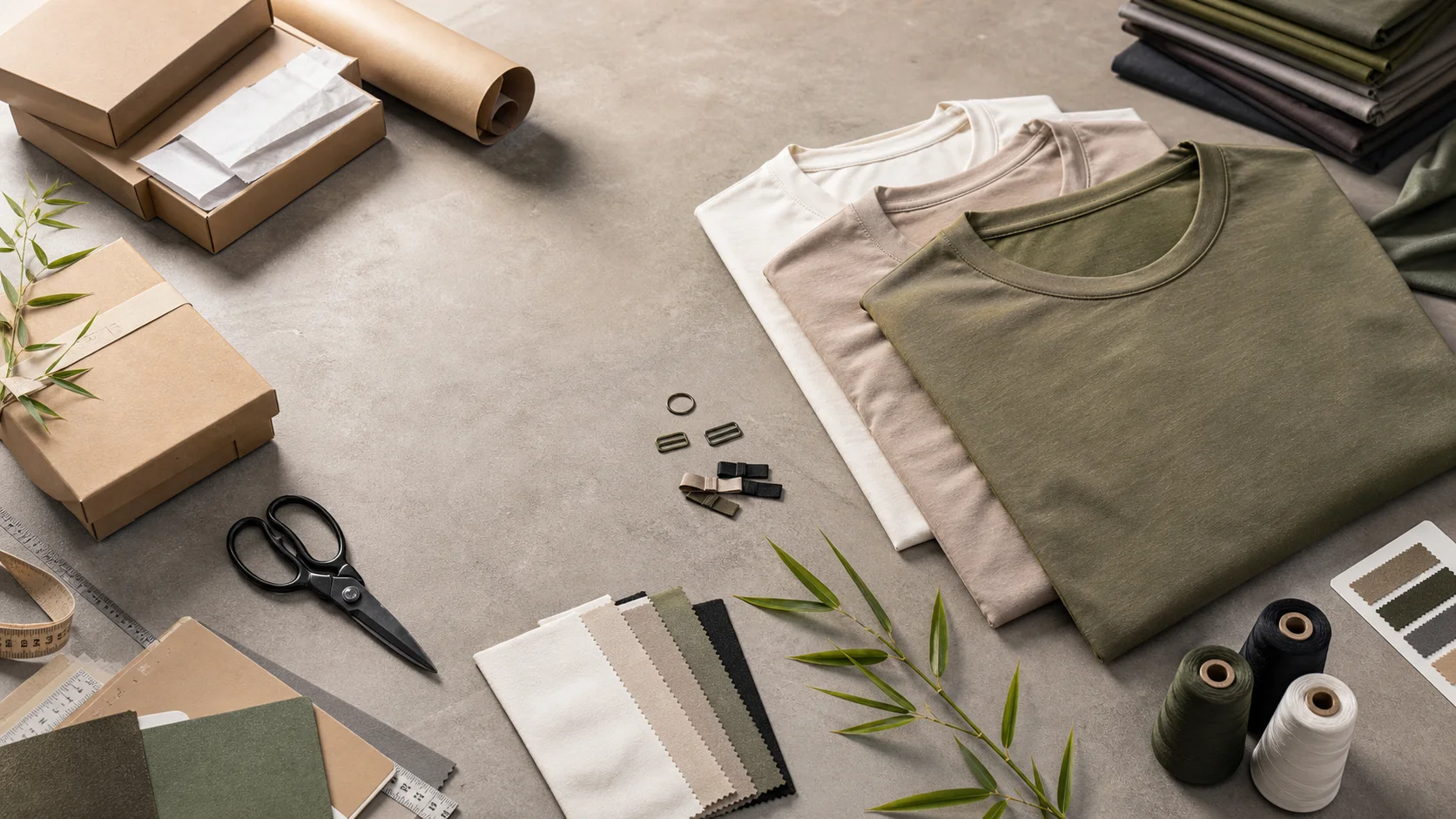
Design Premium Clothing Packaging Box compared by sample evidence, fabric or trim specs, MOQ, AQL terms, cost lines, delivery timing, and rework responsibility.
Fast answer: Design Premium Clothing Packaging Box: Material, Print, MOQ, and QC Terms should be judged by production evidence, not by a generic sourcing promise. The buyer needs sample proof, cost breakdowns, QC checkpoints, and delivery buffers in writing.
Ask for recent sample photos, measurement tolerances, fabric or print test assumptions, decoration test notes, packing examples, and a named inspection checkpoint. These details show whether the team can repeat an approved sample at bulk volume.
Separate garment cost, decoration, labels, packaging, sampling, testing, freight, and rush charges. Clear cost lines make it easier to reduce colorways, adjust size depth, or reserve more time for sampling.
I have watched an $18 rigid box fail a corner-drop test while a $4.20 mailer survived six meters of conveyor abuse. That is the first lesson in how to design premium clothing packaging box systems that actually earn their keep: expensive-looking is not the same as production-ready. Across 200+ factory visits in eight countries, the pattern keeps repeating. The box looks elegant in a sales deck, then arrives with crushed corners, visible glue squeeze-out, or a lid that shifts by 2-3 millimeters.
Vietnam. China. Portugal. Turkey. Each manufacturer, factory, and supplier hears “premium” a little differently. Some build status with 1200 gsm greyboard and a 157 gsm wrap. Others use thinner board, around 2.0 mm, but obsess over closure tension, edge wrapping, and print registration within 0.5 mm. The second version often feels better in hand. Price does not decide quality. Discipline does.
Shoppers make that judgment in seconds. They feel weight first, then closure resistance, then the surface texture under fingertips. A lid that closes with a soft stop. A matte wrap that resists glare under store lighting. Corners that stay square after 3-4 openings. Luxury shows up faster in those cues than in foil, emboss, or an oversized logo.
On a packaging line outside Ho Chi Minh City, the most expensive boxes on the pallet were not the most convincing. The strongest set had restrained graphics, a tight wrap, and a board spec that matched the garment’s perceived value. A denim capsule in a $48 box can look pretentious. A wool coat in a $9.50 box can still feel coherent if the structure, fit, and finish align.
Premium packaging is structure, material discipline, and brand story working together. Not decoration. Not budget inflation. If your box protects the garment, fits the fulfillment flow, and tells a clear visual story, it will outperform something louder and more expensive. For apparel teams building out clothing packaging solutions, that is where the margin sits.
Rigid box, mailer box, drawer box, hinged lid. I have spec’d all four for brands ranging from $22 basics to $1,400 outerwear. Which structure wins? Product type, shipping reality, and how much theater you want at opening. A rigid two-piece box gives the strongest luxury cue for shirts, knitwear, and gifting sets. A folding mailer box works harder on warehouse efficiency. A drawer box adds ritual, but it also adds labor, tolerances, and often 10-15 percent more cost.
For shirts and tees, I usually start at 330 x 240 x 60 mm, which keeps fold memory low and leaves enough room for tissue, a thank-you card, and a barcode label without bulky air space. Knitwear needs more depth, often 80-100 mm, especially if the product is brushed or stacked with a dust bag. Lingerie boxes can be smaller, around 220 x 160 x 50 mm, because the intimacy of scale helps the item feel considered. Outerwear is trickier. A puffer jacket folded into a 450 x 350 x 120 mm rigid box will crush the freight budget fast. In that case, a reinforced mailer often wins.
Structure should match fulfillment, not fantasy. If a box adds 45 seconds of packing time per unit, I will question it immediately. At 10,000 units, that is 125 labor hours. That matters. So does storage density. A flat mailer can ship in 500 units per pallet. A set-up rigid box may only yield 150-220 units, depending on height and board caliper.
Internal fit carries more visual value than most teams expect. A tissue wrap folded to a precise 3-panel geometry. A ribbon pull that lifts the lid with 20-30 grams of resistance. A fitted insert that stops product movement by 1-2 cm. Those details make the box feel expensive without adding much material. For newborn lines and gift sets, I have seen brands borrow the same careful folding logic from custom baby clothing manufacturing because softness, safety, and presentation have to work together.
Choose the smallest structure that still gives the garment room to breathe. Oversized packaging reads wasteful, and freight costs follow. If the box exceeds the product footprint by more than 25 percent on either side, you are probably paying for empty space. The box should feel substantial in hand, not inflated on a packing table.
Drawer boxes work well for premium accessories, lingerie, and subscription drops because they create a reveal. Hinged lids suit collections where customers are likely to reuse the box for storage. Mailer boxes suit volume brands that need a premium print surface and tight carton counts. A folding carton, meanwhile, is the least forgiving and the cheapest. In my experience, it only feels premium when print control is excellent and the product inside is inherently elevated. For brands extending apparel into broader assortments, private label clothing services often need packaging that can flex across 6-10 SKUs without redesigning every carton.
Material choice does half the storytelling. Board grade, wrap paper, coating, and finish all change how a box behaves in the hand and under light. Paperboard around 300-400 gsm is common for folding cartons. Chipboard and rigid greyboard, often 1.5-3.0 mm, are the backbone of premium set-up boxes. Specialty wraps, from cotton-feel papers to embossed laid textures, create a tactile signal that customers read instantly.
I have handled boxes that cost $2.80 and looked rich because the wrap had a calm, dry touch. I have also handled $9.00 boxes that looked cheap because the glossy lamination reflected every fingerprint. Soft-touch can be elegant, but it scratches more easily than people expect. In three factories, I watched reject rates climb by 6-8 percent when a soft-touch film was applied too early in the curing cycle. The finish looked beautiful on day one and tired by day three.
Foil, emboss, deboss, and spot UV each send different messages. Foil says celebration, but too much of it can veer into costume. Emboss gives depth without shouting. Deboss feels quieter, more archival. Spot UV can sharpen a logo, though it can also look disconnected if the rest of the box is matte and restrained. Under retail lighting, overworked finishes become obvious. One pass of spot UV on a small mark can feel premium. A full-panel gloss pattern can read promotional.
According to the ISO standards site, packaging performance should be judged not only by appearance but by consistency and fit under real handling conditions. That matches what I see in production. A board that cracks at the score line, a wrap that bubbles at the corners, or a coating that drifts in shade from one batch to the next will undo the luxury signal faster than a plain box ever could.
Sustainability trade-offs sit inside every finish choice. Recycled greyboard, FSC-certified wraps, and water-based inks make recycling easier. Heavy lamination, metallic film, and mixed-material magnets make it harder. If your brand needs a premium effect, ask whether texture can do the job before plastic film does. A 157 gsm FSC wrap with a subtle grain often outperforms a laminated sheet that looks richer on screen but duller in the hand. In apparel, restraint can carry more authority than shine.
For cut-and-sew brands producing capsule collections, finish decisions should align with garment identity. A French terry 320 GSM hoodie wants a tactile, matte box. A silk blouse can handle a finer wrap and a cleaner white interior. The package should echo the fabric story, not compete with it. That is one reason I refer clients to cut and sew manufacturing teams early, before artwork is locked.
Visual restraint usually reads as more premium than crowded graphics. That sounds almost too simple, yet factory walls are full of boxes that prove it. A logo that sits 18 mm from the edge, a single color field, and generous negative space can look more expensive than a box covered in slogans, badges, and product claims. The eye needs room. Luxury relies on editing.
Typography carries the weight. Serif fonts can suggest heritage, but only if they are printed sharply at 6-8 pt without filling in. Sans serif feels modern and more direct-to-consumer, especially for younger buyers. Logo scale matters too. If the mark covers more than 15 percent of the lid, it starts to behave like advertising. If it is under 3 percent, it can disappear in a warehouse or on a shelf. I like brands that sit in the middle and let the structure do the talking.
Color systems should follow category and price tier. Black, ivory, and deep navy still dominate premium apparel because they signal control. Soft clay, olive, and muted stone work well for premium casualwear and sustainability-led labels. High-street premium lines often use stronger color blocks, but they need perfect print consistency to avoid looking cheap. In several factories, a delta-E shift of more than 2.0 was enough to turn a rich burgundy into a dull brick tone.
Print method matters at scale. Offset gives sharp edges and strong color fidelity for runs above 3,000 units. Digital print is better for testing 300-1,000 units or fast seasonal edits, but it can drift across vendors. If you print in multiple regions, ask for drawdowns and side-by-side approval. I have seen the same Pantone look clean in Portugal and muddy in Guangdong because paper absorbency differed by 8-10 percent.
One more point. If the garment is sold through a premium retail channel, the box should help the associate tell the story in under 20 seconds. That is where typography hierarchy becomes sales support, not decoration. It is also where a disciplined visual system earns its keep. The best box does not try to prove premium status. It assumes it.
Price varies more by structure than by artwork. A simple folding carton may land at $0.45-1.10 per unit at 5,000 pieces. A printed mailer box usually sits around $0.85-2.20 depending on board and finish. A premium rigid box can range from $2.50-6.50 for standard set-up sizes, and $7.00-plus is common once you add inserts, magnets, foil, or custom wrapping. For luxury gifting, I have seen specialty boxes hit $12.00-18.00 each before freight.
The biggest cost drivers are board thickness, insert complexity, finishing steps, tooling, and quantity. MOQ 500 may sound flexible, but the unit cost often jumps sharply below 1,000 pieces because the die, setup, and labor are spread over fewer cartons. A 3,000-piece wholesale or bulk order can easily come in 18-25 percent cheaper per unit than a 1,000-piece run with the same structure. That is why brands with steady volume should standardize dimensions whenever possible.
Sampling takes longer than most teams plan for. A realistic timeline starts with dieline approval, then 5-7 days for the first prototype, another 3-5 days for comments, and 7-10 days for a revised sample. After approval, production often needs 15-25 days, depending on print complexity and factory backlog. Freight adds another 5-35 days. Air is faster. Ocean is cheaper. That trade-off changes the landed cost far more than people admit.
Here is what most people miss: reducing one finish step can save more money than reducing 10 percent of board weight. I have seen brands trim $0.38 per box simply by removing full-panel lamination and switching to a textured wrap with a small foil mark. The box still felt premium. It also moved through production 4 days faster because one curing stage disappeared.
If your assortment mixes tees, knitwear, and gift sets, consider one core box family with two depths instead of three separate sizes. That can reduce tooling, pallet complexity, and warehouse picking errors. It also keeps the brand consistent across channels. A clean box system helps the product line look curated, not improvised. For teams building premium apparel ranges, the same logic used in private label clothing services can prevent packaging sprawl before it starts.
Premium and sustainable are not opposites. They fail together only when teams confuse material richness with excess. Recycled board, FSC-certified paper, and water-based inks can still look refined if the surface treatment is disciplined. I have seen 100 percent recycled greyboard with a cotton-texture wrap outperform virgin board with glossy lamination because the recycled option felt quieter and more deliberate.
Less lamination usually improves recyclability, and it also reduces material costs. Plastic-free aqueous coatings can protect against scuffing without wrapping the box in a film that frustrates recovery. Closure systems matter too. A paper tab, a tuck lock, or a ribbon made from natural fiber may be easier to separate than a magnet strip glued into a rigid shell. That small design choice can make sorting simpler at end of life.
Brands often overspend on details customers rarely notice. A hidden metal plate inside a lid. A full-surface metallic film that cannot be recycled cleanly. A thick insert for a garment that will only be worn once and then stored in a drawer. If the box is meant to travel from studio to customer and then become storage, durability matters. If it is destined for one unboxing and disposal, keep the material stack lean.
Data from Textile Exchange shows how quickly material choices shape broader environmental outcomes across apparel supply chains. Packaging is smaller than fabric, but it is more visible. That visibility creates responsibility. Better structural design can reduce shipping damage and replacement rates, which in turn cuts emissions from reships. I have seen a shift from weak folding cartons to reinforced mailers reduce damage claims by 11 percent in a 9,000-unit seasonal program.
For verification and safer material choices, many brands also review guidance from OEKO-TEX before approving wraps, inks, or inserts that sit near skin-contact products. My rule is straightforward. Choose the most sustainable package that still protects the garment, keeps the brand recognizable, and survives 2-3 handling points without distress. If a lighter box forces a replacement rate above 2 percent, it is not sustainable in practice. Waste avoided at the factory should not become waste created by returns.
Start with a brief that names the garment, channel, target price, and shipping method. Then send the dieline, flat artwork, finish specs, and carton count target. I ask clients to include product weight, folded dimensions, SKU range, and whether the box must survive parcel networks or only retail handoff. That information prevents endless revisions. It also saves 7-10 days of back-and-forth.
Your custom supplier should receive the file as editable artwork plus a locked PDF. Include Pantone references, bleed settings, and exact placement for logo, copy, and barcodes. State the board thickness, the wrap paper, and whether the inside must be printed or left natural. If you want a foil stamp, specify size in millimeters, not just “small.” Precision cuts confusion.
Sample checks should cover lid fit, board crush resistance, scuffing, color matching, and garment presentation. Test the closure 10 times. Drop the packed box from 60-80 cm on three edges and one corner. Check whether tissue shifts, whether the lid bows, and whether the print scratches under light abrasion. If the box is for ecommerce, add a shipping test. If it is for retail, test shelf stacking for 24 hours.
Keep revisions limited by assigning one decision-maker. Factories move faster when feedback is consolidated. Packing instructions should be written for the fulfillment team too: how many tissue sheets, where the sticker goes, whether the garment is folded left or right, and whether inserts ship flat or assembled. A messy final mile can ruin a precise design. That is why I care about cut and sew manufacturing discipline even when I am briefing boxes. Garment handling and box performance are part of the same system.
Before mass production, approve one golden sample, confirm SKU labeling, and sign off on carton counts per master case. Then ask for a pre-production photo set from the factory floor. Boring control saves expensive mistakes. I have seen one wrong barcode force a 2,400-unit relabeling job and delay shipment by 9 days. If you source from China, ask for this step before the first run leaves the factory.
Premium packaging pays off when customers keep it. I have tracked buyers who reuse rigid boxes for storage, gifting, and returns, and the retention pattern is stronger for outerwear, occasionwear, and premium basics than for low-margin tees. In higher price bands, usually above $120 retail, the box becomes part of the product memory. In lower price tiers, it matters most when the item is giftable.
The cues people remember are consistent. The opening sequence. The tactile finish. The interior message. A lid that opens with controlled resistance. A soft surface that does not glare. A note printed inside the flap at 8-10 pt. Those details linger because they create rhythm. If the package feels orderly, the brand feels orderly.
Regional behavior differs too. In Japan and South Korea, clean presentation and compact structure carry more weight. In parts of Europe, recycled materials and restraint often matter more than visual opulence. In the US, larger boxes and stronger unboxing theater still perform well for gifting, but only if the structure is solid. The box has to earn its keep.
For brands that want repeat purchase behavior, the goal is not to make the package louder. It is to make it reliable enough to be remembered. That is the real answer to how to design premium clothing packaging box programs that support brand equity over time. The best packaging does not shout luxury. It proves it through restraint, precision, and consistency. If you want the effect to last, build the box as carefully as you build the garment.
Most premium rigid clothing boxes fall between $2.50 and $6.50 per unit at 1,000-3,000 pieces. Simple folding cartons often cost $0.45-1.10, while add-ons like foil, magnets, and custom inserts can push the price above $8.00.
Use a structure that survives compression, corner impact, and conveyor handling. I prefer reinforced mailer boxes or rigid boxes with 2.0-3.0 mm board for apparel shipped in parcels, plus a fit that leaves no more than 1-2 cm of product movement.
A realistic timeline is 5-7 days for the first sample, 3-5 days for revisions, and 15-25 days for production after approval. Freight can add 5-35 days depending on air or ocean shipping, so plan at least 4-8 weeks total.
Keep the layout restrained, with one clear logo, generous negative space, and controlled typography. Avoid oversized graphics and too many finishes. Sharp offset printing, accurate Pantone matching, and matte or textured surfaces usually read more expensive than crowded decoration.
Yes. Recycled greyboard, FSC-certified wraps, and water-based inks can feel premium if the structure is precise and the finish is calm. I have seen recycled boxes outperform glossy virgin-board boxes when the fold, closure, and print consistency were better controlled.