
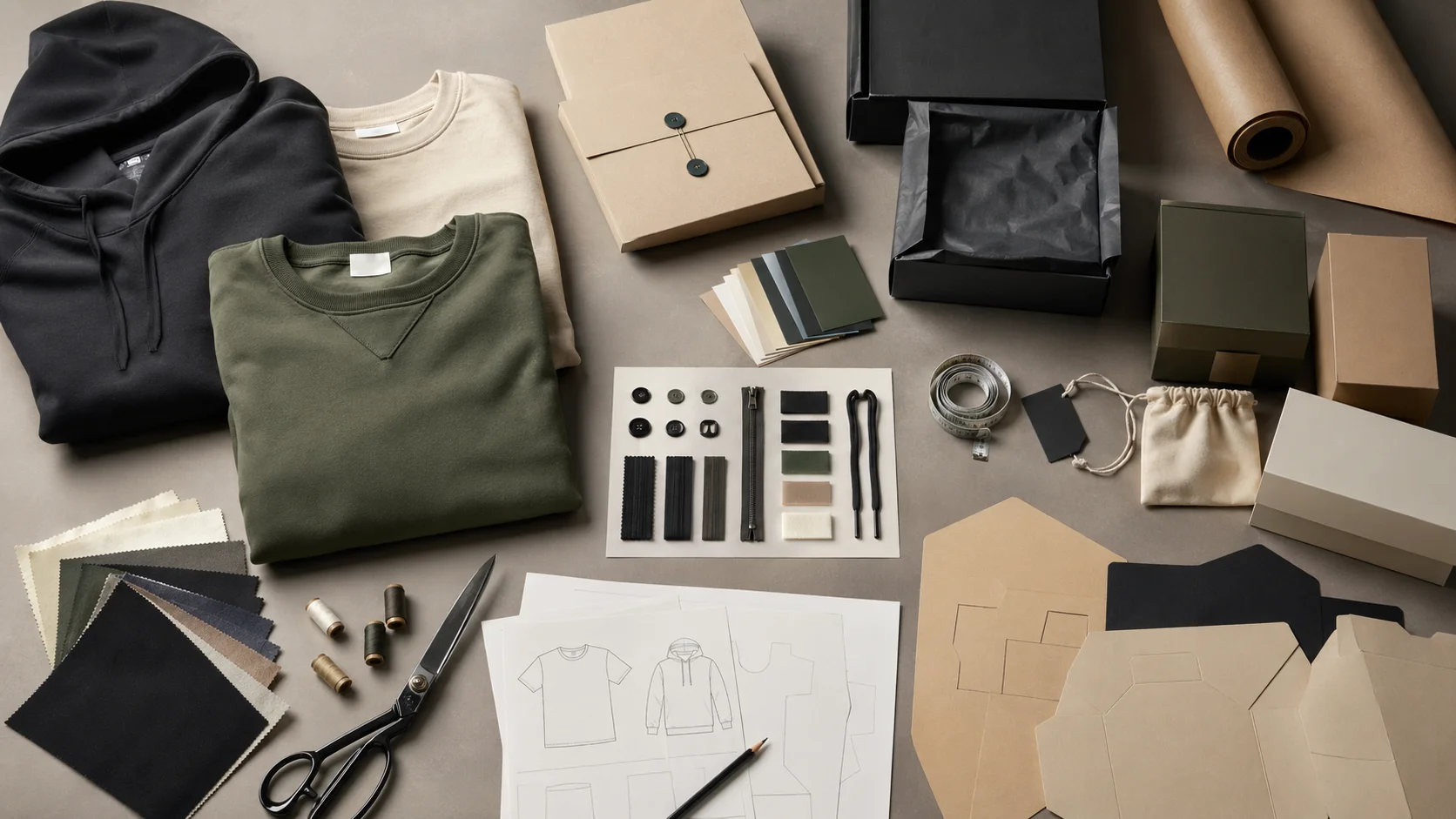
Premium Ecommerce Clothing Packaging with checks for samples, fit, MOQ, QC evidence, pricing terms, and delivery risk.
Fast answer: Premium Ecommerce Clothing Packaging: Layers, Inserts, Cost, and Brand Recall should be judged by production evidence, not by a generic sourcing promise. The buyer needs sample proof, cost breakdowns, QC checkpoints, and delivery buffers in writing.
Ask for recent sample photos, measurement tolerances, fabric or print test assumptions, decoration test notes, packing examples, and a named inspection checkpoint. These details show whether the team can repeat an approved sample at bulk volume.
Separate garment cost, decoration, labels, packaging, sampling, testing, freight, and rush charges. When every cost line is visible, it becomes easier to reduce colorways, adjust size depth, or reserve more time for sampling.
The first seven seconds can settle the argument before the customer even touches the fabric. If you are researching how to design premium clothing packaging for ecommerce, start there: the package changes perceived value at the moment of arrival, when a $68 shirt has to feel like it deserves the cart.
Factory after factory, the same garment moves through three price points. A mass-market poly mailer costs $0.12 to $0.35 and gets the job done. A premium branded mailer or folding carton might add $0.80 to $1.80. A rigid box, tissue wrap, ribbon, and insert can land at $2.50 to $6.00 per order. The gap sounds small until a brand ships 20,000 units and finds packaging alone can absorb $18,000 to $60,000 of annual margin.
The box becomes part of the product because it frames expectations. A recycled kraft mailer says utility and value. A rigid drawer box with clean board edges, one-color foil, and a precisely folded tissue layer signals intent, control, and price discipline. I’ve seen department-store private labels use simpler structures than some DTC startups and still read as more premium because the fit, print registration, and opening sequence were tighter.
Value lives in the details customers can see and feel, not in expensive features hidden inside the box. A satin ribbon that tangles in transit adds cost without adding trust. A 350 gsm insert card with crisp typography adds more credibility than a second magnet closure nobody asked for. In Vietnam, I saw a plant spend $0.22 extra per unit on board gauge and save brands money by reducing crush damage on the way to California. In Portugal, I saw a brand overpay for a velvet sleeve that looked luxurious on a sample table and shed lint in cartons.
The comparison across channels is stark. DTC brands need packaging that performs on camera and in warehousing. Luxury brands need restraint, not clutter. Department-store brands need consistency across 5,000 to 50,000 units, where small defects scale fast. If you are also managing clothing packaging solutions across multiple categories, the lesson repeats: the smartest premium package is the one that makes the garment look more expensive while adding the fewest possible failure points.
According to ISO packaging quality management guidance, packaging quality management is tightly tied to measurable process control, and that matters because the customer does not separate “brand promise” from “shipping damage.” They just remember the arrival.
The strongest premium packaging is engineered like a garment, not decorated like a gift. I’ve visited plants where a beautifully printed carton looked expensive on a desk and failed in transit because the shirt slid, creased, and picked up scuff marks from a loose insert. A package that protects a silk blouse at 0.3 kg is not the same structure you need for a 900 gsm hoodie with drawcord tips and a woven patch.
Fit is the first control point. A rigid mailer box sized within 3 to 5 mm of the folded garment reduces movement, while a too-large box increases abrasion and corner crush. For structured pieces, I’ve seen brands cut damage-related returns by 12% to 18% after shifting from oversized poly mailers to right-sized carton mailers. That saving usually beats the extra $0.40 to $1.20 in packaging cost.
Structure choices should match the product. A rigid box works for luxury shirts, knitwear, and giftable sets. A drawer box adds theater, but only if the tolerances are tight and the drawer pulls cleanly after 20 to 30 open-close cycles. Mailer boxes suit DTC basics and mid-tier fashion, especially when paired with tissue wrap and a printed belly band. Hangtags, inserts, and thank-you cards can reinforce premium cues without adding dead weight, provided the paper stock stays under 4 to 6 grams for cards and the total pack weight stays under 150 grams for smaller orders.
Overbuilt packaging often performs worse than simpler packaging because it shifts from protection to friction. I once saw a brand spend $1.90 on a magnetic closure box that looked luxurious, then pay another $0.28 per unit to reinforce the lid because the magnet alignment failed on the line. The simpler fold-flat carton at $0.74 had fewer defects, faster assembly, and lower damage claims. That kind of waste is common when packaging decisions are made by mood board rather than stress test.
For childrenswear and baby basics, the logic is even stricter. A family buying from custom baby clothing manufacturing wants cleanliness, ease of opening, and fabric protection more than ornamental hardware. The same thinking holds for premium adult apparel, and it becomes especially relevant in cut and sew manufacturing, where construction choices already influence lead times, tolerance ranges, and final hand feel.
Use inserts to maintain shape in transit. A 200 gsm tissue wrap around a blazer, a molded pulp collar support for knit polos, or a simple recycled board divider for two-piece sets can reduce wrinkling without adding much cost. Done properly, premium packaging lowers returns by preventing avoidable damage, not by disguising weak product quality.
Material choice is where sustainability claims either hold up or collapse. I’ve stood in factories where the sample room promised “recycled” boxes, then the production line substituted a lower-grade board with inconsistent fibers and fuzzy cut edges. A premium package can be FSC paperboard, recycled board, molded pulp, cotton ribbon, or compostable mailer film. The brand story changes with each one, and so does the cost to make it consistently.
FSC-certified paperboard is the safest choice for most apparel brands because it balances print quality, structural strength, and supply depth. Recycled board is cheaper in some regions, but I’ve seen caliper variation of 8% to 12% across shipments, which creates folding and registration problems. Molded pulp performs well as an insert or tray, though it is rarely the right outer shell for fashion unless the brand wants a visibly lower-impact aesthetic. Cotton ribbon feels premium, but at $0.10 to $0.45 per unit it can become decoration with no functional return.
Regional differences matter more than brand decks admit. In China, board quality is often excellent at scale, with fast access to embossing, foil, and lamination. Vietnam is strong on assembly discipline and rising paper capability, though color matching can drift if you move between supplier quotes. Turkey offers good print craft and shorter transit into Europe, but recycled stock can vary by mill. Portugal can produce refined finishes and stable quality for smaller runs, yet MOQs sometimes start at 1,000 to 3,000 units for custom structures, which is too high for early-stage brands.
Finishes change perception fast. Soft-touch coating makes a carton feel expensive, but it complicates recycling in some streams and can show scuffs at high handling volumes. Embossing adds texture without relying on ink density. Foil stamping works best in small doses, 3% to 8% of the visible surface, because heavy foil coverage can look louder than premium and make sorting harder for recyclers. I prefer blind emboss plus one restrained metallic detail when the brand wants quiet luxury.
Brands chasing premium positioning should compare packaging to the product itself. A $42 knit tee does not need a $5 box. A $220 tailored trouser set can justify more structure if the fabric is a 320 GSM French terry or a textured wool blend that benefits from crisp presentation. In practice, the package should echo the garment: clean, durable, and honest about what it is. That is also where private label clothing services often need tighter alignment, because the packaging must carry the same tone as the label inside.
According to Textile Exchange sustainability standards, traceability and responsible material claims are becoming more scrutinized, which means your packaging material spec should be as clear as your fabric spec. Vague terms age badly.
The bills arrive in layers. A startup ordering 500 units will not pay the same as a brand ordering 25,000, and the spread is wide enough to change the whole packaging strategy. For a basic setup, expect $0.35 to $0.85 per unit: printed mailer, tissue, sticker seal, and a folded insert. A mid-tier setup with a rigid mailer box, branded tissue, and insert card typically lands at $1.20 to $2.50. Luxury packaging with rigid board, drawer construction, foil, and ribbon often runs $3.50 to $8.00 before freight.
MOQ is where ambition meets reality. Custom boxes in China may start at 1,000 to 3,000 units, Vietnam often sits around 1,500 to 5,000, Turkey can support 1,000-unit runs for simpler structures, and Portugal often prefers 2,000 units or more for refined finishing. Tooling for custom dies can add $150 to $600. Print plates may add $80 to $250 per color. Sampling can cost $40 to $300 per round, and if you need three revisions, the “cheap” option stops being cheap quickly.
Freight and storage are the hidden tax. A large rigid box can occupy 2.5 to 4 times the cubic space of a flat mailer, which raises warehouse fees and inbound shipping. Assembly labor also matters. A package that takes 18 seconds to build versus 7 seconds can add $0.06 to $0.18 per unit in labor, depending on market wage. That difference becomes material at 10,000 units. I’ve seen brands choose a prettier box and lose more to packing labor than they saved on board.
Data from U.S. trade and freight data shows how freight volatility and country-of-origin differences can distort landed cost, so compare landed unit economics rather than factory quotes alone. A $0.68 box that arrives damaged in 4% of cartons costs more than a $1.05 box that lands intact.
Cheaper materials can also cost more once assembly and damage are included. A thin mailer may save $0.22 on paper but create $0.15 in extra void fill, $0.10 in labor, and $0.30 in replacement shipments. I’ve watched brands ignore that arithmetic because the quote sheet looked cleaner. It never stays clean after customer service gets involved. Brands scaling through private label clothing services should model packaging cost alongside margin, not after it.
For a denim brand shipping 8,000 units a month, a packaging upgrade from $0.74 to $1.46 can still improve profitability if returns fall by 2 percentage points and damage claims fall by 1 percentage point. That math is less glamorous than a mockup board, but it is the part that survives board meetings.
A package that photographs well earns unpaid media. A package that arrives intact earns repeat orders. The best systems do both. In practice, the visual hierarchy should be obvious in three steps: outer shell, reveal layer, garment. I like a high-contrast outer box, a restrained logo mark, and a clean interior that gives the first two seconds of video real shape.
Color contrast matters more than decoration density. Cream tissue inside a charcoal box reads richer on camera than a fully black interior that swallows texture. A branded insert placed at the top creates a focal point for Reels and TikTok without making warehouse staff hunt for loose pieces. Keep opening sequences simple. If the customer has to remove six components before seeing the garment, the package is performing for the brand, not the buyer.
Transit testing should be non-negotiable. Run a 1-meter drop test on six faces, crush testing at 20 to 30 kg depending on carton size, humidity exposure at 65% to 85% relative humidity for 24 hours, and rub resistance for any printed or coated surfaces. If foil scuffs after five rubs, it will fail in fulfillment. If a lid warps after humidity exposure, it will not survive a monsoon-season air freight route.
Influencer content depends on predictable handling. A drawer box that opens with one hand is more filmable than a box that needs two hands and a prayer. Warehouse efficiency depends on the same thing. If assembly requires extra tape, a nested insert, or a ribbon tie, packout time rises. I’ve seen a 14-second packout become 28 seconds simply because the design team wanted more “unveiling drama.”
That tension is why the same packaging can look premium online and still fail operationally. The answer is not more embellishment. It is better choreography. For brands scaling premium basics, especially through cut and sew manufacturing, packaging should echo the production discipline already built into the garment line: consistent folds, stable tolerances, no surprises.
The factory cannot read your mind. Send a spec pack that includes outer and inner dimensions, bleed and trim files, Pantone references, finish callouts, tolerance levels, carton counts, and assembly instructions. I also include target packout weight, ship test requirements, and whether the package must survive a 0.5-meter or 1-meter drop. That level of detail saves weeks. It also prevents the classic “close enough” sample that looks fine and ships badly.
My sampling workflow starts with a digital mockup, then a blank structural sample, then a printed production sample, then a pre-production sample with final materials. If color accuracy is off by more than Delta E 2 to 3, I ask for a correction. If glue strength fails under hand pressure, I reject the sample. If fold lines misalign by more than 1 to 2 mm, the package will look cheap even if the paper stock is excellent.
Red flags are usually visible before production. Watch for cracked foil on corners, warped lids after 24 hours, weak magnets, fuzzy cut edges, and tissue that tears at the fold. Check finish alignment by measuring logo placement against the die line, not against the eye. The eye is forgiving. Customers are not. A carton that arrives with a 3 mm print shift can undermine trust faster than a minor garment defect.
I advise brands to build a launch checklist and keep it short. Confirm the final dimensions, sign off the sample, lock the carton count, approve the freight plan, and inspect the first 200 units off the line. If you are working with clothing packaging solutions for multiple SKUs, insist on SKU-level labeling and a photo record from the factory floor. The more complex the order, the more boring the checklist should be.
My practical next steps are simple: request three quotes, compare landed cost, test two structures, and run a 20-unit pilot before committing to 5,000. If the package cannot survive a 1-meter drop, 24 hours of humidity, and a warehouse shift without extra labor, it is not ready for launch. Working with a qualified manufacturer or factory and comparing suppliers on quality, production consistency, and MOQ is the safest way to keep custom and wholesale packaging scalable, whether you buy in bulk or source from China.
Basic branded packaging usually costs $0.35 to $0.85 per unit, mid-tier packaging runs $1.20 to $2.50, and luxury setups can reach $3.50 to $8.00. Freight, sampling, and assembly can add 15% to 40% to the landed total.
Choose mailer boxes, printed tissue, and insert cards instead of rigid multi-part structures. Many suppliers can support 500 to 1,000 units for simpler formats, while custom rigid boxes often start at 1,000 to 3,000 units.
Typical timing is 3 to 6 weeks after sample approval, plus 5 to 20 days for freight depending on origin and destination. Add 1 to 2 weeks if you need multiple sampling rounds or custom tooling.
Yes. FSC paperboard, recycled board, and molded pulp can still look premium if the print registration, fold accuracy, and finishing are tight. Soft-touch coating and embossing help, but use them sparingly so recyclability is not compromised.
Use right-sized cartons with 3 to 5 mm of fit tolerance, add inserts for shape retention, and test for drops, crush, humidity, and rub resistance. Brands often see damage-related returns fall by 12% to 18% after improving fit and structure.