
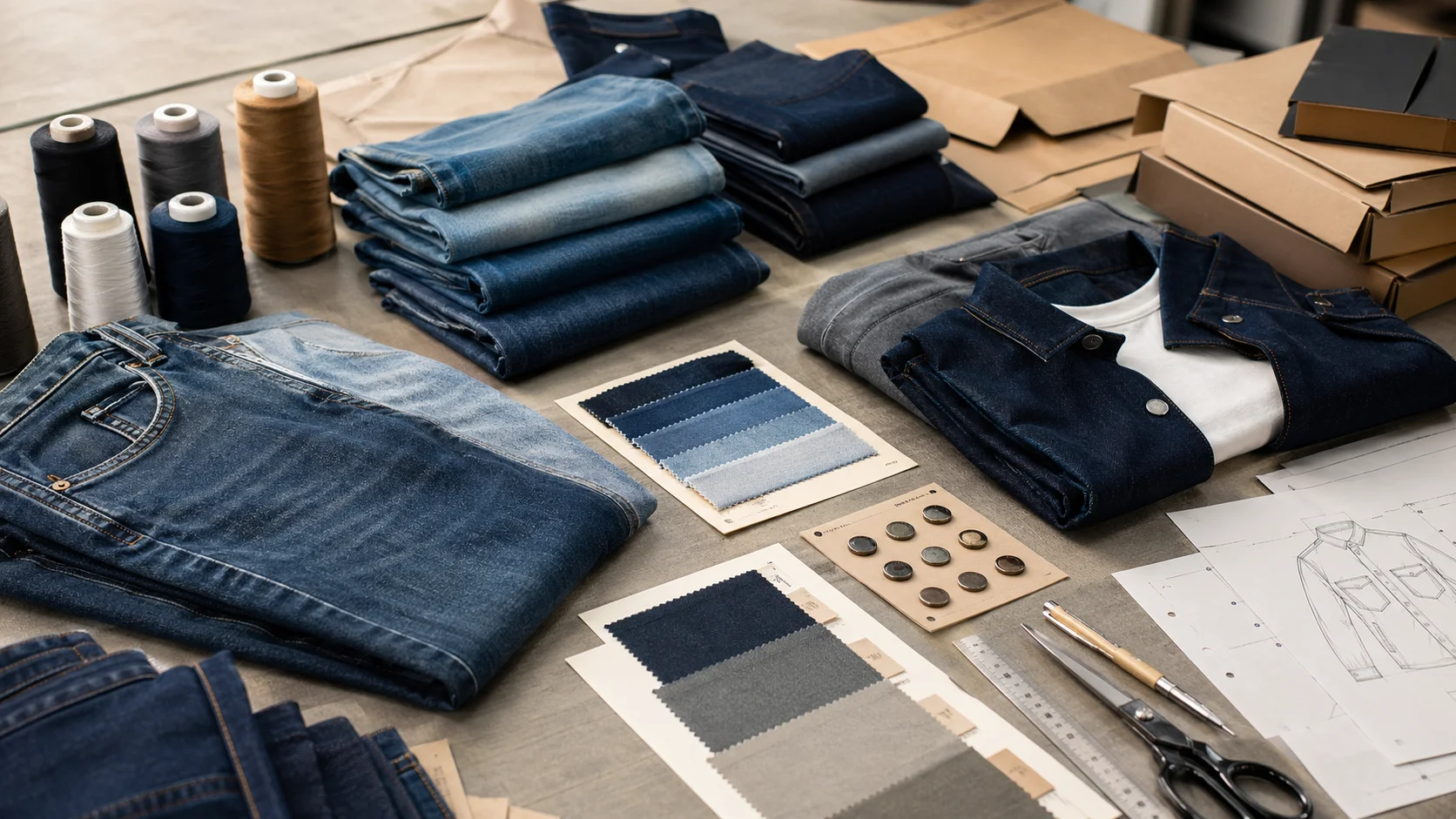
Overseas Garment Factory Sourcing with checks for samples, fit, MOQ, QC evidence, pricing terms, and delivery risk.
Fast answer: Overseas Garment Factory Sourcing: Supplier Vetting, Samples, QC, and Risk should be judged by production evidence, not by a generic sourcing promise. The buyer needs sample proof, cost breakdowns, QC checkpoints, and delivery buffers in writing.
Ask for recent sample photos, measurement tolerances, fabric or print test assumptions, decoration test notes, packing examples, and a named inspection checkpoint. These details show whether the team can repeat an approved sample at bulk volume.
Separate garment cost, decoration, labels, packaging, sampling, testing, freight, and rush charges. When every cost line is visible, it becomes easier to reduce colorways, adjust size depth, or reserve more time for sampling.
The cheapest quote is usually the loudest lie in overseas sourcing. If you are trying to figure out how to source garment factory overseas, start with total cost, not the number in the first email. Labor can be 5 to 8 times cheaper in some hubs, yet I have watched landed cost rise 12% to 30% after defects, freight, and rework. That is the trap: a bargain on paper can turn into an expensive rescue mission.
After visiting more than 200 factories across 8 countries, the same pattern kept showing up. Sample rooms looked polished; bulk floors told the truth. The gap between a one-off prototype and 5,000 pieces is where deals break down, because a neat sample can hide weak line balancing, poor trim control, or a sewing team that has never run the full style at volume.
Buyers also confuse quote price with true sourcing cost, especially on low-MOQ runs of 300 to 800 pieces. A factory may offer $4.20 per knit tee, but if it charges $120 for a size set, $85 for each lab dip round, and $0.18 per piece for special polybags, the real picture changes fast. Shipping, duty, and inspections add another layer. Overseas sourcing is risk control, not price hunting.
The data backs that up. The WTO shows apparel trade remains one of the most globally distributed manufacturing categories, which means buyers are always balancing cost, speed, and control across borders. I see the same three failure points repeatedly: unclear specs, weak factory vetting, and unrealistic timelines.
So follow the sequence, not the hype. Choose the right country and price tier first. Vet the factory before any deposit leaves your account. Then handle cost structure, compliance, quality control, and timelines in that order. Fewer surprises. Better margins.
China still leads for breadth, especially knits, denim, activewear, trims, and development speed. Vietnam is strong in athleticwear, outerwear, and cleaner execution on repeat programs. Bangladesh remains aggressive on basics and large-volume knitwear. India wins on cotton-rich knits, embroidery, and many wash processes. Turkey is strong for fast-fashion replenishment, tailoring, and small-to-medium orders into Europe. Morocco has a real edge for nearshore basics and quicker replenishment to EU buyers.
The price tiers are tighter than many buyers think. Cut-and-sew basics can range from $2.20 to $6.50 depending on fabric, labor, and order size. Small batches often carry a 20% to 40% premium because the factory cannot spread setup time across enough units. Trims may add $0.15 to $1.10 per piece. Packaging, including hangtags and polybags, can add another $0.08 to $0.45, especially if you need custom cartons or clothing packaging solutions.
Lead times shift by region and season. China can turn basic tees in 30 to 45 days once fabric is ready, but port congestion and pre-holiday shutdowns can push that much longer. Bangladesh often needs 45 to 70 days for fuller programs. Turkey and Morocco can move faster on replenishment, sometimes 2 to 4 weeks for repeat styles, yet their labor rates are higher. Vietnam usually sits in the middle, with better schedule reliability than many first-time buyers expect.
A higher-wage country can still produce lower total cost if defect rates are low and replenishment is faster. I have seen a Turkish supplier priced 18% above a South Asian quote win the order because it cut rework, avoided ocean freight delays, and delivered in 19 days instead of 52. That matters for brands selling 1,000 to 3,000 units per drop.
Language and time zone matter too. A factory 12 hours away can add a full day to every approval loop. MOQ also changes coordination costs. If a supplier wants 1,500 pieces per color and you only need 400, the per-unit risk rises. For private label clothing services, I usually compare no fewer than 3 countries and 2 factories per country before narrowing down.
Week one vetting should be boring, thorough, and slightly demanding. I ask for the business license, export records, audit reports, certificates, and 2 to 3 client references. I also request photos of the production floor, not just the showroom, plus a short video showing cutting, sewing, finishing, and packing. A factory that hesitates for 5 days over basic documents usually becomes difficult later.
Sample behavior tells you more than a glossy website. Check stitching consistency at 10x magnification if you can. Measure shrinkage after one wash cycle, not just on delivery day. On a French terry 320 GSM hoodie, I want tolerance within 1 cm on body length and 0.5 cm on rib width for repeat orders. Trim alignment, print placement, and seam density should match the tech pack, not the salesperson’s memory.
Showroom-only sellers are risky because they sometimes outsource production to subcontractors that never appear in the quote. That can be fine if disclosed and controlled. It is dangerous if hidden. I always ask whether the factory is a trading company, a direct factory, or a hybrid model. Trading companies can help with sourcing multiple categories, language support, and lower MOQ coordination. Direct factories are usually better for consistency, traceability, and price transparency on cut and sew manufacturing.
Capacity checks should be concrete. How many sewing machines are on the floor? How many lines are running? How many QC staff inspect inline and final goods? What is the monthly output by style, not just the overall figure? A factory claiming 80,000 pieces per month may still only have capacity for 12,000 pieces of your specific woven shirt if the wash and pressing stations are bottlenecks.
According to OEKO-TEX, restricted substance control is now standard language across many supply chains, but certificates alone do not prove execution. I ask to see the last 3 test reports, then cross-check them against the style’s actual fiber content and finish. A factory with 40 sewing machines and 6 QC staff often performs better than a bigger site with 120 machines and thin supervision.
FOB, EXW, and DDP change margin in different ways. FOB means the factory covers local export handling to the port, while EXW shifts pickup and inland transport to you. DDP can look simple, but it often hides freight, duty, brokerage, and buffer costs inside one inflated line. For first orders, I prefer FOB because it keeps factory and freight responsibility clearer. If you need full-service onboarding, DDP can work, but only with a breakdown.
Here is the cost stack I use: sample cost, tooling cost, testing cost, freight cost, duty, and defect allowance. A domestic order may show labor at $7.50 per piece, but offshore labor at $1.20 to $2.80 does not tell the full story. Add trims at $0.45 to $1.25, lab dips at $25 to $60 each, and pattern revisions at $15 to $75 per round. Carton marks, hangtags, and inspection fees often add another $0.12 to $0.40 per piece.
Payment terms affect cash flow more than many founders admit. A 30/70 structure means you pay 30% upfront and 70% after inspection or before shipment. A 50/50 structure pushes more cash out early and leaves less leverage if quality slips. On a $24,000 order, that difference is $4,800 tied up before production even starts.
A 3% reject rate can erase the labor advantage on a low-cost order. I saw this on a run of 4,000 jersey dresses priced at $3.60 FOB. The factory looked cheap on paper. After 126 defective units, $920 in rework, and $1,340 in air freight to recover a missed launch, the order cost more than a higher-priced supplier that quoted $4.05 FOB with stronger process control.
My rule is simple. Compare landed cost per saleable piece, not quoted unit price. If two factories differ by less than 8% on landed cost, choose the one with better communication, lower defect history, and clearer compliance records. A lower quote with loose specs is not savings. It is deferred pain.
Quality control has stages for a reason. I track prototype sample, fit sample, size set, TOP sample, inline inspection, and final random inspection. Each stage catches different mistakes. A prototype may prove construction, but a fit sample reveals body balance. A size set shows grading issues across S to XL. TOP samples, sent from the first production units, confirm whether bulk matches the approved standard.
The most common defects are predictable. Seam puckering appears when tension is wrong or fabric recovery is poor. Shade variation shows up in dye lots of 800 to 2,000 meters. Print cracks often appear after aggressive curing or poor ink selection. Labeling mistakes, especially care labels and country-of-origin marks, are common when a supplier handles 6 or 7 styles at once. I have seen one misplaced size pip cost a retailer 14 days of relabeling.
Compliance is not a box tick. Buyers should verify working hours, fire safety, wage records, wastewater treatment, and restricted substance testing. If a factory claims sustainability, ask what that means in documents, not slogans. Certifications such as GOTS, OEKO-TEX, BSCI, or WRAP matter because they create a paper trail, but each one covers a different slice of the operation. For claims around organic cotton or safer chemicals, the certificate must match the fabric, the mill, and the final finished article.
Factory visits changed my view on an uncomfortable point. Cleaner factories often have better defect control because process discipline is stronger. The same habits that keep floors tidy also keep trims sorted, needles changed, and bundles tracked. That does not mean every spotless factory is ethical. It does mean disorder is usually expensive.
According to WRAP, social compliance programs focus on lawful, humane manufacturing standards. I use that as a baseline, then inspect the actual production floor myself. If a factory cannot show test reports, fire exits, and wage documentation within 48 hours, I do not advance the order. Sustainability claims are cheap. Proof is not.
Timelines are rarely one number. Basics like tees or sweatshirts can move from first contact to bulk delivery in 6 to 10 weeks if fabric is standard and approvals are quick. Woven shirts often need 8 to 12 weeks. Denim can stretch to 10 to 14 weeks because wash development, hardware approvals, and shrinkage testing take time. Outerwear and technical apparel may need 12 to 20 weeks, especially when seam sealing, coating, or waterproof testing is involved.
Time disappears in five places: fabric development, strike-offs, fit approvals, sampling revisions, and customs delays. A sample round can take 2 to 6 weeks, depending on whether the mill has greige goods, whether trims are in stock, and whether the factory has a pattern maker who actually responds within 24 hours. Bulk production usually needs 30 to 90 days, but those numbers assume the buyer has locked specs before the order starts.
Air freight can save a launch, but it destroys margin fast. Ocean freight is usually the right choice for non-urgent orders over 800 pieces, especially when the style weighs more than 0.45 kg per unit. I use air only for urgent replenishment, small premium capsules, or delayed launches where missing the window would cost more than the freight delta. On a 2,500-piece order, the difference can exceed $6,000.
Planning tactics help more than heroics. Pre-book fabric. Lock trim specs. Approve care labels before cutting starts. Reserve carton dimensions early so the factory does not scramble for packaging at the end. This is where a good manufacturer earns its margin, because the team that controls 20 details well usually saves you from 2 expensive mistakes.
I also keep shipping buffers tied to season. Chinese New Year can remove 10 to 20 days. Ramadan and regional holidays affect parts of South Asia and the Middle East. Port delays can add 3 to 12 days even when the floor is ready. If you sell on fixed launch dates, build a schedule with at least 15% contingency time.
Start with a 10-point checklist. Define the product. Set target price and retail margin. Shortlist 3 countries. Request quotes from 5 to 8 factories. Validate compliance. Order samples. Inspect them against a tech pack. Negotiate payment terms. Place a pilot order. Measure defect rate, responsiveness, and on-time delivery.
A pilot order of 300 to 800 pieces works best, depending on style complexity and MOQ. That size is large enough to show real production behavior and small enough to absorb mistakes. Build a scorecard with weighted criteria: 30% quality, 25% price, 20% communication, 15% speed, and 10% sustainability. If a factory cannot explain one cost line by line, keep moving.
Negotiation should focus on structure, not just squeezing cents. Ask for alternate materials, lower-cost trims, or a 2-tier price based on volume. If the factory quotes $5.10 for 500 pieces and $4.30 for 2,000, ask what changes. Sometimes the answer is labor spread. Sometimes it is just margin padding. I have seen both.
Your first 30 days should look disciplined. Days 1 to 5: define the style and target costing. Days 6 to 12: collect quotes and references. Days 13 to 20: compare samples, test fabric, and check compliance. Days 21 to 30: negotiate terms and choose the pilot factory. If you need support, you can get a free quote for custom garment sourcing and compare it against your current supplier assumptions.
For broader market context, it also helps to review sourcing guidance from the U.S. International Trade Administration on textiles and apparel and sustainability standards from Textile Exchange. Those references can help you evaluate a supplier’s claims before you commit to bulk production. If you want fewer surprises, keep your checklist close and your first order small enough to learn from.
For a basic cotton T-shirt, offshore cut-and-sew pricing often falls between $2.20 and $4.80 FOB, depending on fabric weight, MOQ, and print method. Add testing, freight, duty, and packaging, and landed cost can move to $3.60 to $7.20 per piece.
Request a business license, export records, audit reports, and 2 client references before paying anything. Then verify sample quality, production capacity, and whether the seller is a direct factory or a trading company. If documents arrive slowly or change twice, walk away.
Most sample rounds take 2 to 6 weeks. Simple knits with existing fabric can be faster, while denim, wash development, or technical outerwear often takes longer because strike-offs, fit corrections, and trim sourcing add extra cycles.
Yes, but expect a 20% to 40% premium on unit price for small runs of 300 to 800 pieces. Small MOQ orders work best with factories used to development, private label clothing services, and repeat replenishment rather than massive volume production.
Check the tech pack, sample measurements, compliance documents, payment terms, and delivery timeline. I also recommend confirming packaging specs, including labels and cartons, because those details often trigger last-minute cost changes. Never send a deposit without a written proforma invoice.