
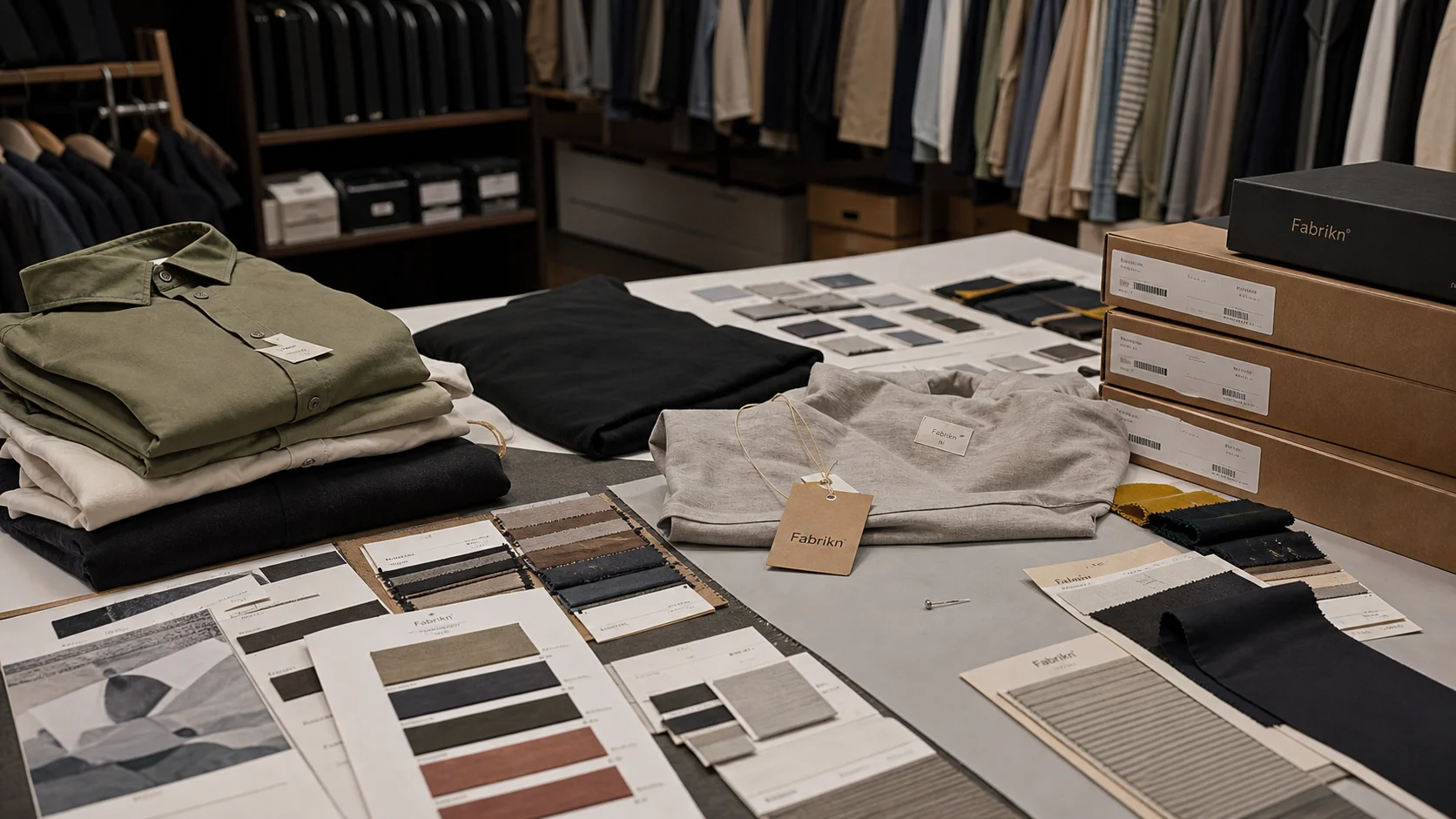
Source Garment Factory in China compared by sample evidence, fabric or trim specs, MOQ, AQL terms, cost lines, delivery timing, and rework responsibility.
Fast answer: Source Garment Factory in China: Tech Pack, Sample Gate, MOQ, and QC Terms should be judged by production evidence, not by a generic sourcing promise. The buyer needs sample proof, cost breakdowns, QC checkpoints, and delivery buffers in writing.
Ask for recent sample photos, measurement tolerances, fabric or print test assumptions, decoration test notes, packing examples, and a named inspection checkpoint. These details show whether the team can repeat an approved sample at bulk volume.
Separate garment cost, decoration, labels, packaging, sampling, testing, freight, and rush charges. Clear cost lines make it easier to reduce colorways, adjust size depth, or reserve more time for sampling.
China still commands a huge share of global apparel production, which is why anyone figuring out how to source garment factory in china keeps ending up here. On factory visits across eight countries, the same pattern kept repeating: dense supplier ecosystems, faster development cycles, and mills, trims, and finishing partners within 2 to 6 hours of the factory gate. For a first run that has to ship in 30 to 45 days, not 90, that edge matters.
But capability shifts sharply by region and product type. In Guangdong, especially around Dongguan and Guangzhou, I saw factories built for speed, low-mix replenishment, and complex cut-and-sew work with MOQ 300 to 800 pieces per color. Zhejiang, around Ningbo and Hangzhou, often had stronger knitwear and fashion basics, with cleaner production records and better access to performance fabrics. Jiangsu leaned into higher-spec woven garments, shirting, and outerwear, while Fujian was strong in sportswear and casual knits. Inland provinces could quote labor 8% to 15% lower, yet the same order often carried longer fabric lead times and more coordination risk.
The brochure never shows the real trade-offs. In sample rooms, the sales team may promise 3-week bulk delivery while the floor has no inline QC charts, no finished-goods quarantine area, and one overworked merchandiser handling 28 active styles. A hoodie quoted at $5.80 a piece can look attractive until you learn the fabric came from another province, the dye house was backlogged by 12 days, and final inspection depended on subcontracted packing. Cheap quote. Expensive surprise.
MOQ changes the math too. A factory that accepts 500 pieces of a French terry 320 GSM sweatshirt may refuse 1,200 pieces of a pleated woven skirt unless the buyer commits to 3 colors and a fabric booking 6 weeks ahead. Trim availability matters as well. If the factory can source YKK zippers, rib knit, and custom woven labels in-house or from nearby vendors, the order moves faster and cheaper. If not, every missing component adds cost and delay. That is why the cheapest factory is rarely the lowest-risk partner.
How to source garment factory in china starts with a tech pack, not a vague email asking for “good quality streetwear.” Brands skip stitch count, seam type, measurement tolerances, and fabric composition, then burn 2 to 4 sample rounds fixing what should have been in the first file. A complete tech pack can cut sample iterations by 1 to 3 rounds and trim quoting errors enough to save weeks. If the product is a 220 GSM jersey tee, say so. If the trim is 100% recycled polyester or the wash is enzyme wash rather than stone wash, put it on page one.
Before any quote request, define the product category. A basic T-shirt, a denim jacket, and a padded shell outerwear piece do not belong in the same sourcing conversation. Knitwear usually tolerates lower MOQs, often 300 to 800 pieces per style, while denim and outerwear can start at 500 to 1,500 pieces because washing, interlining, and hardware drive setup cost. For private-label basics, factories may quote differently depending on whether you need 1 color or 6, one fabric base or three. Building private label clothing services means the factory prices repetition, not design fantasy.
Compliance needs to be stated upfront, in writing. I ask for social audit status, chemical testing requirements, fire safety standards for sleepwear or outerwear, wage records, subcontracting disclosure, and traceability back to mill level where possible. According to OEKO-TEX, restricted substance testing is not a paper exercise; it is a buyer protection tool when a factory sources trims from multiple vendors. For brands selling into the EU or US, ask whether the factory has recent test reports for azo dyes, formaldehyde, and nickel release, plus records for wastewater handling if dyeing is in-house.
Here is where many buyers get surprised. A factory that knows your target retail price, margin, and certification needs may quote differently from one given only a sketch. Tell a supplier your jacket must land below $18 FOB and pass a third-party audit, and some will trim away compliance costs instead of saying the quote is unrealistic. Others will be blunt and say the margin only works at 1,000 pieces, not 400. That honesty saves money. Silence does not.
Alibaba can be a starting point, not a verdict. I shortlist suppliers through trade shows, mill and trim referrals, agent introductions, factory databases, and direct recommendations from knit mills or zipper vendors who already know who pays on time. Trade fairs in Canton, Shanghai, and Ningbo are useful because the booths reveal product focus fast. A supplier showing 40 unrelated categories gets a warning flag from me. One showing 6 tightly related ones gets attention.
To verify whether you are speaking to a true factory, a trading company, or a hybrid operation, ask for the business license, export records, machine list, production capacity by line, customer mix, and audit reports. A real manufacturer can usually explain whether knitting, cutting, sewing, and finishing sit in one building or are split across two sites. A trading company tends to answer with adjectives. A factory answers with numbers: 18 sewing lines, 2 cutting tables, 1,200 pieces per day, 14 QC staff, 3 merchandisers.
I also look at the sample room with suspicion. Over-polished sample rooms often hide very ordinary production floors. That is not always bad, but it means the sales budget may be heavier than the QA budget. Red flags include no line-layout chart, no visible needle detection records, no incoming fabric inspection log, and too many subcontracted lines for one address. I have walked into “factories” that were really offices with 12 sample garments and zero bulk capacity.
A 20-minute video call can reveal more than a glossy product page if you ask for current work-in-progress, line balance, and QC procedures. Ask them to show the sewing floor, not just the conference room. Ask where they store rejected rolls. Ask who signs off on shipment release. Then ask for the last 3 audit summaries. If the answers keep shifting, stop there. In Fujian, one screen-share showed 8 active lines and 2 separated packing zones. The supplier later won the order because they could prove control, not because they had the prettiest brochure.
Regional comparison matters because a $0.40 unit saving can disappear once freight, rework, or a missed ship date enters the picture. Guangdong usually prices higher than inland China, but it also delivers faster quoting, denser accessory markets, and better export experience. Zhejiang tends to sit in the middle on price and strong on knitwear and fashion basics. Jiangsu often carries higher overhead but better execution on structured wovens. Fujian can be highly competitive for activewear and casualwear, especially when the factory already works with export buyers. Inland provinces may look 5% to 12% cheaper on labor, yet logistics, fabric transfers, and slower vendor response can erase that edge.
Here is a practical cost structure I use: sample fee, development fee, unit price, packaging, inspection, inland freight, and export handling. A simple T-shirt might carry a $25 to $50 proto sample fee, a $100 to $300 development charge if prints or washes are involved, and a bulk price from $2.10 to $4.20 depending on GSM, finishing, and MOQ 500 versus MOQ 3,000. Woven shirts can move from $4.50 to $9.00. Outerwear can jump from $12 to $28 when padding, waterproof tape, and metal hardware enter the bill.
Lead times differ just as sharply. A basic tee from a well-run coastal factory can move from approved sample to bulk in 18 to 28 days. A woven shirt may need 30 to 45 days. Complex outerwear often needs 45 to 70 days, especially if fabric dyeing, quilting, or bonded seams are involved. Inland factories may quote the same bulk window, yet the real timeline often stretches by 7 to 14 days once fabric is consolidated from another province. Shipping adds its own math. Saving $0.20 a piece on production does nothing if you lose 10 days and miss retail markdown windows.
Data from Trade.gov and export-side reporting consistently show that proximity to ports and supplier clusters affects speed more than many first-time buyers expect. I have seen a slightly higher unit price in a well-run coastal factory beat a lower inland quote once rework, delays, and inland freight were counted. Not theory. A 3-week delay turned into a lost sell-through opportunity.
The sampling sequence should stay disciplined. I expect a proto sample first, then a fit sample, size-set sample, pre-production sample, and shipment approval. Each stage proves something different. Proto sample checks construction and proportion. Fit sample checks measurements on body. Size-set sample confirms grading from XS to XL or more. Pre-production sample confirms actual bulk fabric, trims, labels, and wash. Shipment approval confirms the final packed goods match the approved standard. A rushed buyer often folds these steps into one and pays twice later.
Timing should be visible too. Proto samples usually take 5 to 10 days if fabric is available. Fit samples can take 7 to 14 days. Size-set and pre-production samples often need 7 to 12 days each, especially when the order includes custom dyeing, embroidery, or special packaging. If the factory says every sample stage will happen in 48 hours, I get cautious. Speed without process usually means the sample room is improvising.
Negotiation works best when you compare like-for-like construction. I ask factories to break out fabric cost, trims, labor, wash, packaging, and overhead. Then I compare fabric yield, because one factory may cut a tee more efficiently and save 3% to 5% on fabric consumption. Separate one-time tooling from recurring cost. A screen print plate, embroidery program, or metal mold can be a one-off fee of $30 to $300, while recurring unit cost should stay stable. The goal is not the lowest quote. It is the cleanest quote.
Factories sometimes answer aggressive price pushing by thinning trims, reducing inspection time, or hiding extra charges in packing and carton fees. So I ask for benchmarks in writing: fabric loss %, defective-rate target, AQL level, and pack-out accuracy. AQL 2.5 is common for general apparel, while tighter programs may require 1.5 or even 1.0 for premium basics. If a supplier will not commit to a defect threshold, they are asking you to buy blind.
The thing nobody tells you: on one denim program, I negotiated a $0.32 lower unit price and later paid back $0.27 in rework because the factory had quietly reduced top-stitch inspection from 100% to spot checks. Better quote. Worse margin.
Audit the floor, not the promise. On-site or through a third-party audit, I inspect incoming fabric inspection, line balancing, needle detection, end-line QC, and final random inspection. I also want to see reject bins, ticketing for repairs, and the packing station. A factory with 12 sewing lines and no visible QC board is telling you that quality lives in memory, not process. That is a dangerous place to park your PO.
Compliance signals matter just as much. Worker records should show age verification, overtime management, and consistent attendance. Waste handling should be documented, especially for dye houses or washed denim programs. Subcontracting controls matter because a factory may accept your order but send 40% of it out to an unapproved workshop. That is where quality and labor exposure both drift. If you are building cut and sew manufacturing relationships, ask exactly who touches the garment at each stage.
Communication habits predict delivery. Weekly WIP photos, critical path tracking, delayed issue escalation, and sample approval logs reduce surprises. Time-zone friction is real. A 12-hour gap means a missing approval can sit overnight, turning a one-day fix into a 3-day delay. Language friction creates its own problems when “approved” and “under review” are treated as the same thing. They are not.
I score suppliers on quality, transparency, responsiveness, and capacity, not on price alone. A good factory with 2 merchandisers, 1 QA lead, and 24-hour response time will usually outperform a cheaper option that replies once every 3 days. If a factory can show a live critical path, that is worth more than a polished quotation PDF. For sourcing standards that align with responsible materials and verification, see Textile Exchange sustainability resources as well.
The practical path is simple: build a shortlist of 8 to 12 suppliers, send the same tech pack to all of them, request itemized quotes, compare construction and compliance assumptions, audit the finalists, and place a test order. I like to start with one style or a smaller PO of 300 to 800 pieces, because the first run teaches you more than any sales call ever will. If the factory misses the first order by 2 days, ask why. If they miss by 10, move on.
For the first production run, use a contract that names payment terms, defect thresholds, late-delivery penalties, IP ownership, and approved-subcontractor rules. If your packaging is part of the brand experience, lock it down with detailed specs and carton markings, then align it with clothing packaging solutions. Packaging errors may look minor, but I have seen 1 mislabeled carton trigger a full warehouse hold at port.
After each order, update a supplier scorecard. Did they hit 95% on-time shipment? Was the defect rate below 2%? Did they answer within 24 hours? Did they honor approved trims and wash standards? Repeat business should go to the factory that makes your life easier on the second order, not the one that gave the prettiest launch quote. If you want a fast next step, you can get a free quote and compare it against two or three benchmarks before you commit.
That is the real answer to how to source garment factory in china: fewer assumptions, more proof, and a long memory for the details that affect cash flow. A supplier that handles 500 pieces cleanly can be more valuable than one promising 10,000. On the first run, control beats ambition every time.
Start with a detailed tech pack, then request quotes from 8 to 12 factories with the same specs. Shortlist those with real production capacity, a clear QC process, and export experience; a test order of 300 to 800 pieces is a sensible first run.
Basic T-shirt sampling can cost $25 to $50, while development work may add $100 to $300. Bulk unit prices often range from $2.10 to $4.20 for tees, $4.50 to $9.00 for woven shirts, and $12 to $28 for outerwear, depending on MOQ and construction.
For a simple tee, approved sample to bulk can take 18 to 28 days. Woven shirts often need 30 to 45 days, while complex outerwear can take 45 to 70 days, especially if dyeing, quilting, or custom trims are involved.
Guangdong is usually fastest for development and replenishment, Zhejiang is strong for knitwear and basics, Jiangsu is often better for structured wovens, and Fujian works well for sportswear and casualwear. Inland provinces can quote lower labor, but logistics and coordination often add 7 to 14 days.
Yes, but the product must fit the factory’s setup. Knitwear and basics may work from 300 to 800 pieces, while denim and outerwear usually need 500 to 1,500 pieces. Good quality depends on process control, not MOQ alone, so verify QC records, fabric sourcing, and audit results.