
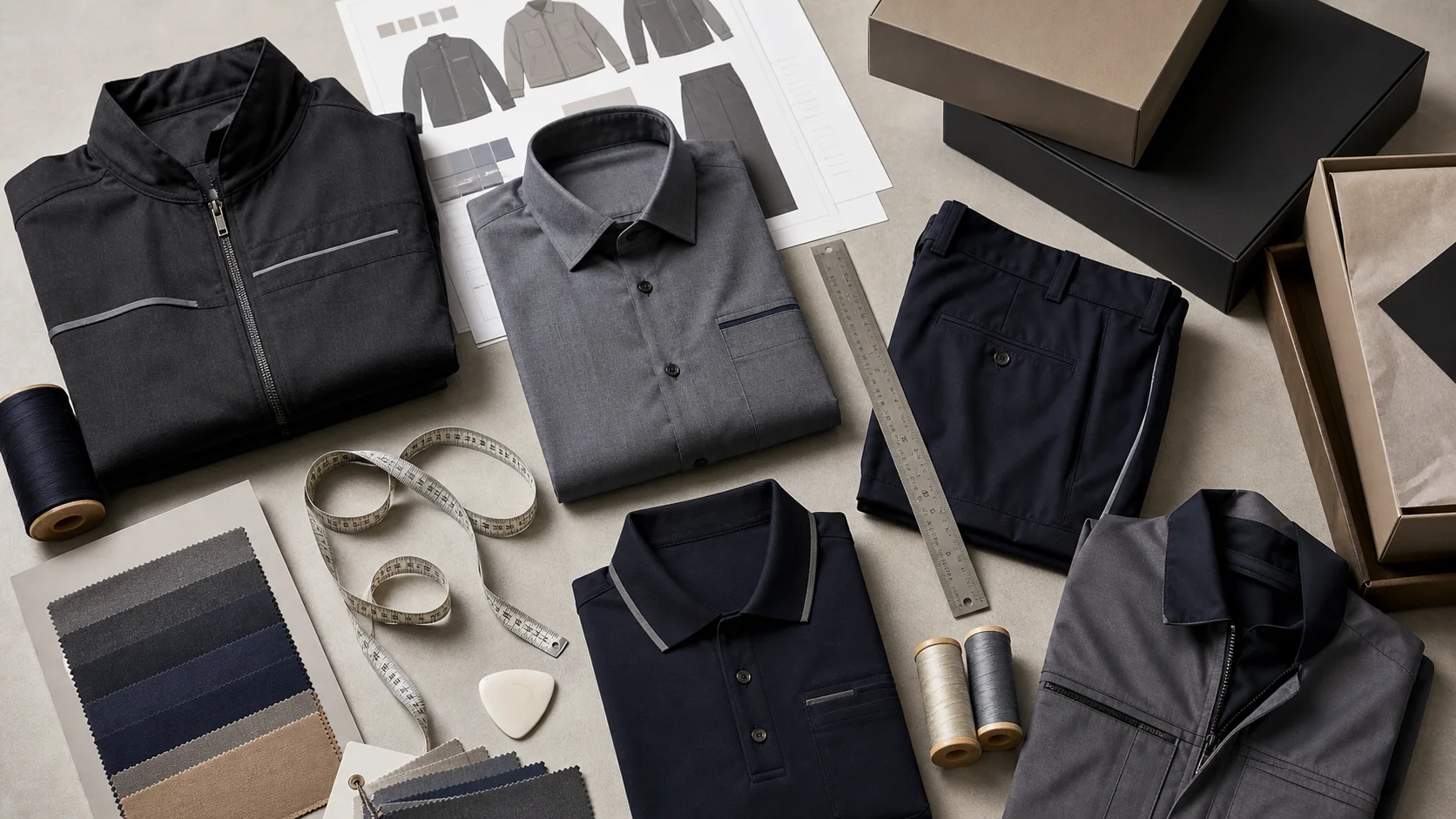
ODM apparel manufacturer for brands with checks for samples, fit, MOQ, QC evidence, pricing terms, and delivery risk.
Fast answer: ODM apparel manufacturer for brands: costs, fit, and speed should be judged by production evidence, not by a generic sourcing promise. The buyer needs sample proof, cost breakdowns, QC checkpoints, and delivery buffers in writing.
Ask for recent sample photos, measurement tolerances, fabric or print test assumptions, decoration test notes, packing examples, and a named inspection checkpoint. These details show whether the team can repeat an approved sample at bulk volume.
Separate garment cost, decoration, labels, packaging, sampling, testing, freight, and rush charges. When every cost line is visible, it becomes easier to reduce colorways, adjust size depth, or reserve more time for sampling.
Most brands do not lose money on one disastrous decision. They lose it in slow motion: a sample round that drags, a fit correction that never quite lands, a launch window that slips while cash sits frozen in development. For many founders, an ODM apparel manufacturer for brands is the first sane way back to earth, because the factory begins with a proven block, not a blank page. In factory after factory, I have watched teams arrive with 12-page moodboards, then burn another 8 to 14 weeks on pattern revisions, fabric substitutions, and comments that never quite match the target price.
On knitwear lines in Zhejiang, I have seen brands cut development time by 30% to 50% simply by adapting a pre-built crewneck or jogger block instead of inventing one. Activewear plants can move even faster. A legging built on an existing rise, waistband, and seam map can go from brief to sales sample in 10 to 18 days; a fully custom version may need 6 to 9 weeks before the fit feels real. Basics factories move quicker still, because the pattern language is already there. That speed matters more than founders expect when the first order is only 500 to 1,500 pieces and cash cannot sit idle.
Speed is not just labor velocity.
What 200+ factory visits taught me is this: material access, pattern library depth, and decision discipline do most of the work. A factory with 40 ready fabric qualities, 120 trims in stock, and one strong merchandiser will beat a larger plant that needs approvals for every button and zipper. Small and mid-sized brands also use ODM to protect margin. Trim the range to 6 styles instead of 14, and a higher MOQ can cut unit cost by 8% to 15% while lowering design risk, because fewer SKUs need to be tested, photographed, and reworked.
Counterintuitive? Yes. But it is usually the overdesigned collection, not the larger order, that kills the business case.
ODM means original design manufacturing. In plain terms, the factory already has styles, blocks, fabrics, or tech packs that a brand can adapt. OEM is more blank-canvas: the buyer brings the concept, the specs, and often the first pattern idea. Private label is narrower still, usually a stocked style with a logo swap, new label, or color change. If you buy private label clothing, you may be buying speed first; if you buy ODM, you are buying development that has already been paid for once, then reused intelligently.
What does a brand actually own in an ODM deal? Usually the colorway, trims, branding, and fit tweaks. Sometimes it also owns market exclusivity, such as one season, one territory, or one retail channel. I have seen agreements where a brand controls neckline height by 0.5 cm, rib width by 2 cm, or denim wash effect, while the factory keeps the base pattern. That split is normal. It can be a smart balance if the product still feels distinct on shelf.
Most serious ODM programs include sourcing, grading, pattern adjustment, sampling, testing, production, and packing. On the best runs, the factory also manages lab dips, shrinkage testing, seam strength checks, and carton planning. For structured categories such as bras, the bar is higher because fit and support are unforgiving; a factory with strong custom bra manufacturing experience can save weeks by starting from a validated cup and band system instead of guessing at wire placement.
Here is the risk. Some factories label private label as ODM when there is almost no original development on offer. That matters. If the “ODM” range is just a catalog of stock garments with logo placement, the buyer may still need 2 to 4 extra sample rounds, and the promised time saving evaporates. I always ask for proof of original pattern ownership, test records, and a clear list of what is customizable before I treat the offer as real ODM.
Category fit comes first. ODM works best for repeatable products with proven blocks: T-shirts, hoodies, leggings, polo shirts, simple denim, shackets, and basic outerwear. It works less well for experimental silhouettes, asymmetry, or draped fashion that depends on drape trials and 3D iteration. If a design needs 7 pattern revisions before it looks intentional, I would push toward OEM or a cut-and-sew partner such as cut and sew manufacturing rather than force an ODM framework.
Region matters, but specialization matters more. China still wins on speed and material access. In the factories I visited in Guangdong and Zhejiang, sampling often took 7 to 12 days because trims, zips, fabrics, and wash houses sat within 50 to 150 kilometers of the plant. Vietnam is strong on technical execution, especially for sportswear and outerwear, with cleaner handoff discipline and lower defect rates on some programs, though sampling can stretch to 2 to 3 weeks when material sourcing is split across vendors. Bangladesh dominates volume; 5,000 to 20,000 piece runs can price well, but communication often moves slower and sampling can take 2 to 4 weeks. Turkey is excellent for knitwear and quicker EU access, with transit times to major European hubs often under 7 days. Portugal suits premium smaller runs, frequently 100 to 800 pieces, with shorter freight and better fit communication for European brands.
Labor cost alone misleads buyers. A T-shirt in Bangladesh may cost less than the same shirt in Turkey by 12% to 25%, but if Turkey shaves 10 days off sampling and 7 days off freight, the total launch clock may be shorter and the sell-through better. That is not theoretical. I have watched a mid-market brand miss a sell window in the U.S. because its “cheaper” order arrived 19 days late.
Within the same city, factories can behave very differently. A denim ODM factory in Guangzhou may be brilliant at enzyme wash and hand sanding, while a T-shirt plant 15 minutes away struggles with neckline recovery and shade consistency. Country is the headline. Specialization is the story.
Cost starts before bulk production. Expect development fees, sampling, lab dips, trims, garment cost, testing, packaging, freight, and duties. On a small program, development and sample work can absorb $300 to $1,500 before the first production piece is cut. Testing alone may run $80 to $300 per style depending on the market, the fabric, and whether you need CPSIA, REACH, or colorfastness verification. For brands importing to the U.S. or EU, those line items are not optional vanity charges. They are the price of avoiding recalls and chargebacks.
Fabric choice moves the needle by 18% to 40% in many programs. A 200 GSM combed cotton jersey is not priced like a 320 GSM French terry, and recycled polyester with OEKO-TEX or GRS documentation usually carries extra cost in both fiber and compliance. According to Textile Exchange, preferred fibers and materials continue to reshape sourcing decisions, and the market still pays a premium for traceability. In practical terms, a budget basic might land at $3.20 to $5.50 FOB, a mid-market hoodie at $8.50 to $14.00, and a premium knit or outerwear piece at $16.00 to $38.00 depending on fabric, wash, and construction. Margins tighten fast when freight adds $0.40 to $2.10 per unit and duties add another 8% to 20% of landed cost.
MOQ is where buyers get nervous, but the math is not always brutal. Lower MOQs can add 10% to 25% to unit price because the factory loses fabric efficiency and setup time is spread across fewer pieces. Yet better fabric consolidation can win some of that back. If you run 3 styles in 2 colors rather than 9 styles in 6 colors, you reduce leftover rolls, simplify color approval, and improve yield. I have seen a 700-piece order outperform a 2,000-piece order on margin because the brand edited the palette and removed one expensive wash.
Here is what most people miss: many brands overpay for “custom” details consumers cannot perceive. Hidden stitching changes, four label placements, and obscure inside tapes can add $0.18 to $0.65 per garment without improving sell-through. When I visited one knitwear factory in Dongguan, the most profitable buyer was not the one asking for the most features. It was the one who deleted two internal label variants and stuck to one neck print.
A realistic sample path has four stages: proto sample, fit sample, salesman sample, and pre-production sample. For a simple fleece hoodie, that can be 2 to 4 weeks if fabrics are ready. For an outerwear style with bonded panels or technical trims, 5 to 8 weeks is more realistic. Brands that try to skip steps usually pay later in rework, air freight, or markdowns.
Fit tolerances are not equal across categories. In leggings, a 1 cm waist error can change compression and movement enough to trigger returns. In an oversized hoodie, a 1 cm body width deviation is often invisible. I have measured production runs where sleeve length varied by 0.8 cm and the customer never noticed, then seen a waistband miss by 1.2 cm and the entire size curve fail wear trials. According to AATCC, standardized test methods for shrinkage, colorfastness, and dimensional stability are essential if you want repeatable performance instead of hope.
QC needs checkpoints, not trust. Fabric inspection should happen before cutting. Inline inspection should catch construction drift while 10% to 30% of the order is still in process. Final AQL checks then confirm the lot before packing. I also want shrinkage tests, seam strength checks, and shade banding reviewed before bulk approval. If a factory says it can ship 20,000 units in 12 days with no test plan, I worry more, not less.
Fast factories are not always safe factories. Speed without test discipline often hides rework costs in the last week, where no one wants to admit the fabric puckers after wash or the zipper tape shades off by half a tone. That is why I prefer a factory that quotes 3 extra days for testing over one that promises miracle timing and no evidence.
Start with a brief that is short, numeric, and specific. Include the target customer, price ceiling, size range, fabric preference, compliance rules, packaging needs, and delivery window. I want to see statements like “women’s basics, retail target $28 to $42, sizes XS to XL, 180 to 220 GSM jersey, recycled content preferred, carton pack of 24, delivery in 8 to 10 weeks.” That gives the factory enough to quote honestly.
Then move in a disciplined sequence: brief, product shortlist, sample review, costing approval, testing, bulk production, shipment. Weekly or biweekly approvals are enough if decision-makers stay in the loop. I have seen entire calendars collapse because a founder took 11 days to approve a color chip that had a 2-day turnaround. The calendar does not care about internal politics.
Watch for red flags early. Vague cost sheets are one. So is reluctance to explain who owns the pattern or whether the base block can be reused for another client. Refusal to share test reports is another. Sample delays without a root cause are often a sign of overloaded capacity or weak merchandising discipline. If the answers stay fuzzy in week 1, they usually stay fuzzy in week 8.
When a brand gets this right, an ODM apparel manufacturer for brands becomes a practical tool, not a shortcut. It works because the factory already solved part of the product equation. Your job is to shape the commercial outcome, not reinvent every seam.
I shortlist factories by asking for five things before I place any order: specialization, export history, compliance audits, lead times, and client references. A factory that does 60% knitwear and 40% wovens is not automatically better than one that does 90% activewear if my product is a legging or training top. Ask how many ODM programs they ran last year, and ask for the size range. A factory doing 100-piece fashion capsules is a different machine from one shipping 30,000-piece replenishment orders.
Request samples, testing certificates, capacity charts, and a written cost breakdown. If you need proof of quality systems, ask for ISO or social compliance records and compare them with your product requirements. Trade data from trade.gov is useful for understanding where categories are flowing and which regions consistently serve your target market. I also want to see whether the factory can explain lead time by process, not just by promise: 7 days for fabric booking, 5 days for sampling, 14 to 21 days for bulk, 4 to 7 days for packing and dispatch.
To compare 3 factories fairly, send the same tech pack, the same size spec, the same target price, and the same trim request. Do not let each supplier rewrite the brief. That only hides the truth. Ask each one to quote the same Incoterm, same MOQ ladder, and same test scope. Then compare not just price, but sample speed, communication clarity, and whether they can show a real production calendar.
Move from research to supplier shortlist, then sample order, test plan, and pilot run. That sequence saves money faster than sending ten RFQs and hoping one factory reads your mind.
An ODM factory provides pre-developed garments, pattern blocks, fabrics, or tech packs that a brand can adapt. In practice, that can save 30% to 50% of development time compared with starting from scratch.
Small development work often starts at $300 to $1,500 before bulk, and production depends on category. Basic tees may land at $3.20 to $5.50 FOB, while premium hoodies or outerwear can run at $16.00 to $38.00.
Simple ODM styles can move from brief to production in 3 to 6 weeks if fabrics are available. Technical products, outerwear, or new wash processes can take 6 to 10 weeks.
Yes. Most buyers change trims, colors, labels, fit points, and sometimes fabric weight or wash finish. The best results come from editing 1 to 3 key details rather than trying to redesign the whole garment.
Check category specialization, MOQ, lead time, testing discipline, and export history. Ask for three recent references, a written cost sheet, and sample records before you sign anything.