
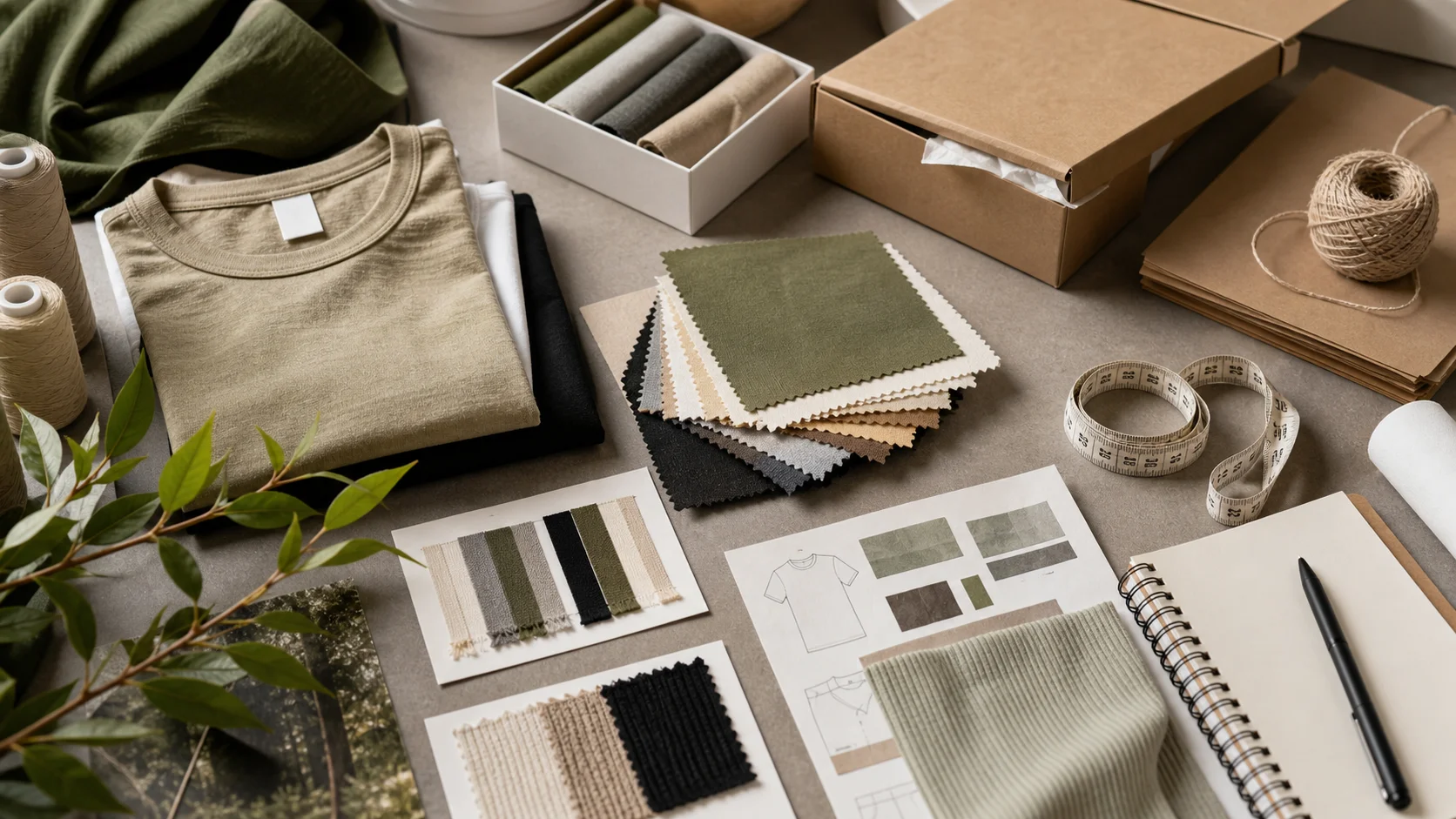
odm apparel manufacturer for fashion brands with checks for samples, fit, MOQ, QC evidence, pricing terms, and delivery risk.
Fast answer: odm apparel manufacturer for fashion brands: What Brands Pay should be judged by production evidence, not by a generic sourcing promise. The buyer needs sample proof, cost breakdowns, QC checkpoints, and delivery buffers in writing.
Ask for recent sample photos, measurement tolerances, fabric or print test assumptions, decoration test notes, packing examples, and a named inspection checkpoint. These details show whether the team can repeat an approved sample at bulk volume.
Separate garment cost, decoration, labels, packaging, sampling, testing, freight, and rush charges. When every cost line is visible, it becomes easier to reduce colorways, adjust size depth, or reserve more time for sampling.
If your launch calendar is breathing down your neck, ODM can feel like a cheat code. Brands using an odm apparel manufacturer for fashion brands often cut product development time from 12-16 weeks to 6-10 weeks. That speed matters when cash is tight, a seasonal drop has a fixed date, or a retailer is already asking for delivery windows you cannot afford to miss.
The reason is simple: the factory is not starting from zero. On factory floors I have visited, strong ODM teams already keep pattern blocks, graded size sets, and fabric libraries ready for common categories like French terry 320 GSM, ribbed jersey, and 120-140 GSM woven shirting. Two or three sampling rounds can disappear before a brand even signs off on a prototype.
Vietnam and China showed me the same lesson from different angles. The fastest teams were not always the cheapest; they were the ones running repeat programs on the same machines, trims, and wash recipes. In Bangladesh, unit economics looked excellent on larger runs, but first-time samples often took 7-12 days longer than the same category in China. Turkey moved quicker for European buyers, especially on small runs of 500-1,500 pieces, because transit could take 2-5 days instead of 20-35 days at sea.
Speed has a trade-off. An odm apparel manufacturer for fashion brands may leave less room for radical design changes, because the factory is working from an existing block instead of building from scratch. I have seen brands accept a wider armhole, a narrower pocket, or a standard neckline because the alternative was missing a drop date by three weeks. Know where to push. Know where to stop.
For smaller labels, the attraction is often cash flow, not romance. A full custom program can tie up $8,000-$25,000 before the first shipment lands, while ODM may start at $2,000-$7,500 in sample and development fees, depending on category and fabric complexity. For a brand testing 300-800 pieces, that gap can make the difference between a launch and a long conversation about what might have been.
ODM means the factory proposes styles, develops samples, and often owns the base design. The brand chooses colorways, trims, branding, and assortment depth. In plain English: you get a head start, not a blank page.
That sits apart from OEM, where the brand supplies the full design package and the factory builds to spec. It also differs from private label, where a brand may simply place its label on an existing product with minimal changes. If you want the middle ground, I would place odm apparel manufacturer for fashion brands services between private label clothing and full cut and sew manufacturing.
A typical ODM package includes pattern library access, fabric sourcing, fit adjustments, trim selection, labeling, packaging, and production. In better factories I have toured, the package also includes size grading across 5-7 sizes, shade band checks, and a pre-production meeting that locks the spec before cutting begins. That meeting can shave 1-2 weeks off the back end.
Ownership is where many brands get burned. If the factory owns the base design or mold, the brand may have usage rights but not exclusivity. Artwork, logos, and prints are usually the brand’s property, while the block, construction details, and sometimes the tech pack adaptation remain with the factory. Put it in writing. If a factory calls a sample “free,” ask what happens when you want to move the design elsewhere next season.
Price point changes everything. Low-cost factories may offer fewer fabric options, fewer custom trims, and minimums that start at 1,000-3,000 pieces. Higher-tier factories may ask for 300-500 more units per color, but they often deliver sharper fit, better consistency across 5,000 pieces, and fewer late-stage surprises. The gap shows up most clearly in women’s knitwear and tailored trousers, where millimeter-level pattern discipline matters.
The real cost of working with an odm apparel manufacturer for fashion brands lives in six buckets: sample development, tech pack adaptation, fabric testing, production, packaging, freight and duties, plus rework. Brands that compare only unit price miss half the bill. I have seen a $4.20 tee turn into a $6.10 landed cost once freight, labels, polybags, and a 4% defect allowance were added.
For a simple knit tee, I usually see these regional bands: China at $2.40-$4.80 FOB on 500-2,000 pieces, Vietnam at $2.60-$5.00, Bangladesh at $1.70-$3.60, and Turkey at $3.80-$7.20. A woven shirt often sits at $5.50-$11.50 in China, $5.80-$11.00 in Vietnam, $4.20-$8.50 in Bangladesh, and $7.50-$14.00 in Turkey. Outerwear is a different animal. Lightweight jackets can start at $11-$18 in Bangladesh and climb to $18-$35 in Turkey or China depending on padding, seam sealing, and wash complexity.
Sample fees usually run $50-$250 per style, though special fabrics or custom trims can push them higher fast. Development fees for adapting an existing block may land at $300-$1,500. Fabric testing for colorfastness, shrinkage, and pilling can add $150-$600 per round. If you need compliance lab work aligned with OEKO-TEX benchmarks, build in an extra 5-10 business days.
Here is the part nobody likes to hear: the highest quote is not always the most expensive order. I have visited factories that charged 8%-12% more per unit but kept defect rates below 1.5%, while cheaper suppliers ran 4%-7% defects and missed ship windows by 2-3 weeks. On a 2,000-piece order, that delay can vaporize margin faster than a slightly higher FOB ever will.
For technical categories like bras, compression tops, and complex bodies, I push brands to compare against specialized programs such as custom bra manufacturing. A bra factory may price higher on labor and still save money on fit corrections, because one bad cup block can wreck sell-through across three sizes.
Glossy brochures mean almost nothing. I have seen polished sales decks from factories that could not hold a 10-day lead time, and modest offices with production records cleaner than a clinic. Capacity, lead times, QA process, compliance certificates, and references from brands that look like yours — those are the non-negotiables.
Ask to see the sample room. Then ask for the inline inspection sheets, fabric testing logs, and final audit records from the last 3 months. If a factory says it “does quality control,” that tells you nothing. If it can show a defect matrix by style, size, and operator line, you are talking to a real operator. According to WTO trade data, apparel supply chains are still highly regionalized, which makes process discipline more valuable than ever because switching suppliers mid-season is expensive and slow.
Do not lean on photos or trade-show promises. Many factories outsource cutting, washing, embroidery, or even packing. That is not automatically bad, but you need disclosure. Last year I worked with a brand that assumed a factory’s embroidery was in-house. It was subcontracted 45 minutes away, and one late thread delivery pushed the shipment by 11 days.
Here is the checklist I use on first calls:
Ask for references from similar brands by category and price point. A factory that makes 50,000 polyester uniforms is not necessarily strong at 800-piece washed jersey drops. If your business sits in a niche category, compare the partner’s experience with the specification intensity of cut and sew manufacturing; the closer the match, the less likely you are to pay for trial and error.
China still wins on breadth and speed. Need knitwear, outerwear, accessories, and trims from one sourcing hub? China can often compress development into 6-8 weeks and keep repeat orders moving with 2-4 week production windows on familiar styles. The trade-off is rising labor costs and, sometimes, higher minimums, especially for custom fabrics.
Vietnam tends to be strong on stable quality in basics, activewear, and cleanly executed woven apparel. I have seen better consistency on repeat programs there than in many lower-cost markets, especially where stitching tolerances matter. A lead time of 8-12 weeks is common for first orders, with more predictable second runs once fabric approvals are settled.
Bangladesh remains highly competitive on labor for large runs. On orders above 5,000 pieces, the per-unit savings can be meaningful, sometimes 15%-25% below China on simple knits. Yet fabric sourcing can be slower if you need niche textiles, and smaller brands may struggle with minimums that are too high for test orders. Shipping matters too. A 35-day ocean route to the US can erase some savings if the brand needs inventory faster.
Turkey is the shortest runway into Europe. For brands selling into the UK, Germany, France, or the Nordics, transit can be 2-5 days by truck or short sea leg, which changes cash flow. I have seen Turkish factories outperform higher-volume Asian factories on tailored trousers, structured dresses, and smaller flexible batches of 300-1,000 units because they can pivot quickly when fit issues appear.
Data from Trade.gov shows how tariff exposure and shipping lanes shape landed cost more than FOB alone. My rule is simple: choose China for breadth and speed, Vietnam for dependable repeat quality, Bangladesh for lower labor on volume, and Turkey for shorter lead times to Europe and more agile small-batch replenishment. If your launch is first-season and margin is thin, optimize for lower development risk. If your reorder forecast is strong, prioritize the region that can repeat the same garment with the fewest surprises.
For many brands, the right odm apparel manufacturer for fashion brands is the one whose regional strengths match the product category, MOQ, and market destination. A supplier in China may be ideal for broad custom development, while a factory in Turkey may be better for wholesale and bulk replenishment into Europe.
Weak specs cost more than people admit. The most expensive mistakes I have seen started with vague color standards, loose grading rules, skipped wash tests, or a buyer approving a sample after one fitting instead of two. A shade tolerance of 0.5-1.0 delta E matters if you are matching body fabric and rib; “close enough” is how you end up with cartons that look mismatched under store lighting.
Brands rush approvals too. A pre-production sample that looks acceptable on a desktop screen can fail after enzyme wash or stone wash. I have watched jeans shrink 4%-6% in length because nobody asked for a wash test on the second sample. That mistake adds rework, delay, and sometimes a brand-new cutting ticket.
A small defect rate can wipe out margin on a low-priced item. If you sell a tee at $18 retail and your gross margin target is 60%, a 5% return rate plus replacement freight can erase 8%-12% of profit on that SKU. On a 3,000-piece run, that is not a rounding error. That is the difference between reinvesting and markdowns.
There is a sustainability penalty too. Overproduction and unsold stock usually start with weak forecasting and poor communication, not just factory waste. A brand that orders 2,500 units because the minimum looked manageable may still sit on 800 units if the fit is off or the color story misses. Then the stock becomes a discount problem, a storage problem, and sometimes a disposal problem.
Brands trying to build categories like lingerie or performance base layers should align specs with specialist partners rather than generalists. Programs connected to private label clothing can work for basics, but fit-critical categories often need tighter iteration cycles and more detailed testing than a casual buyer expects.
Give yourself 30 days. Week one: define the product, target retail price, and acceptable margin. Week two: gather 5-8 visual references, fabric swatches, and competitor benchmarks. Week three: send one RFQ to each shortlisted factory with the same questions. Week four: review samples, compare terms, and verify compliance documents before you move past the first round.
A fair RFQ should ask every factory the same questions: MOQ by color, sample cost, sample lead time, bulk lead time, defect rate target, payment terms, and whether the factory owns the base design. Include your target retail price, preferred fabrics, size range, packaging needs, QC expectations, and delivery target. If you want faster replies, attach a mood board, a measurement chart, and 2-3 reference garments with photos of the inside seams.
Then compare apples to apples. A factory quoting $3.20 may look cheaper than one quoting $4.10, but if the first requires 2,000 units, 14 weeks, and a 50% deposit while the second accepts 600 units, 8 weeks, and a lower rework risk, the cheaper quote is not really cheaper.
My workflow is blunt. Shortlist 3 factories. Sample 2. Negotiate 1. Keep 1 backup supplier for the second season, especially if your launch depends on a 6-10 week calendar. If you need to move quickly, you can get a free quote early, before you lock the season’s colors and fabric weights.
If you are comparing an odm apparel manufacturer for fashion brands against a factory partner for wholesale or bulk production, ask for landed-cost estimates, MOQ by style, and production timelines in writing before you commit. The best partner is the one who can hit the date, hold the fit, and leave you enough margin to do it again.
An ODM partner usually provides base styles, pattern development, sample making, fabric sourcing, trim selection, labeling, packaging, and bulk production. In many cases, the factory already owns the block or construction formula, which can shorten development by 2-6 weeks.
Sample fees often run $50-$250 per style, while development can add $300-$1,500 depending on complexity. For bulk production, a simple tee may land around $1.70-$5.00 FOB by region, while outerwear can range from $11-$35 or more.
First samples usually take 7-21 days, depending on fabric availability, trim sourcing, and factory workload. If the factory is adapting an existing block and using in-stock materials, I have seen samples arrive in 5-10 days.
Yes, but minimums vary widely. Smaller ODM factories may accept 300-500 pieces per style, while larger programs often start at 1,000-3,000 pieces. Smaller orders usually cost more per unit because setup and cutting expenses are spread over fewer garments.
Ask about MOQ, sample turnaround, lead time, defect rate, payment terms, compliance certificates, and ownership of the base design. Also request references from brands in your category, because a manufacturer strong in uniforms may not be strong in fashion knits or tailored pieces.