
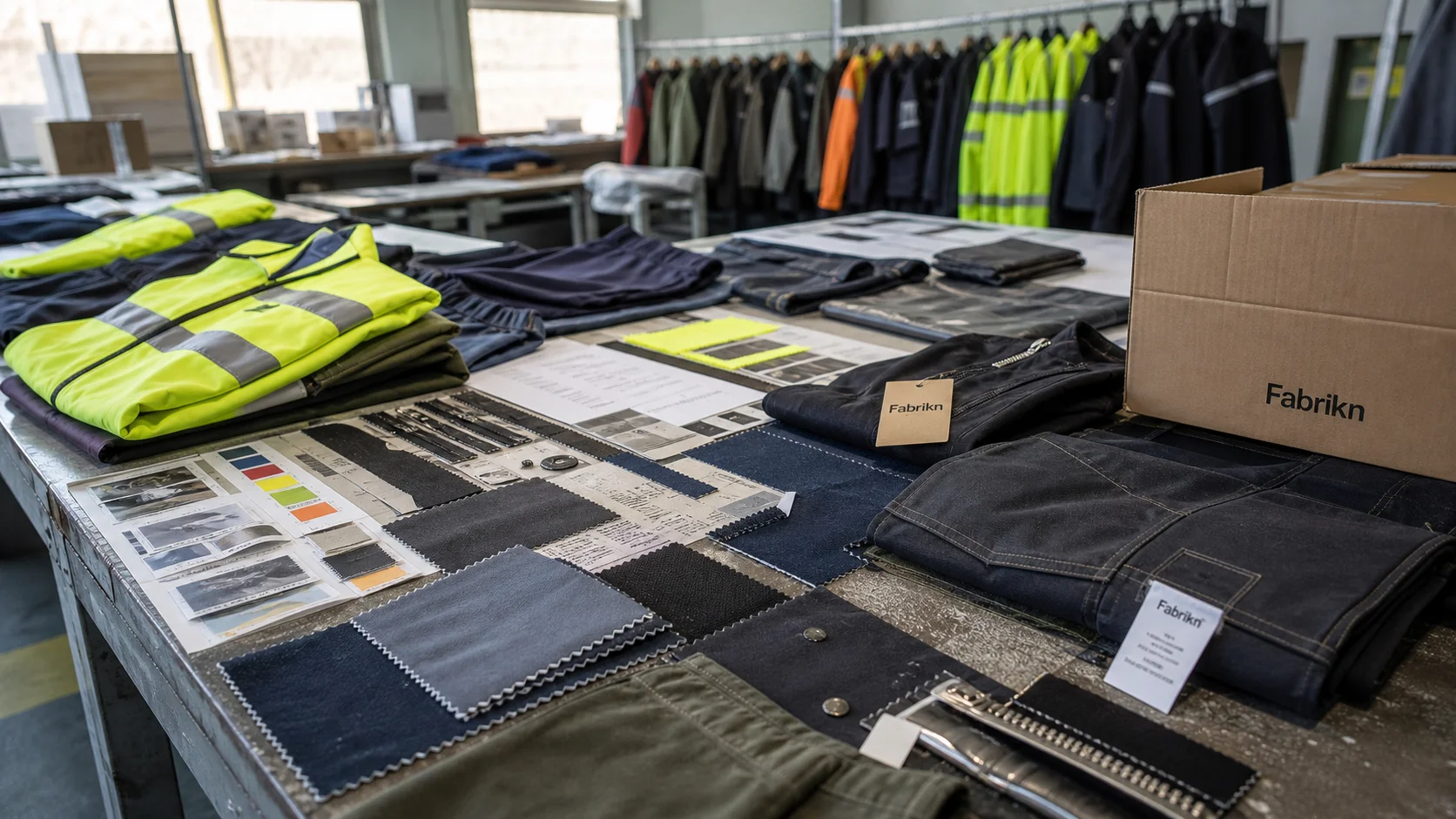
A focused outline for industrial retailers evaluating OEM workwear coats with compliance testing, covering certification workflows, material specs, factory QA artifacts, and private label launch requirements.
OEM Workwear Coats With Compliance Testing - Fabrikn production reference
OEM workwear coats with compliance testing are a serious sourcing category for industrial retailers. Buyers in this segment are not simply selecting outerwear by color, fit, and price. They are balancing worker protection, repeat-order consistency, shelf performance, and documentation requirements that can affect sell-through as well as legal exposure.
In practical terms, a compliant workwear coat program usually means the product has been developed against a clearly defined performance brief. That brief may include abrasion resistance, seam strength, colorfastness, dimensional stability, water resistance, visibility requirements, chemical restrictions, and labeling accuracy. The exact package changes by market and end use, but the purchasing principle stays the same: the coat specification needs to be fixed before bulk production starts, not negotiated after goods are packed.
For industrial retailers building a private label line, OEM manufacturing can be the right route when they need custom branding, controlled material choices, and repeatable construction standards. It also gives buyers more responsibility. Once a retailer places its own label in the garment, it takes ownership of product claims, specification discipline, and test-report traceability.
That is why compliance testing should be treated as part of product development, not a last-minute admin step. A supplier that understands workwear can support fabric booking, trim matching, pre-production approvals, and inspection checkpoints, but the retailer still needs to define the commercial tradeoffs. Lower pricing can be achieved by reducing fabric weight, simplifying pocket construction, or switching closures. Those changes may also affect durability or test outcomes.
Retailers comparing private label workwear options can also review broader production support through Fabrikn’s services and align that with their sourcing model before finalizing a vendor shortlist.
Industrial retail is different from fashion wholesale. End users often buy workwear coats for utility first and appearance second. A coat may need to handle warehouse abrasion, outdoor weather exposure, mechanical movement, frequent laundering, and long wear cycles. If the product fails in the field, the retailer usually absorbs the reputational cost quickly.
OEM production gives retailers several commercial advantages:
The tradeoff is that OEM is less forgiving than buying generic stock. Buyers need to manage a real product development path. That includes a tech pack, graded size chart, approved fabric standard, trim card, artwork, testing plan, labeling language, and packaging details. If one of those pieces remains vague, production risk rises.
Industrial retailers should also think about assortment strategy. A heavy-duty canvas coat for cold weather and a lighter shell coat for transitional conditions may belong in the same brand family, but not under the same specification logic. One style may prioritize tear strength and insulation retention, while another prioritizes water resistance and movement. Good OEM sourcing separates these requirements early.
Retailers that are still qualifying manufacturing partners often benefit from reviewing a supplier’s background, product categories, and communication style before discussing quotations. A useful starting point is the company profile page at /about-us/.
Compliance testing in workwear coats can mean different things depending on the destination market, product claims, and user environment. Buyers should avoid using the term as a vague marketing label. It needs to be translated into a testing matrix tied to the exact garment.
Typical compliance and performance checkpoints may include:
Some workwear coats also require more specialized testing depending on the specification. Flame resistance, antistatic properties, chemical splash considerations, and visibility standards are not interchangeable. Buyers should not assume that a generic workwear factory can meet every protective category without a clear development and certification path.
Purchasing judgment: if a supplier says a coat is “testable” but cannot confirm the exact test method, sample source, or bill of materials tied to that test, treat the claim as incomplete.
A practical approach is to break testing into three layers. First, material-level testing on shell fabric, lining, padding, or reflective components. Second, garment-level testing after construction. Third, shipment-level verification through inline and final inspections, with document matching to the approved version. This structure reduces the common problem of a fabric passing in isolation while the finished coat fails because of seam construction, trim substitution, or finishing changes.
Retailers should also clarify whether testing will be done on development samples, pre-production samples, or bulk production pull samples. The strongest control point is usually a combination of all three when the program is large enough to justify the cost.
A disciplined OEM process matters more in workwear than in many casual categories because performance claims and durability expectations are higher. The most reliable development path usually follows a structured sequence.
The retailer should define where and how the coat will be used. Indoor logistics, roadside utility, cold-storage handling, and general construction environments create different product demands. Without this step, factories tend to quote against a vague reference image rather than a usable technical standard.
The tech pack should include construction details, measurements, point of measure tolerances, stitch classes where necessary, artwork placement, label language, and packaging instructions. Fabric specs should note composition, weight, weave or knit type, finish, backing or coating if used, and target performance levels.
The first prototype checks silhouette, construction feasibility, and major material assumptions. This is not the stage to approve bulk quality. It is the stage to catch issues like poor collar shape, weak cuff construction, awkward pocket placement, or incompatible trim selection.
Workwear sizing often needs more ease than lifestyle outerwear. Buyers should review arm mobility, layering allowance, sleeve length, back reach, and pocket accessibility while worn over likely base layers. A coat that looks clean on a mannequin can still fail in actual work use.
This sample should be made with bulk-intended materials, approved branding, and final construction methods as closely as possible. Many testing decisions should be tied to this stage. If fabric or trims remain provisional, the sample loses value as a control point.
Before production starts, buyers should lock the bill of materials, labeling, packaging, carton ratio, inspection criteria, and test plan. Delays here often push lead times more than sewing itself.
For industrial retailers, sample approval discipline is often the difference between a repeatable program and a constant claims problem. One weak approval can carry through thousands of units.
In OEM workwear coats, compliance outcomes are heavily shaped by the physical specification. Retail buyers sometimes focus on shell fabric alone, but trims and construction details can create test failures just as easily.
Common options include cotton canvas, polyester-cotton twill, oxford polyester, ripstop blends, and coated woven fabrics. Typical weights for workwear coats can range from around 220 GSM for lighter utility outerwear to 360 GSM or more for rugged cold-weather shells. There is no single correct weight. The right choice depends on climate, abrasion exposure, and price target.
Heavier fabric can improve perceived durability, but it raises cost, affects mobility, and may extend drying and finishing time. Coated or laminated fabrics may improve weather resistance, but they can complicate seam performance, breathability, and care requirements.
Quilted polyester lining, fleece lining, sherpa-style lining, or padded constructions are common. Retailers should confirm fill weight, quilting method, needle impact on coated shells, and laundering behavior. Insulation migration and lining tearing are frequent field complaints when specs are too lean.
Needle choice, seam type, bartack reinforcement, topstitch density, and seam sealing method all affect performance. Double-needle seams may help in stress zones, but they also add labor cost. Reinforced elbows, action backs, storm flaps, and concealed closure plackets can improve function, but each added feature influences MOQ flexibility and sewing time.
Direct purchasing judgment matters here. A coat can be overbuilt for the selling price. If the retail channel is value-driven, it may be smarter to prioritize the three or four features that customers actually use rather than loading the garment with expensive details that create production variability.
MOQ for OEM workwear coats depends on material complexity, color count, and customization level. In many private label programs, buyers can expect approximate MOQ ranges such as:
Program Type Typical MOQ Range Notes Basic stock-material adaptation 300 to 500 pcs per style Usually easier if colors and fabrics are available from mill stock Custom fabric or branded trim program 800 to 1,500 pcs per style MOQ rises when mills require custom dyeing, finishing, or special components Multi-size, multi-color industrial range 1,500 pcs and above Helps balance carton ratios and material booking efficiencyThese are working estimates, not fixed rules. Some suppliers can be flexible on cut-and-sew MOQ if they can combine fabric usage across programs. Others will hold firm because outerwear consumes more capital and production space than basic knitwear.
Sampling usually moves through three checkpoints: prototype, fit or sales sample, and pre-production sample. If testing is involved, one more revision round is common. Retailers should budget enough time for comments and rework. Rushed approvals are one of the main reasons bulk output drifts away from intent.
Lead times also depend on inputs, not just factory sewing capacity. A realistic outerwear calendar may be shaped by:
For many OEM workwear coat orders, bulk lead times often land in the range of 60 to 120 days after final approvals, with shorter timelines possible for simpler programs using stock materials. That range can expand quickly if the order needs custom finishing, specialized testing, or multiple sample corrections.
When timelines are tight, the best question is not “Can you ship faster?” It is “Which dependency is driving the schedule?” That answer tells the buyer whether the delay sits in fabric, trims, testing, approvals, or line allocation.
Workwear coats carry several recurring risk points that industrial retailers should monitor during inline and final inspection.
Inspection should not be reduced to appearance alone. A clean-looking coat can still fail on critical points such as label accuracy, seam security, or closure function. For industrial retail, document control matters as much as visual quality. The approved sample, packing list, purchase order, test report references, and carton markings all need to match.
Tradeoff to keep in mind: tightening tolerance standards improves consistency, but it can also increase rejection rates and slow output. Buyers should apply strict controls to the measurements and functions that truly affect wear and compliance, rather than over-policing minor cosmetic points with low commercial impact.
A balanced inspection plan usually includes inline review during early sewing, mid-line checks for recurring defects, and final random inspection before shipment. This catches repeat issues earlier, when correction is still possible.
Industrial retailers should source OEM workwear coat suppliers with a commercial lens, not just a catalog lens. The right factory for fashion puffers may not be the right one for utility coats with compliance obligations.
Start with the supplier’s ability to handle technical communication. Can they review a full tech pack, comment on feasibility, and identify risk areas before sampling? That matters more than a quick price quote. A cheap quote based on incomplete specs often becomes an expensive order later.
Key questions worth asking include:
Buyers should also check whether the supplier understands the destination market’s labeling and claim requirements. A technically acceptable coat can still become a retail problem if hangtags, fiber declarations, warning labels, or care content are wrong.
It is often wise to begin with one controlled style rather than launching a full range immediately. A focused first order helps retailers judge communication speed, sample accuracy, test-report reliability, and bulk consistency before extending the product line.
If you are planning a private label program and want to discuss specification support, sourcing flow, or development requirements, the most direct next step is through /contact-us/.
OEM workwear coats with compliance testing can be a strong category for industrial retailers, but only when the product is managed as a technical garment rather than a generic promotional jacket. The most successful programs are built on clear end-use definitions, tight material specifications, realistic MOQ planning, staged sample approvals, and a testing matrix that matches actual product claims.
Price still matters. It always does in industrial retail. Yet the lowest offer is rarely the best buying decision if it introduces uncertainty around fabric performance, trim durability, labeling accuracy, or repeat-order consistency. A better sourcing decision usually comes from understanding where cost is being saved and whether that saving weakens the garment in a way the end customer will notice.
For private label apparel buyers, the strongest approach is practical and disciplined: define the coat properly, approve samples carefully, test what the garment claims to do, and inspect bulk against the approved standard. That is how OEM workwear sourcing becomes commercially reliable rather than reactive.
Get a free quote from Fabrikn — your trusted B2B clothing manufacturer with 10+ years of experience. MOQ as low as 200 pieces.
Get a Free Quote →OEM usually refers to manufacturing based on the retailer’s own brand and product specification. In workwear coats, that can include custom fabrics, branded trims, labeling, measurements, packaging, and performance requirements.
Not every coat needs the same level of testing, but most industrial retail programs should include baseline checks such as fiber content, colorfastness, dimensional stability, and labeling accuracy. If the garment carries claims around visibility, weather protection, flame resistance, or other protective features, testing requirements become more specific.
A common starting range is around 300 to 500 pieces per style for simpler programs using available materials. Custom fabrics, branded components, and multiple colorways often push MOQ closer to 800 to 1,500 pieces or more.
After final approvals, many programs run about 60 to 120 days, depending on fabric lead time, trim sourcing, testing, sample revisions, and production-line capacity. Custom outerwear with complex materials can take longer.
Most programs include a prototype, fit or revised sample, and a pre-production sample. For compliance-sensitive garments, buyers often add testing checkpoints during development and may require confirmation on bulk production samples as well.
Common problems include size inconsistency, weak closures, shade variation, poor padding distribution, incorrect label content, and missed reinforcement at stress points. These issues are easier to control when the approved sample and inspection criteria are documented clearly before bulk starts.