
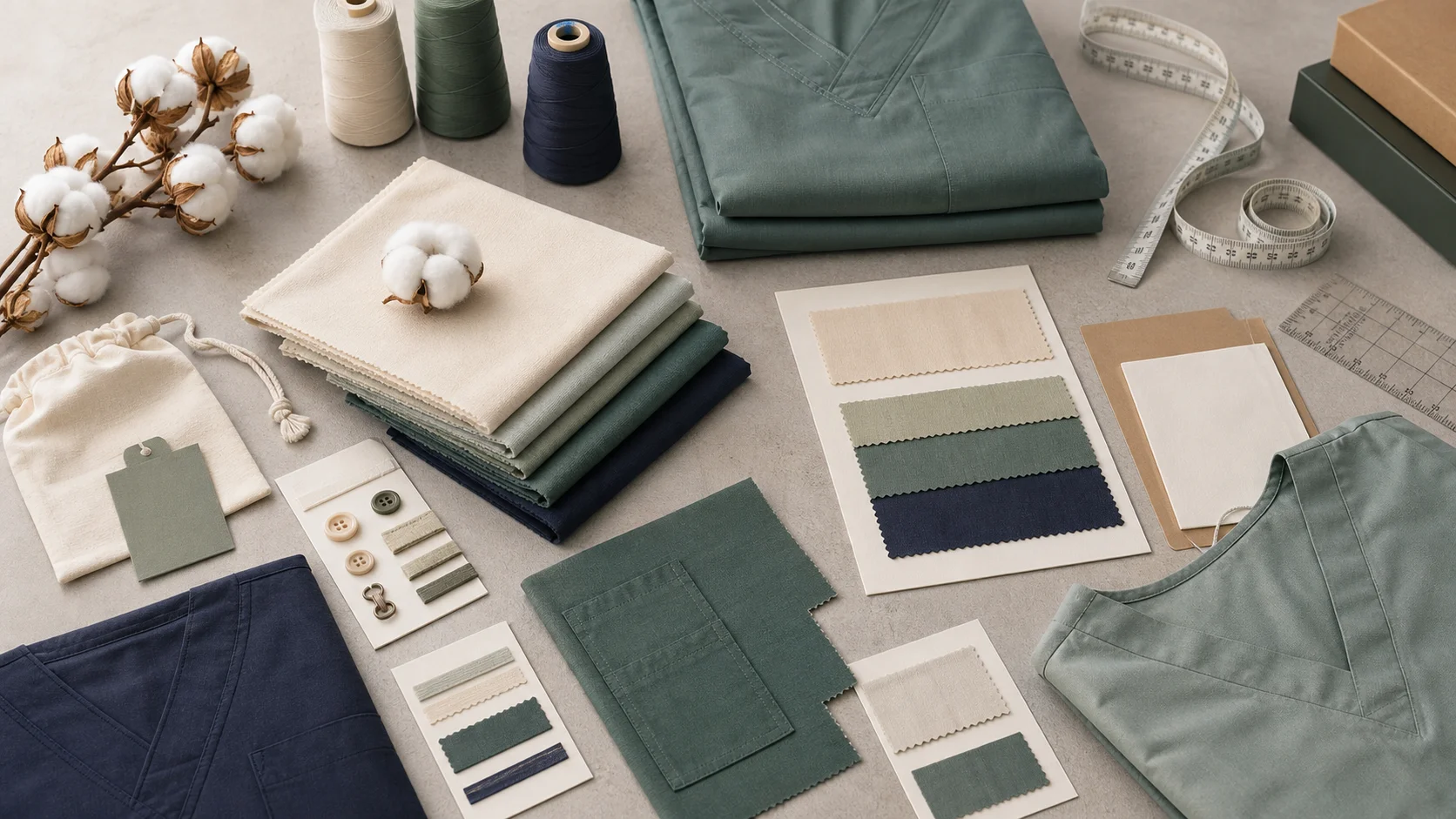
Clothing Packaging Supplier China Selection with checks for samples, fit, MOQ, QC evidence, pricing terms, and delivery risk.
Fast answer: Clothing Packaging Supplier China Selection: Samples, MOQ, QC, and Lead Time should be judged by production evidence, not by a generic sourcing promise. The buyer needs sample proof, cost breakdowns, QC checkpoints, and delivery buffers in writing.
Ask for recent sample photos, measurement tolerances, fabric or print test assumptions, decoration test notes, packing examples, and a named inspection checkpoint. These details show whether the team can repeat an approved sample at bulk volume.
Separate garment cost, decoration, labels, packaging, sampling, testing, freight, and rush charges. When every cost line is visible, it becomes easier to reduce colorways, adjust size depth, or reserve more time for sampling.
I’ve walked through more than 200 factories across 8 countries, and the same truth keeps tapping me on the shoulder: the cheapest packaging quote is usually the one with the most expensive surprises. If you are figuring out how to choose clothing packaging supplier china, start by assuming the invoice is only the opening bid. In Guangdong, Zhejiang, and Jiangsu, my notes show MOQ ranges from 500 to 5,000 units, defect rates from 1.5% to 7%, and lead times from 7 days to 28 days depending on how prepared the buyer was.
One coastal box plant quoted $0.18 per mailer box for 10,000 units, then added $85 in plate fees, a $120 sampling charge, and a 14-day revision cycle. An inland supplier quoted $0.24 per unit with sampling included, faster artwork checks, and a lower freight-claim rate because the packs were better. That difference matters. A 2-cent saving on unit price can vanish into $400 in rework, $260 in extra freight, and three missed launch dates.
Coastal hubs such as Guangdong and Zhejiang usually bring stronger export readiness, denser print ecosystems, and better access to coated board, lamination film, and barcode testing. Inland factories, especially in Henan or Sichuan, often compete on labor cost and low base pricing, but I’ve seen slower sample feedback and weaker English-language documentation. Not bad. Just different. If your brand runs on seasonal timing, proximity to ports, paper mills, and packaging subcontractors can matter more than a $0.03 quote gap.
The counterintuitive bit from my visits: mid-priced suppliers often beat premium agents on print consistency. A factory charging $0.28 for a rigid drawer box may run tighter registration than a trading company charging $0.36, because the factory controls the presses, not three layers of middlemen. I saw this repeatedly in Hangzhou and Dongguan, where a modest-sized workshop held Pantone Delta E within 1.5–2.0 while pricier intermediaries drifted beyond 3.5. That is visible on shelf.
My buying framework is simple. Compare unit price against setup fees, freight risk, and revision speed. Judge the factory’s actual capability, not its sales pitch. Choose the supplier that can hold quality when the order scales from 1,000 to 20,000 pieces. The next sections break that down into material, compliance, cost, and QC signals you can verify before you wire a deposit.
Clothing packaging looks simple until a box arrives with cracked folds, smudged logos, or a tissue insert that tears at the first pull. I’ve inspected mailer boxes, hangtags, tissue paper, garment bags, polybags, labels, and folded inserts in factories from Shenzhen to Ningbo, and the spec sheet always tells me more than the sales deck. If you are working on how to choose clothing packaging supplier china, ask for material numbers before you approve a single sample.
For paper packaging, request GSM, caliper thickness, coating type, recycled content, and FSC claims. A rigid box might use 1200–1500 GSM greyboard wrapped in 157 GSM art paper, while a mailer box may run on 250–400 GSM corrugated board. For tissue, I look for 17–22 GSM, plus tear resistance. For soft-touch laminates, check whether the supplier uses water-based adhesive or solvent-heavy film, because odor and scratch resistance differ sharply after 48 hours in transit. If the product touches skin or children’s goods, ask for food-contact-style safety language and migration testing where relevant.
Print performance deserves its own checklist. I ask for Pantone matching against a physical chip, barcode legibility scans, scuff resistance, and fold-crack tests after 10–15 open-close cycles. Ink adhesion is not an abstract issue. A black logo on coated kraft can look perfect on day one, then flake after tape removal or show color drift under warehouse light. In one factory visit, a $0.22 hangtag from a budget printer lost 12% ink coverage after abrasion testing, while a $0.31 tag from a smaller shop held at 98% coverage.
Budget suppliers often cut corners in places shoppers notice immediately: uneven die cuts, weak glue lines, cloudy lamination, or polybags that split at the seam. That drives returns, even for apparel brands with otherwise strong product quality. I worked with a brand that saw a 4.8% packaging rejection rate after switching to a low-cost vendor; the return rate fell to 1.1% after they moved to thicker board and better ink control. The box did not sell the garment, but it changed how customers judged the brand.
Before sampling, send a QC checklist with five basics: material spec, exact dimensions, color target, print method, and drop-test expectation. If you also buy through custom clothing packaging solutions for apparel brands, make sure the supplier matches the packaging format to the garment weight, not just the artwork. A 320 GSM French terry hoodie needs very different protection from a 90 GSM tee.
The thing nobody tells you: a cleaner sample from a mid-tier factory is often a better sign than a glossy presentation from a sales agent. One tells you who controls production. The other tells you who controls PowerPoint.
Compliance is not paperwork theater. I’ve seen brands lose 2–6 weeks to customs holds because the box supplier had a valid certificate, but the certificate name did not match the production factory. Preventable. Start with identity checks. Before you trust any supplier, ask for the business license, export history, and a recent audit report with the exact factory name, address, and issue date. If those three do not align, stop.
Which certifications matter depends on what you are shipping. For paper-based packaging, FSC is useful if you need responsible fiber claims. For recycled content, GRS or a chain-of-custody document may matter. For chemical safety, OEKO-TEX or REACH-related declarations can be relevant when packaging includes textile components such as garment bags or fabric wraps. For social compliance, BSCI or SMETA reports help, but I read them for audit findings, not the logo on page one. For official guidance on imports and supplier diligence, the U.S. International Trade Administration is a useful reference, while OEKO-TEX certification standards and Textile Exchange sustainability standards help benchmark material claims.
I also check the scope. A supplier may hold FSC, but only for printing paper, not the full packaging line. Another may show an ISO 9001 certificate from 2020, yet its current factory moved in 2023 and never updated the address. That matters. I have watched buyers accept certificate photos on WeChat and then discover the audit applied to a different workshop 40 kilometers away. Compliance risk is not only about fines. It can trigger reprints, delayed shipments, and retailer chargebacks.
For categories with tighter rules, the bar is higher. Babywear packaging, for example, may need stricter material declarations and better traceability, especially if inner wraps or labels sit close to skin-contact products. That is one reason brands that also source through custom baby clothing manufacturing tend to build stronger documentation habits earlier. The same discipline applies to private label collections, where packaging claims sit next to brand reputation, not just unit cost. If your own range uses private label clothing services, ask the packaging supplier how it handles carton traceability, batch coding, and ink safety from batch to batch.
In export work, weak compliance slows everything. A missing declaration can hold a shipment for 5–12 days. A mismatched invoice can delay duty clearance. A poor audit record can kill a retailer onboarding before the first PO lands. I would rather pay $0.04 more per unit to a factory that answers documentation questions cleanly than gamble on an immaculate sample and a messy file.
Quote comparison is where good buyers save real money. A supplier may offer a mailer box at $0.19, but the true landed cost can climb past $0.34 once you add tooling, plates, sampling, inland trucking, ocean freight, duties, and warehouse handling. I build every comparison around six lines: ex-works price, setup fees, sample cost, domestic freight, international freight, and landed storage. If a quote leaves out even one, it is not complete.
MOQ changes the arithmetic fast. At 500 pieces, a box might cost $0.42 because the printer spreads setup across a tiny run. At 5,000 pieces, the same spec may fall to $0.21. For hangtags, I’ve seen 1,000-unit orders at $0.09 and 10,000-unit orders at $0.03. That is why small-batch brands should expect a premium. The mistake is not paying more per unit. The mistake is believing a 500-unit order should price like a 20,000-unit run.
Speed-first suppliers usually compress the timeline by running existing board stocks and standard dies. They can move from artwork approval to shipment in 7–12 days for simple items and 15–20 days for more complex packs. Lower-MOQ factories may take 18–30 days because they need to queue custom plates, source specific coatings, or wait for print slots. Neither is wrong. The right choice depends on whether you need launch inventory now or margin later.
Hidden fees are common. I have seen color-change charges of $45 per revised plate, late-stage lamination upgrades billed at 8%–12% extra, and “urgent handling” fees added after the buyer already approved the proof. A strong quote matrix should force every supplier to price the same spec: same GSM, same finish, same ink count, same pack method. If one quotes 2,000 units and another quotes 5,000, the comparison is fake.
For complex product lines that include sewn garments and packaging together, it helps to separate packaging from production planning. If your supplier also handles cut and sew manufacturing, ask whether the packaging schedule is tied to fabric cut dates or to finished goods inspection. That distinction can save 4–7 days on a release schedule.
My decision rule is straightforward. Choose premium when brand presentation and retail handling matter. Choose budget only when the pack is disposable and the risk of reprint is low. Choose speed-first when launch timing beats margin by a wide margin. For most apparel brands, the best value sits in the middle: clean print, honest lead time, and no surprise fees.
Fast replies are useful, but speed alone is a vanity metric. I judge suppliers by whether they answer with numbers, not adjectives. A good rep will tell me tolerance is ±1.5 mm, color drift target is Delta E under 2.0, and sample turnaround is 3–5 days. A weak rep says “no problem” to everything, then sends a sample that misses the brief by 8 mm. If you want to know how to choose clothing packaging supplier china, test the sales person, the merchandiser, and the QC contact separately.
Sample rounds should prove different things. First sample: structure, dimensions, finish. Golden sample: the benchmark you sign off. Pre-production sample: the factory running the job for real, not just mocking it up. I ask for two things every time — a photo of the production line setup and a signed sample sheet listing material, ink, coating, and carton count. Without that, you are guessing.
The clearest warning sign I see is inconsistency across departments. If sales says one thing, QC says another, and the sample arrives in a third color, the factory is not controlled well enough for scale.
Watch for evasive tolerance claims. If nobody will commit to a measurement range, or the plant refuses to discuss scuff or fold-crack tests, that is a red flag. So is a sample that matches the artwork only under one light source. I always check natural light, warehouse light, and a phone flash. Color should hold across all three, especially on white-on-black or dark matte finishes.
My QC gate is simple. Approve structure, then approve print, then approve pack-out. Never mix those stages. Once a supplier passes those gates, the chance of a painful mass-production surprise drops sharply. That discipline is worth more than a fluent salesperson and a polished PDF.
Shortlisting is where many buyers get lazy. They collect 10 quotes, smile at the prettiest one, and forget to compare pack sheets line by line. I do the opposite. I ask each supplier for a pack sheet, a quote matrix, a material spec sheet, and proof of recent production. The goal is to reduce each option to the same variables: price, MOQ, lead time, materials, and defect risk.
My sequence is always the same. First, send one spec sheet to 3–5 suppliers. Second, request photos of recent orders with similar GSM, finish, and print complexity. Third, inspect the sample against the quote, not against the sales pitch. Fourth, verify the business license and audit evidence. Fifth, if the supplier still looks strong, run a small pilot order. That pilot should usually be 500–2,000 units, depending on whether you are buying hangtags, mailer boxes, or more complex garment bags.
The pilot is not a formality. It is a controlled stress test. I tell brands to log every issue: corner crush, barcode failure, glue seepage, misfolding, and shade variation. Take photos. Keep batch numbers. Ask for reprint terms in writing before the PO goes out. A supplier willing to fix a 2% defect rate quickly is worth more than one who promises perfection and then blames shipping.
At this stage, ordering discipline matters as much as factory skill. If the packaging is for a broader product launch, coordinate it with the garment calendar so labels, inserts, and outer packs land together. That is especially useful for brands scaling across categories, because one packaging mistake can stall a whole season. My rule: buy small, test hard, then scale only after the pilot proves the numbers hold.
If you follow that sequence, you reduce risk without freezing your launch. The reward is simple: fewer reprints, fewer customs delays, and fewer boxes that embarrass the product inside them.
The first mistake is agent dependency. Trading agents can be useful, but too many buyers let the agent own the relationship, the technical brief, and the blame when something goes wrong. That blurs responsibility. I’ve seen 6-week delays blamed on “the factory” when the real issue was a missed artwork revision buried in an agent’s inbox. The second mistake is price-only sourcing. A cheaper quote can create more waste, more rework, and higher freight because damaged packs need replacement shipments.
The third mistake is trusting sustainability claims without proof. “Recycled,” “biodegradable,” and “compostable” all sound virtuous, yet I’ve seen boxes labeled recycled that used only 10%–15% post-consumer content, or compostable film that had no valid testing basis. Ask for documentation, not adjectives. Check whether the claim applies to the full pack or only one layer. A premium-looking matte laminate can also block recyclability, even if the board underneath is FSC-certified.
Finally, some packaging looks premium but fails in handling. Soft-touch boxes can scuff in transit. Thin polybags can split on warehouse shelves. Heavy rigid packs can inflate freight by 18%–25% and still arrive dented if corner protection is weak. Cheap is rarely cheap once returns, replacements, and freight are counted. The supplier with the lowest quote is usually not the one with the lowest risk.
Start with a supplier that accepts 500–2,000 units and gives a written quote matrix. Check material specs, sample turnaround of 3–7 days, and whether the factory can hold Delta E under 2.0 on print. Small brands should prioritize clarity and revision speed over the lowest unit price.
Simple hangtags can run $0.03–$0.09 each, while mailer boxes often land around $0.18–$0.42 depending on MOQ, finish, and freight. Add $45–$150 for plates or tooling when relevant, plus sampling and domestic freight. The final landed cost can be 20%–60% higher than the factory quote.
Sampling usually takes 3–10 days, depending on complexity and revision rounds. Production can take 7–12 days for simple stock-based packs and 15–30 days for custom printed items. If artwork changes after sampling, expect another 3–5 days.
Ask for the business license, export record, audit report, and certificates with matching factory names and current dates. FSC, GRS, BSCI, ISO, and chemical declarations matter only if they cover the exact product and site. Verify scope before you place a deposit.
Yes, but only if the factory has documented capability in both areas. Bundling can save 4–7 days in coordination, yet it also increases dependency if one line slips. Ask whether packaging schedules are separate from garment cut dates, especially for larger launches.