
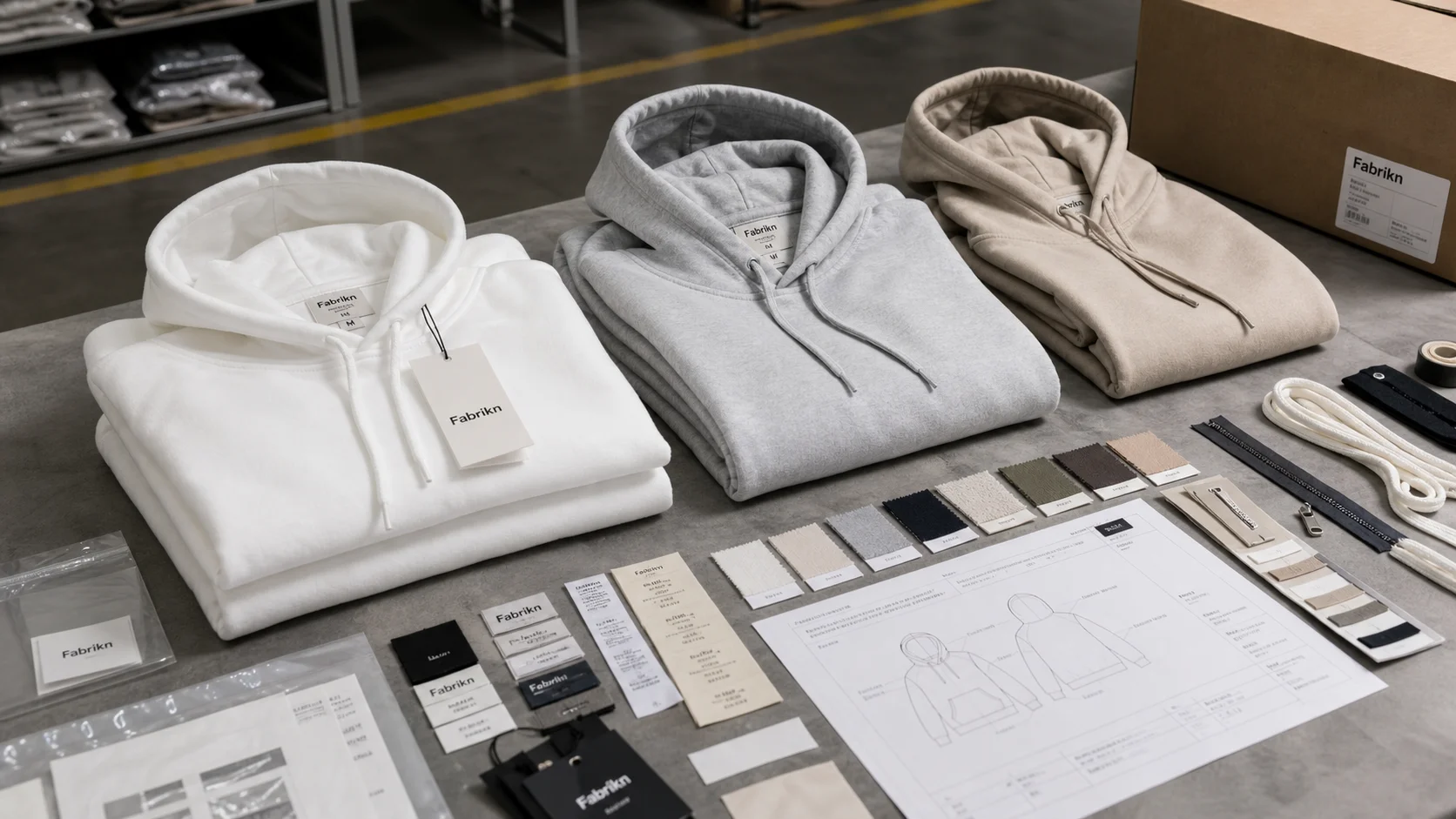
QR Code Printing On Clothing Tags with checks for samples, fit, MOQ, QC evidence, pricing terms, and delivery risk.
Fast answer: QR Code Printing On Clothing Tags: Text, Placement, Material, and MOQ should be judged by production evidence, not by a generic sourcing promise. The buyer needs sample proof, cost breakdowns, QC checkpoints, and delivery buffers in writing.
Ask for recent sample photos, measurement tolerances, fabric or print test assumptions, decoration test notes, packing examples, and a named inspection checkpoint. These details show whether the team can repeat an approved sample at bulk volume.
Separate garment cost, decoration, labels, packaging, sampling, testing, freight, and rush charges. When every cost line is visible, it becomes easier to reduce colorways, adjust size depth, or reserve more time for sampling.
QR code printing on clothing tags has become one of the most practical ways for apparel and packaging brands to connect physical products with digital experiences. In a marketplace where customers expect convenience, transparency, and instant access to product information, a small printed code can do a lot of heavy lifting. From product authentication and care instructions to marketing campaigns and customer support, QR codes help brands turn a standard clothing tag into an interactive brand asset.
For packaging and apparel businesses, the rise of QR code printing on clothing tags is not just a trend. It is a strategic shift toward smarter packaging, stronger brand storytelling, and better post-purchase engagement. Whether you manufacture private-label garments, premium fashion items, athleisure, uniforms, or promotional apparel, adding a QR code to a clothing tag can improve both function and customer experience.
This guide explains what QR code printing on clothing tags is, why it matters, how to design it properly, and what brands should consider before production. If you are exploring custom tag solutions, you can also learn more about our production capabilities on our services page, or reach out directly through our contact page.
QR code printing on clothing tags refers to placing a scannable QR code on a garment label, hangtag, swing tag, woven tag insert, or packaging tag so customers can access digital content by scanning it with a smartphone camera. The code can link to a product page, care guide, sizing chart, video, authentication page, or any other mobile-friendly destination.
In apparel packaging, QR codes are especially useful because they bridge the gap between the physical garment and the digital brand ecosystem. Instead of printing long URLs or overwhelming customers with too much text, brands can use a compact square code that is easy to scan and simple to integrate into modern packaging design.
Facilities in Guangzhou and Ho Chi Minh City typically run HP Indigo 12000 digital presses coupled with Komori Lithrone GL offset units to produce high-resolution QR codes, while woven tag suppliers in Dhaka and Istanbul rely on Karl Mayer jacquard looms and laser-etched moulds to ensure the codes stay crisp on fabric.
There are several ways QR codes can be used in clothing tag production:
The method you choose depends on your brand style, budget, tag size, and the content you want to deliver after the scan. Most suppliers quote between $2.50-4.00 per unit at 500 MOQ for digitally printed matte paper tags with a single QR code and spot UV, while woven label QR codes start closer to $5.20-6.80 each due to the fine weaving process.
QR code printing on clothing tags is popular because it delivers measurable value across branding, operations, and customer service. For packaging and apparel brands, the benefits go beyond novelty.
Customers often want immediate details about fabric composition, wash instructions, origin, size charts, or product features. A QR code gives them direct access without cluttering the tag with too much text.
Brands can use QR codes to share behind-the-scenes videos, sustainability commitments, founder stories, lookbooks, or campaign landing pages. This transforms a simple clothing tag into a storytelling tool.
Instead of filling a small tag with multiple paragraphs, brands can keep the printed design clean and minimalist while placing detailed content online.
For premium, limited-edition, or high-value garments, QR codes can link to verification systems that help customers confirm authenticity. This is particularly useful in luxury, streetwear, and collectible apparel.
A QR code can connect shoppers to loyalty programs, social media channels, email sign-up pages, or customer service portals. That means a clothing tag can support long-term customer relationships.
Brands focused on sustainability can use QR codes to reduce the need for large printed inserts by moving care instructions, supply chain details, and recycling information online.
In short, QR codes help packaging and apparel brands create a more efficient, modern, and interactive product experience. To learn more about the company behind these solutions, visit our about page.
Not every tag material is equally suitable for QR code printing on clothing tags. The best option depends on how the tag will be used, the print method, and how much durability is required.
Paper hangtags are the most common choice for QR codes. They offer a flat surface, strong print clarity, and flexibility in size and finish. Matte paper is often ideal because it reduces glare and improves scan reliability.
Coated hangtags can support vibrant branding, but if the surface is too glossy, scanning may become difficult under bright light. A soft-touch or matte coating usually performs better than high-gloss finishes.
Kraft paper is popular among sustainable and lifestyle brands. QR codes can work well on kraft tags, but print contrast must be carefully managed. Dark code printing on a lighter kraft background is usually the best option.
It is possible to place QR codes on fabric or woven labels, but the code must be large enough and printed with excellent clarity. Because fabric textures can interfere with scan accuracy, these labels are better for simple branding or backup information rather than detailed content.
Lamination can protect QR codes from moisture and wear, making them useful for products that may be handled frequently. However, reflective finishes should be avoided if they interfere with scanning.
Some brands prefer to print QR codes on hang inserts or branded packaging cards instead of directly on the tag attached to the garment. This can provide more space for messaging and offers more flexibility in layout.
For QR code printing on clothing tags to work effectively, design and production details matter. A code that looks good but fails to scan defeats the entire purpose.
QR codes need sufficient size to remain scannable, especially when printed on small tags. As a general rule, avoid making the code too small just to fit more design elements. The required size will depend on the amount of data stored and the printing method, but clarity should always come first.
High contrast is essential. A dark QR code on a light background usually performs best. Avoid placing the code over busy patterns, gradients, metallic textures, or dark images that reduce readability.
A QR code needs an empty margin, often called a quiet zone, around the edges. This helps scanners detect the code properly. Do not crowd the code with borders, icons, or nearby text.
Every QR code should point to a mobile-friendly page that loads quickly and works properly on smartphones. If the landing page is broken, slow, or hard to navigate, customers will lose trust.
Static QR codes link to a fixed destination. Dynamic QR codes allow the destination to be updated later without reprinting the tag. For brands running campaigns, seasonal products, or authentication systems, dynamic codes offer more flexibility.
While functionality comes first, QR code printing on clothing tags should still fit the brand aesthetic. Use consistent typography, colors, and layout so the code feels intentional rather than added as an afterthought.
Because QR codes contain fine detail, production accuracy is critical. Offset printing, digital printing, and high-resolution flexographic processes can all be effective when managed correctly. The final proof should always be scanned before mass production. At our Guangzhou plant we combine the HP Indigo 25K and digital UV-curable inkjet machines with inline MHM digital die cutters, while our Dhaka facility uses Mitsubishi L300 printers for vibrant white ink QR applications on tinted paper stock.
Customers are more likely to scan when the tag clearly explains what they will get. Phrases like “Scan for care instructions,” “Scan to verify authenticity,” or “Scan to see the collection story” make the code more useful.
QR code printing on clothing tags unlocks many practical applications across both apparel and packaging. Here are some real-world examples:
Choosing the right materials and production flow is vital when adding QR codes to clothing tags. Brands should balance aesthetics, cost, and durability, especially when working with multiple sourcing regions.
Paper and board options range from 220-450gsm coated card stock printed in Guangzhou to 100% recycled kraft panels produced in Ho Chi Minh City. When you need a more tactile touch, natural cotton paper or Stone Paper is run through a duplex coating line with UV-cured ink that sets instantly, preventing smudging around the QR modules.
Fabric labels that carry QR codes are often woven in Dhaka and Istanbul, using organic cotton with GOTS certification or blends containing recycled nylon certified to the GRS. These labels sit on Karl Mayer looms, then pass through laser die-cutting and ultrasonic sealing to prevent fraying. The QR artwork is previewed using a microscope camera to ensure each module retains clarity.
For cost planning, expect pricing between $2.50-4.00 per unit at 500 MOQ for matte-coated digital paper tags, and $3.80-6.00 per unit for laminated or foil-embossed finishes. Lead times usually fall within 18-22 business days for standard print jobs including die-cutting, or 3-5 days longer if woven labels require additional setup and compliance audits.
Compliance is critical: factories in Guangzhou and Dhaka operate under WRAP and BSCI frameworks, OEKO-TEX Standard 100 for inks, and often secure GRS certificates for recycled fibers. These certifications back up claims about responsible sourcing, especially when you pair them with QR code links to third-party verification dashboards.
Even small errors can render a QR code useless. Here are the most common pitfalls we see:
Fabrikn partners with apparel, packaging, and retail brands across the globe, coordinating production in Guangzhou, Dhaka, Ho Chi Minh City, and Istanbul. Our quality teams in each city oversee the entire workflow, from prepress to final inspection.
We integrate machinery such as the Heidelberg Speedmaster CX for offset printing, HP Indigo 12000 for short-run QR jobs, and Swiss Q-winder tag finishing systems for premium die-cut shapes. Every facility adheres to WRAP and BSCI social compliance standards, while the materials we recommend carry certifications like GOTS, OEKO-TEX Standard 100, and GRS for recycled content.
Our production team orchestrates material sourcing, proofing, and packaging so you receive complete tag kits ready for attachment. Most standard orders ship in 18-22 business days from confirmation, with expedited options available when you need a closer-than-normal turnaround.
We also offer QR code management tools to help connect the scanned destination with Shopify, Magento, or custom back-office systems, updating dynamic links as campaigns evolve. For more insights into how we run these programs, visit our services page or contact us directly through our contact page.
Prioritize high contrast, a proper quiet zone, and final proof scanning. We use inline quality control cameras on the HP Indigo presses and manual spot checks with scanners from different phone models before shipping.
Ask for GOTS if you need organic cotton, OEKO-TEX Standard 100 for inks and dyes, WRAP and BSCI for ethical production, and GRS when using recycled fibers. These complement the sustainability stories linked via QR codes.
Yes. We coordinate across Guangzhou, Dhaka, Ho Chi Minh City, and Istanbul production partners, so you can combine paper hangtags, woven labels, and packaging inserts in one seamless program.
Standard QR tag production typically takes 18-22 business days, with pricing ranging from $2.50-4.00 per unit at 500 MOQ for paper options. More complex labels or woven tags may require longer prep times and slightly higher price points.