
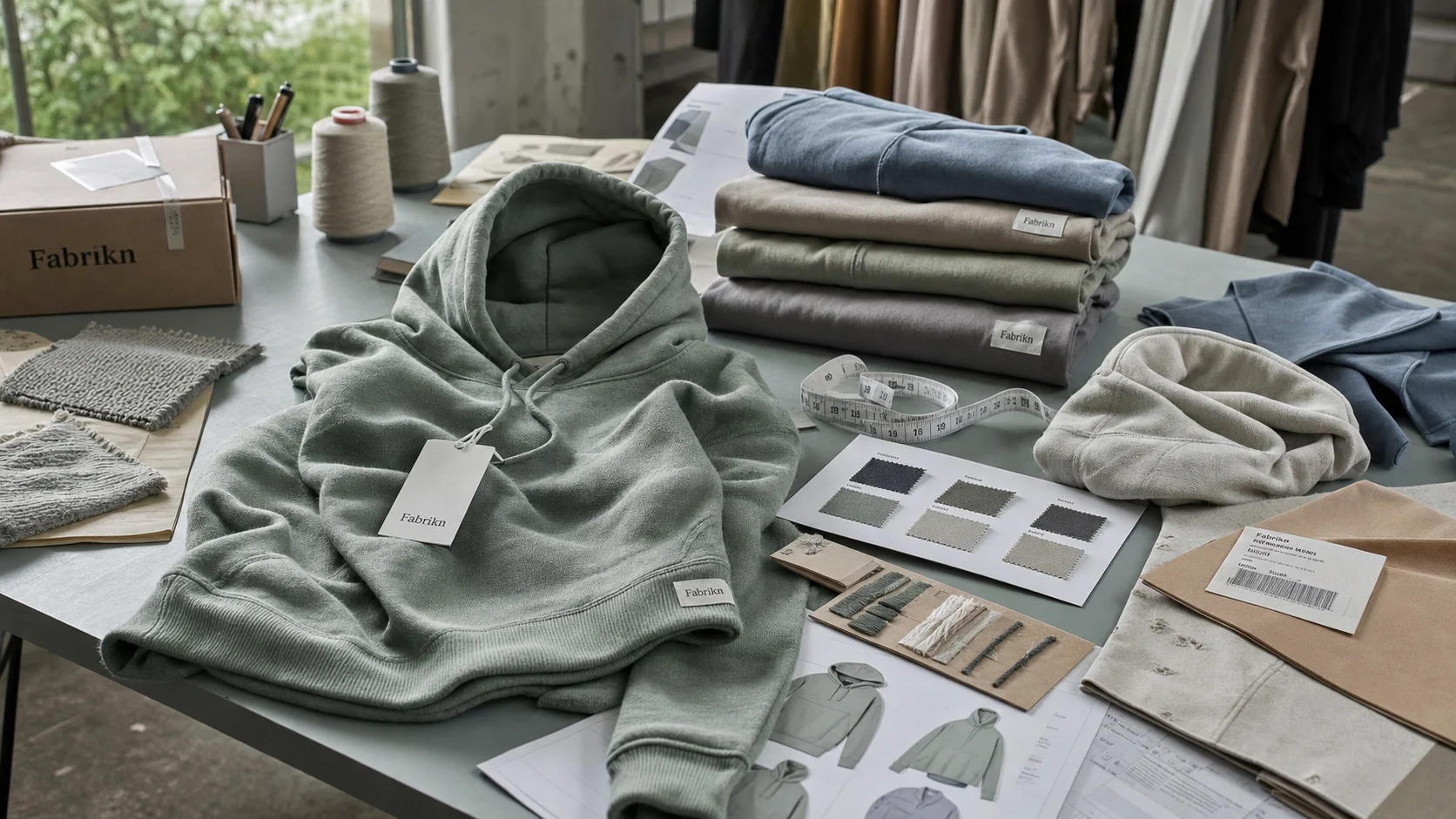
Recycled Cardboard Apparel Delivery Boxes with checks for samples, fit, MOQ, QC evidence, pricing terms, and delivery risk.
Fast answer: Recycled Cardboard Apparel Delivery Boxes: Cost, Quality, Sustainability should be judged by production evidence, not by a generic sourcing promise. The buyer needs sample proof, cost breakdowns, QC checkpoints, and delivery buffers in writing.
Ask for recent sample photos, measurement tolerances, fabric or print test assumptions, decoration test notes, packing examples, and a named inspection checkpoint. These details show whether the team can repeat an approved sample at bulk volume.
Separate garment cost, decoration, labels, packaging, sampling, testing, freight, and rush charges. When every cost line is visible, it becomes easier to reduce colorways, adjust size depth, or reserve more time for sampling.
A crushed garment box has a way of turning up the bill in places no one budgeted for. Returns follow. Margins get clipped. Brand trust takes a hit. In the last 18 months, I have watched apparel teams lose 2.5% to 6% of shipments to crush damage, corner splits, and wet cartons on long-haul routes, while replacement costs pushed landed packaging spend up by 8% to 14% without warning. That is why recycled cardboard boxes for apparel delivery have moved from the sustainability team to the buying table.
Factory floors in Vietnam, Poland, and North Carolina told the story fast. In Ho Chi Minh City, a mid-tier box supplier quoted $0.18 to $0.26 for a 3-ply mailer at 10,000 units, with 5-7 day sampling. In Łódź, the same format landed closer to €0.24 to €0.33, but print registration was tighter and board consistency was better across the run. In North Carolina, prices ran $0.29 to $0.41, yet freight times were shorter and complaint loops moved faster. Same product category. Three regions. Three different risk profiles.
That is the real shift. Buyers used to ask only whether a carton could survive transit. Now they ask whether it can do that, hold print cleanly, and meet internal emissions targets at a unit price that still protects gross margin. A box that costs 3 cents less but triggers a 2% increase in damage claims is not cheaper. It is a quiet tax. I have seen brands spend $12,000 to $40,000 a year more on reverse logistics because they shaved too hard on board grade.
Retailers are pressuring suppliers too. Several major channels now require packaging specs before onboarding, and I have seen private-label teams tie carton quality directly to vendor scorecards. If a supplier cannot prove board caliper, edge crush, and moisture tolerance, the order slows. That is why apparel teams using private label clothing services now ask packaging questions earlier, often before sampling fabric. The box has become part of the product promise.
The tension is simple. Lower environmental impact sounds clean on paper, but not every recycled board performs equally. Print quality on recycled liners can vary by 10% to 15% in ink absorption, and a flimsy box can look tired before it leaves the warehouse. Buyers want sustainability, yes, but they also want sharp unboxing, low damage, and predictable cost. Those three goals do not always arrive together.
Board construction matters more than branding copy. Recycled linerboard is the outer face, the visible sheet that takes print and handles scuffs. Corrugated fluting is the wavy middle layer that gives cushioning and stacking resistance. Kraft-facing board uses longer virgin fibers or cleaner recycled mixes on the print side, which can improve appearance without changing the entire structure. In my factory visits, the best-performing cartons were rarely the prettiest on paper. They were the ones with the right fiber mix for the route.
For apparel, single-wall board is usually enough for shirts, jerseys, and lightweight knitwear. I have seen 32 ECT single-wall mailers hold 2 to 4 folded shirts at 500 to 1,000 g total weight without compression failure if the die-line is smart. Double-wall makes sense for denim, coats, and multi-item bundles, especially when cartons are stacked 6 to 8 high in a fulfillment center. A 275# burst test or 44 ECT double-wall spec is common for heavier orders, but spec sheets matter more than old shorthand because not all recycled boards read the same under test.
Mailer boxes, rigid-style folding cartons, and shipping boxes serve different jobs. Mailers are efficient for e-commerce because they ship flat, assemble quickly, and keep labor under 12 to 18 seconds per pack. Folding cartons work well for premium tees or accessories, though they need a secondary shipper if the route is rough. Shipping boxes are the most durable, but they add freight weight and cube. I have seen brands pay 9% to 16% more in outbound freight just by over-boxing a simple hoodie.
Here’s what most people miss: higher recycled content does not automatically mean weaker performance. A 70% to 100% recycled board can meet stacking and burst targets if flute profile, glue line, and box dimensions are optimized together. In one Indonesian facility, a 100% recycled mailer passed compression tests at 28% higher load than a badly designed 40% recycled version because the manufacturer adjusted flute height, reduced excess panel size, and tightened tolerances to within 1.5 mm. Design can beat raw fiber purity.
When brands work with a factory or cut-and-sew partner, packaging should be tested alongside garment specs, especially for heavier French terry 320 GSM hoodies or structured twill trousers. If the clothing program also uses cut and sew manufacturing, ask for carton samples during the same approval cycle. That saves 2 to 4 weeks and prevents the common mistake of approving fabric, trims, and packaging in separate silos.
For sourcing teams building a new packaging line, a reliable recycled cardboard packaging catalog can make it easier to compare styles, print options, and board grades before production starts. That is especially helpful when the supplier is managing custom dimensions, wholesale programs, or bulk replenishment for multiple apparel categories.
Price is where the spreadsheet gets honest. At 5,000 units, recycled cardboard boxes usually land around $0.22 to $0.38 each in Asia, $0.30 to $0.48 in Eastern Europe, and $0.34 to $0.55 in the US, depending on print, size, and board weight. Virgin board is often 6% to 15% more expensive at lower volumes because mills pass through fiber costs and buyers lose negotiating power. Poly mailers can look cheapest at $0.06 to $0.14, but that number hides a lot.
At 25,000 units, the gap narrows. Recycled boxes may drop to $0.16 to $0.28 in China or India, $0.23 to $0.36 in Eastern Europe, and $0.29 to $0.46 in the US. Virgin board can still cost more, but not by much if the supplier already runs the same board grade. At 100,000 units, packaging economics shift again: a well-specified recycled mailer often wins because freight and waste rates stabilize, while custom poly mailers still save on unit cost but lose on structure and presentation.
The real comparison needs three columns: unit price, freight weight, and damage cost. A 12 x 10 x 2 inch recycled carton may weigh 48 to 72 grams. A poly mailer weighs 8 to 15 grams. That 40 to 60 gram gap sounds large until a damaged sweater triggers a return that costs $4.50 to $9.00 in handling, reshipment, and restocking. I have seen brands save $7,000 on packaging spend and give back $19,000 in returns within one quarter.
In warehouse terms, boxes can also reduce labor. Flat-packed recycled cartons stack neatly and speed line packing by 10% to 18% versus sorting mixed mailers and inserts. That matters in peak season, when one extra second per unit becomes 40 to 60 labor hours over a 50,000-unit run. For brands comparing formats, I often suggest they review apparel packaging options in the product catalog only after defining the garment mix, because a box that fits tees will rarely be the right answer for padded jackets.
Table-style comparison in plain language: recycled boxes cost more than poly mailers on unit price, but they outperform on structure, unboxing, and claim reduction; virgin board can match strength, yet it usually brings a higher fiber footprint; poly mailers win on sheer price and low weight, but they perform poorly on premium presentation and often lose the cost battle once returns enter the equation. In Eastern Europe, where labor is dearer but transit shorter, recycled boxes often pencil out better than in India. In the US, higher labor and faster replenishment can make the same carton more expensive but easier to control.
Before anyone signs off, the spec sheet should answer five questions: recycled content percentage, board grade, test method, print finish, and tolerance range. Buyers should ask for FSC or PEFC chain of custody where relevant, but they should not stop there. According to ISO, testing standards only mean something when they are paired with consistent sample conditions, so ask which humidity, load, and stacking protocol the supplier used.
I want to see ISTA-style transit testing, compression data, and clear die-cut tolerances. If the carton is meant to hold 3 kg, ask for a loaded test at 1.5x that weight. If the supplier claims moisture resistance, ask what was used: aqueous coating, sizing agent, or a simple stronger liner. Those are not the same. A box that survives 24 hours in a dry warehouse may fail after 72 hours in a monsoon port.
Print should still look clean on recycled surfaces, but not every finish belongs on a recyclable carton. Water-based inks, simple one- or two-color graphics, and matte varnishes usually work well. Heavy lamination, metallic foils, and plastic windows complicate end-of-life recovery. I have watched brands reject perfectly good recycled board because they wanted a glossy finish that erased the sustainability benefit.
Watch for supplier shortcuts. Underweight board is common. So are glue lines that vary by 1 to 2 mm and oversized tolerances that create loose lids or crushed corners. Ask for a 10-piece sample set, then inspect edge crush, print rub resistance, and assembly time. If a box takes more than 20 seconds to fold, a warehouse supervisor will notice before the sustainability team does.
When you source from a supplier in China or another export hub, compare factory capacity, production lead time, and MOQ against the same quality requirements you would use with a domestic vendor. The best manufacturer is not always the cheapest one; it is the one that can hold quality across repeat bulk orders and still support custom print changes without disrupting production.
The cleanest claims are the ones procurement can verify. With recycled cardboard boxes for apparel delivery, buyers can measure recycled content, weight reduction, landfill diversion, and transport emissions tied to cube efficiency. That sounds dry. It is not. A 15% weight reduction across 250,000 shipments can remove several tonnes of freight mass a year, depending on route and carton size.
Factory audits tell a sobering story. I have seen suppliers advertise 80% recycled content while using mixed scrap with high contamination, which lowers real recovery value. I have also seen smaller mills deliver 65% recycled board that performed better because the fiber was cleaner and the glue line was tighter. Data from Textile Exchange is useful for material benchmarks, but packaging claims must also reflect actual board recovery systems and local recycling rates.
That local recovery point matters more than glossy marketing language. A carton that is technically recyclable does little good if municipal recovery is weak or if ink, tape, and inserts contaminate the waste stream. In one UK audit, 82% of corrugated board entered recovery, while in a fragmented urban market I reviewed, the practical recovery rate was closer to 41% because collection infrastructure lagged behind demand.
Packaging copy should be specific enough to survive a procurement review. Say: “Made with 70% post-consumer recycled fiber, certified chain of custody, and designed for curbside recovery where facilities accept corrugated board.” Do not say “eco-friendly” and leave it there. If you want a credible packaging claim, pair the material statement with a route statement, a recovery note, and a test basis. That is how claims hold up in audits and in customer service scripts.
For brands benchmarking compliance, a review of OEKO-TEX standards and certifications can also help align packaging decisions with broader textile and chemical compliance programs. It is not a packaging test, but it is useful when teams want one quality framework across fabrics, trims, and shipping materials.
Start with a brief, not a supplier pitch. List garment weight, fold dimensions, target ship method, and damage tolerance. Then request three samples: a standard recycled carton, a lighter version, and a reinforced one. Test them on real lines for 2 weeks, not in an office. In my experience, a 90-day rollout works best because it catches weather changes, peak labor shifts, and market-specific courier handling.
Run freight tests with at least 50 units per route. Include one domestic lane, one regional lane, and one long-haul lane. If the box survives all three with less than 1% visible damage and no more than 3% assembly delay, it is ready for wider use. Negotiate MOQ 500 pieces for prototyping, 5,000 for pilot production, and 25,000 if you want sensible unit pricing. Lead times should sit around 3 to 4 weeks for standard print and 5 to 7 weeks for complex finishes.
Before launch, align sourcing, merchandising, and fulfillment. Merchandising must approve the customer experience, sourcing must lock the spec, and fulfillment must confirm line speed. If those three groups do not sign the same sheet, the rollout will wobble. For brands preparing a broader packaging refresh, I tell them to request a packaging quote from a specialist supplier only after they have a test matrix, not before.
Practical next steps:
They work best for flat garments, basics, subscription orders, and most e-commerce shipments under 3 kg. A recycled mailer handles 1 to 5 folded tees, socks, underwear, and lightweight knits elegantly. It also fits brands that want a cleaner shelf-to-door story without switching to plastic. The customer opens one box. The product arrives intact. That is the point.
They struggle on humid routes, premium gifting, and heavy layered products. If a shipment crosses tropical ports, sits in a 75% to 90% humidity warehouse, or carries dense products like padded coats and denim sets, single-wall recycled board can bow if it is not reinforced. In those cases, a hybrid package makes more sense: recycled outer box, minimal paper fill, and a protective insert or double-wall inner sleeve.
Counterintuitively, premium gifting is often where recycled board gets judged most harshly, even though it could work with better print and structural design. The failure is usually not sustainability. It is weak presentation. If a brand insists on both luxury cues and lighter board, it should budget for sharper die-cutting, better closure mechanics, and a tighter quality check.
The right box is the one that survives the trip and still feels deliberate on the doorstep. It should protect the garment, respect the inbox by reducing complaints, and avoid pretending that every product needs the same package. Packaging is not a moral contest. It is a logistics decision with consequences.
At 5,000 units, expect about $0.22 to $0.38 per box in Asia, $0.30 to $0.48 in Eastern Europe, and $0.34 to $0.55 in the US, depending on size, print, and board grade. At 25,000 units, unit prices usually fall by 10% to 18%.
Ask for board grade, recycled content, compression data, print finish, and transit testing that reflects your shipping lane. Also confirm MOQ, lead time, and whether the factory can handle custom dimensions and repeat bulk production without quality drift.
Standard production usually takes 3 to 4 weeks after artwork approval. Complex print, special coatings, or unusually large MOQs can push that to 5 to 7 weeks, so plan samples and pilot runs early.
Yes, if the design is right. Double-wall constructions and tighter die-line tolerances are often needed for denim, coats, and multi-item bundles. For loads above 3 kg, ask for compression tests and transit samples before approving the full order.
They work best for basics, flat garments, subscription boxes, and most e-commerce orders under 3 kg. They are less suitable for humid routes, premium gift packaging, or very heavy layered products unless you add reinforcement or a hybrid insert system.