
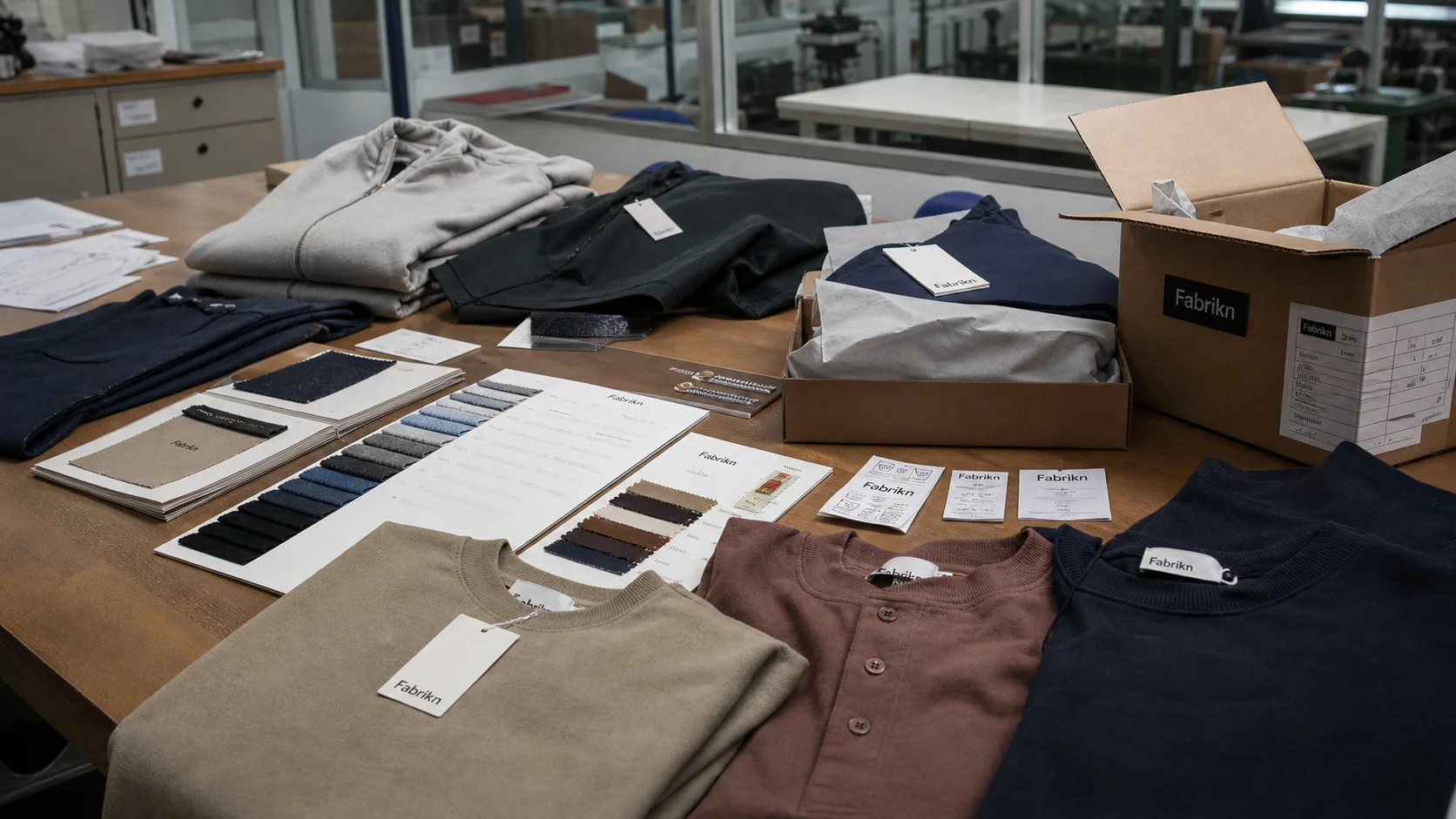
Sampling Process for Clothing Manufacturer compared by sample evidence, fabric or trim specs, MOQ, AQL terms, cost lines, delivery timing, and rework...
Fast answer: Sampling Process for Clothing Manufacturer: Sample Evidence, MOQ, Capacity, and Rework Terms should be judged by production evidence, not by a generic sourcing promise. The buyer needs sample proof, cost breakdowns, QC checkpoints, and delivery buffers in writing.
Ask for recent sample photos, measurement tolerances, fabric or print test assumptions, decoration test notes, packing examples, and a named inspection checkpoint. These details show whether the team can repeat an approved sample at bulk volume.
Separate garment cost, decoration, labels, packaging, sampling, testing, freight, and rush charges. Clear cost lines make it easier to reduce colorways, adjust size depth, or reserve more time for sampling.
One bad sample can save a brand from a very expensive mistake. I have watched that happen on factory floors from Dhaka to Porto. In the sampling process for clothing manufacturer teams, the first round is not a formality. It is the invoice for mistakes you have not paid for yet, especially when a manufacturer is managing custom details for wholesale or bulk production.
Last year, in a knitwear room in Vietnam, a $6.80 sweatshirt sample exposed three problems at once: collar recovery, sleeve balance, and a print that cracked after one wash. The brand had budgeted $18,000 for 2,000 units. Fixing those issues after bulk would have meant at least 12 days of delay, two airfreight shipments at $1.70 per kilo, and a 6 percent cut into margin. The sample cost $28. The lesson was blunt.
Factory floors show what a sketch cannot. Fit, fabric behavior, stitch density, trim placement, and label shrinkage all change once a real pattern meets real machinery. A cheap first sample often becomes the most expensive garment in the range because the brand mistakes speed for progress. I have watched low-cost factories deliver a first sample in 2 days, then watched the buyer spend 4 more rounds untangling a shoulder slope that should have been corrected immediately.
Premium factories usually move slower at first. They ask for 8 to 12 measurement points, a proper tolerance chart, and fabric swatches before cutting. Low-cost suppliers often skip that discipline and hope the second round fixes everything. In practice, that “faster” path can create 15 to 20 extra days of back-and-forth, especially if the product needs embroidery, enzyme wash, or bonded seams. The rushed sample is not cheap. It just hides the invoice.
I have also seen brands skip a fit round on a $14 tee and then pay $4.25 per unit to rework 500 pieces because the neck rib was too loose. That is not sampling savings. That is a tax on impatience. For brands working on private label clothing services, the early sample stage is where your margin either survives or leaks through tiny, avoidable errors.
The sampling process starts with a tech pack, and weak tech packs create weak samples. I have reviewed packs with 2-page sketches and no tolerance chart, and I have reviewed 26-page documents with 18 measurement points, wash standards, stitch references, and trim callouts. The second category produces fewer surprises. Not theory. Factory pattern.
A complete tech pack should include flat sketches, construction notes, graded measurements, fabric composition, GSM, trim specs, artwork placement, color standards, and packing instructions. If you are developing cut and sew styles, the pattern maker needs seam allowances, not just a mood board. For more complex programs, especially cut and sew manufacturing, missing a single note can change the entire block.
From there, the factory moves to pattern making, then a proto sample. Some teams use a digital pattern system; others still draft by hand. Either way, the sample room depends on precise communication. If the buyer says “slightly relaxed,” that means nothing in production terms. If the tech pack says body width 54 cm, tolerance plus or minus 1 cm, the sewing line knows exactly what to chase.
Pattern accuracy also depends on fabric sourcing. A 180 GSM combed cotton tee behaves differently from a 320 GSM French terry hoodie. A woven viscose blouse can twist after stitching. A rib with 5 percent spandex can recover differently from one with 2 percent. Strong documentation shortens the cycle because the factory does not need to interpret the style from scratch. I have seen solid packs cut sampling from 14 days to 6 days simply because the fabric was pre-approved and the trim references were locked.
The usual sample sequence is proto, fit sample, size set, and pre-production sample. Each one exists to answer a different question: Does the style resemble the design? Does it fit a body? Can the style scale across sizes? Can production run without drama? Brands that treat these stages as one blurred round usually get burned. In factory visits, misunderstandings almost always come from vague comments, missing color references, or late fabric substitutions. A buyer may think a “white” button is harmless. The factory sees three different shades and waits for direction.
Proto sample is the first physical version. It is not meant to be perfect. It answers the basic question: does the concept work in cloth? For a women’s woven shirt, that may take 5 to 7 days. For a hoodie with custom embroidery, 7 to 10 days is more realistic. I have seen buyers panic when the proto is off by 2 cm at the chest. Usually normal. The point is to expose the problem early, not to celebrate the first cut.
Fit sample comes next. Here the factory adjusts the pattern against the body, usually with model feedback or a size form. For knitwear, one fit round may be enough if the block is strong. Tailored jackets often need 2 to 3 fit rounds because lapel roll, sleeve pitch, and shoulder balance have more variables. Activewear is its own animal. Compression stretch, recovery, and seam strength can force 3 rounds before the line is ready.
Salesman sample is produced for showroom or buyer presentation. It must look polished enough to sell the line, even if production trims are not final. This stage matters most for brands that attend trade shows and wholesale appointments. A salesman sample made in a different fabric weight from bulk can still work, but the buyer should know the delta: a 220 GSM sample tee does not tell the full truth if bulk will be 180 GSM.
Size set sample checks grading across the size range. I rarely see new brands understand how many problems hide in grading. A style that fits well in medium can fail in small and XL because neck drop, sleeve length, and hem sweep do not scale evenly. For basics, 3 sizes may be enough. For denim or tailored jackets, I prefer at least 5 sizes reviewed before approval. The cost of a bad grade is brutal: one factory in Turkey quoted me $1.15 extra per unit to fix a distorted yoke after 1,200 pieces were already approved on paper.
Pre-production sample is the final checkpoint before bulk. This sample should use the actual fabric, trims, labels, prints, and wash process. If the product includes a stone wash or enzyme wash, this is where the hand feel must be confirmed. I visited a denim plant in India where the pre-production sample differed from the proto by only 1.5 cm in inseam, yet that tiny shift changed the fit on tall sizes. That is why this stage matters. It reveals how the approved version behaves under real production conditions.
Here’s what most people miss: the slowest step in the sampling process for clothing manufacturer teams is often not pattern work. It is fabric or trim waiting. A factory can cut a sample in 24 hours, then lose 5 days because a zipper is trapped in customs or a reactive dye lab dip was rejected twice. For custom baby clothing manufacturing, this gets stricter because safety trims, soft hand feel, and seam smoothness leave almost no room for shortcuts. Buyers who understand the chain reduce rework before bulk ever starts.
Sampling fees vary sharply by factory tier. A low MOQ supplier may charge $15 to $35 for a basic T-shirt sample, while a mid-tier factory may charge $35 to $80. Premium manufacturers often quote $80 to $150 for the same tee if they include advanced pattern support, wash testing, or dedicated sample room labor. For woven shirts, I usually see $25 to $50 at entry level, $50 to $95 mid-tier, and $95 to $180 at the premium end. Denim samples can run $45 to $90, and outerwear can climb to $120 to $250 because of lining, hardware, and construction complexity.
Timeline follows product complexity. In China, a simple knit sample often takes 5 to 10 days, while denim or outerwear can take 12 to 18 days. Vietnam is similar on simple styles, often 6 to 12 days, but can move faster if fabric is already in house. India can be 7 to 14 days, especially when fabric sourcing is local and embellishment is involved. Turkey commonly sits at 4 to 8 days for well-organized accounts, and Portugal can turn around samples in 5 to 9 days, especially for knit and jersey programs with tight communication.
Fabric availability changes everything. If the mill has the right 180 GSM jersey on hand, a sample may ship in 3 days. If the buyer wants a custom yarn-dyed check or a specific brushed fleece, add 1 to 3 weeks. Embroidery takes more time than plain sewing, and lab dips or wash tests can add another 4 to 7 days. I have watched a brand lose 9 days because a metal snap was out of stock in two colors and the factory refused to substitute without approval.
Shipping matters too. Couriering one sample from Guangzhou to New York can cost $28 to $65, while heavier outerwear samples may cost $70 to $140 depending on weight and speed. If the brand requests three rounds, that can mean 3 packages, 3 customs declarations, and 3 to 6 extra days lost in transit. Teams often budget only the factory fee and ignore freight. That mistake is common and expensive.
According to AATCC testing practices and industry norms, wash and colorfastness checks can add meaningful lead time because approval should not rely on visual inspection alone. Data from WTO trade statistics also shows how regional sourcing networks shape turnaround speed, especially where fabric and trim suppliers sit close to the garment plant. That proximity can save 5 to 10 days on repeat sampling.
I check measurement points first. Chest width, body length, shoulder width, sleeve length, neck opening, rise, inseam, and hem sweep are the usual suspects. For denim, I also verify waist, front rise, back rise, thigh, knee, and leg opening. One centimeter can matter because a pattern scaled across 5 sizes can turn a small error into a visible fit problem by XL. Most factories work within a tolerance of 1 cm to 1.5 cm on basic knits and 0.5 cm to 1 cm on tailored pieces.
Construction comes next. I inspect stitch density, seam strength, topstitch balance, bartacks, overlock finish, and whether the seam allowance matches the tech pack. A cheap sample may look tidy on a hanger but fail when the hem is stretched 20 times. Hand feel matters too. A 280 GSM fleece with poor brushing can feel harsh even if the measurements are correct. Shrinkage, color matching, and wash response must be checked against the intended use, not against the sample room light.
I tell buyers to review a sample in layers. Start with the tech pack. Move line by line. Then compare a measuring tape to the sample, then a fabric hand test, then a wash test if one is required. Never approve by eye alone. If the garment includes prints, verify placement in centimeters, not “centered.” If it includes labels, check size, weave quality, and stitch position. Brands that miss these details often discover them after bulk, when corrections cost 2 to 4 times more.
Buyer checklist:
Small brands need speed, honesty, and low friction. They usually cannot support 4 rounds of sampling on 6 styles without blowing budget, so the factory has to be strong at pattern support and communication. A startup should expect sample fees in the $25 to $75 range for basics and should ask whether the fee is credited back on bulk. MOQ can start at 100 to 300 pieces for some knit suppliers, but a complex woven program may still need 500 pieces or more. Communication speed matters more than glossy sales decks.
Mid-market buyers want consistency. They need a factory that can handle 500 to 3,000 pieces per style, quote clearly, and keep sample revisions within 2 to 3 rounds. This is where regional strengths matter. China can offer broad material access and fast trim sourcing. Vietnam often excels at organized production flow. India has strong textile depth and embellishment skill. Turkey is sharp on speed and flexible reorder windows. Portugal is strong for premium jersey, knitwear, and smaller European accounts.
Premium and luxury buyers should care about construction control, not just price. They need a sample room that can execute complex tailoring, artisanal finishes, or delicate fabric handling. A factory charging $120 for a sample may actually cost less in the long run than one charging $20 if the cheaper site needs 4 extra rounds. I have seen lower-priced factories produce more revisions because the pattern team was thin and the buyer had to explain everything twice. Cheap sampling can be a trap.
The right partner depends on complexity. A basic jersey tee belongs in a different factory from a sharply tailored blazer or a baby romper with soft elastics and nickel-free snaps. If your line includes structured shapes, ask for private label clothing services with a strong sample room rather than a supplier that only sells blanks. The sample process should match the product, not just the budget.
For brands that want lower-impact materials, it also helps to ask whether the supplier works with recognized standards such as Textile Exchange or certified chemical controls like OEKO-TEX. That matters when the sampling process for clothing manufacturer teams must align with sustainability claims, quality expectations, and production consistency.
Send the first email with a tech pack, artwork files, measurement chart, reference images, target price, and target MOQ. Add fabric composition, expected GSM, and your preferred timeline in days. Set reply deadlines, approval windows, and a single contact person on both sides. If the factory needs 48 hours to respond, build that into the schedule. If your team needs 3 business days to review each round, say so early. That discipline cuts confusion fast.
Use one internal sample tracker with date, status, comments, and next action. Mark each round clearly: proto, fit, size set, or pre-production. Do not send vague comments like “make it better.” Say “reduce sleeve length by 1 cm” or “replace 12 mm button with 14 mm matte resin.” If you need a fast quote to compare development options, request a production quote from fabrikn.com before cutting the first sample. Clear direction protects margin and keeps the brand credible.
For brands selling custom, wholesale, or bulk programs, the best results usually come from treating the sampling process for clothing manufacturer teams as a controlled production stage, not as a creative side task. The more precise your comments, the fewer rounds you need, and the faster the factory can move into final production with confidence.
Basic samples often cost $15 to $35 for tees, $25 to $50 for woven shirts, $45 to $90 for denim, and $120 to $250 for outerwear. More complex styles cost more because of pattern work, trims, wash tests, and extra labor. Some factories credit the sample fee back if you place bulk production.
Simple knit samples can take 5 to 10 days in China or Vietnam, while tailored pieces and outerwear may take 12 to 18 days. Turkey and Portugal are often faster on simple, well-documented styles, sometimes 4 to 9 days. Fabric delays, trim sourcing, and wash approvals can add 1 to 3 weeks.
Send a tech pack, flat sketches, reference photos, measurement chart, fabric composition, target GSM, artwork files, target price, and MOQ. If you already know the required trims, include zipper, button, label, and packaging specs. The clearer the first brief, the fewer sample rounds you usually need.
Yes, if the brand keeps the brief tight and chooses a factory that supports low MOQ development. Many small brands start with 100 to 300 pieces on knit basics, though woven and tailored products often need 300 to 500 pieces or more. Ask about sample fees, revision limits, and whether pattern support is included.
Match the factory to the product complexity. Basic tees and fleece can work with smaller knit suppliers, while denim, tailored jackets, and babywear need stronger pattern and construction teams. Check sample speed, communication quality, MOQ, and whether the factory can deliver 2 to 3 accurate rounds without confusion. A low price is not a win if the sample room cannot execute the block.