
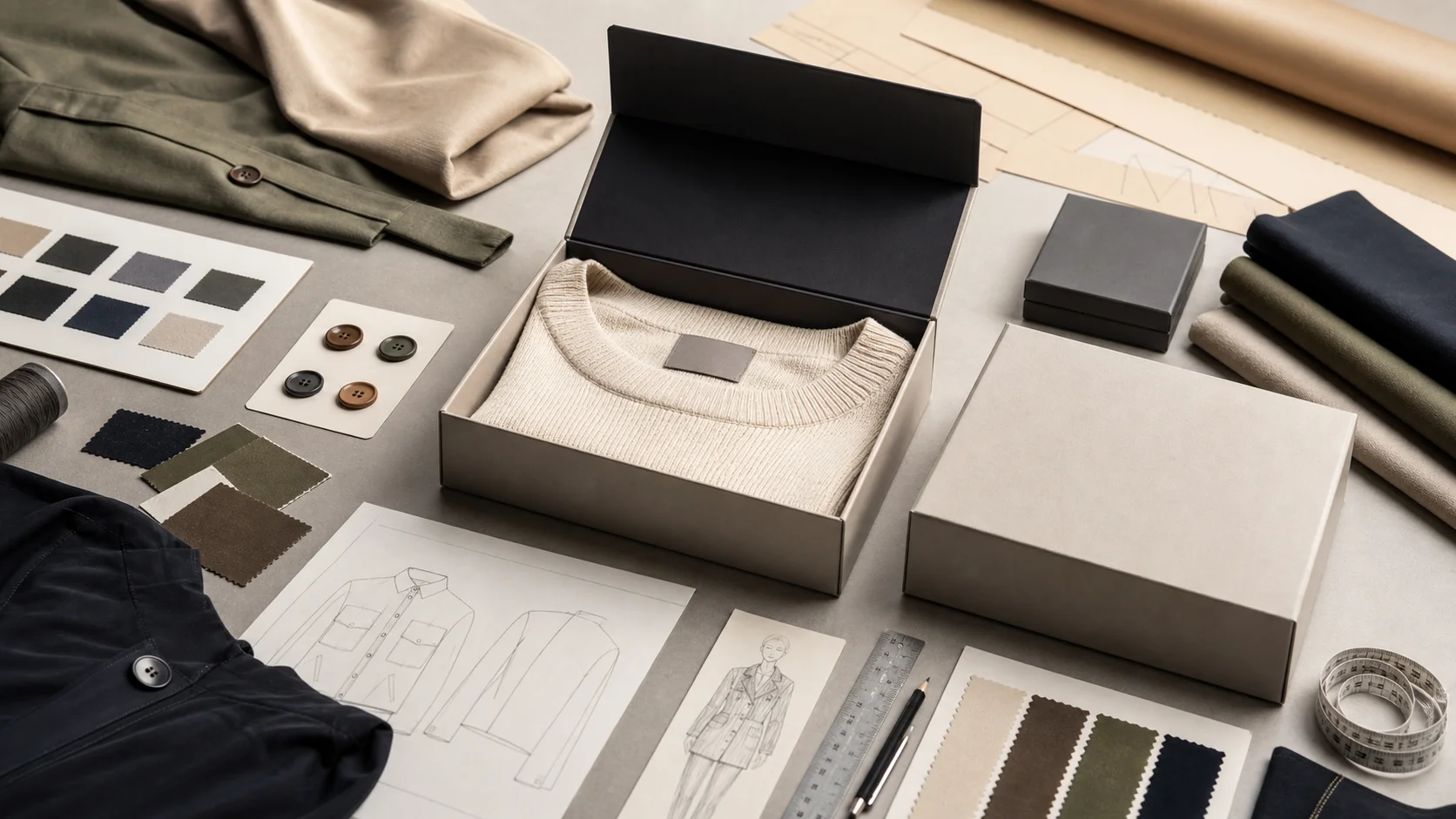
Screen Printing on Reusable Garment Bags with checks for samples, fit, MOQ, QC evidence, pricing terms, and delivery risk.
Fast answer: Screen Printing on Reusable Garment Bags: Costs, Quality, ESG should be judged by production evidence, not by a generic sourcing promise. The buyer needs sample proof, cost breakdowns, QC checkpoints, and delivery buffers in writing.
Ask for recent sample photos, measurement tolerances, fabric or print test assumptions, decoration test notes, packing examples, and a named inspection checkpoint. These details show whether the team can repeat an approved sample at bulk volume.
Separate garment cost, decoration, labels, packaging, sampling, testing, freight, and rush charges. When every cost line is visible, it becomes easier to reduce colorways, adjust size depth, or reserve more time for sampling.
Packaging used to be the thing brands glanced at between the real decisions. Not anymore. screen printing on reusable garment bags has moved into brand audits because it has to earn its place twice: it stores the garment and it speaks for the label. That matters when a brand ships 5,000 units a month and burns through $0.18 to $0.60 on disposable packaging that never makes it past the first handling cycle. A reusable bag priced at $0.80 to $2.00 can look steep on paper. Give it 6 to 12 retail touches, and the math starts behaving.
Three factories I visited last year told me the same thing in different languages: buyers are checking whether packaging survives real use, not a photo shoot. A bag that lands crisp, carries a logo cleanly, and folds back without scuffing supports the garment price. A bag that flakes, tears, or prints off-center does the opposite. Cheap-looking product. Not-quite-cheap package.
Packaging teams are comparing garment bag spend against sleeves, hangtags, woven labels, and poly mailers with more skepticism than I saw five years ago. Fair enough. A paper sleeve may cost $0.05 to $0.12, a woven label $0.03 to $0.09, and a printed reusable bag $0.80 to $2.50 depending on size, material, and order volume. If the bag replaces a sleeve plus a mailer insert, the math shifts fast.
According to the ISO framework for management systems, traceable process control matters as much as the visible result. I see that in packaging rooms all the time: if the spec calls for a 1-color mark on a 40 x 50 cm bag, the print has to land within the same tolerance on unit 500 as it did on the sample. That is where many programs fail. Not on the concept. On repeatability.
At a Guangzhou facility running 18,000 bags a day, an operator showed me two nearly identical programs. One was a $2 bag with a 1-color print on coated polypropylene; the other was a $0.80 bag with thinner film and a larger logo. After three handlings, the cheaper bag showed crease whitening and edge splits. The pricier one still looked retail-ready. Weird truth, but true: cost does not track durability in a straight line.
Presentation changes by channel too. In wholesale, buyers notice stackability and whether the logo faces out neatly in cartons of 50. In DTC, the unboxing moment is shorter and more visible on social media, so a bag that prints clearly at 1-meter viewing distance can matter more than a complex graphic. Sustainability claims have to survive shipping, handling, and reuse, or they’re just glossy language.
The substrate decides more than most buyers expect. I’ve seen beautiful artwork ruined by a bag film that looked premium but rejected ink after 200 folds. For screen printing on reusable garment bags, the main options are polypropylene, cotton, PEVA, and coated fabrics. Each takes ink differently, and each creates its own failure points at the seam, zipper, or gusset.
Polypropylene is common because it’s light, cheap, and easy to source at MOQ 1,000 to 5,000 pieces from a manufacturer, factory, or supplier with the right production capacity. Cotton feels better in hand and fits higher retail positioning, but textured yarns can blur small type below 6 pt. PEVA and coated fabrics bring a cleaner surface, though coatings can crack if the print area sits on a hard fold. Data from OEKO-TEX programs also reminds buyers that chemical safety and material traceability belong in the spec, not in a postscript.
For custom and wholesale programs, buyers should also confirm bulk availability early, especially when the order includes mixed sizes or a tight delivery window. That helps the supplier protect quality and reduce waste during production.
Polypropylene accepts bold graphics cleanly when the surface is corona-treated or otherwise prepared. Cotton works best with simpler logos and thicker strokes, especially at 300 GSM or above. PEVA is smooth, so it can print fine detail well, but it may show pinch marks if packed too tightly. Coated fabrics are a mixed blessing. They look premium. They can also crack at 90-degree folds if the coating is too rigid or the ink layer is too heavy.
A smoother, lower-cost substrate can sometimes deliver better print consistency than a thicker premium bag. I found that in a small Phnom Penh plant where a 0.45 mm coated film held registration better than a heavier 0.65 mm version because the thicker material shifted under pressure. The cheapest surface was not the worst surface. The pricier one created more waste.
Water-based ink gives a softer hand feel and works well when the bag will be folded often or sits close to apparel with a delicate finish. Plastisol brings stronger opacity and better color density, which matters on dark substrates and for logos that must read from 2 to 3 meters away. Specialty inks help on low-energy surfaces, but they also raise cost by $0.10 to $0.35 per unit depending on color count and curing method.
Buyers should ask for rub resistance, fold stress, and wash-or-wipe durability tests depending on end use. If the bag is for retail storage, a dry rub test after 20 to 50 cycles makes sense. If it’s meant to be wiped down in back-of-house use, request a damp abrasion check after 10 to 15 wipes. ASTM methods are useful shorthand, and ASTM references help standardize language between sourcing and QA teams.
Artwork that looks excellent on a screen can fail on a bag in five different ways: distortion, cracking, poor registration, show-through, and text loss. I’ve seen brands approve 9-color concepts for packaging runs of 3,000 pieces, then wonder why the lead time jumped from 12 days to 28 days and the reject rate hit 8 percent. Design is cost control. Design is damage control too.
Line weight matters. On textured or recycled substrates, I rarely approve strokes below 0.35 mm, and small text under 7 pt gets risky once the bag has seams or gussets. Safe margins around seams should stay at least 12 to 15 mm. That gives the material room when it shifts during loading. One-color designs usually beat multicolor artwork on durability and unit cost, especially for high-volume packaging runs where each added screen can lift price by $0.08 to $0.20.
Large logos are tempting. They also warp. When the print crosses a crease line, the image can stretch by 2 to 4 mm, enough to make a wordmark look clumsy. I’ve seen brands improve consistency by shrinking logo width from 280 mm to 220 mm and moving the artwork 18 mm away from the zipper. Small move. Big difference.
For brands already using sublimation printing services on polyester apparel, it’s easy to assume the same visual density will translate to bags. It usually doesn’t. Screen printing on reusable garment bags needs stronger allowances for substrate movement, and that is where a stripped-back layout wins. Bold mark. Fewer colors. Better yield.
Placement should be treated like pattern engineering, not decoration. A logo centered over a fold can split visually after the first use. Handles interfere with the platen. Zippers create ridges that steal ink from nearby areas. The cleanest programs I have seen used a dedicated print zone mapped against the bag pattern before production began, not after artwork approval.
Buyers should request physical strike-offs or pre-production samples before greenlighting a run. Digital mockups hide defects that show up immediately on the press. One hour of samples can save a 5,000-piece reprint and a freight bill of $450 to $1,200. That isn’t caution for its own sake. It’s disciplined buying.
The cleanest way to price packaging is to calculate total cost per garment, not cost per bag. A reusable printed bag may cost $0.80 at 20,000 pieces, $1.20 to $1.60 at 5,000 pieces, and $2.00 to $3.50 at 1,000 pieces once setup is included. By contrast, a paper sleeve, hangtag, and poly mailer combination might sit at $0.18 to $0.42, but it may not deliver the same branding or reuse function.
Setup fees are the divider. Screen prep, plate costs, and art adjustment can add $60 to $220 per color, which is why small runs feel expensive. Once screens exist, the unit price drops fast. A 1-color job at 20,000 pieces may cost less than half of a 3-color job at 1,000 pieces. Freight can add another 6 percent to 14 percent, depending on cube and origin.
At 1,000 pieces, labor and setup dominate. A bag priced at $2.20 plus $140 in screen costs becomes $2.34 before inbound freight. At 5,000 pieces, that same bag may land at $1.35 to $1.65 if the artwork stays simple. At 20,000 pieces, I have seen strong programs reach $0.85 to $1.10, especially in hubs with steady packaging throughput and low scrap.
Factory location matters. In parts of Vietnam and southern China, labor may run 10 percent to 18 percent lower than in nearshore sites, but quality-control risk rises if the line chases speed over cure time. In Portugal or Mexico, unit labor is higher, yet short-run control can be better, and reprint risk can fall by 2 to 5 percentage points. That difference can erase the apparent savings.
Hidden waste often hides in the reject carton. If 4 percent of a 10,000-piece order is misregistered, the real cost per accepted unit jumps more than most buyers expect. Add overrun, rework, and inbound inspection time, and the packaging line item can swell by 12 percent to 20 percent. That’s why brands should compare printed bags with clothing packaging solutions on a landed, approved, and usable basis.
For premium programs, I often pair the cost model with clothing packaging solutions that include hang loops, tissue, and outer cartons. For simpler assortments, a lower-cost sleeve plus a strong label may do the job. Match packaging spend to garment margin. A $38 blazer can carry a $2 bag. A $14 tee usually cannot.
Good suppliers do not just print. They control variables. I look for mesh counts matched to artwork density, curing temperature records, and operators who can explain why a 160-mesh screen behaves differently from a 120-mesh one on coated fabric. I also want registration marks checked at press start, mid-run, and end-run. Without that discipline, a 3,000-piece order can look fine on unit 1 and drift by unit 900.
Sampling tells you more than sales decks. If a factory sends three preproduction versions with different Pantone matches, that’s a warning. If prepress files arrive with inconsistent trap settings or the logo shifts 2 mm between versions, the print room is not tightly managed. Weak adhesion, uneven curing, reject rates above 5 percent, and promised lead times under 7 days for a complex job are red flags.
Ask to see a wash or wipe test on the actual substrate, not a generic fabric swatch. Request cure temperature logs showing the press held within a defined range for the full production window. On flexible bags, smudging often comes from stacking before the ink is fully set. A factory that has a staged cooling area usually manages this better than one that sends bags straight to carton.
Supplier questions should cover compliance, material traceability, packaging drop tests, and documented quality standards. I want lot codes on material rolls, ink batch numbers, and a clear explanation of what happens if 2 percent of the order fails inspection. A factory that knows its escalation path is usually a factory that can protect your margin.
Ask these five things before PO placement: What is your mesh count for this artwork? What is the curing window by substrate? How many operators inspect registration? What is the historical reject rate on similar bags? How many sample rounds are included in the quoted price? If the answers are vague, the quote is cheaper for a reason.
Last year I worked with a brand that asked for 4 sample rounds on a new PEVA bag and caught a color shift before mass production. The extra sampling cost $120. The avoided reprint cost more than $2,000. Due diligence with numbers, not mood.
Regional differences shape everything: price, turnaround, MOQ, and the quality bar you can reasonably expect. In Asia, MOQ 1,000 to 5,000 pieces is common, and turnaround can run 10 to 21 days if materials are in stock. In Europe, buyers often face higher labor but tighter control and more responsive short-run production. Nearshore supply chains can trim shipping time by 1 to 3 weeks, which matters when replenishment is tied to a launch calendar.
Premium brands tend to specify heavier fabrics, cleaner stitching, and more exacting print tolerances. Mass-market programs usually focus on speed and lower unit cost. I have seen $3.50 bags fail simple abrasion checks, while $1.40 mid-price bags held up better after 25 rub cycles and repeated folding. Price signals quality. They don’t guarantee it.
In Asia, scale gives you options. You can source coated polypropylene, PEVA, or cotton in large lots and spread screen costs across 10,000 to 30,000 units. Europe can win on short-run consistency and lower ocean freight, especially for restocking 500 to 2,000 units. Nearshore production, particularly in Mexico, Morocco, or Eastern Europe, can support smaller replenishment cycles and cleaner ESG narratives tied to lower transport miles.
Data from U.S. Trade & Investment data shows how shipping, tariffs, and sourcing routes alter landed cost more than many brands expect. I have watched a program save $0.22 per unit offshore, then lose $0.31 per unit in reprints, delay fees, and air freight. Cheaper quotes are not always cheaper programs.
Here’s the operational split. Premium programs often use 0.50 mm to 0.70 mm substrates, 1-color or 2-color prints, and inspection on every 250 units. Mass-market packaging may use thinner film, tighter pricing, and larger batch checks. The premium route costs more, but it also reduces the odds that a retailer receives damaged or faded packaging that drags down the garment’s presentation.
I have visited factories where the higher-price program looked polished in the sample room and then failed at fold endurance after shipment. I have also seen mid-price suppliers outperform luxury-branded packaging after 20 rub cycles and a 1-meter drop test. That contradiction is common. A prettier quote does not always mean a better bag.
The cleanest buying process starts with use case, not artwork. Define whether the bag is for retail display, warehouse storage, or repeated consumer reuse. Then set the material, print method, approved size, and expected reuse count. If the bag must last 10 cycles, say so. If 3 cycles is enough, say that too. Vague specs breed vague results.
Build one specification sheet that finance, sourcing, compliance, and design can all sign. Put the target cost, acceptable defect rate, MOQ, delivery window, and packaging method in the same document. A brand that aligns those teams before sampling usually moves faster, because the supplier receives one truth instead of four conflicting versions.
Use this sequence: define use case, choose material, set print method, approve artwork, request samples, then test durability. For high-visibility logos or new substrates, order at least 2 sample rounds before production. Digital mockups are useful. They are not enough. I have seen them hide zipper interference, edge distortion, and poor ink deposit.
Send the supplier six concrete details: dimensions, material, color system, print area, pack method, and delivery window. If you need a 500-piece rush in 14 days, say it. If you need 8,000 pieces in 6 weeks, say that too. Precision lowers friction. Precision also lowers blame.
Include performance targets in the brief. State the acceptable scuff level, the minimum line weight, and whether the print must pass a wipe test after 20 cycles or a dry rub test after 50. If the packaging is tied to broader sustainability targets, compare total reuse count and scrap rate, not just material type.
For brands with a broader label and packaging mix, I often pair these specs with private label clothing services so the garment and its bag speak the same visual language. That creates cleaner handoff points at retail and in DTC fulfillment. The bag stops being decorative. It becomes a measured asset with a replacement plan.
When you source custom packaging at wholesale or bulk scale, it also helps to compare the supplier’s quality system with the practical needs of your launch calendar. The best fit is usually a manufacturer that can balance production speed with consistent print registration, not simply the lowest quote from China or any other region.
On a well-prepared substrate, a 1-color print can hold for 10 to 25 reuse cycles, depending on handling and storage. Polypropylene and coated fabrics usually outperform textured cotton for sharpness, while cotton can age better visually if the artwork is simple.
At 1,000 pieces, expect roughly $1.80 to $3.50 per bag including setup on many programs. At 5,000 pieces, unit cost often drops to $1.10 to $1.80, and at 20,000 pieces it can fall to $0.80 to $1.20 for simple artwork.
Many factories start at MOQ 500 to 1,000 pieces, but the pricing is usually inefficient below 1,000 because screen setup and labor are spread across too few units. For multi-color jobs, MOQ may rise to 3,000 pieces or more.
Typical turnaround is 10 to 21 days after artwork approval and sample sign-off. Complex jobs, new materials, or tight Pantone matching can extend that to 3 to 4 weeks, especially if the factory needs an extra strike-off round.
Yes. Cotton prints well with bold graphics, polypropylene is efficient for large runs, and PEVA can take fine detail if the surface is clean and stable. The ink choice and curing method should match the substrate or adhesion will suffer.
For buyers serious about cost control and ESG claims, the next move is straightforward: write the spec, request strike-offs, test the bag for rub and fold durability, then compare the landed cost against the reuse count you can prove. If screen printing on reusable garment bags is going to sit on your packaging line, make it earn its keep.