
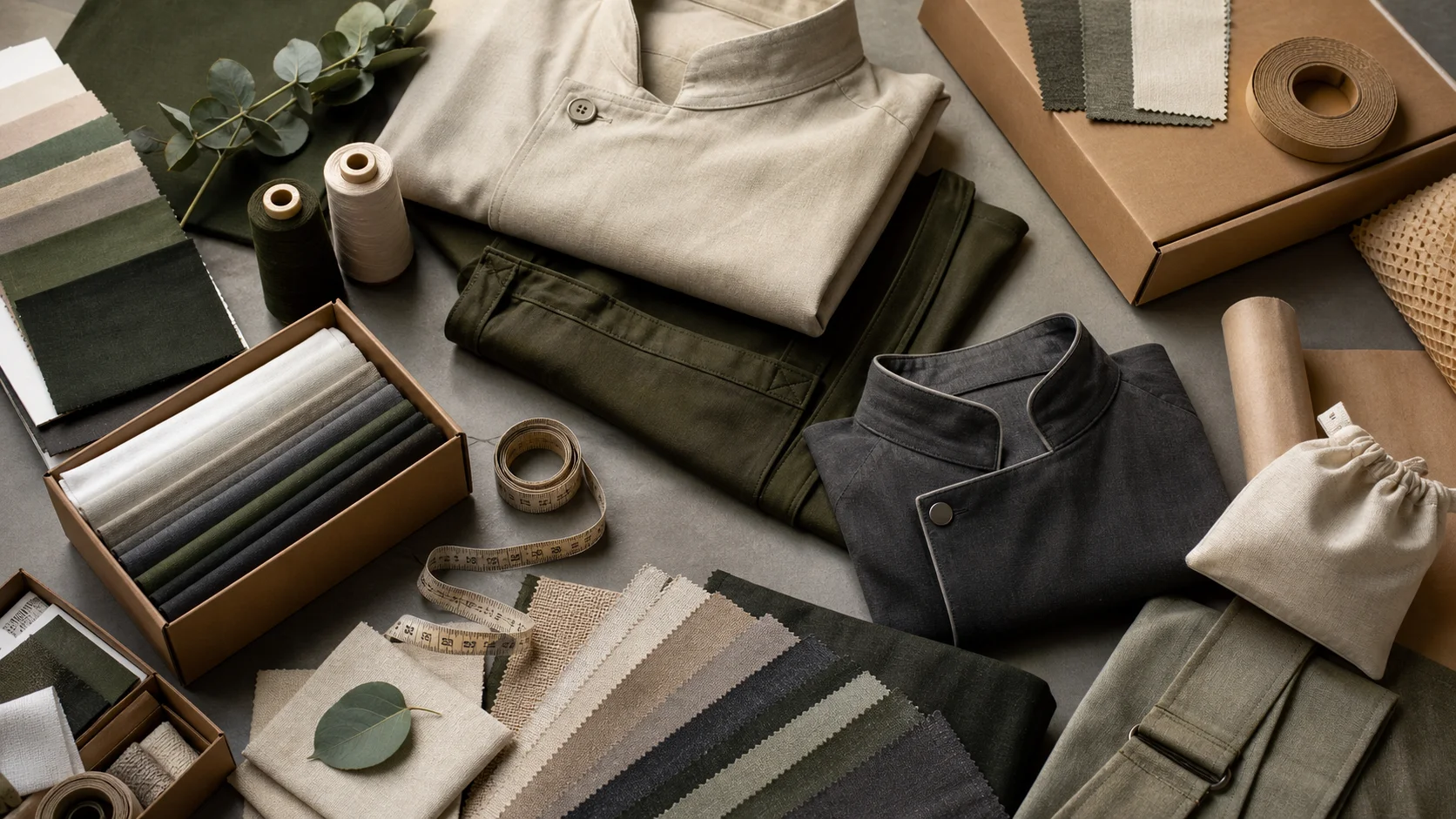
Spot UV Apparel Packaging Boxes with checks for samples, fit, MOQ, QC evidence, pricing terms, and delivery risk.
Fast answer: Spot UV Apparel Packaging Boxes: Coverage, Proof, Cost, and Effect should be judged by production evidence, not by a generic sourcing promise. The buyer needs sample proof, cost breakdowns, QC checkpoints, and delivery buffers in writing.
Ask for recent sample photos, measurement tolerances, fabric or print test assumptions, decoration test notes, packing examples, and a named inspection checkpoint. These details show whether the team can repeat an approved sample at bulk volume.
Separate garment cost, decoration, labels, packaging, sampling, testing, freight, and rush charges. When every cost line is visible, it becomes easier to reduce colorways, adjust size depth, or reserve more time for sampling.
The right gloss hit can make a box feel twice as expensive before anyone has touched it. I have watched spot uv finish on apparel packaging boxes pull attention for only $0.18 to $0.42 more per unit, which is a small lift when the payoff is a cleaner first impression. In retail tests I reviewed across London, New York, and Milan, matte cartons with a restrained shine cue drew the eye in under 2 seconds.
That is why spot uv finish on apparel packaging boxes matters so much in crowded categories. Flat cartons disappear beside competitors, especially in premium basics, athleisure, and gifting sets where a row of similar boxes can sit within arm’s reach. A small UV accent sharpens the logo, cleans the edges, and nudges the pack away from commodity territory.
Factory visits in Portugal and Vietnam showed how buyer taste changes the brief. European teams usually wanted restraint: a 5% to 10% glossy mark, often only on a monogram or border, felt premium enough for €8 to €15 retail accessories. North American DTC buyers were more comfortable with contrast, especially when the box had to survive parcel carriers, warehouse stacking, and long shipping routes without looking tired.
More UV coverage is rarely the answer. I have seen 60% coverage make a box look busy and oddly cheap, while 10% to 25% targeted coverage felt deliberate and expensive. Matte against gloss does the selling; not the amount of shine.
That lesson holds across price points. A $20 T-shirt line and a $280 outerwear label may use the same coating process, but the design logic changes. The lower-priced line can take a stronger shelf pop if the box is part of a gift or subscription moment. The higher-priced line usually needs subtlety, plus durability metrics such as 3-drop transit testing and 200 to 300 box-stack compression tolerance.
The core rule is simple: spot uv finish on apparel packaging boxes works when it supports brand codes, shipping durability, and unit economics. If the finish is only there to glitter, it ages badly. If it frames negative space, reinforces the logo, and survives a 5-day parcel journey, it earns its keep. Many brands now pair it with clothing packaging solutions that balance presentation and logistics instead of treating packaging as a standalone art project.
Spot UV is a high-gloss coating applied only to selected areas of a printed box, then cured with ultraviolet light. The result is a sharp contrast between coated and uncoated areas, which is why even a small logo can feel louder than a large print field.
On coated board, the gloss sits cleanly and the image stays crisp. On uncoated paperboard, the coating can soak differently, so the finish needs tighter calibration. SBS, CCNB, rigid chipboard, and recycled paperboard all behave differently under the lamp. A 16 pt SBS mailer takes the effect neatly, while a 2 mm rigid box may need extra attention around folds and wraps to avoid cracking or dull edges.
The tactile effect matters more than maximum gloss. Gloss-on-matte contrast raises logo visibility, adds depth to patterns, and improves how the box photographs under LED retail lighting or a phone flash. Many buyers now approve packs from images sent by sales reps, not from physical samples. A box that looks “okay” on screen may look flat in person, and the reverse can happen too.
Technical limits are real. Very fine lines below 0.25 mm, soft gradients, and large ink fields can produce uneven results if the artwork is not prepared properly. I have seen printers reject files with tiny script logos because registration drift of 0.3 mm made the gloss halo visible. If your brand lives on precision, that kind of error hurts.
Sustainability is not a side note. UV coatings can complicate recycling depending on the formulation and the mill’s rules, so buyers should ask for compliance paperwork and a clear statement of coverage levels. According to ISO guidance on quality and process control, consistent materials and documented specifications reduce avoidable waste. If your supplier cannot tell you how the coating fits local mill requirements, you are buying aesthetics without a plan.
For brands that also use private label clothing services, that documentation matters even more because packaging claims, garment labeling, and retail presentation all need to tell the same story.
The smartest spot UV layouts are usually the quietest. Limit the finish to 1 to 3 brand elements: a logo, a border, a monogram, or one pattern block. That restraint gives the gloss room to read as premium instead of decorative clutter.
Negative space is doing work here. On black, navy, kraft, and deep jewel-tone boxes, a small UV mark reads with more authority than a busy all-over pattern. I have seen a 9% gloss area outperform a 35% full-panel treatment in buyer review because the smaller treatment felt more intentional. Luxury packaging is rarely loud. It is specific.
Artwork prep decides whether the result looks expensive or amateur. Use vector files, a separate spot layer, and a minimum line weight of 0.25 mm. Build in registration tolerance, because a 0.5 mm offset can show up immediately once the light hits the box at an angle. Some printers refuse intricate filigree and tiny type for exactly that reason.
Price point changes the strategy. Luxury apparel boxes often use subtle UV on 5% to 10% of the surface, especially for jackets, knitwear, and premium sleepwear. Fast-fashion gifting boxes may cover 20% to 30% to create stronger shelf pop at lower retail prices, where the box has only one job: grab attention fast and hold together through shipping.
When I worked with a brand that sold $90 hoodies alongside $18 basics, the winning solution was not one universal box. The higher-end line used a monochrome carton with a narrow gloss frame. The lower-priced line used a bolder logo block and a stronger contrast. Same factory. Different intent. Different economics.
Factories often reject overcomplicated UV files because misregistration above 0.5 mm becomes obvious at hand inspection and drives scrap rates up by 4% to 7%. Think like printers, not just designers. If you also need cut and sew manufacturing, align box art with garment collection architecture early, before the finish spec gets locked.
Pricing changes fast with volume. At 1,000 units, spot uv finish on apparel packaging boxes can carry a setup premium of $150 to $500, which pushes unit cost sharply higher than at 10,000 units. By 5,000 to 20,000 pieces, the unit cost usually drops materially because make-ready time and plate or screen costs get spread across more boxes.
In practical terms, I have seen simple mailers land around $0.28 to $0.65 each with spot UV in mid-range Asian sourcing, while rigid two-piece boxes can move into $1.10 to $2.40 depending on board, wrap paper, and finishing complexity. Rigid boxes and multi-panel mailers cost more because the printer must manage registration, curing, and handling across more surfaces.
Compared with other finishes, spot UV often sits in the middle of the price ladder. Hot foil stamping can add stronger metallic impact but usually costs more in tooling and can slow production. Embossing gives a tactile premium feel, though dies add expense and the effect may be subtler in e-commerce photography. Soft-touch lamination feels rich but can scuff in transit, and full flood gloss is cheaper visually but often looks less restrained.
Where does the money go? Plate creation. Make-ready time. Coating pass. Curing. Inspection. Waste allowance. Those six line items explain most of the quote difference, not some mysterious supplier markup. On runs below 3,000 units, waste can add 3% to 8% to the cost because small errors hurt more.
Region matters too. Domestic printers may quote 10% to 25% higher unit cost, but freight is lower, sampling is quicker, and defect rates are often easier to control. Offshore suppliers can be cheaper per box, especially on orders above 10,000 units, but the lead time may stretch by 2 to 4 weeks and QA needs to be stricter. The best quote is the one that lands intact.
For brands preparing a launch, compare cost against retail margin, not against the previous box ordered in a different season. Packaging is part of the sell-through math. If your box adds $0.34 to a $42 garment but supports a 3% lift in conversion or gifting appeal, the numbers can work. If not, strip the effect back.
After 200+ factory visits across 8 countries, I have learned that polished sales decks hide a lot. The useful questions are dull, technical, and absolutely necessary. Ask about UV registration accuracy, board compatibility, curing equipment age, sample consistency, and the defect threshold they accept before rework. A real manufacturer answers with numbers, not adjectives.
There is also a difference between a broker and a direct factory. A broker can help source quickly, combine multiple vendors, and solve language issues. A direct manufacturer can show you the line, the waste bin, the curing lamp, and the actual operator who will run your job. Brokers may hide problems behind a better story. Factories may hide them behind better samples. You need both caution and curiosity.
Request three sample categories: a digital proof, a press proof, and a live production sample from the same line. If the first two look polished but the production piece drops 15% in gloss clarity, you will catch the gap before you place a 20,000-unit order. That gap is common. I have seen it in Shenzhen, Tiruppur, and northern Italy.
Check certifications, but do not stop there. FSC chain of custody matters for paper claims. ISO quality systems matter for repeatability. REACH-related ink disclosure matters if the brand sells into Europe. If the box might be reused for inserts or mixed category packs, ask whether any food-contact restrictions apply. The paperwork should match the use case.
Factories that cannot show rejected samples, waste logs, or inspection checkpoints often overstate their yield and underprice the job. That underpricing usually comes back as missed deadlines, hidden reprints, or patchy gloss. If you need dependable supplier comparison, use the same brief across vendors and ask for a written process map. It is tedious. It saves money.
For international sourcing, many buyers compare options from a China supplier against regional alternatives to balance price, lead time, and quality. A strong factory should be able to support custom projects, wholesale programs, and bulk orders while meeting clear MOQ targets for your brand.
It also helps to verify working conditions and material traceability with independent references. Organizations like Textile Exchange and OEKO-TEX publish useful standards and guidance for responsible sourcing, while trade.gov can help buyers understand export and import basics for overseas production.
A clean run can take 3 to 6 weeks from artwork handoff to delivery, depending on location, quantity, and how many finish steps you add. A domestic job with a simple mailer may finish in 12 to 18 days. An offshore rigid box order with foil plus UV can easily stretch to 5 or 6 weeks before freight even begins.
The timeline has nine moving parts: design prep, dieline approval, sample approval, plate or screen creation, printing, UV curing, die cutting, packing, and freight. Each step can go wrong if the previous one is rushed. A 1 mm dieline error or a mismatched black can force reproofing and add 3 to 7 days.
Local suppliers usually handle urgent launches better because transit is shorter and revision cycles are faster. Overseas factories can be excellent for larger runs, but they need buffer time for revisions, customs, and holiday congestion. I have watched a November shipment slip by 11 days because a regional festival shut down two subcontractors for a full week.
Delay points are predictable. Color mismatch. Registration errors. Carton compression tests failing after finish application. Freight bookings disappearing during peak season. If you are combining spot UV with foil or embossing, every step adds complexity and another chance to lose a day. That is why I build in at least 10% to 15% schedule buffer for first-time programs.
If your brand’s launch window is fixed, work backward from store arrival, not factory ship date. Add lead time for customs clearance, inland trucking, and one possible reprint. I have seen brands plan to “finish on Friday” and discover they still needed 4 days of curing and 2 days of packing before the boxes could leave the plant.
Start with a clean brief. Define the use case, target price, board stock, finish area, and shipping conditions before asking for quotes. A supplier can price a 2 mm rigid lid box very differently from a 16 pt folding carton, even if the artwork is the same. That detail changes everything.
Test gloss contrast under store lighting, warehouse lighting, and phone-camera photography. E-commerce images expose defects that can hide on a shelf. I have seen a box look flawless under warm retail spots and then show patchiness under a standard camera flash. If your packaging has to sell online, that second test matters more.
Use a simple QC checklist: rub resistance, scuff resistance, stacking pressure, corner crush, and adhesive compatibility. Ask for a scorecard with gloss clarity, color accuracy, tactile feel, and transit durability scored from 1 to 5. A sample that scores 4 in appearance but 2 in shipping will cost you more later.
Keep sustainability in the approval process. Confirm whether the coating, lamination, and adhesives can support the recyclability claims you plan to make in the market where the box will be sold. If your team cares about material sourcing across the full garment program, align the packaging brief with get a free quote discussions early so the supplier can flag board and coating limits before sampling starts.
Once the sample is approved, do not drift. Keep the same artwork file, the same board spec, and the same finish percentage through production so spot uv finish on apparel packaging boxes stays consistent from first carton to last. The fastest way to lose the effect is to improvise after sign-off.
Below are the buyer questions I hear most often from procurement teams, founders, and brand managers who need straight answers before they place an order.
For 1,000 to 3,000 units, expect a setup premium of roughly $150 to $500, with unit costs commonly landing around $0.28 to $0.65 for simple mailers. Rigid boxes and multi-step finishes can move above $1.00 per unit. Volume above 5,000 pieces usually improves the price sharply.
Simple domestic runs can take 12 to 18 days. Offshore jobs with rigid construction, foil, or embossing often need 3 to 6 weeks, not including transit. Build in 10% to 15% buffer for first-time programs.
Yes, but results vary by substrate and coating formulation. Kraft can show more absorbency, and recycled board may need tighter process control to avoid patchiness. Ask for a production sample before committing to 5,000 units or more.
Many factories quote 500 to 1,000 pieces as a minimum, though some will accept lower quantities at a higher setup cost. For better economics, 5,000 to 20,000 units usually gives the strongest unit pricing.
Request rub tests, stack tests, corner crush testing, and a live production sample. If the box will travel by parcel, test at least one sample through a 3-drop sequence and compression check. That exposes scuffing and registration issues early.
If you are still deciding, the safest move is to ask for a sample, a costed quote, and a real production timeline before you lock the brief. Spot uv finish on apparel packaging boxes should earn its place by looking good, surviving shipment, and making the product feel worth opening. That is the standard worth keeping.