
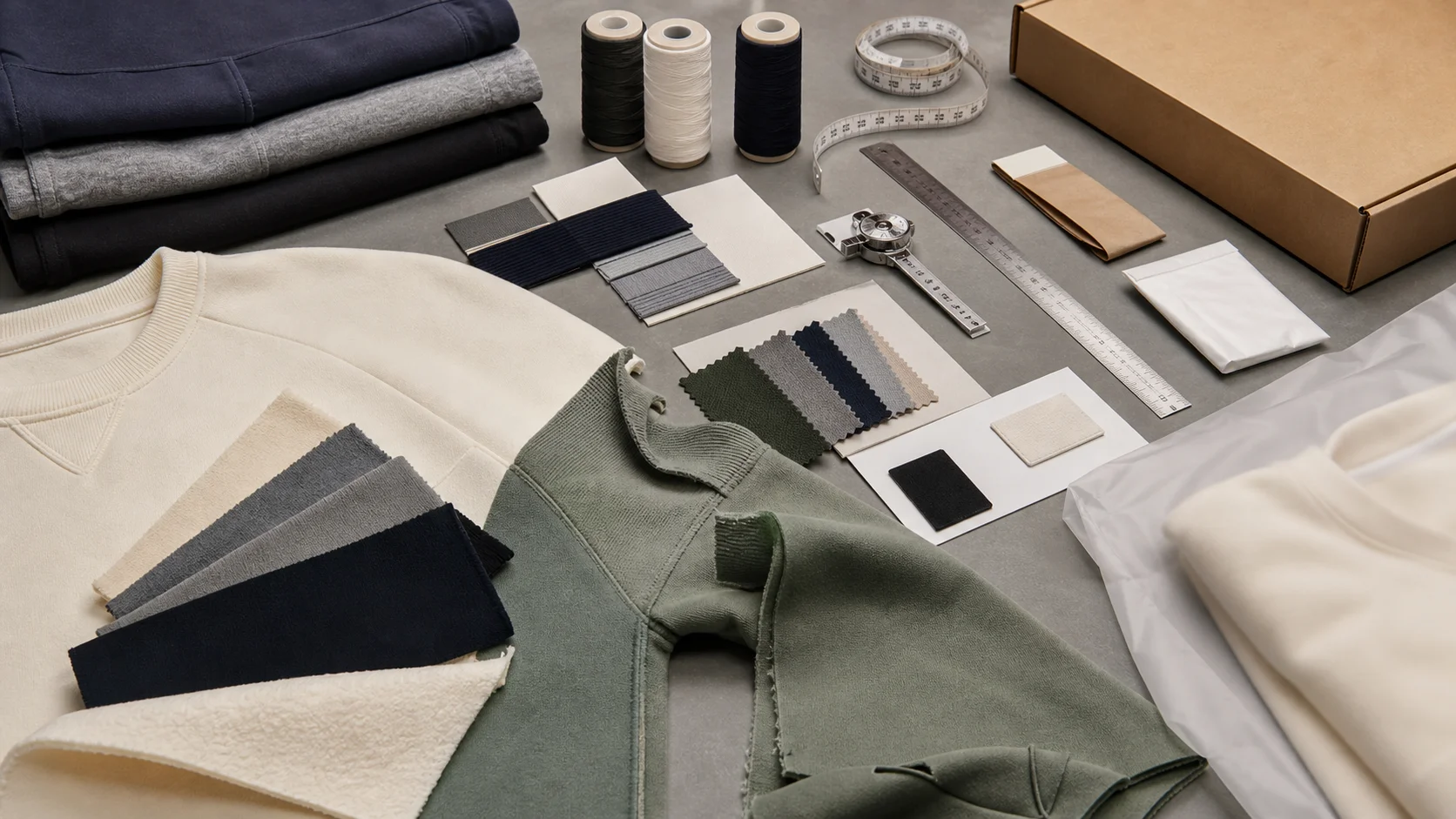
Included in Luxury Unboxing Packaging compared by sample evidence, fabric or trim specs, MOQ, AQL terms, cost lines, delivery timing, and rework responsibility.
Fast answer: Included in Luxury Unboxing Packaging: Material, Print, MOQ, and QC Terms should be judged by production evidence, not by a generic sourcing promise. The buyer needs sample proof, cost breakdowns, QC checkpoints, and delivery buffers in writing.
Ask for recent sample photos, measurement tolerances, fabric or print test assumptions, decoration test notes, packing examples, and a named inspection checkpoint. These details show whether the team can repeat an approved sample at bulk volume.
Separate garment cost, decoration, labels, packaging, sampling, testing, freight, and rush charges. Clear cost lines make it easier to reduce colorways, adjust size depth, or reserve more time for sampling.
A luxury box can change a customer’s mind before the product even comes into view. I’ve watched a $14 box make a $280 product feel worth more, and a $48 pack make a $900 item feel disappointingly ordinary. That gap isn’t decoration. It’s psychology, supply-chain discipline, and print control.
What is included in luxury unboxing packaging is not one item. It is a coordinated system of board, wrap, insert, print, finish, and protection. In factory visits across Guangdong, Milan, and Ho Chi Minh City, I saw the same principle repeated: the reveal is built in stages, not pulled from one SKU. The outer shell arrives first, then inserts, then tissue, then cards, then seals. Miss one component and the whole experience collapses.
High-end DTC labels usually spend hardest on structure and inserts. Department-store labels often spend on print fidelity and tissue presentation, because those packs need to stand up under store lights and shelf handling. Both are trying to control the same moment: the hand opening the lid. That first contact is where value is either confirmed or quietly downgraded.
When I visited a box plant outside Dongguan, one line was cutting 3 mm rigid board while another was hand-wrapping sleeves with 157 gsm art paper. A third team was sorting magnetic closures and ribbon pulls for the next day’s assembly. It looked fragmented. It was actually precise. Premium packaging is built like clothing production at its best: cut, assemble, finish, inspect. If you have ever worked with clothing packaging solutions, the logic will feel familiar. The smallest alignment error, 2 mm off-center, can ruin the perception of a 2,000-piece run.
Buyers should approve a sample only after seeing the full component map: outer structure, inner support, printed wrap, closure method, tissue, label, and any protection layer. That is the real brief. Not “make it luxurious.”
The core structure is the loudest signal in the room. Before the foil, before the emboss, before the ribbon is touched, the box itself tells the customer whether the brand is charging $35 or $350. I have seen a plain shoulder box feel richer than a heavily printed mailer because the board density, lid resistance, and closure pressure were right.
What is included in luxury unboxing packaging at the structure level usually starts with rigid setup boxes, magnetic closure boxes, drawer boxes, shoulder boxes, folding cartons, and premium mailers. Rigid boxes usually use 1.5 mm to 3 mm board, wrapped in paper with tighter tolerances than commodity cartons. Lower-tier folding cartons can use much thinner paperboard, often around 250 gsm to 400 gsm, which is fine for apparel tags or lightweight cosmetics but not for heavy glass bottles or jewelry sets.
Structure gets more interesting inside. Insert trays, partitions, false bottoms, pull ribbons, and locking tabs are the hidden workhorses. In a fragrance box I inspected in Spain, the outer shell looked simple, yet the inner tray had a die-cut pocket, a foam-free cradle, and a paperboard lift tab that stopped the bottle from shifting by even 1 mm. That is luxury too. Quiet, engineered, exact.
Box type changes with the product category. Jewelry needs a compact rigid box with velvet or paper-wrapped inserts. Cosmetics often use drawer boxes or magnetic lids with carded trays. Apparel packaging usually needs a folding carton or mailer with a clean reveal and enough volume for folded garments, hangtags, and tissue. Leather goods may need shoulder boxes for structure, and when the product is hats, the pack becomes larger and more cylindrical in feel; I’ve seen smart brands pair premium packaging thinking with custom hat manufacturing so the box shape matches the brim, crown, and storage needs.
The structure is usually the biggest visual cue of luxury before any print or foil is seen. A 3 mm board with a sharp corner and clean wrap edge will beat a flashy but flimsy pack almost every time. I’ve seen that happen on retail floors and in fulfillment rooms.
For buyers working with a manufacturer or factory on custom packaging, structure is where quality, MOQ, and production efficiency meet. A supplier in China may offer faster bulk production, but the best result still depends on precise dielines and sample approval.
The box is only the stage. The supporting cast does the convincing. In a proper premium pack, I expect tissue paper, a branded dust bag, a thank-you card, an authenticity card, a care card, stickers or seals, ribbon, and sometimes a simple insert card that explains the product story or materials. Each item has a job.
Dust bags reduce abrasion during storage and shipping. Tissue adds ceremony and slows the reveal by a few seconds, which matters more than most brands admit. Care cards prevent returns by explaining how to store, clean, or wear the product. Authenticity cards matter in categories with resale value. Seals signal tamper evidence. None of this is decorative fluff when the product is $120, $240, or $1,200.
Here’s what most people miss: fewer, better components often outperform a crowded pack. I have seen brands spend $1.80 on ribbon, card stock, and stickers, then underinvest in a $0.12 insert that would have stopped the item from scuffing. The result is predictable: damage claims, refunds, and a beautiful unboxing with a broken product inside.
This is where sensible brands cut waste without cutting experience. A single folded card can carry care instructions, sustainability notes, and QR code access to warranty info. One well-made dust bag can replace plastic sleeves. If you are building private label clothing services, the same logic applies: the pack should protect the garment, not inflate the bin.
Luxury packaging should protect product and elevate the reveal at the same time. I have watched teams get seduced by ribbons and neglect corner protection. That is backward. The customer notices the damage before the charm.
For wholesale and bulk orders, the best supplier will simplify the part count without lowering the experience. That keeps production stable, improves quality control, and often reduces lead-time risk.
Finish choices are where premium packaging either earns its price or exposes it. The standard stack includes coated or uncoated paper wrap, matte or soft-touch lamination, foil stamping, embossing, debossing, spot UV, and specialty inks. On a sample table, these look like small decisions. In hand, they change weight, temperature, and resistance. Customers read those signals instantly.
Soft-touch lamination feels expensive because it resists slip and adds a velvety drag. Foil stamping catches light in a narrow band, which can sharpen a logo or monogram. Embossing lifts the mark; debossing presses it inward. Spot UV adds gloss only where you want it. Specialty inks can deepen black, mimic pearl, or create subtle texture. None of these are free. Each adds cost, setup time, and a chance of misregistration.
According to ISO, consistent process control matters because small deviations in assembly and material performance can affect both appearance and durability. I saw that firsthand in a Portuguese plant that rejected a whole batch because foil shifted by less than 1 mm on the lid edge. Brutal. Correct.
Regional differences are real. Several European factories I visited excel at restrained, high-precision finish work: tight foil lines, square corners, and wrap alignment that holds under inspection at arm’s length. Lower-cost Asian suppliers often move faster and can be excellent on volume, but detailing may be simpler unless the buyer pays for tighter QC and more sample rounds. The price gap is not just labor. It is tolerance discipline.
Counterintuitive, but true: a minimal design can feel more premium than an overdecorated one if the board quality and wrap alignment are exact. I have seen a plain black rigid box outshine a gold-foil, multi-layer pack because the edges met cleanly and the lid closed with a controlled, expensive-sounding click. For cut-and-sew brands that already obsess over finish quality, this is the same logic behind cut and sew manufacturing. Precision beats clutter.
For shipping, matte wraps and deeper embossing generally travel better than highly raised embellishments or fragile glitter coatings. Retail display favors dramatic finishes, but ecommerce favors durability, abrasion resistance, and a surface that survives 3 to 5 touchpoints in transit.
Independent testing and textile standards also matter when packaging supports apparel and soft goods. See OEKO-TEX for material safety guidance and Textile Exchange for responsible fiber sourcing context.
Luxury packaging does not have one cost profile. Starter premium, true premium, and bespoke high-luxury sit in different buckets. A starter premium pack for apparel might include a folding carton, tissue, one insert card, and a printed sticker, landing around $0.80 to $2.50 per unit at 1,000 to 5,000 units. True premium rigid packaging with a custom insert can move to $3.50 to $8.00. Bespoke presentation packs for fragrance, jewelry, or gifting can run well past $12.00, especially at low quantities.
What drives the cost? Board grade, print complexity, hand assembly, insert precision, minimum order quantity, and sourcing region. A run of MOQ 500 pieces will almost always cost more per unit than 10,000 pieces because setup and waste are spread over fewer boxes. A 4-color print with foil, emboss, and magnetic closure raises both material and labor. Add a custom tray cut for one product dimension and the price climbs again.
In export hubs, assembly can be faster because labor pools are larger and component sourcing is close by. In boutique European plants, I often see more artisanal finishing, but lead times stretch to 3 to 6 weeks for sampling and 6 to 10 weeks for production, especially when the pack needs hand-glued inserts or specialty wrap stocks. The tradeoff is not just speed. It is control versus craft intensity.
Packaging often lands around 1% to 5% of retail for many consumer brands, though jewelry, fragrance, and gifting can sit above that. A $40 box is not automatically better than a $12 box. If the expensive version ships in an oversized mailer, crushes at the corner, and forces volumetric freight up by 18%, the customer pays twice.
I have seen a $1.90 pack outperform a $6.80 one because the cheaper option used a better-fit insert and shipped flat in a smarter configuration. That is why brand teams should judge packaging on function, freight, and return rate, not on unit price alone. If you want packaging that supports apparel ranges without swallowing margin, start with the same discipline used in private label clothing services: plan the full system, not the one pretty sample on the table.
For global procurement teams, what is included in luxury unboxing packaging also depends on factory capability, supplier responsiveness, and whether the China sourcing partner can meet bulk deadlines without sacrificing quality.
Sustainability claims only matter if they survive inspection. Buyers should ask suppliers for FSC certification, recycled content percentages, plastic-free component lists, and exact ink specifications. If a vendor says the pack is recyclable, I want to see what percentage is truly recyclable by weight, not by sentiment.
Magnets, mixed materials, heavy lamination, and glued inserts can complicate recycling streams. A beautiful box with a metal closure and laminated wrap may be elegant on a desk, but awkward in municipal sorting. According to FSC, traceable wood and paper sourcing matters because supply chains need documented origin, not vague claims printed in green ink.
Plastic-free is not automatically better if the alternative requires three layers of board and a non-separable adhesive. I have seen brands add a paper sleeve over a rigid box, then a second printed insert, then a third card, all to signal eco-friendliness. The waste pile grew. The value did not.
Ask factories these four things: What percentage is recyclable? What is the adhesive type? Can the pack be flat-shipped? What is the minimum component count before the cost rises sharply? Those answers reveal whether the supplier understands real production or just styling.
Real sustainability in luxury packaging comes from material efficiency, durability, and honest claims. A pack that protects a silk blouse for 18 months of storage, or a leather accessory for repeated gifting, can be more responsible than a delicate showpiece that cracks after one delivery cycle. That thinking matters for teams building product ranges through cut and sew manufacturing, because the garment and the pack should age at compatible speeds.
If you are sourcing from a factory or manufacturer in China, ask for compliance documents up front and verify the supplier can maintain the same quality across production and wholesale repeat orders.
Sampling goes faster when the brief is exact. A strong package brief should include product dimensions, weight, drop-test requirements, closure preference, brand colors, finish references, and the unboxing sequence. If the product has a bottle, cuff, garment, or accessory, include a physical sample or CAD file. Factories price what they can measure.
I ask buyers to send exact board thickness, print count, insert material, accessory list, and target cost before the first sample. A good supplier should return a bill of materials and a component map so nothing disappears between quote and production. That means tissue, stickers, foam, ribbons, magnets, cards, and any coating are all named. No hidden extras. No surprise charges.
Most projects need 2 to 4 sample iterations before sign-off. If a brand gives a loose brief, that number can double. The quickest approvals I have seen came from teams that defined the unboxing sequence in plain language: lift lid, remove tissue, reveal product, read card, store dust bag, close box. Simple. Precise.
For apparel brands, packaging needs to match the garment architecture. A heavyweight knit in French terry 320 GSM needs different folding space than a light poplin shirt. The same goes for brands scaling beyond one category. If you’re already working through clothing packaging solutions, the best box brief is the one that respects volume, crease risk, and return handling from the start.
The fastest way to waste money is to approve aesthetics before engineering. Send the factory the engineering first.
Before sampling, share target MOQ, expected bulk volume, and whether the project is custom or standard. That helps the supplier quote the right production path and avoid delays at the factory.
When people ask what is included in luxury unboxing packaging, the honest answer is simple: whatever protects the product, supports the brand, and survives production without drama. Get those three things right, and the rest stops feeling like guesswork.
It usually includes the outer box or mailer, inserts, tissue, a dust bag or protective sleeve, cards, seals, and finishing details such as foil or embossing. In higher-end packs, you may also see ribbons, authenticity cards, and custom trays. The exact mix depends on product type and price point.
Many premium packs land between 1% and 5% of retail value. Starter premium can be $0.80 to $2.50 per unit, mid-tier rigid packaging often runs $3.50 to $8.00, and bespoke presentation boxes can exceed $12.00. MOQ, finish count, and region move the price quickly.
Sampling usually takes 2 to 4 rounds and 7 to 21 days per round, depending on complexity. Production commonly takes 3 to 6 weeks after approval, while more artisanal European runs can stretch to 6 to 10 weeks. Peak season adds delays.
Yes, but only if the materials are chosen carefully. FSC paper, recyclable board, and water-based or low-impact inks help, while magnets, heavy lamination, and mixed-material inserts make recovery harder. Ask for recyclability by weight and component type, not vague claims.
Check dimensions, board thickness, closure strength, print alignment, insert fit, and whether the pack survives a drop test. Also confirm the bill of materials, adhesive type, and packed shipping format. A sample that looks good but ships badly is not ready.