
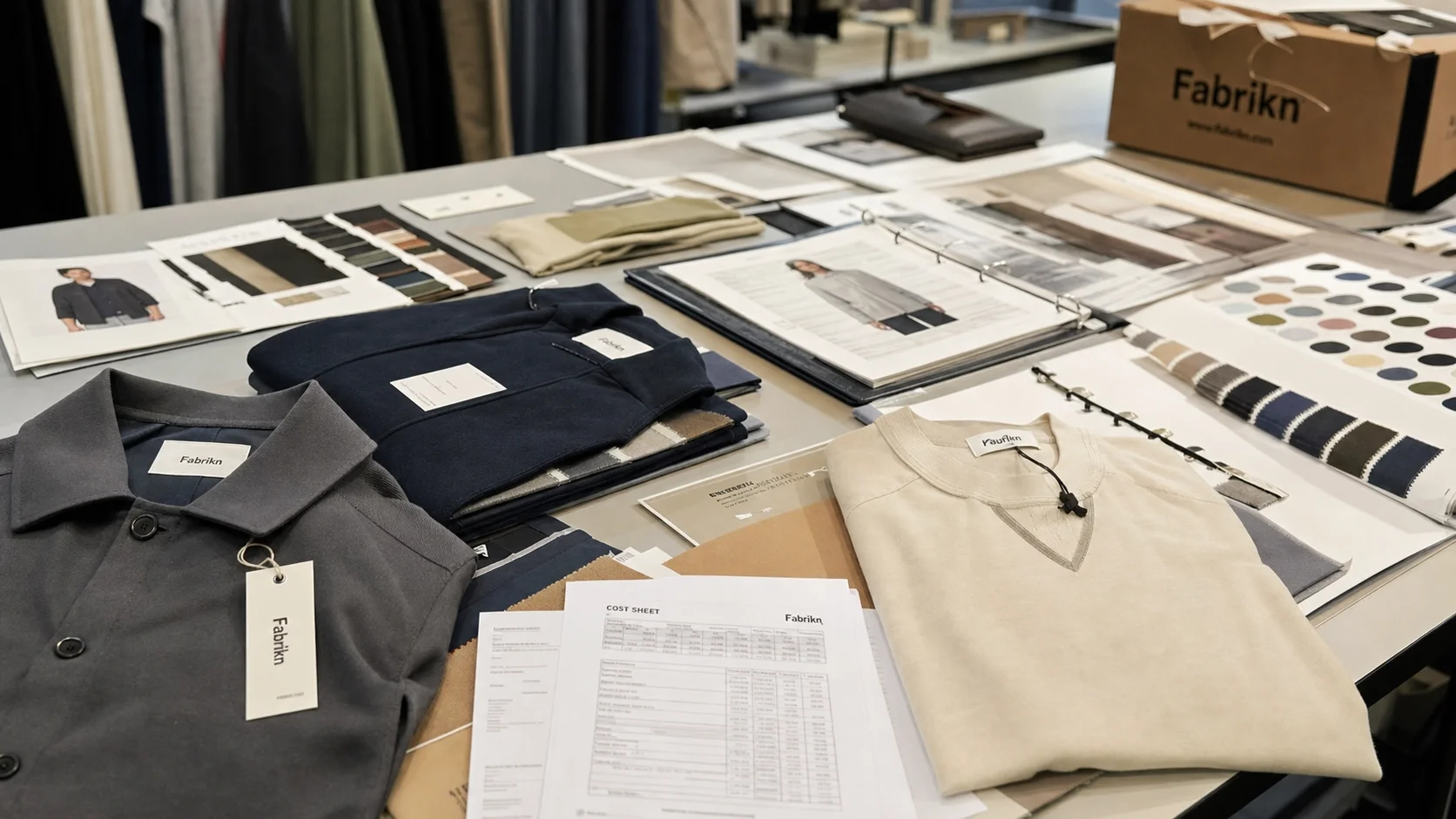
Clothing Packaging Insert Content with checks for samples, fit, MOQ, QC evidence, pricing terms, and delivery risk.
Fast answer: Clothing Packaging Insert Content: Care, Offer, Message, and QR Code should be judged by production evidence, not by a generic sourcing promise. The buyer needs sample proof, cost breakdowns, QC checkpoints, and delivery buffers in writing.
Ask for recent sample photos, measurement tolerances, fabric or print test assumptions, decoration test notes, packing examples, and a named inspection checkpoint. These details show whether the team can repeat an approved sample at bulk volume.
Separate garment cost, decoration, labels, packaging, sampling, testing, freight, and rush charges. When every cost line is visible, it becomes easier to reduce colorways, adjust size depth, or reserve more time for sampling.
A dress can travel through mailer, box, tissue, and tape, then arrive with a tiny insert that either steadies the sale or quietly sabotages it. I’ve seen it in factories, warehouses, and customer service dashboards. The insert is often the only thing customers read twice. That’s why the answer to what should be included in clothing packaging inserts matters more than many founders want to admit.
In DTC, the insert is not decoration. It is instruction, reassurance, and sometimes damage control. A clear return path can cut support emails by 15% to 30% in the first quarter after launch, based on brands I’ve worked with that tracked ticket themes before and after adding simple order guidance. In retail, where the shopper may never speak to a sales associate, a good card stands in for the conversation that never happened.
Factory visits across Vietnam, Portugal, and Turkey showed me a pattern that keeps repeating. Low-cost facilities often offer generic inserts printed 10,000 at a time, with templated copy and no brand nuance. Premium labels, including those paying $18 to $28 FOB for knitwear, use inserts to reinforce price. Strange, really. The expensive brands often print fewer words, not more.
Here’s the part most people miss: the best-performing inserts are usually the simplest ones, with one clear message and one clear action. A single care reminder or a single return URL can outperform a crowded card with 12 bullets and three QR codes. I’ve watched customers keep a clean, 300 GSM recycled card for weeks, while tossing a glossy leaflet after 10 seconds.
The hidden cost of a weak unboxing moment is not emotional. It is operational. Confused buyers ask the same question three times, returns get mislabeled, and restock teams lose hours fixing avoidable errors. For a brand shipping 5,000 units a month, a 2% drop in support tickets can free enough labor to pay for better print and still lower total cost.
So the real question is not whether inserts matter. It is what should be included in clothing packaging inserts for this exact product, this return policy, and this promise to the customer. A basics label selling $22 tees does not need the same card as a premium wool coat brand or a kidswear line. Context decides the content.
First-time buyers want answers fast. The parcel opens, the clock starts, and within seconds they want to know whether they ordered the right item, whether it fits, and what to do if it doesn’t. At minimum, the insert should name the product, size, color, and order reference. A simple set like that prevents confusion better than a paragraph of brand poetry ever could.
Care instructions belong on the insert when the fabric is likely to fail without guidance. Cotton jersey may tolerate 30°C and line drying, but wool loses shape if it gets spun hard, and denim can bleed if washed with light fabrics in the first 2 to 3 cycles. Synthetics may survive 40°C but pill if tumble-dried. When the fiber mix is printed badly on a hangtag or buried in a web page, the insert becomes the last chance to stop a costly mistake. For brands that need stronger presentation across mailers and inserts, custom clothing packaging solutions can be built around the actual customer journey.
Returns or exchange instructions should be written in plain language. Say the deadline, usually 14 or 30 days; state condition rules, such as unworn, tags attached, and original packaging; and tell the buyer exactly where to start the process. I prefer one phone number or one URL, not three channels that all point to different teams. A first-time customer should not need a support ticket to understand a return label.
A short brand note can help, but only if it proves something useful. An origin story works when it explains a quality choice, like why a merino sweater uses 18.5-micron yarn or why a t-shirt is made in a factory that runs 95% renewable electricity. Empty mission statements are ignored. Proof earns attention.
For export markets, multilingual inserts matter more than some teams expect. In parts of Europe, buyers respond better when the insert covers English plus local language. In the Middle East, Arabic can improve trust and reduce post-purchase friction, especially when sizing or return terms are involved. A two-language card may cost $0.04 to $0.12 more per unit, but a confused customer costs much more.
Compliance language should be boring, precise, and consistent. If the website says 30 days and the insert says 14, the brand creates a dispute before the garment is even tried on. I’ve seen chargebacks triggered by that mismatch, and they are expensive. They can take 2 to 6 weeks to resolve, with extra labor from finance, customer service, and logistics teams.
For many markets, an insert can carry fiber content references, country of origin, wash symbol explanations, and a reminder to check the sewn-in care label. That does not replace the legal label inside the garment, but it can reduce confusion. Data from ISO and textile care standards show that standardized symbols work best when paired with plain-language reinforcement, especially for cross-border sellers shipping into 3 or 4 language zones. For brands focused on sustainability and responsible sourcing, Textile Exchange standards are also worth reviewing during production planning.
Return rules should answer five points: how long the customer has, what condition the product must be in, whether refund or exchange is available, whether original packaging is required, and where the buyer sends the item. I advise brands to keep the wording tight enough to fit on a postcard if possible. A 100 mm x 148 mm insert can often handle this with 2 sides and 200 to 250 words.
Warranty or claim language belongs only when it is real. If a zipper fails within 90 days, say so. If the brand offers repair credit on premium outerwear, define the process and the postage responsibility. Otherwise the insert can create expectations that the factory, the customer service team, or the finance team cannot meet.
Lower-cost factories can print compliant inserts cheaply, sometimes at $0.02 to $0.05 per piece in runs of 5,000 to 20,000. That does not solve the accuracy problem. The brand still owns the policy, the dates, the claims, and the translation. I always recommend legal review plus customer service review before print approval, especially for brands shipping from Asia into the UK, EU, and North America. For teams building recurring collections, private label clothing services often work best when insert language is set before production begins. Brands sourcing from China should also align insert specs with the manufacturer, factory, or supplier early so the print file matches the final production run.
Basics need discipline, not decoration. A tee, legging, or sweatshirt usually needs care instructions, return steps, and maybe one line on fabric composition. If the garment is a $12 basics piece with a $4 to $6 landed packaging budget, every extra card stock layer eats margin fast. A one-color folded leaflet often does the job at $0.03 to $0.08 per unit, while a foil-stamped card may cost 3 to 5 times more without improving clarity.
Premium apparel deserves more restraint. A cashmere knit at $140, a tailored trouser at $180, or a silk blouse at $220 can justify authentication language, stitching notes, or repair guidance, but the insert should not shout. Luxury buyers respond better to fewer words and heavier stock, usually 250 GSM to 350 GSM with soft-touch or uncoated finishes. In my factory visits, the smartest premium brands used one card, not a stack of leaflets.
Activewear has its own rules. If a legging uses 75% nylon and 25% elastane, the insert should explain heat sensitivity, tumble-dry risk, and the effect of rough detergent on recovery stretch. A customer who understands why compression fails after 5 hot washes is less likely to blame the product for user error. Kidswear needs safety reminders, age guidance, and wash frequency notes, especially for items that shrink 3% to 5% after the first wash. For baby ranges and smaller runs, custom baby clothing manufacturing often pairs well with inserts that focus on safety, sizing, and care.
Postage and warehouse labor affect the real cost of the insert. A flat card is faster to pack than a tri-fold leaflet. A QR-enabled insert requires testing, link maintenance, and sometimes a separate insert SKU in the WMS. Custom-printed pieces can add 7 to 14 days of lead time if the proof changes. Stock cards move faster, but they rarely carry much brand value.
The thing nobody tells you: the more expensive the garment, the less clutter the insert should have. I’ve seen a $380 coat shipped with a four-panel booklet and a $32 shirt shipped with a single, elegant card. The coat buyers kept the card. The shirt buyers kept the booklet for one day. Silence often sells better than excess.
Hierarchy matters more than ornament. One headline, one primary action, one contact path. That is enough for most inserts. When the eye lands on a card, it should find the product name or care cue in under 3 seconds, then move straight to the return URL or care instructions. If the layout asks the customer to choose between four different messages, it has already failed.
Paper stock changes perception fast. A 200 GSM recycled card feels very different from a thin 120 GSM flyer, even if the copy is identical. Uncoated stock signals practicality. Soft-touch signals price. Heavy ink coverage can look premium, but it also raises waste and sometimes slows drying by 24 to 48 hours in production. Minimal lamination keeps recyclability higher and reduces the plastic feel that many shoppers now notice. For paper and packaging decisions that support environmental goals, OEKO-TEX guidance can help teams verify safer material choices.
Sustainability belongs in the design brief, not as an afterthought. Recycled paper, soy inks, and right-sized trims can lower material waste without making the insert cheap. I’ve seen brands cut trim waste by 18% simply by changing the fold size from A6 to a custom 90 x 140 mm format that better matched the mailer. Small change. Visible impact.
QR codes work when they solve one problem. A code that opens a care guide, a return form, or a product registration page earns its place. A code that sends shoppers to a generic homepage adds friction. Test every code before print, and test it again on iPhone and Android. Broken links are expensive. They also make the insert look careless.
Personalization can help, but only if fulfillment can handle it. A handwritten-style note, a first-name greeting, or product-specific messaging can raise perceived care, especially for gift orders or subscription drops. Variable data printing adds cost, usually $0.02 to $0.15 per insert depending on volume and format, so the system needs to be reliable. If the warehouse cannot sort it cleanly, do not promise it.
I use a simple filter. Start with what the customer needs on day one. Then add only what reduces friction or strengthens retention. That means care, returns, and product identity first. Brand storytelling, referral offers, and loyalty prompts come later if the numbers justify them.
Track four metrics: return rate, repeat purchase rate, support ticket volume, and insert scan rate. A brand shipping 1,000 orders a month can test two insert versions and compare outcomes over 500 to 1,000 orders. If one version reduces “where is my return label” tickets by 20% and improves repeat purchase by 5%, it earns the print run. For trade and sourcing teams evaluating scale, the U.S. government’s Trade.gov market guidance is a useful reference when planning wholesale or bulk expansion across regions.
Startups need education and trust. Scaled labels need efficiency and fewer questions. The more orders a brand ships, the more expensive confusion becomes. At 20,000 monthly units, even a $0.03 mistake per insert becomes real money. Factory input matters, but it should not dictate strategy. The brand defines the message, then briefs the printer or garment factory on format, paper, and count. For custom wholesale programs, the supplier should confirm MOQ, production lead time, and any special finishing before artwork is approved.
In my experience, the best decision framework is written down before artwork begins. If the insert cannot answer a customer’s most likely question in under 20 seconds, it should be rewritten. If it does not reduce a known support issue, it should be cut. If it does not reinforce the brand promise, it should stay out.
I have seen brands save more by deleting one weak line than by adding one clever sentence. That is the sort of ruthless editing packaging usually needs. In other words, what should be included in clothing packaging inserts should be decided by the customer’s journey, not by what feels easiest for production.
Before print approval, run a checklist. Approve copy, confirm legal wording, test every barcode or QR code, and sign off a physical sample. Check paper size against the mailer or polybag. A 100 x 150 mm insert may fit one carton perfectly and jam another. Packaging suppliers and factories should see the same spec sheet, not separate versions with different trim tolerances.
Reprint risks are usually simple. Outdated return policies, wrong sizing charts, broken links, and seasonal messages that expire after 8 weeks are the big ones. I have watched brands destroy a full print run because a promotion was still on the card after the sale ended. That kind of mistake is avoidable with one final proof review.
Roll out in stages. Pilot one SKU, ship 500 to 1,000 orders, then review customer feedback after 30 days. If support tickets drop and scan rates hold, expand to the rest of the line. Good inserts are edited, measured, and tested, not just designed.
Include the product name, size, color, order reference, care instructions, and a simple return path. If space allows, add one short brand note or QR code that solves a real problem, such as returns or registration.
List the return window, condition rules, refund or exchange options, and the exact contact channel. Keep it consistent with the website and packing slip, or customers will challenge the policy.
Stock cards often cost $0.02 to $0.08 each, while custom folded inserts can run $0.05 to $0.20 depending on stock, finish, and quantity. Variable data or QR logic can add a small setup fee or 1 to 2 extra production days.
Generic stock inserts can ship in 3 to 7 days. Custom printed versions usually take 7 to 14 days after final artwork approval, and changes after proofing can add another 2 to 4 days.
Yes, if the insert supports the market and does not contradict sewn-in labels or legal requirements. Use clear language, keep the policy accurate, and confirm translation for export markets before printing 5,000 or more units.