
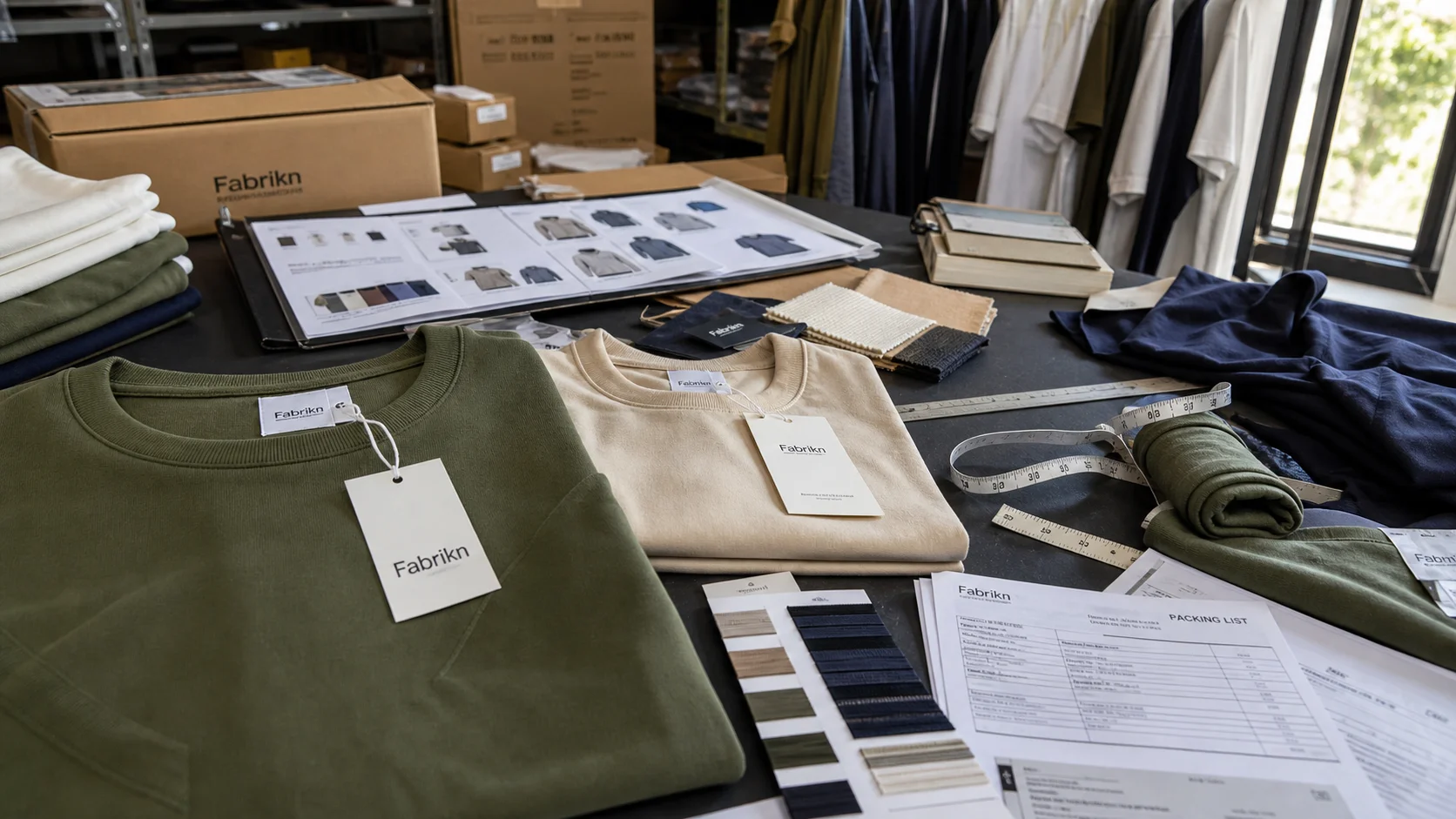
Wholesale Fashion Hang Tags with checks for samples, fit, MOQ, QC evidence, pricing terms, and delivery risk.
Fast answer: Wholesale Fashion Hang Tags: Paper, Print, Attachment, and China MOQ should be judged by production evidence, not by a generic sourcing promise. The buyer needs sample proof, cost breakdowns, QC checkpoints, and delivery buffers in writing.
Ask for recent sample photos, measurement tolerances, fabric or print test assumptions, decoration test notes, packing examples, and a named inspection checkpoint. These details show whether the team can repeat an approved sample at bulk volume.
Separate garment cost, decoration, labels, packaging, sampling, testing, freight, and rush charges. When every cost line is visible, it becomes easier to reduce colorways, adjust size depth, or reserve more time for sampling.
A tag can change how a $18 tee sells in the space of a heartbeat. I watched buyers pick up the same garment, compare the hanger card, and decide within 10 seconds which brand felt worth more. That is why wholesale hang tag printing for fashion brands china is not a tiny procurement task. It is retail psychology with a cost sheet attached.
On factory visits across Guangdong and Zhejiang, I saw fast-fashion programs running on 300 gsm coated board with one-color black text and a simple cotton string, while premium labels used 700 gsm textured stock, blind embossing, and matte foil. The production cost gap was often only $0.04 to $0.18 per piece at higher volumes, yet the shelf impact looked miles apart. One buyer paid $0.09 for a basic tag on a 10,000-piece run. Another paid $0.31 for a textured tag with foil and variable numbering. Same garment category. Different perception.
China serves both ends of that market. Mass suppliers often quote MOQs of 500 to 1,000 pieces, with standard lead times of 7 to 12 days. Premium printers may want 3,000 to 5,000 pieces before they price specialty finishes properly, but they can offer deeper customization: die-cut shapes, serial numbers, tamper seals, and mixed-paper inserts. Vietnam and India can be competitive on labor, yet I have found fewer options for tight color control, complex finishing, and quick rework. Local print shops win on speed for 200 to 500 pieces, but the unit cost can jump 2x to 4x once you ask for embossing or custom stringing.
Hang tags do three jobs at once: they carry price, SKU, and origin information; they enforce compliance; and they sell the brand story before the first wash.
When I visited a denim factory supplying both mid-market and luxury labels, the production manager told me the tag budget was reviewed by the sales team, not procurement, because retailers read the tag as part of the garment. He was right.
Chinese hang tag factories usually offer a wider material menu than brands expect. The common base options are coated board, kraft, recycled paper, textured stock, PVC-free synthetic paper, and cotton paper. In my factory walk-throughs, coated board around 300 gsm to 400 gsm was the cheapest and fastest to run. Kraft and recycled papers add a softer, more ethical feel, though the surface is less forgiving for fine typography. Cotton paper is a favorite for premium basics because it feels expensive even before finishing touches are added.
Finishes can change the brand signal fast. Foil stamping, embossing, debossing, spot UV, matte lamination, and soft-touch coating all add texture. A matte laminated tag with one gold foil logo can cost $0.12 to $0.22 more than a plain printed tag at 5,000 pieces. That sounds small. On 20,000 pieces, it is a real budget line. Factories also handle die-cutting, rounded corners, perforations, and fold-over formats, plus variable data for QR codes, barcodes, serial numbers, and anti-counterfeit numbering. I have seen sportswear brands use a simple QR on the back to route shoppers to care instructions and resale verification.
Strings and fasteners matter more than people think. Cotton cord, polyester string, elastic loop, plastic fastener, and metal pin each affect the perceived category. A recycled tag with a natural string may cost more than a standard coated tag on a small order of 800 pieces because the factory has to source custom components, set up a shorter press run, and hand-attach more of the finishing. That is the thing nobody tells you: “eco” often becomes more expensive at low MOQ, not less.
I have also seen brands pair tag production with clothing packaging solutions so the print finish, tissue paper, and carton graphics stay visually aligned. That coordination matters on the shelf and in the unboxing.
Pricing is rarely just printing. For wholesale hang tag printing for fashion brands china, the unit price is driven by paper weight, colors, finish complexity, die-cut shape, stringing, packaging, and whether the factory is doing one-sided or double-sided artwork. At 1,000 pieces, a basic 350 gsm coated tag with one-color print and no special finish may land around $0.08 to $0.18 per piece. Add foil or embossing, and it can move to $0.20 to $0.45. At 5,000 pieces, the same tag often drops to $0.04 to $0.12, while premium versions can land around $0.12 to $0.28. At 20,000+ pieces, simple tags can fall below $0.05, and more complex tags usually benefit most from the scale.
MOQ tiers shape the bill sharply. A brand ordering 500 tags may pay more for setup than for paper. A 1,000-piece order may carry the same plate charge as a 10,000-piece order, which is why smaller brands get squeezed. On one visit in Dongguan, I saw a quote difference of $68 in setup fees alone between two tags that looked nearly identical to the eye, because one used a custom die and the other used a standard shape.
China usually beats local print vendors on unit price once the order passes 3,000 pieces, especially with finishing. Local shops can be faster for emergency reprints, but they often charge $0.25 to $1.20 per tag for boutique quantities. Southeast Asian suppliers can sit between China and local vendors, yet their tooling depth is often thinner for serial numbering and premium finishes. For simple cards, Vietnam or Thailand may land around $0.09 to $0.22 at mid-volume. For complex tags, China still tends to win on cost and capability.
Hidden costs hurt margins. Plate charges can run $20 to $120. Samples may cost $15 to $60 before freight. Air shipping for a rush lot can add $1.50 to $4.50 per kg. Customs paperwork, duty, and a reprint caused by artwork errors can wipe out the savings from a low quote. I have seen a brand save $140 on the tag price and lose $480 fixing a barcode layout mistake. A cheap quote is not a cheap order if the file is wrong.
Last year I worked with a brand that paired tag buying with private label clothing services, and the combined order improved both artwork consistency and freight efficiency. Two smaller cartons became one stronger shipment.
Factory audits do not need a full day. In 15 minutes, I look for proof of machinery, clean finishing stations, consistent storage, and whether samples are handled by the same team that runs production. A serious manufacturer can show offset or digital press specs, lamination equipment, die-cut tools, and a QC desk with retained samples. If they outsource every finishing step, timelines stretch and quality control gets fuzzy.
Ask for certifications and documents before you place money. FSC matters if you want paper traceability. ISO 9001 suggests a managed process, though it is not a quality guarantee by itself. For materials and inks, request safety documentation and test reports where relevant. According to ISO, documented management systems are about repeatability, which is exactly what you need when a brand is reordering the same hang tag three seasons in a row. For recycled claims or responsible sourcing, check whether the supplier can back it with paper origin data and chain-of-custody paperwork.
Sample quality can be deceptive. I have seen perfect samples arrive on 300 gsm stock with extra hand-trim, then bulk production comes out slightly duller because the supplier switched to a faster press setup. Ask for pre-production samples from the actual production line, not a polished sales sample made in isolation. Color drift of ΔE 2 to 4 is common if no one locks the profile. That is acceptable for some brands and a problem for others.
Regional differences matter. Guangdong factories often feel more export-focused and faster on small revisions. Zhejiang suppliers, especially around Ningbo and Wenzhou, can be strong on paper finishing and mass consistency. Coastal hubs tend to handle 5,000 to 50,000 piece runs more predictably than inland subcontractors. I have seen the same design print with crisp black type in one province and a slightly warmer gray-black in another. That tiny shift is enough to make a premium tag look less expensive.
For technical print categories, I often cross-reference finishing standards used in other product lines, including sublimation printing services, because color discipline travels across categories. A supplier who respects one process usually respects the next.
A compliant tag is not just branding. It needs brand name, size, fiber content where required, country of origin, care symbols, SKU, and often price fields for retail use. If the garment is for children or specialty categories, local rules may add more detail. A good custom layout leaves enough white space for a barcode that scans first time, because a failed scan on the shop floor wastes seconds and irritates staff.
Barcodes need quiet zones and clear contrast. I have seen beautiful tags fail retail testing because the barcode sat too close to a foil edge or a punched hole. Keep the barcode zone simple, with at least 3 to 5 mm breathing room on all sides if the format allows it. SKU placement should be consistent across styles so warehouse teams can sort fast. A tag that reads well at arm’s length saves labor in receiving, replenishment, and markdown processing.
Sustainability claims need proof. If a supplier says recycled content, ask for the percentage and source. If they say FSC paper, ask for the certificate number. If soy inks are mentioned, ask what that means in practice. According to Textile Exchange, traceability claims only hold value when the chain can be documented. That principle applies to hang tags too, even if the product is small. Markets in the US, EU, UK, and Australia are not identical, so tags often need slightly different legal wording by region.
I keep a strict rule: design for one retail floor, not for every fantasy. A tag that tries to say everything becomes unreadable at 4 inches away. Put the compliance data where it belongs. Put the brand story where it can breathe.
A realistic timeline starts with artwork approval and ends with boxed cartons leaving the factory gate. For a 1,000-piece order, sample development usually takes 2 to 4 days, proofing another 1 to 2 days, and production 5 to 8 days. For 5,000 to 20,000 pieces, expect 7 to 14 days once the sample is approved. If you add custom die-cutting, stringing, and serial numbering, the schedule can extend by 3 to 5 days. I have seen clean projects ship in 12 days, and I have seen a “simple” tag run take 28 because the artwork file had a font issue and the client approved the wrong paper shade.
Air freight is for urgency. It is fast, but it can cost $4 to $8 per kg or more depending on route and season. Sea freight is cheaper for heavier combined orders, especially if tags are shipping with garments or packaging, but it adds 10 to 25 days in transit. If the order is under 30 kg, air often makes sense. If it is 200 kg with cartons bundled into a larger apparel shipment, sea usually wins on cost. The right answer depends on launch date, not ego.
Common QC failures are painfully predictable: color mismatch, wrong perforation placement, weak string attachment, barcode failure, edge fray, and trim errors on die-cut corners. Ask for a retained sample from the first approved batch and a final inspection photo set before dispatch. If the factory can’t show you 100% count checks or AQL sampling results, I would slow down. According to trade.gov import and export guidance, shipping schedules can swing widely around port congestion and documentation holds, especially near holiday peaks. That warning is real.
Peak season, Chinese New Year, Golden Week, and port congestion can add 7 to 21 days to a calendar. That is not an excuse. It is a planning fact. Build the tag schedule backward from store delivery, not forward from the purchase order date.
Start with a short RFQ that forces clarity. Define size, paper stock, finish, quantity, delivery port, timeline, and required certifications. Then ask for a quote on 1,000, 5,000, and 20,000 pieces so you can see where the real break points sit. That comparison reveals whether the supplier is pricing setup honestly or hiding it in the unit rate.
Your RFQ should include tag dimensions in mm, board weight in gsm, front and back artwork, color references, string type, hole position, finish, packaging format, and destination terms. If you need FSC, recycled content, or specific ink declarations, say so on day one. Brands waste weeks when they mention compliance only after the sample is already approved.
Before you pay a deposit, ask for lead time from artwork approval, proof of machine capacity, sample turnaround, and the name of the person handling QC. If the factory is new to you, place a pilot run of 500 to 1,000 pieces first. That is enough to test color accuracy, string attachment, and barcode scans without exposing the full season to risk.
Measure suppliers on defect rate, response time, and on-time delivery, not just price. A tag quote that is $0.03 lower but arrives 9 days late is not a saving. I tell brands to keep one spreadsheet column for price, one for rework risk, and one for communication speed. That way the lowest quote does not win by accident.
If your tags must coordinate with packaging or a broader brand launch, align the order with your custom bra manufacturing or apparel production calendar so packaging, labels, and garments arrive together. That reduces split shipments and prevents mismatched branding across the line.
Basic hang tags often cost $0.04 to $0.18 per piece at 5,000 pieces, depending on paper weight and print colors. Premium finishes like foil, embossing, or special die-cuts can move the price to $0.12 to $0.45 per piece. Small runs of 500 to 1,000 pieces usually carry higher setup costs.
Most orders take 7 to 14 days after artwork approval for production. Sample development adds 2 to 4 days, and shipping adds another 3 to 25 days depending on air or sea. Holiday peaks can add 7 to 21 extra days.
Include size, paper stock, GSM, finish, quantity, delivery port, timeline, and certifications needed. Add artwork files, barcode requirements, string type, and packaging format. The more exact the RFQ, the fewer expensive revisions later.
Ask for machinery proof, QC process details, sample turnaround time, and relevant certifications such as FSC or ISO. Request a pre-production sample from the real production line, not only a sales sample. A reliable supplier answers quickly and documents changes clearly.
Yes. A pilot run of 500 to 1,000 pieces is a smart test for new suppliers. It helps you verify color, barcode scans, string attachment, and finish quality before committing to 5,000 or 20,000 pieces. That small spend can prevent a costly reprint.