
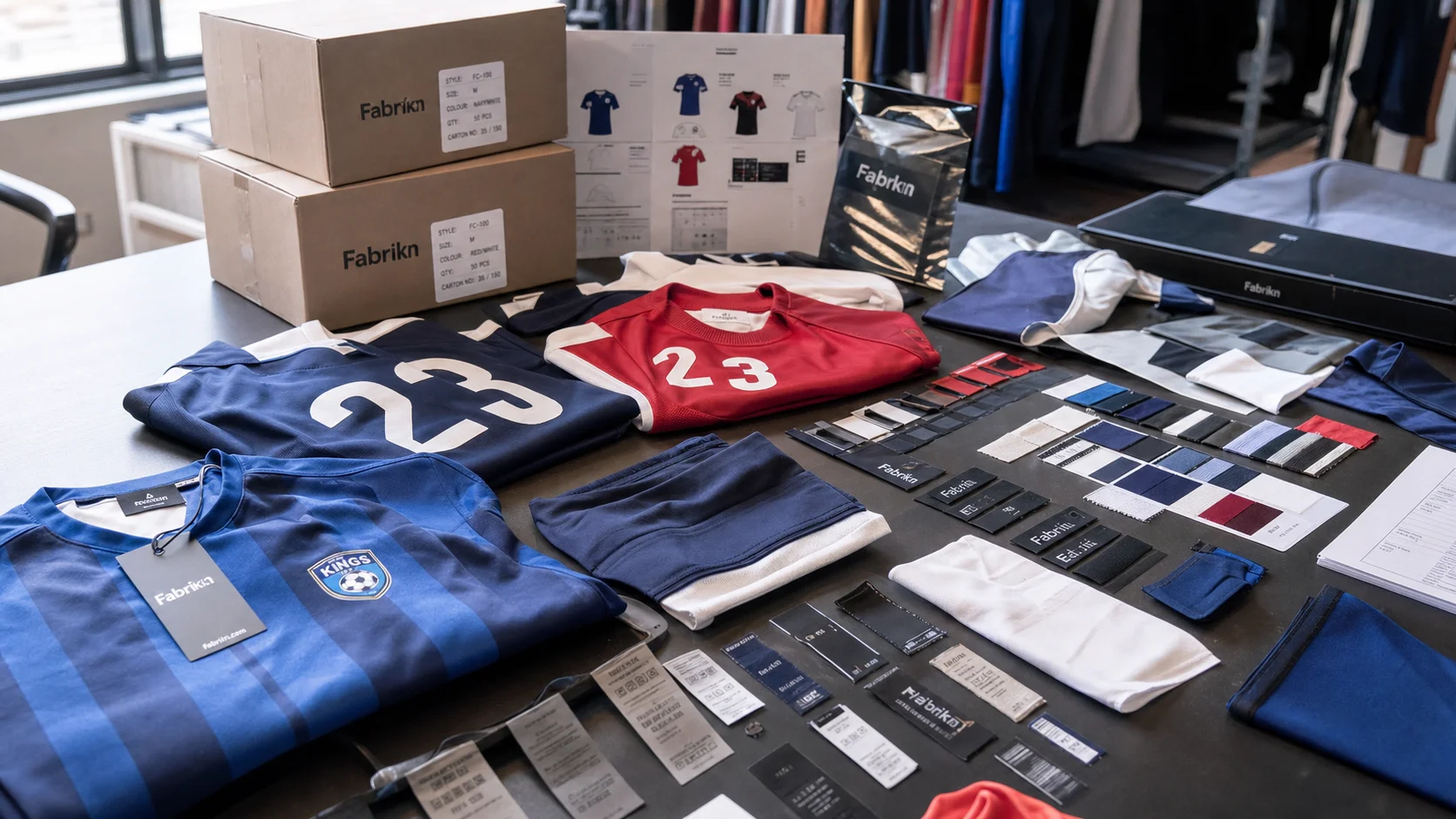
Clothing Manufacturer in China with checks for samples, fit, MOQ, QC evidence, pricing terms, and delivery risk.
Fast answer: Clothing Manufacturer in China: Samples, MOQ, QC, and Lead Time should be judged by production evidence, not by a generic sourcing promise. The buyer needs sample proof, cost breakdowns, QC checkpoints, and delivery buffers in writing.
Ask for recent sample photos, measurement tolerances, fabric or print test assumptions, decoration test notes, packing examples, and a named inspection checkpoint. These details show whether the team can repeat an approved sample at bulk volume.
Separate garment cost, decoration, labels, packaging, sampling, testing, freight, and rush charges. When every cost line is visible, it becomes easier to reduce colorways, adjust size depth, or reserve more time for sampling.
A quote that looks 20% cheaper can hide 15% higher defect rates and lead times that stretch by 10 to 18 days. I have seen that pattern repeat across Guangdong, Zhejiang, and inland provinces, and it is why the best clothing manufacturer in china is rarely the one with the lowest first number. Price looks decisive in an email. On the production floor, it gets expensive fast.
During visits to factories in Dongguan, Shaoxing, and Hubei, the sample rooms all looked polished. The split showed up behind them. Guangdong plants near export ports often had 300 to 800 workers, tighter trim sourcing, and accessories available in 3 to 5 days. Zhejiang factories, especially around knitwear and woven casualwear, usually had stronger fabric knowledge and cleaner finishing on jersey, rib, and washed cotton. Inland factories sometimes came in 8% to 12% lower on labor, but replenishment took longer, compliance programs were thinner, and revisions after strike-off approval moved more slowly.
Small-order brands take the hardest hit. A factory may accept 300 pieces on paper, then push the MOQ to 800 once custom zippers, branded labels, or a special wash enter the conversation. I have seen brands pay 9% to 14% more per unit because they approved samples without written tolerances, relied on WhatsApp alone, and left specs vague. Poor quality control is expensive. So is silence. One missed measurement on a 220 GSM tee can turn into 600 unusable units if shrinkage lands at 4% instead of the promised 2%.
Who can repeat the same fit, same shade, and same construction across 5,000 pieces, then again at 15,000? That is the factory that protects margin when the order gets real.
The right factory depends on the product, not the postcode. A supplier that excels at 180 GSM promotional tees may fail badly on brushed French terry, while a knitwear specialist can produce cleaner rib cuffs and necklines yet move slower on basic woven shirts. I have watched brands choose a large generalist in Shenzhen for activewear, then spend 6 weeks fixing flatlock tension and stretch recovery issues that a smaller specialist factory would have caught in sampling.
For tees, hoodies, and basics, look for factories that can prove fabric control, not just sewing capacity. Ask for yarn count, GSM, shrinkage data, and whether they understand enzyme wash versus silicon wash. A decent basics factory should quote a sample turnaround of 7 to 14 days, keep defect tolerance under 2.5%, and show capacity from 8,000 to 20,000 pieces per month without outsourcing critical steps. If they cannot explain collar rippling, skip them.
Activewear needs stretch testing, bonded seams, and consistent elastane handling. Denim needs wash expertise, pattern correction after shrink, and hardware reliability on rivets and zippers. Knitwear needs gauge consistency, linked seams, and yarn sourcing discipline. Premium fashion often lives or dies on the final 5%: seam alignment, press quality, and trim matching. According to AATCC, test methods for dimensional stability and color fastness are essential when buyers want repeatable results, not hopeful assumptions.
I compare factories on four numbers before I compare mood or office décor: MOQ, sample turnaround, monthly output, and the number of in-house processes. A knitwear specialist may accept only 500 pieces, while a bigger generalist wants 3,000. That smaller factory may be slower on capacity, but it can still outperform on neckline recovery, pilling resistance, and hand feel. For brands building private label clothing services, that trade-off often matters more than a lower quote.
Factory size changes everything. Small workshops of 20 to 50 workers can be agile, but they often rely on one production manager and a narrow machine set, which makes them vulnerable if one operator leaves. Mid-size factories, usually 80 to 250 workers, are where I have seen the strongest balance of consistency and flexibility. Large factories with 500 to 2,000 workers can offer scale, yet they sometimes become rigid on customization and less forgiving when a buyer wants custom trims, contrast stitching, or unusual packing instructions.
Small workshops usually quote MOQs of 100 to 300 pieces, but rework rates can climb if they outsource washing or embroidery. Mid-size factories often sit in the sweet spot at 500 to 1,500 pieces, with enough volume to maintain systems and enough agility to handle custom labels, branded hangtags, or mixed color runs. Large factories may insist on 3,000 to 5,000 pieces per color and set a 15 to 20 day sampling window because the line is optimized for volume, not nuance.
Here’s what most people miss: the best results I have seen often came from mid-size factories, not the biggest ones. They had two quality checkpoints before packing, response times under 24 hours, and fewer handoffs between sales, merchandiser, and production. When a brand changed rib width from 7 cm to 6.5 cm on a hoodie, the mid-size factory corrected it in 2 days. The large factory took 9 days and still shipped 8% of the lot with trim inconsistency. For cut and sew manufacturing, that middle tier often wins.
Size is not destiny. Process is.
The cleanest way to compare suppliers is not by factory quote alone. It is by FOB, EXW, and landed cost. A tee quoted at $3.10 FOB in China can land at $4.05 after freight, duty, and testing, while a $2.85 EXW quote may end up closer to $4.20 once you pay for pickup, export handling, and the remake of 3% defective units. The cheapest quote often moves like a trapdoor.
For a 220 GSM cotton tee, I typically see China at $1.80 to $3.50 FOB depending on order size and wash complexity, Vietnam at $1.70 to $3.30, Bangladesh at $1.35 to $2.80, and Turkey at $3.20 to $6.00. For denim jeans, China often sits between $6.50 and $12.00 FOB, Vietnam $6.00 to $11.50, Bangladesh $5.20 to $9.50, and Turkey $8.50 to $16.00. These ranges shift with fabric, wash, and volume, but they show the pattern: labor is only one slice of the bill.
According to trade.gov, buyers should factor duties, freight volatility, and compliance into sourcing decisions, because a $0.40 unit savings on FOB can disappear fast once shipping climbs by $0.15 to $0.60 per piece. Sampling adds another layer. A fashion brand may spend $250 to $800 per style in sample rounds, plus 1 to 3 weeks per revision cycle. Audit fees can run $400 to $1,500. Remake costs on a 1,000-piece order can erase the margin benefit of a cheaper country if the defect rate hits 4% instead of 1.5%.
China still wins when you need faster fabric access, wider trim libraries, and better control over mixed constructions. I have seen one factory source 12 different zipper types in 48 hours and correct shade variance before bulk cutting. That speed matters more than a 6% quote advantage in Vietnam or Bangladesh. It matters even more for brands that need custom baby clothing manufacturing, where compliance, softness, and finish consistency cannot be compromised.
Turkey can outperform on premium knits and small luxury runs. Bangladesh can win on labor-heavy basics. China remains strongest when the order needs speed, technical breadth, and enough supplier depth to solve problems mid-production.
I trust factories that can show process, not promise. Before placing an order, I want to see a pre-production sample approved in writing, fabric test results, and a production plan with checkpoints at cutting, sewing, and packing. A reliable manufacturer will tell you exactly when inline inspection happens, usually after 20% to 30% of the order is complete, not after everything is boxed. Final inspection should follow AQL standards, with a documented acceptance number that reflects the order value and product risk.
Common failure points are predictable. Shade variation appears when dye lots are not controlled. Seam slippage shows up on lightweight woven fabrics if stitch density is wrong. Shrinkage often exceeds the promised 2% to 3% when fabric is not pre-shrunk. Trim mismatch happens when buttons, cords, or labels are sourced from different sub-suppliers without sign-off. In one factory visit, I saw a 1,200-piece hoodie order held back because the drawcord tipped in black on 300 units and navy on the rest. That mistake cost 5 production days.
Verification should be numerical. Ask for certificates such as OEKO-TEX or GRS where relevant, plus recent inspection reports, not PDFs from 2019. Check whether the factory can name 2 or 3 buyer references in your category. Ask how many pieces were rejected in the last 6 months and what the top 3 defects were. According to OEKO-TEX, material safety claims should be backed by current certification, not generic assurances. If they hesitate, that tells you enough.
For sustainability and traceability, buyers can also review standards from Textile Exchange to understand preferred fiber claims and supply chain expectations.
The strongest buyers do not micromanage every stitch. They control the process with a clean tech pack, a single decision-maker, and deadlines that leave no room for guesswork. I have seen brands cut error rates by half simply by adding a measurement sheet, labeled artwork files, and a spec table with acceptable tolerances of plus or minus 0.5 cm on key points. If a factory gets three different answers from three people, mistakes follow fast.
Payment terms reveal confidence. A factory asking for 30% deposit and 70% before shipment is normal. A supplier willing to negotiate 20% deposit, 40% after fabric approval, and 40% after final inspection often has more trust in its own process. That said, payment terms should never replace paper. Contracts need written tolerances, delivery dates, defect thresholds, and approval gates for fabric, trim, and pre-production samples. If the supplier wants to swap a 2x1 rib for a cheaper 1x1 rib, that change should be documented before cutting begins.
Response time matters too. I set a 24-hour benchmark for routine messages and 48 hours for technical questions. Anything slower becomes expensive when a bulk order is already moving. For branding, protect IP with NDAs, artwork watermarks, and branded components such as custom zipper pulls or woven labels that are harder to reuse elsewhere. For construction-heavy projects, cut and sew manufacturing contracts should spell out who owns patterns, markers, and graded specs.
One decision-maker. One spec file. One approval trail.
This week, build a shortlist of 3 factories and send them the exact same tech pack, size chart, fabric reference, and packaging brief. Score each one from 1 to 5 on price, quality, capacity, compliance, and communication. A factory that scores 4s across the board is often stronger than one that looks cheap but scores 2s on responsiveness and inspection discipline.
Then ask for a sample quote, a production timeline, and a written breakdown of MOQ, lead time, and payment terms. If one factory offers 500 pieces and another demands 2,000, do not average the numbers. Compare the risk. If possible, request a factory audit or third-party inspection before bulk production, especially if your order value exceeds $15,000 or your fabric is sensitive, like 320 GSM French terry, bonded nylon, or enzyme-washed denim.
After sampling, place a pilot order of 300 to 800 pieces rather than jumping straight to 5,000. That pilot reveals fit drift, color consistency, and packing errors while the damage is still manageable. When the supplier can repeat the result, scale. If they cannot, move on quickly. You can get a free quote once you have your spec sheet ready, but only after you have compared at least 3 factories using the same data.
The best fit for small brands is usually a mid-size factory with an MOQ of 300 to 1,000 pieces, sample turnaround of 7 to 14 days, and one clear merchandiser handling the account. That structure reduces miscommunication and keeps change requests under control.
For basics, expect about $1.80 to $3.50 FOB for tees and $4.50 to $9.00 FOB for hoodies, depending on fabric and volume. Landed cost usually rises by 15% to 35% once freight, duties, testing, and remakes are included.
Sampling takes 7 to 21 days for most products, and bulk production often runs 3 to 6 weeks after sample approval. Complex items like denim with special wash or technical activewear may need 6 to 10 weeks total.
Yes, but you need a factory that handles higher-end finishing, tighter tolerances, and lower defect tolerance, often under 2%. Premium fashion suppliers should also provide fabric traceability, trim approvals, and detailed press and packing standards.
Start with 3 factories, one tech pack, and a scoring matrix for price, quality, capacity, compliance, and communication. Then request samples, verify certifications, and place a pilot order of 300 to 800 pieces before committing to a larger run.